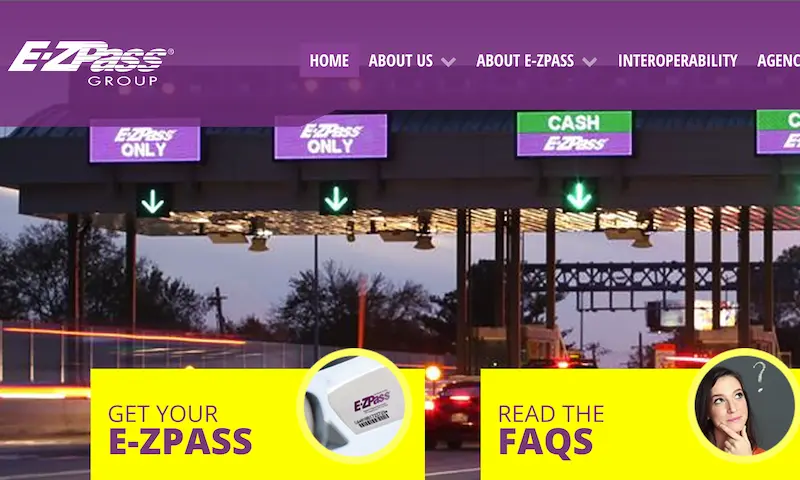
Ever wonder who’s actually running the show when you zoom through a toll plaza? That little plastic transponder on your windshield connects to a surprisingly complex web of public agencies, private companies, and even international corporations. Let’s break down who really owns E-ZPass and how this electronic toll collection system works.
The E-ZPass Interagency Group: The Real Owners
E-ZPass isn’t owned by a single company. It’s actually controlled by the E-ZPass Interagency Group (IAG), a consortium of 26 toll agencies across 20 states. This group began in 1987 when toll authorities in New York, New Jersey, and Pennsylvania joined forces to create a standardized electronic toll collection system.
Today, these public toll authorities collectively own:
- The E-ZPass brand and trademark
- The technology standards used across the network
- The policies governing interoperability between states
When you pay for an E-ZPass transponder, you’re actually doing business with whichever toll authority issued it, not a single “E-ZPass company.”
State Agencies: The Local Managers
Each state within the E-ZPass network has designated authorities responsible for managing the system locally. For example:
- In New Jersey, the New Jersey Turnpike Authority (NJTA) serves as the lead agency
- In New York, the New York State Thruway Authority manages E-ZPass operations
- In Pennsylvania, the Pennsylvania Turnpike Commission oversees their program
These agencies set their own toll rates, manage customer accounts for their state, and handle enforcement of toll violations. They’re the actual entities collecting your toll money—not a private corporation.
Private Contractors: The Behind-the-Scenes Operators
While public agencies own E-ZPass, they don’t handle the day-to-day operations themselves. Instead, they outsource to private contractors who manage:
- Customer service call centers
- Billing and payment processing
- Transponder distribution
- Violation enforcement systems
Currently, two major players dominate this space:
Conduent, Inc. – Until recently operated New Jersey’s E-ZPass system under a $1.48 billion contract spanning multiple years. They continue to manage systems in other E-ZPass states.
TransCore – Recently won New Jersey’s E-ZPass contract with a $1.73 billion bid. They’re a Nashville-based company that manages toll systems across multiple states.
The Controversial Foreign Connection
One of the most controversial aspects of E-ZPass ownership emerged in 2021 when TransCore was acquired by Singapore Technologies Engineering (ST Engineering). This raised eyebrows because:
- ST Engineering is majority-owned by Temasek Holdings, an investment company wholly owned by the Singapore government
- Former ST Engineering board members had ties to Chinese state-owned enterprises
- Critics worry about foreign entities potentially accessing sensitive travel data of millions of Americans
These concerns prompted bipartisan questions about national security implications, with former Senator Robert Torricelli calling it potentially “worse than TikTok” due to the sensitive nature of toll transaction data.
The Financial Model: How E-ZPass Makes Money
The E-ZPass consortium was established using a unique financial structure:
- Initial funding came from projected revenues rather than upfront investment
- Revenue sources include toll fees, account maintenance fees, and violation penalties
- Early financial models relied heavily on violation revenue, which proved problematic
A New Jersey state investigation revealed that by 2001, the consortium faced a $161.7 million deficit when violation revenue reached only 10% of projections. This forced member agencies to guarantee payments through special agreements and bond issuances.
Commercial Fleet Solutions: The Third-Party Providers
For commercial trucking fleets, specialized service providers like Bestpass offer integrated E-ZPass management. These companies:
- Provide unified billing across multiple toll systems
- Deploy and track transponders for commercial fleets
- Prevent toll-by-plate violations through integrated systems
While these providers partner with E-ZPass, they function as intermediaries rather than owners of the system.
Consortium Governance: How Decisions Are Made
The E-ZPass IAG makes system-wide decisions through a collaborative process:
| Decision Type | Decision Maker | Example |
|---|---|---|
| Technology Standards | Full IAG vote | Adopting new transponder types |
| Toll Rates | Individual agencies | New Jersey raising Turnpike tolls |
| Operational Contracts | Individual agencies | TransCore winning NJ contract |
| Interoperability | Full IAG vote | Adding new member states |
This structure allows local control while maintaining the standardization that makes E-ZPass work across state lines.
The Evolution of E-ZPass Ownership
The ownership structure of E-ZPass has evolved significantly since its inception:
- 1987-1990: Informal collaboration between NY, NJ, and PA toll authorities
- 1990-1995: Formalized as the E-ZPass Interagency Group with 7 founding agencies
- 1995-2000: Expansion phase with additional northeastern states joining
- 2000-2010: Growth beyond the northeast to midwest states
- 2010-Present: Expansion to 26 agencies across 20 states with 59 million transponders
Throughout this evolution, the fundamental public ownership model has remained constant, though with increasing reliance on private contractors for operations.
National Security Concerns in Modern E-ZPass Contracting
Recent controversies have highlighted potential vulnerabilities in the E-ZPass operational structure:
When TransCore won the New Jersey contract, critics pointed to concerning data security implications:
- E-ZPass systems track the movements of government officials, military convoys, and ordinary citizens
- Personal data including license plates and credit card information for millions of users passes through these systems
- Foreign ownership of operators potentially creates access points for foreign intelligence
TransCore maintains they comply with all National Security Agreements and manufacture their hardware domestically, but the controversy demonstrates the strategic importance of toll infrastructure in modern society.
The Technology Behind E-ZPass Ownership
The E-ZPass technology infrastructure includes multiple components with different ownership structures:
- Transponders: Owned by the issuing toll authority, manufactured by contractors
- Lane Equipment: Owned by individual toll authorities, installed and maintained by contractors
- Back-Office Systems: Typically owned by toll authorities but operated by private contractors
- Data Centers: Mix of public and private ownership depending on the state
This hybrid infrastructure creates a complex web of responsibilities and potential vulnerabilities that toll authorities must constantly monitor.
How E-ZPass Funding Works
Understanding who owns E-ZPass means understanding its funding mechanisms:
- Initial funding came through the New Jersey Economic Development Authority in the form of bonds
- Ongoing operational funding comes from toll revenues and customer fees
- Capital improvements are funded through toll authority budgets
- Contractors are paid through long-term agreements worth billions of dollars
This financial structure keeps E-ZPass primarily under public control while leveraging private expertise for operations.
State-by-State E-ZPass Ownership Differences
While the overall structure is similar, there are notable differences in how states manage their E-ZPass programs:
| State | Lead Agency | Operational Model | Notable Feature |
|---|---|---|---|
| New Jersey | NJ Turnpike Authority | Contractor-operated | Consortium lead since 1995 |
| New York | NY State Thruway Authority | Hybrid public/private | First to implement E-ZPass |
| Pennsylvania | PA Turnpike Commission | Contractor-operated | Among the largest by miles covered |
| Virginia | VA Department of Transportation | Centralized management | Manages for 11 independent agencies |
These variations show how the E-ZPass ownership model adapts to local governance structures while maintaining interoperability.
The Future of E-ZPass Ownership
As toll collection technology evolves, the ownership structure of E-ZPass faces several challenges:
- Increasing cybersecurity threats require greater scrutiny of contractors
- The growing importance of toll data as a strategic asset may prompt more direct government control
- New technologies like mobile payment apps may reduce reliance on physical transponders
- Expansion beyond the current 20 states will test the consortium governance model
Despite these challenges, the public ownership/private operation model seems likely to continue, though with enhanced security measures and greater transparency.
The Bottom Line: Who Really Owns Your E-ZPass
To finally answer the question directly: your E-ZPass is owned by the public toll authority that issued it, as part of the 26-member E-ZPass Interagency Group consortium. When you use it, you’re interacting with a system that’s publicly owned but privately operated, with money flowing to government agencies rather than corporations.
The contractors who handle customer service and technical operations are just that—contractors working on behalf of public agencies. Recent controversies about foreign ownership apply to these contractors, not to the E-ZPass system itself.
So the next time you zip through a toll booth, remember that complex web of public agencies, private contractors, and international corporations all working together to make your commute just a little bit smoother.