Ever found yourself stuck in a parking lot with a flashing brake light on your Mazda’s dashboard? Nothing ruins your day quite like a parking brake that won’t release—or worse, won’t engage when you’re parked on a hill. Mazda’s electronic parking brake (EPB) systems have become notorious for certain malfunctions across popular models like the CX-5, CX-9, Mazda3, and Mazda6. But don’t worry—you’ve got options beyond an expensive tow to the dealership.
What Exactly Is a Mazda Parking Brake Malfunction?
Mazda’s electronic parking brake system replaces the traditional hand lever with an electronic switch that activates motors at the rear wheels. When working properly, it’s convenient and seamless. When it fails, you’re facing anything from annoying warning lights to a completely immobilized vehicle.
The system uses electric motors to apply and release the parking brake. These motors, along with their control modules and switches, can develop problems that trigger the dreaded “Parking Brake Malfunction” message on your dashboard.
Common Warning Signs of Mazda Parking Brake Problems
Dashboard Warning Lights
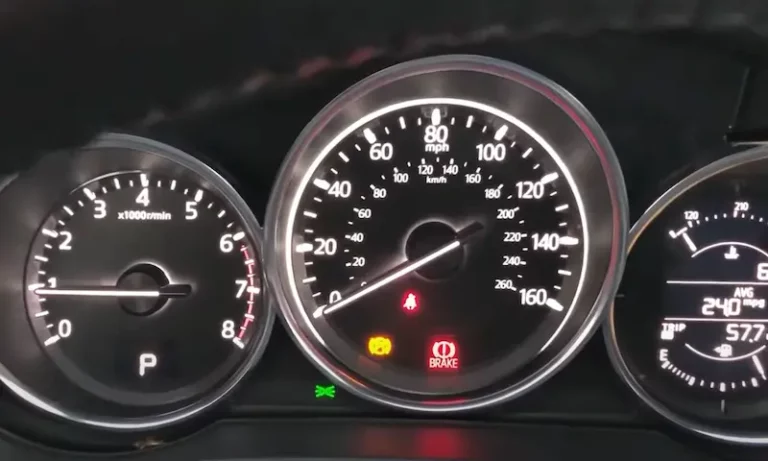
Your Mazda will typically alert you to parking brake issues through several warning indicators:
- A red parking brake light that won’t stop flashing
- An amber parking brake warning light with an exclamation point
- The words “Parking Brake Malfunction” displayed on your information screen
- A “See dealer” message that appears alongside brake warnings
If you see the parking brake warning light flashing while driving, don’t ignore it—this indicates a problem that needs attention.
Physical Symptoms
Beyond the warning lights, you might notice:
- The parking brake won’t engage when you pull up the switch
- The parking brake refuses to release when pressing down the switch
- Your vehicle rolls even though the parking brake appears to be engaged
- Strange grinding or clicking noises coming from the rear wheels
- The parking brake switch and dashboard lights flashing simultaneously
These symptoms suggest either a mechanical failure or an electrical issue with your Mazda’s parking brake system.
Diagnostic Trouble Codes: Speaking Your Mazda’s Language
When your Mazda’s parking brake malfunctions, it stores specific error codes that help identify the problem. These codes can be retrieved using an OBD-II scanner:
| Code | Description | Typical Symptoms |
|---|---|---|
| C1128 | Electric parking brake switch circuit malfunction | Switch unresponsive or intermittent |
| C2005:07 | Mechanical problem of EPB motor gear unit (right) | Right rear brake won’t engage/release |
| C2006:07 | Mechanical problem of EPB motor gear unit (left) | Left rear brake won’t engage/release |
| C112A:77 | Incorrect EPB motor gear unit position | Parking brake partially engaged |
| U3000 | Missing calibration in control module | System needs reprogramming |
These codes provide valuable information about the specific electronic parking brake issue your vehicle is experiencing.
Why Your Mazda’s Parking Brake Is Acting Up
Mechanical Failures
The physical components of your parking brake can wear out or break:
- Worn brake pads and shoes reduce the effectiveness of the electronic parking brake
- Damaged or frayed parking brake cables prevent proper operation
- Faulty brake calipers with integrated EPB motors fail to respond to commands
- EPB motor gear units with dimensions outside specifications can’t function properly
Electrical Problems
Many EPB issues stem from electrical faults:
- A faulty parking brake switch sends incorrect signals to the control module
- Low battery voltage prevents the EPB motors from operating correctly
- Corroded electrical connections disrupt communication between components
- Control module programming errors prevent proper system function
CX-5 owners have reported that low battery voltage is a surprisingly common cause of parking brake malfunctions.
Environmental Factors
Your environment plays a bigger role than you might think:
- Corrosion and rust buildup on brake components can cause mechanical failures
- Cold weather conditions, particularly temperatures between -4°F to 14°F, have caused EPB failures in some 2016 CX-5 models
- Moisture intrusion into electrical components can short-circuit the system
Mazda has acknowledged that certain 2016 CX-5 models produced before June 9, 2015, have a known cold weather EPB failure requiring motor gear unit replacement.
Maintenance-Related Issues
Improper maintenance can also trigger parking brake problems:
- Rear brake service performed without using maintenance mode can damage EPB components
- Liquid spills near cup holders have been known to affect electrical connections in some models
- Failure to calibrate the system after component replacement leads to malfunction warnings
Emergency Release Methods When You’re Stuck
Battery Reset Method
When your parking brake refuses to release, try this simple fix that has worked for many Mazda owners:
- Turn off your vehicle completely
- Pump the brake pedal several times until it becomes firm
- Restart the car and try the parking brake again
This method has successfully resolved issues for many CX-5 owners by resetting the electronic systems.
Manual Caliper Release
If you’re comfortable working on your car and the battery reset doesn’t work, you can manually release the brake:
- Safely raise and support the vehicle
- Locate the EPB motor on the rear caliper
- Remove the EPB motor mounting bolts (don’t disconnect the wiring)
- Use the appropriate socket to turn the caliper piston adjustment bolt 1/2 to 1 full turn
- Perform this procedure on both sides if necessary
This manual override can get you moving again when the electronic system fails.
Maintenance Mode Activation
You can force the system into maintenance mode using this sequence:
- Turn ignition ON (engine off) by pressing the start button twice without pressing the brake pedal
- Make sure the parking brake is released
- Hold the accelerator pedal fully down
- Press and hold the parking brake switch DOWN
- Press the start button 3 times quickly
- Listen for motor operation and check for the amber warning light
This maintenance mode trick has helped many Mazda owners release stuck parking brakes when other methods fail.
The Importance of Maintenance Mode for Brake Service
If you’re planning to service your rear brakes, you MUST use maintenance mode to prevent damage to the EPB system.
Entering Maintenance Mode Correctly
Follow these steps precisely:
- Switch ignition ON (engine off) by pressing the start button twice without pressing the brake pedal
- Release the parking brake by pressing the brake pedal and pushing the EPB switch down
- Release the brake pedal, then fully depress the accelerator pedal
- Press and hold the EPB switch DOWN
- Press the start button 3 times within 5 seconds
- Confirm the amber parking brake warning light is illuminated
This procedure puts the EPB system in a safe state for rear brake service.
Exiting Maintenance Mode
After completing your brake work:
- Switch ignition ON (engine off)
- Fully depress and hold the accelerator pedal
- Pull UP and hold the EPB switch
- Press the start button 3 times within 5 seconds
- Verify the amber warning light turns off
These steps ensure the system is properly reactivated after service.
Critical Maintenance Notes
- Never rotate rear brake pistons during compression—push them straight back like front calipers
- Do not disconnect the battery while in maintenance mode as it may require dealer recalibration
- Failure to use maintenance mode can damage EPB motors and require complete caliper replacement
Many Mazda owners have learned this the hard way, with EPB failures following rear brake service when maintenance mode wasn’t used.
Repair Costs and Solutions
Component Replacement Costs
If you need professional repairs, here’s what you might expect to pay:
| Component | Approximate Cost |
|---|---|
| Parking brake activation switch | $161-$184 |
| EPB motor actuator (each) | $100+ |
| Complete rear brake caliper with EPB | $250-$500 each |
| Control module replacement | $300-$600+ |
The parking brake activation switch is relatively affordable at $161-$184, while actuators and calipers can become quite expensive.
Known Service Issues
Some Mazda parking brake problems are well-documented:
- 2016 CX-5 models produced before June 9, 2015, have a known cold weather EPB failure requiring motor gear unit replacement
- Mazda service departments often report that EPB actuators are “known failure items” that should be replaced during rear brake service
- Some repairs are covered under Mazda warranty, while others (like liquid damage) are considered owner-caused and not covered
When DIY Isn’t Enough
While temporary fixes like the battery reset method can get you moving, underlying issues typically require professional attention:
- Many EPB malfunctions need dealer-level diagnostic equipment
- Calibration procedures often require proprietary Mazda software
- Component replacement frequently necessitates system reprogramming
If you’ve tried the emergency release methods without success, it’s time to seek professional help to prevent further damage or safety hazards.
Model-Specific Parking Brake Issues
Mazda CX-5
The CX-5 seems particularly prone to parking brake issues, with the 2016 model year having a technical service bulletin regarding cold weather EPB failures. Many owners report that the battery reset method works well for temporary relief.
Mazda3
Mazda3 owners commonly report the “Parking Brake Malfunction” message with a flashing red light. The maintenance mode procedure is particularly important when servicing these vehicles.
Mazda6
The Mazda6 often experiences switch-related issues, with owners reporting that the parking brake won’t disengage even after multiple attempts. The parking brake switch itself can be the culprit.
Mazda CX-9
CX-9 owners have reported parking brake actuator problems, with some mechanics noting that these are common failure points requiring replacement during regular maintenance.
The Bottom Line on Mazda Parking Brake Malfunctions
Mazda’s electronic parking brake system offers convenience when working properly but can be frustrating when it fails. Understanding the warning signs, knowing emergency release procedures, and recognizing when professional help is needed can save you time, money, and stress.
Remember that while DIY fixes can get you moving in an emergency, they don’t address underlying issues. For long-term reliability, proper diagnosis and repair by qualified technicians using Mazda-specific tools and procedures is your best bet.
Have you experienced parking brake problems with your Mazda? What solutions worked for you? Share your experiences and help fellow Mazda owners navigate this common issue.