
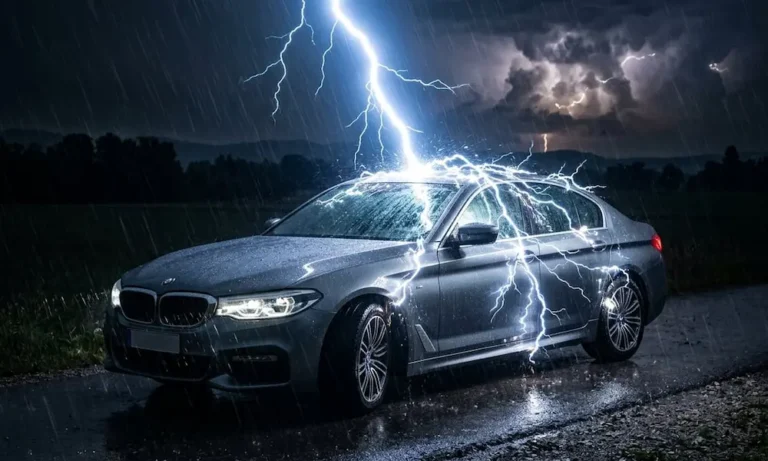
Short answer: yes. And what happens next might surprise you. Your car isn’t just a metal box — it’s doing something clever to keep you alive. But there’s a catch. Not every car protects you equally, and the vehicle might not survive even if you do. Read to the end to learn what keeps you safe, what lightning destroys, and what your insurance actually covers.
Lightning Absolutely Can Hit Your Car
The U.S. takes 25 to 37 million cloud-to-ground lightning strikes every single year. Your car sits right in that playing field. The good news? A properly built car handles a direct strike surprisingly well. The bad news? “Properly built” carries a lot of weight in that sentence.
And before you credit your rubber tires for keeping you safe — they’re not doing anything. A bolt that just crossed several miles of atmosphere isn’t stopping for a half-inch of rubber. Rubber provides zero meaningful insulation against hundreds of millions of volts. Something far more interesting is actually protecting you.
Your Car Acts Like a Faraday Cage
Here’s the cool part. A solid, metal-roofed car works like a Faraday cage — a physics concept dating to 1836. A conductive shell redirects electricity around its interior rather than through it.
When lightning hits your metal roof, the free electrons in that metal move instantly. They cancel out the electric field inside the cabin. The current then races across the outer surface of the car — roof, pillars, chassis — and jumps to the ground through or around your tires. You sit safely in the middle.
Physicists call this the “skin effect.” The electricity rides the skin of the car, not the inside. That’s why staying inside a hard-topped metal car during a thunderstorm is genuinely smart advice.
What Breaks This Protection
The Faraday cage only works when the metal shell stays largely continuous. These things disrupt it:
- Open windows or doors — gaps break the electrical continuity
- Touching exterior-connected metal — door handles, steering columns, gear shifts
- Plugged-in devices — a charging cable can deliver current directly to your hand
- Corded radios with exterior antennas — they create a direct pathway to your face
Keep hands in your lap, windows up, and don’t touch metal. It’s simple, but the stakes aren’t.
Not Every Car Protects You
Most people assume any car keeps them safe during a lightning storm. That assumption can get someone killed.
Convertibles Offer Nothing
NOAA is unambiguous about this: only fully enclosed, metal-topped vehicles qualify as safe lightning shelter. Convertibles — cloth top, synthetic top, even a retractable metal hardtop — don’t cut it. Their structural pillars aren’t continuous enough to safely route a massive electrical surge.
Open-cab vehicles are even worse. Golf carts, farm tractors, riding mowers — without an enclosed metal cab, you become the tallest conductive point in the area. Lightning finds you, not the machine.
Fiberglass and Carbon Fiber Bodies
Some vehicles don’t have conductive bodies at all. Fiberglass bodies can’t form a Faraday cage. The current finds the path of least resistance — straight through the cabin.
Carbon fiber is trickier. It does conduct electricity, but its resistance runs far higher than steel or aluminum. When lightning hits a carbon fiber body, that resistance generates extreme heat instantly. The material cracks, delaminates, and fails structurally. The car might route the current to ground eventually, but your protection drops dramatically compared to a standard steel body.
What About Panoramic Glass Roofs?
Glass doesn’t conduct electricity. When lightning hits a car with a panoramic roof, the charge immediately finds the metal frame surrounding the glass — roof rails and structural pillars — and routes through those instead. The Faraday cage still functions, as long as that surrounding metal frame stays solid.
The real concern is secondary damage. The thermal shock and acoustic blast from a direct strike can shatter laminated glass violently. You’d survive the electrical event only to deal with glass raining down from above. Know your car’s roof structure — it matters more than most people think.
What Lightning Actually Does to Your Car
Even if you walk away fine, the car might not. Lightning routinely causes catastrophic damage to modern vehicles.
Your Electronics Take the Hit
A lightning return stroke generates a massive electromagnetic pulse that surges through your car’s wiring. Modern vehicles run on dozens of interconnected control units and miles of fine-gauge wiring. A single strike can destroy fuel injectors, ignition coils, engine control units, navigation systems, and the entire wiring harness. Replacing a wiring harness alone costs $3,000 to $9,500+. That’s before touching anything else.
Airbags Can Fire Spontaneously
This one surprises most people. The surge voltage from a strike can short-circuit airbag sensors or directly trigger the SRS control module. Your car registers a phantom high-speed collision — and every airbag fires.
A deploying driver’s airbag destroys the clock spring in the steering column. Passenger bags, side curtains, seat pretensioners — all fire simultaneously. None can legally or safely be reused. Every single component needs complete replacement.
Tires, Antennas, and Exterior Damage
The current exits through your tires. It superheats the air inside the tire cavity, causing multiple blowouts at once. Carbon tracking burned into the sidewalls tells the story afterward.
Your antenna typically takes the first hit since it’s the car’s highest conductive point. It can melt, warp, or explode outright. Exterior paint and clear coat show pitting and burn marks at both the entry and exit points.
EVs and Lightning: One Extra Risk to Know
Structurally, an EV gives you the same Faraday cage protection as any metal-bodied car. But there’s a wrinkle when you’re charging.
If your EV is plugged in during a storm and lightning hits the local power grid or charging station, that surge travels through the charging cable straight into your battery management system. IEC-certified surge protective devices — specifically Type 2 EV charger surge protectors — clamp voltage spikes before they reach your battery. If you don’t have one installed, unplug during thunderstorms. It’s a five-second habit that can save thousands.
Will Insurance Pay for a Lightning Strike?
Only if you carry comprehensive coverage. Standard collision and liability policies don’t cover acts of God. Without comprehensive coverage, you pay for everything yourself.
Comprehensive coverage specifically handles non-collision events, including lightning. You file a claim, pay your deductible, and the insurer covers repairs — or declares a total loss.
The Total Loss Math
Lightning-struck cars get totaled all the time. Insurers compare repair costs against the car’s actual cash value (ACV). If repairs exceed the state’s total loss threshold — typically 70%–100% of ACV — they write the car off.
Here’s why that threshold gets crossed so fast:
| Component | Estimated Cost (Parts + Labor) | Notes |
|---|---|---|
| Airbag unit (per bag) | $300 – $1,000+ | Deployed bags can’t legally be reused |
| Passenger dashboard assembly | $1,000 – $2,500+ | Airbag deployment shatters the dash molding |
| SRS control module | $400 – $1,200 | Requires replacement or factory-level reset |
| Steering clock spring | $300 – $900 | Destroyed by driver airbag deployment |
| Crash sensors (each) | $120 – $450 | Highly sensitive; all require replacement |
| Seatbelt pretensioners (each) | $80 – $400 | Pyrotechnic devices; fire alongside airbags |
| Main wiring harness | $3,000 – $9,500+ | Requires stripping the entire interior |
A severe strike can push total repairs past $15,000–$20,000. On a $25,000 car, that’s a total loss. Even repaired vehicles suffer in resale value — the event permanently marks the vehicle’s history report.
Your Car Qualifies as an OSHA-Approved Lightning Shelter
OSHA treats lightning as a recognized occupational hazard under the General Duty Clause. Outdoor workers in construction, agriculture, landscaping, and utilities must follow a written Emergency Action Plan that includes lightning safety protocols.
Preferred shelter is always a substantial enclosed building. But on remote job sites, OSHA explicitly designates hard-topped metal vehicles with windows rolled up as the approved secondary shelter.
The 30/30 rule applies: stop all outdoor work if thunder follows a lightning flash within 30 seconds. Don’t resume until 30 full minutes pass after the last thunder. Lightning can strike 10 miles outside the visible storm — waiting for rain already puts you dangerously behind.
One critical rule for heavy machinery operators: stay inside an enclosed cab. Stepping off creates “step potential” — current traveling up one leg and down the other, straight through your heart. Stay in the cab, hands in your lap, engine off.
Who Gets Struck Most? The Real Numbers
CDC lightning fatality data shows the annual odds of a strike hover below one in a million. But 10%–30% of direct strike victims die, usually from instant cardiac arrest. Up to 80% of survivors live with permanent neurological damage.
Between 2006 and 2021, 446 people died from lightning strikes in the U.S. The patterns in that data show you exactly where real risk hides:
- Males account for 80%+ of all fatalities — across nearly every age group and activity category
- 72%+ of deaths occur June through August — peak storm season aligns with peak outdoor activity
- Florida and Texas lead in total fatalities — near-daily summer storms meet large, outdoor-active populations
And forget the golfer myth. Golf fatalities dropped 75% after a dedicated safety campaign. Fishing now tops the list by a wide margin.
| Activity | Fatalities (2006–2021) | Why It’s Risky |
|---|---|---|
| Fishing | 40 | Slow to reach shore and vehicle shelter |
| Beach activities | 28 | Flat terrain makes people the high point |
| Camping | 22 | Tents provide zero protection |
| Yard work | 21 | People delay stopping tasks near home |
| Farming/ranching | 21 | Open fields and unenclosed equipment |
| Boating | 19 | Open water, no grounding protection |
| Soccer/golf | 13 each | Open fields, though awareness keeps improving |
Most of these victims had a safe vehicle nearby. They just waited too long to reach it. Because lightning travels laterally ahead of a storm cell, waiting for rain often means the bolt arrives before the first drop does. Get inside that metal-roofed car at the first sound of thunder — not the first raindrop.
FAQs About Lightning and Cars
Does rain on your car’s exterior change how lightning travels through it?
Not harmfully. A wet car surface actually helps route the current along the exterior more efficiently. Water mixed with road salts conducts electricity well. The current may travel through the surface water layer toward the ground rather than forcing through the metal alone. You might see localized steam where the current vaporizes water instantly — but the core protection keeps the current outside the cabin.
Can the acoustic shockwave from a direct strike hurt you inside the car?
Yes. The Faraday cage blocks electrical current, but it doesn’t absorb shockwaves. A direct strike generates an acoustic blast just inches from your ears, separated only by thin metal and glass. That proximity can cause severe hearing damage, tinnitus, and in serious cases, ruptured eardrums — even when the electrical discharge misses you entirely.
Do steel roof racks or aftermarket light bars affect lightning protection?
They don’t destroy the Faraday cage, but they change where lightning attaches first. Elevated steel accessories become the highest conductive point, drawing the strike toward them. If the mounting hardware uses non-conductive gaskets or poor grounding, the current can arc unpredictably across the roof before finding the chassis. The accessories absorb the worst thermal damage and can melt directly into the roof structure beneath them.
Does parking over a flooded road make a lightning strike more dangerous?
Not for you inside the car — water conducts electricity well, so the current exits the vehicle efficiently. The danger sits outside. When the discharge reaches the surrounding water, it electrifies the entire puddle. Anyone standing in that water, or stepping out of the car immediately after a strike, faces electrocution through step potential voltage moving up through their legs.


