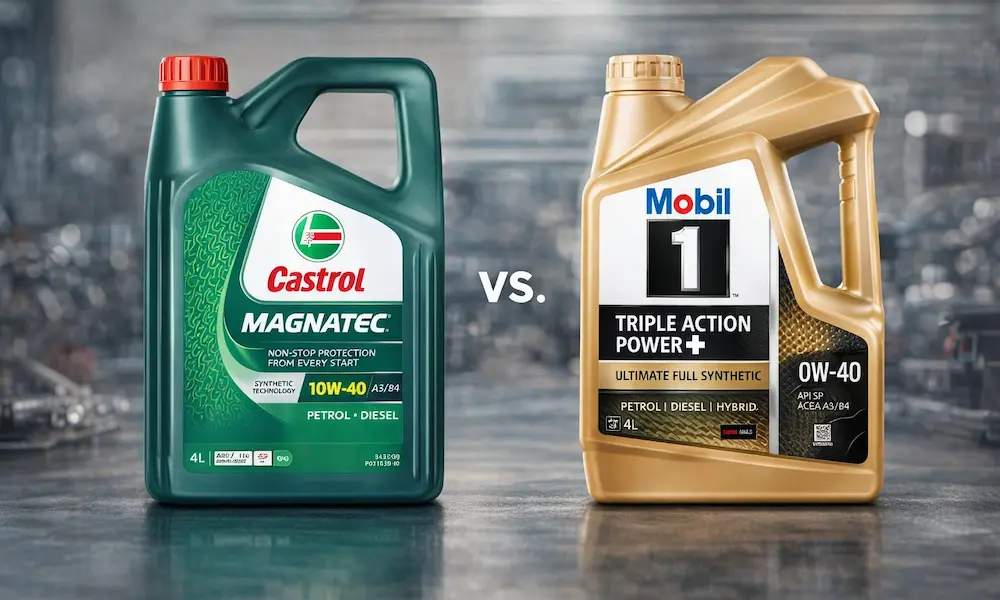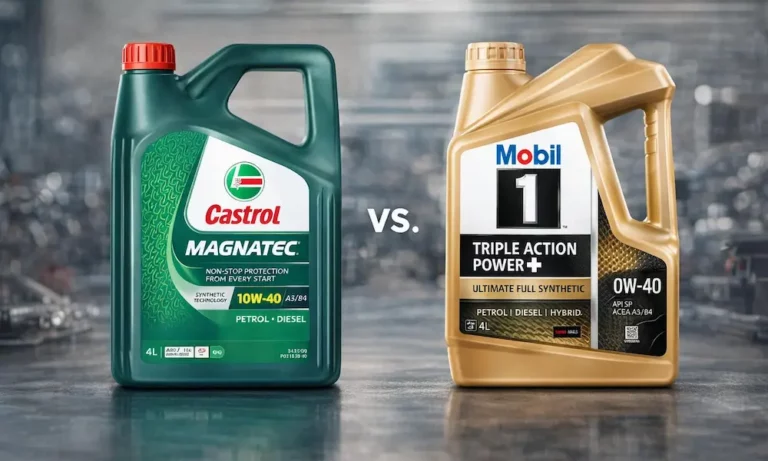
You’re staring at two bottles of synthetic oil, wondering if you’re about to make a $30 mistake. The labels scream competing claims—one promises titanium strength, the other boasts 20,000-mile protection. Here’s the truth: these aren’t just marketing battles. The chemistry inside these bottles is fundamentally different, and that difference matters for your engine. Let’s cut through the noise and figure out which oil deserves your money.
The Cold Hard Truth About “Synthetic” Oil
Not all synthetic oils are created equal, and here’s why that matters to you.
Back in 1999, Mobil sued Castrol over the word “synthetic.” Mobil used lab-made molecules (PAO). Castrol used super-refined crude oil (Group III). The lawsuit changed everything. The advertising board ruled that “synthetic” just means performance, not chemistry. This decision opened the floodgates—most “full synthetic” oils you see today are actually fancy mineral oils.
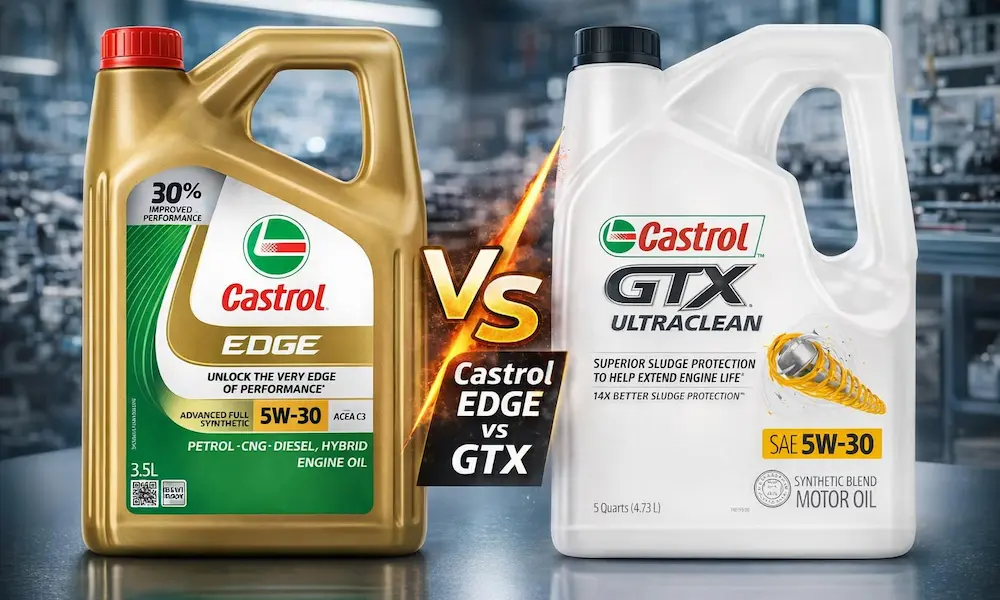
Mobil 1 still uses its original recipe as a foundation: a blend of Gas-to-Liquid (GTL) and PAO base stocks. These are chemically pure, synthesized from natural gas and ethylene. Castrol EDGE relies on heavily processed Group III oils from crude petroleum, then compensates with aggressive additive packages.
Think of it like this: Mobil 1 starts with premium ingredients. Castrol starts with good ingredients but adds exceptional spices to match the flavor.
What’s Actually Inside These Bottles
The base oil makes up 75-90% of what’s in your jug. It determines how the oil behaves when it’s freezing outside or when your turbo’s glowing red.
Mobil 1’s GTL Advantage
ExxonMobil uses Gas-to-Liquid technology in their Extended Performance line. The Fischer-Tropsch process converts methane into pristine liquid hydrocarbons with virtually zero sulfur or impurities.
What this means for you:
- Cold starts don’t kill your engine. GTL flows faster at -40°F than Group III oils
- Less oil consumption. Lower evaporation means you’re not adding a quart every 3,000 miles
- Cleaner combustion. No contaminants to gunk up your direct-injection system
Castrol’s Hydrocracked Strategy
Castrol EDGE uses Group III base oils—petroleum subjected to extreme heat and hydrogen pressure. The safety data sheets confirm “hydrotreated heavy paraffinic distillates” at 60-75% concentration.
These oils are high quality but contain mixed molecular shapes compared to the uniform structure of Mobil 1’s GTL. Castrol bridges this gap with chemistry—specifically, their Fluid Titanium additive package.
The Additive Arms Race
Base oils provide the medium. Additives provide the armor. This is where the brands diverge dramatically.
Castrol’s Fluid Titanium Technology
Don’t picture metal shavings floating in your oil. Fluid Titanium is an organometallic compound that transforms under pressure.
Here’s how it works: Under normal conditions, titanium polymers float loosely in the oil. When pressure spikes—like between your camshaft and follower—the molecules physically interlock into a shock-absorbing barrier. Castrol claims this doubles film strength.
Patent documents reveal they combine organic molybdenum with titanium/tungsten compounds. Molybdenum reduces sliding friction. Titanium handles the crushing loads. In standardized wear tests, Castrol EDGE demonstrates high resistance to metal seizure.
Mobil 1’s Synergistic System
Mobil 1 doesn’t market a magic ingredient. They focus on the interaction between pure base stocks and a balanced additive package.
Key components:
- Molybdenum friction modifiers that plate onto metal surfaces (70-100 ppm in used oil analysis)
- Boron dispersants that keep contaminants suspended and boost anti-wear effectiveness
- High-magnesium detergents that prevent Low Speed Pre-Ignition in turbo engines
The shift to magnesium was critical. High calcium levels caused pre-ignition events in GM’s turbocharged Ecotec engines. Mobil 1 aggressively reformulated to meet the stricter dexos1 Gen 3 standard before most competitors.
The Iron Wear Mystery
Pop open any oil enthusiast forum and you’ll find debates about iron levels in used oil analysis.
Users running Mobil 1 often see iron readings of 15-25 ppm, compared to 10-15 ppm with Castrol. This sparked panic: “Is Mobil 1 wearing out my engine?”
The reality is less dramatic. Tribologists suggest Mobil 1’s additive chemistry creates “chemical machining”—it polishes microscopic peaks on cylinder walls rather than causing destructive wear. Engines running Mobil 1 routinely exceed 200,000 miles without compression loss.
Still, if you obsess over your used oil analysis spreadsheet, Castrol delivers lower iron numbers that look better on paper.
Real-World Performance Testing
Marketing claims need validation. Independent tests reveal clear performance differences.
Cold Weather Showdown
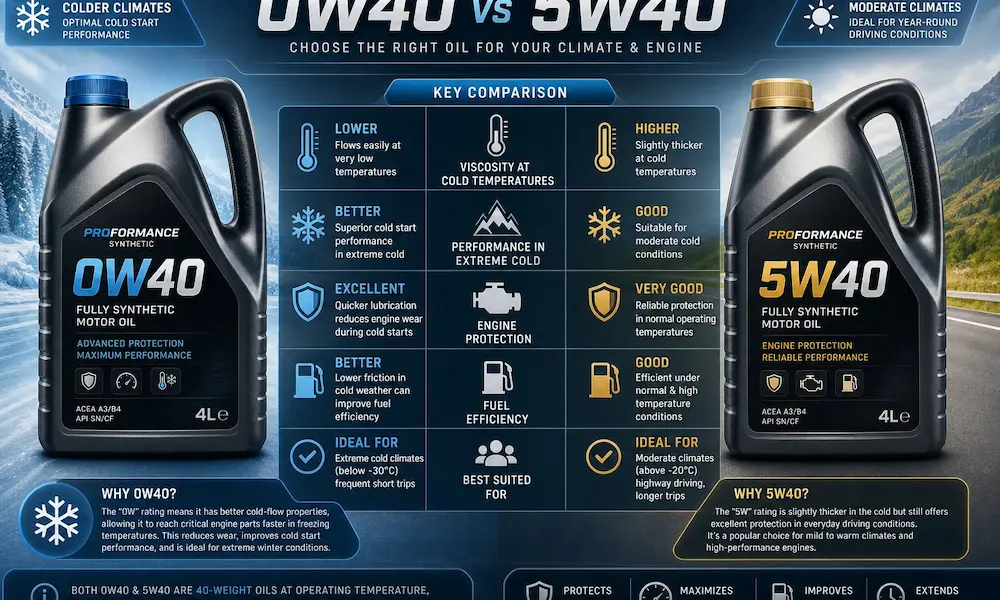
Project Farm’s brutal -40°F testing showed Mobil 1 flowing significantly faster than Castrol EDGE. The GTL/PAO molecules resist waxing and crystallization better than hydrocracked paraffins.
If you live in Minnesota, Alaska, or anywhere winter temperatures drop below zero, that 4-5 second flow advantage means your cam bearings get lubricated faster at startup—the most critical wear moment.
Evaporation Resistance
Mobil 1 achieves lower Noack volatility scores (often under 10%) thanks to its GTL content. Castrol meets industry limits (10-13% for dexos) but can’t match the structural advantage of synthetic base stocks.
Translation: You’ll add less oil between changes with Mobil 1.
Film Strength Under Load
Castrol claims “3X stronger against viscosity breakdown” compared to leading synthetics. This matters because polymer thickeners get sheared by mechanical stress. If your 5W-30 shears down to a 5W-20, protection suffers.
For towing, track days, or aggressive driving, Castrol’s formulation maintains its protective viscosity longer under extreme conditions.
European vs American: The Approval Game
Don’t gloss over those cryptic codes on the back label—they’re more important than the front label claims.
BMW Longlife Standards
For decades, Castrol was BMW’s partner. “Castrol Recommended” appeared on oil caps across the lineup. Then BMW switched to Shell around 2015.
Modern BMW LL-01 approval requires passing the brutal N20 timing chain wear test. Castrol EDGE Euro 5W-40 carries this approval. Mobil 1 FS 0W-40 has had an on-again, off-again relationship with BMW specs, depending on reformulation cycles.
If you own an out-of-warranty BMW and want to stick with the oil chemistry the engine was designed around, Castrol EDGE Euro is the safer bet.
Mercedes-Benz MB 229.5
Mobil 1 FS 0W-40 is the factory fill for many Mercedes-AMG engines. Its high Total Base Number (TBN) handles the extended service intervals Mercedes demands in Europe—up to 20,000 km between changes.
Castrol EDGE 0W-40 A3/B4 also meets MB 229.5, providing a viable alternative with similar approvals.
GM dexos1 Gen 3
Both brands are fully licensed for modern GM turbo engines. The dexos1 Gen 3 standard forced similar detergent chemistries (magnesium/calcium balance) to prevent pre-ignition.
For a Chevy Silverado or Equinox, the performance difference between Mobil 1 and Castrol narrows significantly. Both meet the strict requirements that protect your turbocharger from low-speed pre-ignition damage.
Extended Drain Intervals: Marketing or Science?
The interval war has reached absurd territory, with both brands guaranteeing service intervals that make old-school mechanics cringe.
Mobil 1’s 20,000-Mile Promise
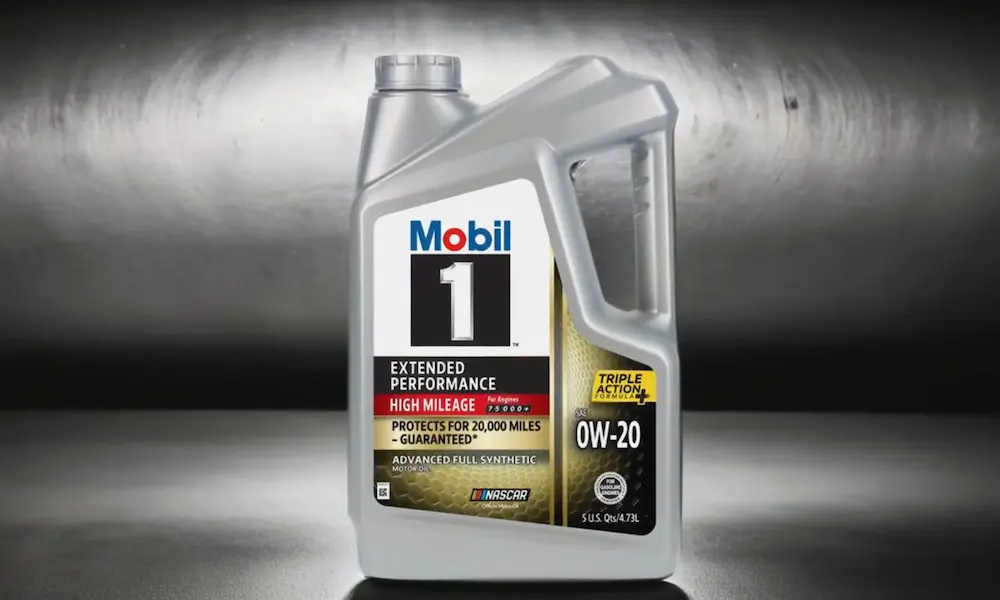
Mobil 1 Extended Performance guarantees 20,000 miles or one year. This works because of massive antioxidant reserves and base stocks that resist oxidative thickening.
The catch: You must use their branded Mobil 1 Extended Performance Oil Filter with synthetic media rated for 20,000 miles. Without it, your filter goes into bypass mode and unfiltered oil circulates through your engine.
Castrol’s 25,000-Mile Gamble
Castrol upped the ante to 25,000 miles. The oil relies on Fluid Titanium to protect even as the additive package depletes.
The problem: Castrol doesn’t make filters. You’re on your own to find a third-party filter capable of lasting 25,000 miles. If your filter fails at 15,000 miles and goes into bypass, the oil quality becomes irrelevant—abrasive particles recirculate freely.
The Annual Protection Failure
Mobil 1 launched “Annual Protection,” a premium oil at $50/jug that guaranteed one year or 20,000 miles. It failed commercially and was discontinued.
Why? Consumers weren’t willing to pay double when Extended Performance already delivered 15,000-20,000 mile intervals. The engineering was solid. The economics weren’t.
High-Mileage Applications: Stopping Leaks vs Cleaning Sludge
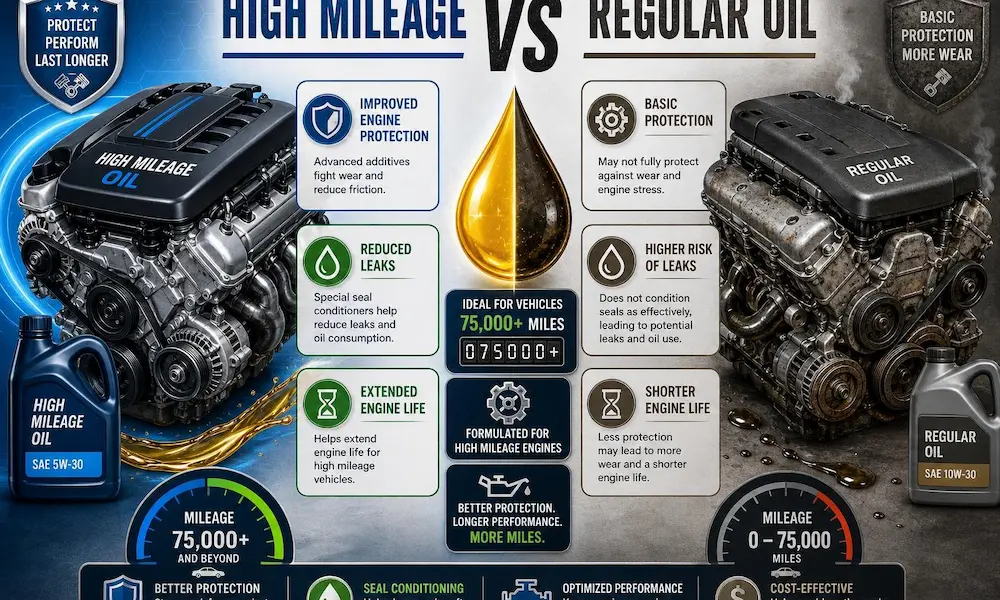
Once your odometer crosses 75,000 miles, seals harden and piston rings wear. Different oils take different approaches to aging engines.
Castrol GTX High Mileage
Castrol GTX High Mileage is arguably the most respected high-mileage formula in the industry.
It uses ester additives that gently swell cork and neoprene seals, stopping minor leaks. The formulation runs on the thicker side of grade tolerance, helping seal worn piston rings and maintain compression.
Anecdotal evidence overwhelmingly supports Castrol’s ability to reduce oil consumption in high-mileage engines that burn oil.
Mobil 1 High Mileage
Mobil 1 High Mileage emphasizes sludge removal through aggressive detergency.
The paradox: Some users report switching to Mobil 1 HM causes leaks. This happens when high-detergent formulas clean away “structural sludge”—the gunk that was effectively plugging gaps. Once cleaned, the gap is exposed.
Additionally, PAO base stocks can be less friendly to older seal materials than Group III oils, though modern formulations include seal conditioners to mitigate this.
Product Comparison at a Glance
| Feature | Mobil 1 Extended Performance | Castrol EDGE Extended Performance |
|---|---|---|
| Primary Base Stock | GTL + PAO Blend | Group III Hydrocracked |
| Signature Additive | Molybdenum/Boron/Magnesium | Fluid Titanium Technology |
| Drain Interval | 20,000 miles | 25,000 miles |
| Cold Flow (-40°F) | Superior (flows faster) | Good (slower flow) |
| Evaporation Resistance | Excellent (low Noack) | Good (meets standards) |
| Film Strength | Excellent | Superior (3x claim) |
| Best For | Cold climates, commuters, MPG | Performance, towing, European cars |
Pricing Reality Check
| Product | Average Price (5-qt jug) | Availability |
|---|---|---|
| Mobil 1 Full Synthetic | $27.97 – $29.97 | Widely available, frequent rebates |
| Castrol EDGE | $27.48 – $29.48 | Widely available |
| Mobil 1 Extended Performance | $29.97 – $32.00 | Excellent value for GTL content |
| Castrol EDGE Extended Performance | $29.48 – $34.00 | Often priced slightly higher |
| Mobil 1 ESP (Euro Formula) | $35.00+ | Harder to find in jugs |
| Castrol EDGE Euro Car | $28.00 – $32.00 | Readily available |
Special Applications Worth Knowing
Some scenarios demand specific formulations beyond the standard shelf oils.
Mobil 1 ESP for Modern Emissions
Mobil 1 ESP 5W-30 and 0W-30 are designed for vehicles with Diesel Particulate Filters (DPF) and Gasoline Particulate Filters (GPF).
These “Low-SAPS” oils limit Sulfated Ash, Phosphorus, and Sulfur to prevent clogging delicate emissions filters. Despite reduced anti-wear additives, ESP formulations use cutting-edge organic friction modifiers and higher PAO/ester content to pass brutal VW 504/507 wear tests.
For any modern VW, Audi, or Mercedes diesel, ESP is arguably the best over-the-counter oil available in the US.
Castrol EDGE Euro Car Line
This line is the spiritual successor to the legendary “German Castrol.”
Available in 0W-30, 0W-40, 5W-30, and 5W-40, Euro Car formulas cover the big three German specs: MB 229.5, BMW LL-01, and VW 502 00/505 00.
Unlike standard Castrol EDGE, Euro formulas have higher HTHS (High Temperature High Shear) viscosity—usually above 3.5 cP. This means thicker oil film at 150°C, critical for high-operating-temperature German turbos, with a slight fuel economy penalty.
Racing Formulas: Track Only
Mobil 1 offers Racing 0W-30 and Racing 0W-50 with massive ZDDP (Zinc/Phosphorus) content exceeding 1,700 ppm.
Don’t put these in your street car. That zinc level will destroy your catalytic converter in short order. For a track-only car with straight pipes, they offer ultimate wear protection. Castrol’s equivalent (Castrol R) is rarely found on retail shelves in the US.
Debunking the “All Oil is the Same” Myth
You’ll hear this claim in forums and from budget-conscious friends. The data proves otherwise.
While base oils are converging, additive packages remain chemically distinct. A magnesium-detergent oil behaves fundamentally differently during a pre-ignition event than a calcium-detergent budget brand.
Castrol’s Titanium polymer is a patented chemical entity you won’t find in generic supermarket synthetic. The 4-5 second cold-flow advantage Mobil 1 shows at -40°F is the difference between a lubricated cam bearing and a dry start.
Cheap synthetic is adequate for gentle commuting with frequent changes. Premium formulations from Castrol and Mobil 1 offer tangible engineering benefits at the extremes—extreme heat, extreme cold, and extended drain intervals.
Which Oil Should You Actually Buy?
The answer depends on your specific situation, not brand loyalty.
Choose Mobil 1 Extended Performance if:
- You live in a cold climate (anywhere winter temps drop below 0°F)
- You drive a hybrid or standard commuter vehicle (Toyota, Honda, domestic SUV)
- You prioritize fuel economy and low oil consumption
- You want a true 20,000-mile interval with their matched filter system
- Your car requires dexos1 Gen 3 or standard API SP certification
Choose Castrol EDGE if:
- You drive a turbocharged performance vehicle aggressively
- You tow heavy loads regularly
- You own a European vehicle (BMW, Mercedes, Audi, VW)
- You have a high-mileage engine (75,000+ miles) with minor leaks or oil consumption
- Your manufacturer specifies BMW LL-01, MB 229.5, or VW 502/505 approvals
- You want maximum film strength under extreme loads
For specific scenarios:
- Modern VW/Audi diesel or GPF-equipped vehicles: Mobil 1 ESP or Castrol EDGE Euro (Low-SAPS formulations only)
- High-mileage vehicles burning oil: Castrol GTX High Mileage
- Mercedes-AMG or BMW M cars: Mobil 1 FS 0W-40 or Castrol EDGE Euro 0W-40 matching your specific approval
- Budget-conscious with frequent changes: Either brand’s standard Full Synthetic at 5,000-7,500 miles is excellent

- Phosphorus Replacement Technology to help extend the life of the emission system
- Reduces leaks, oil burnoff and power robbing deposits
- 15,000 miles between oil changes*
- Meets or exceeds the following specifications: API SP/SN PLUS/SN/SM | ILSAC GF-6 | Meets engine test requirements of Chrysler MS 6395 | Meets Ford WSS-M2C946-B1 | Meets Ford WSS-M2C961-A3
- Or one year, whichever comes first


- Helps extend engine life, even in severe conditions
- Protects for 15,000 miles – guaranteed*
- Contains additives to help fight sludge
- Keeps your engine running like new
The Bottom Line
Castrol vs Mobil 1 isn’t about good versus bad—it’s about selecting the right tool for your specific mechanical environment.
Mobil 1 built its reputation on GTL and PAO base stock technology that delivers unmatched cold-weather performance, low volatility, and excellent fuel economy. It’s the pragmatic choice for modern vehicles where sludge prevention and all-weather versatility matter most.
Castrol EDGE compensates for Group III base stocks with aggressive Fluid Titanium additives that create superior film strength under extreme loads. It’s the enthusiast choice for turbocharged engines driven hard, European vehicles with strict OEM specs, and older engines where oil consumption is a concern.
Both oils exceed modern API SP and ILSAC GF-6 standards by comfortable margins. Both protect your engine exceptionally well when used within their design parameters. The “best” choice depends entirely on how you drive, where you live, and what you drive.
Stop overthinking it. Match the oil to your driving conditions, follow the drain interval appropriate for your usage (not the maximum marketing claim), and your engine will outlast your car payment.