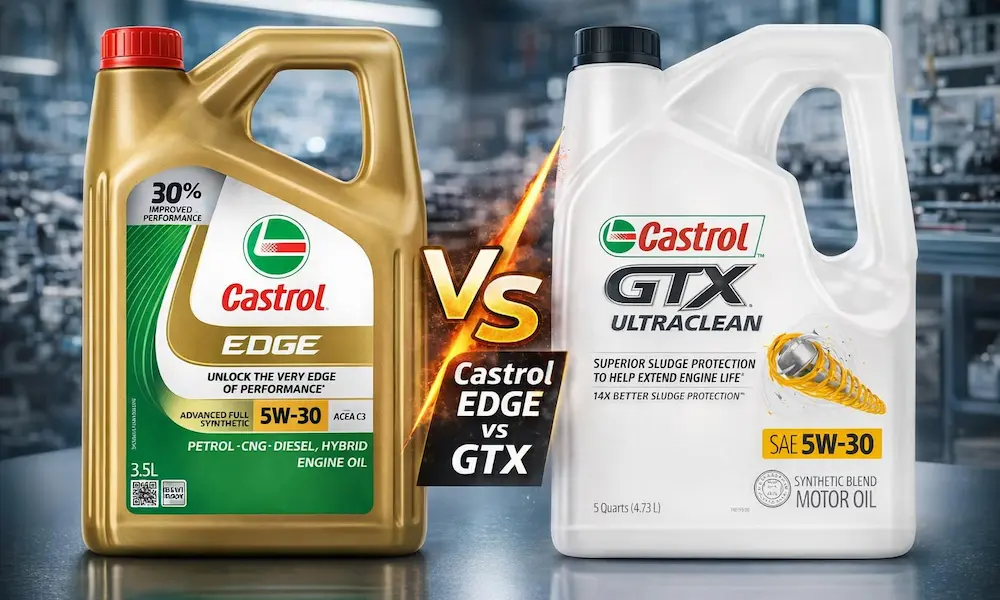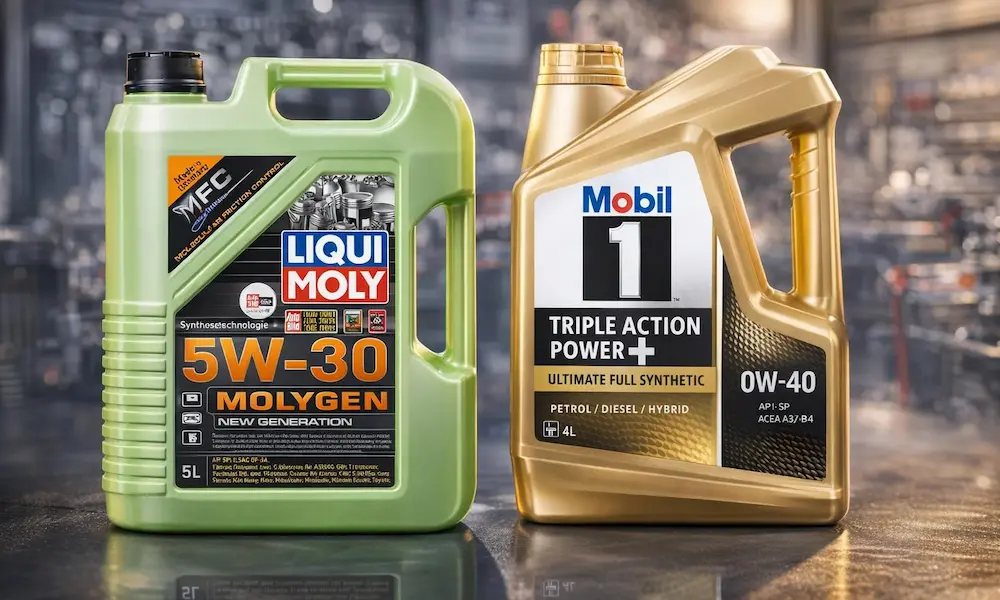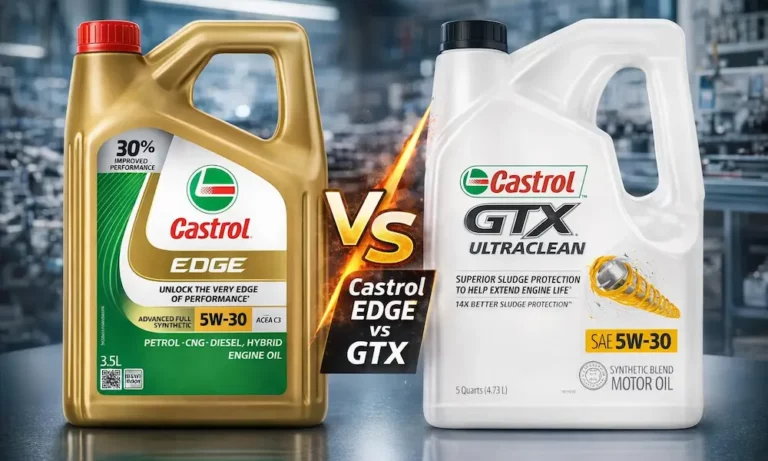
You’re staring at two bottles in the auto parts aisle. One’s $20. The other’s $27. Both say “Castrol” and promise to protect your engine. So what’s the real difference between Castrol EDGE vs GTX? More importantly, which one does your car actually need? This isn’t about marketing hype—it’s about chemistry, performance data, and whether that extra $7 is buying you real protection or just fancier packaging.
What Makes These Oils Different (The Chemistry Part, Made Simple)
Here’s the thing: not all “synthetic” oil is created equal.
The Base Oil Story
Think of motor oil like coffee. You’ve got basic drip, premium blend, and single-origin pour-over. Same idea here.
Castrol GTX (the standard bottle) uses what’s called Group II base oil—it’s mineral oil that’s been cleaned up through a process called hydrotreating. It’s decent. Gets the sulfur out, makes it more stable than your grandfather’s Pennzoil.
Castrol GTX Full Synthetic steps up to Group III base oil. This is where things get interesting. The oil goes through intense heat and pressure (hydrocracking) that reorganizes the molecules into more uniform chains. Technically “synthetic” after a 1999 legal ruling, even though purists will argue it’s still refined petroleum.
Castrol EDGE blends Group III with Group IV PAO (Polyalphaolefin). PAO is chemically engineered from scratch—not refined from crude. It’s like comparing a hand-forged knife to a stamped one. The molecules are identical in size, which means less internal friction and better performance when temps go extreme.
Why This Matters to Your Engine
The base oil determines how the oil behaves when it gets hot or cold. Group II oils thin out faster as they heat up. PAO-based oils like EDGE stay more consistent, which is critical if you’ve got a turbocharged engine where bearing temperatures can spike past 400°F.
Here’s the breakdown:
| Base Oil Type | Used In | Main Benefit | Weakness |
|---|---|---|---|
| Group II | GTX Standard | Affordable sludge control | Thins out under heat |
| Group III | GTX Full Synthetic | Modern spec compliance | Volatility (oil burn-off) |
| Group III + IV | EDGE | Extreme temp stability | Higher cost |
The Additive Battle: Titanium vs Double Action
Base oil is the canvas. Additives are what make the painting.
Castrol EDGE’s Fluid TITANIUM Tech
Don’t let the name fool you—there aren’t actual titanium flakes floating around. It’s a proprietary organometallic polymer that does something clever: it changes behavior under pressure.
When your camshaft slams into the lifter (we’re talking 10,000+ PSI), these titanium polymers physically stiffen to create a protective cushion. It’s like having airbags that only deploy during a crash. The result? Castrol claims 15% less friction and “6X better wear protection” than industry standards.
Independent 4-ball wear tests back this up. EDGE consistently produces smaller wear scars on metal test balls than competitor oils.
GTX’s Double Action Formula
GTX takes a different approach. Its mission isn’t extreme pressure protection—it’s cleanliness.
The “Double Action” claim means it both cleans existing sludge and prevents new buildup. It does this with high concentrations of dispersants (think molecular trash collectors) that grab contaminants and keep them suspended so they can’t glom together into engine-choking gunk.
If you’ve got a neglected engine with unknown service history, GTX is your rehab program. It’s designed to scour varnish and deposits that previous owners let accumulate.
Real-World Performance: What the Tests Actually Show
Marketing claims are cute. Lab data tells the truth.
Cold Start Protection
Your engine wears most during the first 30 seconds after a cold start. Oil needs to flow fast.
The Cold Cranking Simulator (CCS) measures resistance at -30°C:
- GTX Ultraclean: 5,845 centipoise
- EDGE Extended Performance: Under 4,000 centipoise
Translation? EDGE flows 30% faster in freezing temps. That means critical engine components get lubricated seconds earlier, reducing cold-start wear significantly.
High-Temperature Stability
Turbocharged engines are thermal torture chambers. Oil in the turbo bearing can hit 400°F.
Flash Point Test (when oil starts to vaporize):
- GTX: 200-205°C
- EDGE: Over 220°C
Higher flash point means EDGE burns off slower. Less oil consumption. Fewer top-offs between changes. And critically—less carbon buildup on your intake valves if you’ve got a direct-injection engine.
Volatility (The Burn-Off Problem)
The Petroleum Quality Institute independently tested Castrol EDGE 5W-20 and measured 8.8% Noack volatility. That’s excellent—well below the 15% limit.
Typical synthetic blends? Often 12-14%. That extra evaporation feeds carbon deposits in GDI engines, eventually choking airflow and killing fuel economy.
Which Oil for Which Engine?
Here’s where the rubber meets the road.
Pick GTX If You Have:
Older naturally aspirated engines – Think pre-2015 Civics, Corollas, base-model sedans. These engines run moderate temps and don’t stress the oil much. The blend or Full Synthetic GTX handles them fine.
Engines with sludge issues – If you bought a used car with questionable maintenance, GTX’s dispersant-heavy formula will clean things up better than EDGE.
Frequent oil changers – Swapping every 3,000-5,000 miles anyway? You don’t need EDGE’s extended protection. Save the cash.
High-mileage leakers – GTX High Mileage includes seal conditioners that swell gaskets slightly to slow leaks. It’s cheaper than EDGE High Mileage and works just as well for this specific purpose.
Pick EDGE If You Have:
Turbocharged engines – The low volatility and high-temp stability prevent turbo coking. A replacement turbo costs $2,000+. The $7 EDGE premium is cheap insurance.
Direct injection engines – EDGE’s low Noack score means less oil vapor coating your intake valves with carbon. GDI valve cleaning costs $300-500. Prevention wins.
Extended drain intervals – Planning to go 7,500+ miles between changes? EDGE’s shear-stable polymers maintain protective film thickness longer. GTX breaks down faster.
European cars – VW, BMW, Mercedes have strict specs (like VW 504.00) requiring high HTHS viscosity. Standard GTX doesn’t cut it. You need EDGE Euro Car formulation.
Performance driving – Track days, aggressive acceleration, high-RPM runs? The Titanium tech provides measurable protection against shock loads that would shear through GTX’s film.
The GM dexos1 Gen 3 Question
Here’s a critical compatibility issue many miss.
Modern GM vehicles (Chevy, Buick, GMC, Cadillac) require dexos1 Gen 3 approval. This spec demands specific LSPI (Low-Speed Pre-Ignition) protection for turbocharged engines.
- Castrol EDGE: Approved ✓
- Castrol GTX Full Synthetic: Approved ✓
- Castrol GTX Standard Blend: NOT approved ✗
Using non-approved oil in a dexos1 Gen 3 engine voids your warranty and risks catastrophic pre-ignition damage. If you drive a newer GM, GTX Full Synthetic is your minimum entry point.
What About High Mileage Formulas?
Both product lines offer “High Mileage” variants for engines over 75,000 miles.
Shared Technology
Both include seal conditioners (ester additives) that penetrate rubber gaskets and make them swell slightly. This often stops minor leaks without mechanical repair.
They also use specialized phosphorus chemistry that maintains anti-wear protection while reducing volatility—protecting your catalytic converter from contamination.
The Decision Matrix
Choose GTX High Mileage if your engine consumes oil due to worn piston rings or valve seals. The thicker mineral-based formula can sometimes reduce consumption better than thin synthetic.
Choose EDGE High Mileage if your well-maintained older engine just needs seal conditioning but you want to retain all the performance benefits of the EDGE platform—low volatility, extreme pressure protection, extended drains.
If the engine is burning oil because it’s mechanically worn, no fancy synthetic will fix that. Save money with GTX. If it’s burning oil from heat-related volatility, EDGE’s lower Noack score helps.
The Economics: Is EDGE Worth $7 More?
Let’s talk actual dollars.
| Product | 5-Qt Price | Cost Per Change |
|---|---|---|
| GTX Blend | $20.97 | $20.97 + filter |
| GTX Full Synthetic | $23.96 | $23.96 + filter |
| EDGE Standard | $27.48 | $27.48 + filter |
| EDGE Extended Performance | $29.48 | $29.48 + filter |
The False Economy of Cheap Oil
The jump from GTX Blend to GTX Full Synthetic is three bucks. For that you get dexos1 approval and drastically better wear protection. If you’re still buying the blend, you’re making a mistake.
The EDGE premium is $7 over GTX Full Synthetic. Here’s the ROI:
If you do 5,000-mile changes: You’re paying $7 for better protection. That’s 0.14 cents per mile. Worth it for turbo engines? Absolutely.
If you do 10,000-mile changes with EDGE Extended Performance: You’re actually spending less annually because you’re doing half as many oil changes. Fewer filters, less disposal hassle, less labor.
If you avoid one turbo replacement: That’s $2,000+ in savings. How many $7 premiums does that buy? About 285 oil changes. You’ll never use that many in the car’s lifetime.
Understanding the Spec Sheets
Product data sheets look intimidating. Here’s what actually matters:
Viscosity Index (VI)
This number shows how much the oil’s thickness changes with temperature.
- GTX Ultraclean: 148
- GTX Full Synthetic: 163
- EDGE: 160-174
Higher is better. EDGE’s superior VI means it stays more consistent from winter cold starts to summer highway cruising. Less reliance on viscosity modifiers (which can shear apart) means more stable protection.
HTHS Viscosity
High-Temperature High-Shear measures the oil’s thickness at 150°C under stress.
Most GTX formulations run ~3.0 cP (optimized for fuel economy). European specs demand 3.5+ cP for high-speed Autobahn protection. If you’ve got a German car and use regular GTX, you’re risking bearing failure.
EDGE Euro Car formulations meet ACEA C3 standards with proper HTHS values.
The Sludge vs Strength Philosophy
This is the fundamental difference in design philosophy.
GTX is a janitor. It’s built to clean up messes, handle neglect, and keep average engines running in average conditions. Its dispersant-heavy formula excels at managing contamination.
EDGE is a shield. It’s engineered to prevent damage before it happens through superior film strength, thermal stability, and chemical resilience. It’s over-built for normal use.
For a daily-driven Camry that sees regular oil changes, GTX Full Synthetic handles the job fine. For a turbocharged EcoBoost that sees highway pulls and carries a $30K loan, EDGE’s extra protection makes sense.
What Independent Testing Shows
Beyond manufacturer claims, third-party testing reveals patterns.
Used Oil Analysis (UOA) data from enthusiast forums consistently shows:
EDGE maintains higher TBN (Total Base Number) at drain time, meaning more acid-neutralizing reserve remains. It ages slower.
GTX shows higher fuel dilution in some applications, likely due to the thinner base oil allowing more blow-by past piston rings.
Both control wear metals well in standard applications. The EDGE advantage appears most in turbocharged or high-performance use where GTX shows accelerated wear metal accumulation.
The Verdict: Match Oil to Mission
There’s no universal “best” between Castrol EDGE vs GTX. There’s only best for your specific engine and driving style.
GTX Full Synthetic hits the sweet spot for most modern vehicles. It meets current API SP and dexos1 Gen 3 specs, costs $4 more than the outdated blend, and delivers 90% of EDGE’s protection for 5,000-7,500 mile intervals.
EDGE justifies its premium in three scenarios: turbocharged engines, extended drain intervals, and European vehicles with strict HTHS requirements. The Titanium technology, superior base oils, and low volatility provide measurable advantages that cheap oil can’t match.
Standard GTX blend has limited use cases in 2025. It’s being phased out by the Full Synthetic line’s aggressive pricing and superior performance. Unless you’re running a fleet of old work trucks with frequent changes, skip it.
Want to know exactly which viscosity and formulation your specific car needs? Check the owner’s manual or oil cap for manufacturer specs, then match to the appropriate Castrol tier that meets or exceeds those requirements.
The best oil isn’t the most expensive or the most marketed—it’s the one that matches your engine’s actual operating conditions.