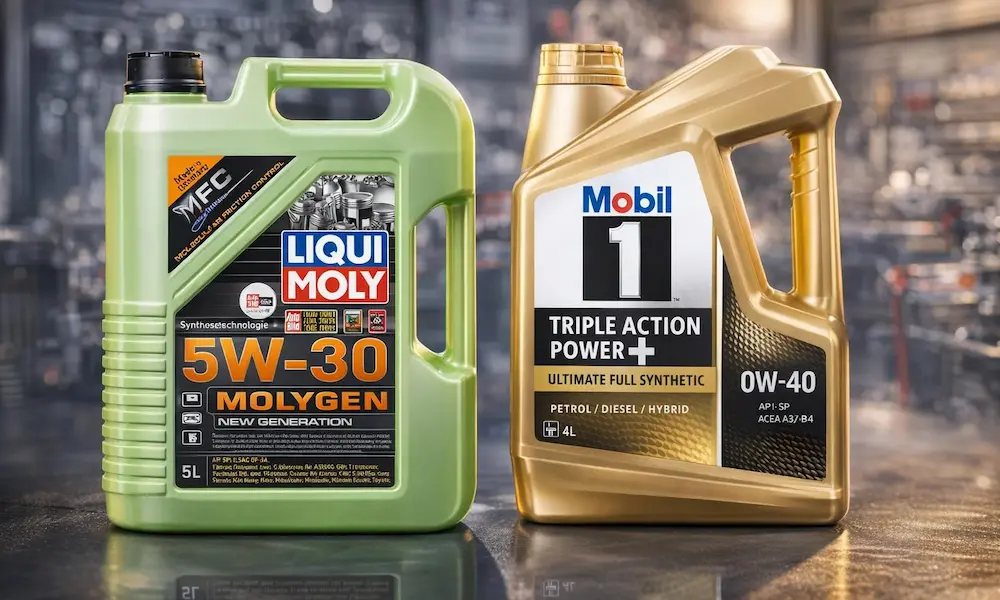
Your engine’s begging for the right oil, but you’re stuck between Liqui Moly and Mobil 1 at the auto parts store. Both claim they’re the best. Both look legit on the shelf. Here’s the real difference between these oils and which one your car actually needs. Stick around—you’ll save money and maybe your engine.
What Makes Liqui Moly Different from Mobil 1?
These brands couldn’t be more different if they tried. Mobil 1 comes from ExxonMobil, an American oil giant that makes everything from crude oil to the synthetic stuff in your engine. They’ve got massive factories and they’re everywhere—Walmart, AutoZone, your local gas station.
Liqui Moly’s a German specialty company that started by making liquid molybdenum additives. They don’t drill for oil. They engineer specific formulas for specific engines, mostly European ones.
Think of it this way: Mobil 1’s like buying a quality suit off the rack. It’ll fit most people pretty well. Liqui Moly’s more like a tailor who measures you first and makes something custom.
The chemical difference matters too. Mobil 1 FS 0W-40 uses a blend of PAO and GTL base oils—fancy synthetic stuff made in a lab. Liqui Moly often uses high-grade hydrocracked oils (Group III) for their volume sellers, though their premium Synthoil line uses full PAO just like Mobil 1.
Here’s what’s wild: in Germany, Liqui Moly can’t legally call their Group III oils “fully synthetic.” They have to label them “Synthetic Technology.” In America, both brands can slap “Full Synthetic” on pretty much the same stuff, thanks to a 1990s lawsuit between Mobil and Castrol.
The 0W-40 vs 5W-40 Debate
This is where people get religious about their oil choice.
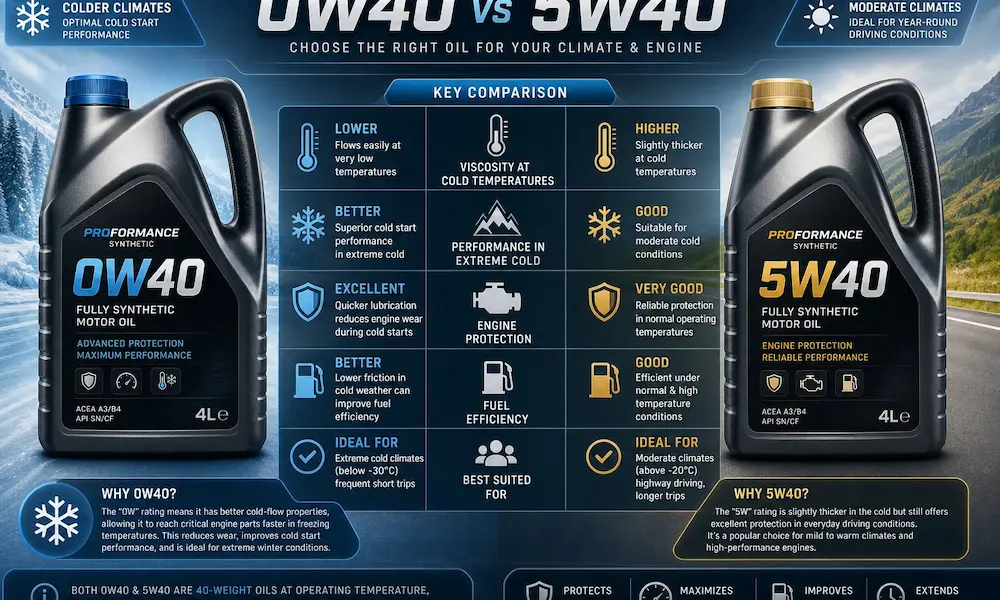
Mobil 1’s flagship European formula is 0W-40. That first number (0W) means it flows like water when it’s freezing cold outside. If you’re in Canada or Minnesota and it’s -40°F, Mobil 1 will flow to your engine bearings faster than just about anything else on the market.
Liqui Moly pushes 5W-40 for most of their German car formulas. That slightly thicker base means it doesn’t need as many viscosity improver additives—those polymer chains that help thin oil act thick when it heats up.
Why does this matter? Those polymers break down under stress. Your crankshaft literally shears them apart. Used oil analysis shows that Mobil 1 0W-40 can thin out to a 30-weight oil by the end of a 10,000-mile drain interval. It’s still protective, but it’s not what you started with.
Liqui Moly 5W-40 stays thicker throughout its life because it starts with a heavier base. Less polymer magic needed. Better shear stability. For a BMW doing autobahn runs or a track day, that thickness cushion matters.
Cold climate? Mobil 1 0W-40 wins. High-performance driving or hot weather? Liqui Moly 5W-40 stays in grade better.
Additive Chemistry: Where Liqui Moly Gets Weird (in a Good Way)
This is where Liqui Moly earns its reputation.
Their name literally means “liquid molybdenum.” They pioneered adding molybdenum disulfide (MoS2)—a solid lubricant—to motor oil. When your oil film breaks down under extreme pressure, those moly particles coat metal surfaces and slide against each other like graphite. It’s the same stuff they used in WWII aircraft engines.
Modern Liqui Moly oils like Molygen use tungsten combined with molybdenum. This “Molecular Friction Control” tech actually smooths out microscopic rough spots on your engine’s metal surfaces. It’s why Molygen is fluorescent green—that’s not just for looks. There’s a UV dye in there so mechanics can trace leaks with a blacklight.
Mobil 1 uses organic molybdenum instead—no solids. It’s cleaner, it won’t settle out, and it’s more compatible with modern engines. They also pack in boron (acts as a dispersant) and calcium/magnesium detergents to keep your engine clean over long drain intervals.
Mobil 1’s approach: Keep everything in solution, balance longevity with cleanliness, play it safe.
Liqui Moly’s approach: Use exotic friction modifiers to solve specific problems like noisy lifters or worn cam followers.
The BMW Approval Drama You Need to Know About
Around 2016, something interesting happened. Mobil 1 FS 0W-40 lost its official BMW Longlife-01 (LL-01) approval. It disappeared from the bottle. BMW stopped listing it in their approved oils.
Nobody knows exactly why. Some say Mobil 1 reformulated to cut costs (more Group III, less expensive PAO). Others think BMW’s new N20 engine test was too brutal and Mobil 1 didn’t pass. Maybe it was a licensing fee dispute.
What we know: Liqui Moly Leichtlauf High Tech 5W-40 still has the official BMW LL-01 stamp. If you’ve got a BMW under warranty, using Mobil 1 might technically void coverage if something goes wrong—even though it’s probably still perfectly fine oil.
For Mercedes, it’s reversed. Mobil 1 FS 0W-40 was literally co-developed with Mercedes for their 229.5 specification, which demands 18,600-mile drain intervals. Mobil 1’s high initial alkalinity (TBN of 12.5) neutralizes acids better over those monster intervals.
Bottom line: For BMWs, Liqui Moly’s the safer bet. For Mercedes, Mobil 1’s got the heritage.
Real-World Case Study: The Hemi Tick
Here’s where theory meets your driveway.
The 5.7L Hemi V8 in Ram trucks and Dodge Chargers has a notorious “tick” at idle. It sounds like a sewing machine. Most mechanics blame failing lifter needle bearings.
Standard Mobil 1 5W-30? The tick often persists or even gets worse. Switch to Liqui Moly Molygen 5W-40? The forums light up with people saying it quieted or eliminated the noise completely.
Why? That tungsten/molybdenum additive plates the lifter bearings. The thicker 40-weight oil increases film thickness. The combination dampens the metal-on-metal shock that makes the tick. It’s not fixing the underlying wear, but it’s managing the symptom better than standard synthetics.
This is Liqui Moly’s specialty: solving specific, annoying mechanical problems with targeted chemistry.
Price Reality Check
Let’s talk money because this matters.
Mobil 1 FS 0W-40 at Walmart runs about $27 for 5 quarts. That’s $5.40 per quart. Add in frequent rebates and you’re under $25 per oil change. For a PAO-heavy synthetic with Mercedes approval, that’s stupid cheap.
Liqui Moly? You’re looking at $45-60 for 5 liters at most auto parts stores. Nearly double the cost.
But here’s the loophole: FCP Euro offers a lifetime replacement guarantee on consumables. Buy Liqui Moly for $50, use it, buy it again, ship the old oil back, get refunded. You only pay return shipping ($15-20). This weird policy has made premium German oil cheaper than Walmart Mobil 1 for European car enthusiasts willing to deal with the logistics.
When Mobil 1 Is the Better Choice
You should reach for Mobil 1 FS 0W-40 if:
- You live where winter regularly hits below -20°F. The pour point advantage is real.
- You want to stretch oil changes to 10,000+ miles. That high TBN holds up.
- You’ve got a Mercedes that specifies 229.5 approval. Mobil 1 wrote the book on this spec.
- You’re not made of money and want quality protection at a mass-market price.
- You’re running a daily driver that doesn’t see track days or extreme use.
Mobil 1’s cold-flow performance is hard to beat. Independent testing consistently shows it flowing faster at extreme low temps than boutique competitors.
When Liqui Moly Is Worth the Premium
Go with Liqui Moly Leichtlauf or Molygen 5W-40 if:
- You own a BMW and want to maintain strict OEM approval compliance.
- Your engine runs hot—turbocharged German engines that see sustained high RPM.
- You’re fighting specific issues like the Hemi tick, valve clatter, or oil consumption.
- You’re in the FCP Euro ecosystem and can game the lifetime replacement system.
- You need UV dye for leak diagnosis (Molygen’s green glow under blacklight is genuinely useful).
- Shear stability matters more than cold-flow—you’re in Texas, not Toronto.
The tungsten and molybdenum friction modifiers in Molygen are legitimately different chemistry. Used oil analysis from Blackstone Labs consistently shows Liqui Moly maintaining viscosity grade and producing average to low wear metals. It’s boring oil in the best way—predictable and safe.
The Diesel Oil Trap
If you’ve got a modern diesel with a DPF (diesel particulate filter), pay attention to SAPS levels (Sulfated Ash, Phosphorus, Sulfur). High SAPS oils clog DPFs. Expensive repairs follow.
Mobil 1 sells both high-SAPS (FS 0W-40) and low-SAPS (ESP 0W-30) oils under similar branding. The confusion causes problems. People grab the wrong bottle and toast their emissions system.
Liqui Moly Top Tec 4200 5W-30 is specifically engineered for VW 507.00 (TDI diesels) and MB 229.52 specs. The branding is distinct. Harder to screw up. The TDI community swears by it for longevity and DPF compatibility.
For diesels, Liqui Moly’s targeted approach reduces the risk of using the wrong spec.
What Used Oil Analysis Actually Shows
Blackstone Labs and similar services test used oil for metal wear, contamination, and viscosity loss. When you look at aggregated data from forums:
Mobil 1: Excellent TBN retention (it neutralizes acids well over long drains). Occasionally shows higher iron wear numbers in certain BMW engines, though this could be from chemical leaching rather than actual mechanical wear. Viscosity can drop from 40-weight to high-30s/low-30s by 10,000 miles—still protective, but measurable thinning.
Liqui Moly: Boring, consistent reports. Stays in the 5W-40 grade. Wear metals typically average to low. No surprises. It’s the “set it and forget it” oil for European cars.
Neither oil is “failing” in these analyses. They’re both protecting the engine. The difference is in behavior over time.
Porsche’s Complicated Relationship with Oil
Mobil 1’s been Porsche’s factory fill since 1996. Their co-development gives Mobil 1 massive credibility with Porsche owners.
But here’s the twist: many Porsche specialists recommend switching older water-cooled 911s (996/997) to 5W-40 oils like Liqui Moly or Motul for track use. The reason? Cylinder bore scoring—a catastrophic failure where the cylinder wall gets scratched by the piston. The theory is that 0W-40 becomes too thin at extreme track temperatures (oil temps exceeding 250°F). The thicker 5W-40 base provides better film strength under sustained abuse.
For street-driven Porsches in normal climates, Mobil 1’s fine. For track warriors or hot-climate spirited driving, many go thicker.
The Technical Specs That Actually Matter
Here’s what you should care about when comparing oils:
| Specification | Mobil 1 FS 0W-40 | Liqui Moly Leichtlauf 5W-40 | Why It Matters |
|---|---|---|---|
| Viscosity Index | ~181 | ~170 | Higher number means less thinning when hot. Mobil 1 edges ahead. |
| Pour Point | -42°C to -57°C | -36°C | How cold before oil won’t flow. Mobil 1 dominates. |
| HTHS Viscosity | >3.5 mPa·s | >3.5 mPa·s | Film strength at operating temp. Both meet European specs. |
| NOACK Volatility | ~8.7-10% | ~9-10% | How much evaporates. Lower is better for keeping intake valves clean. Roughly tied. |
| TBN (Alkalinity) | 12.5 | ~10-11 | Neutralizes acids. Mobil 1 better for long drains. |
Data from technical data sheets.
The viscosity index difference is marginal in real-world use. Pour point matters if you’re in Siberia. TBN matters if you’re stretching intervals past 8,000 miles.
Common Myths You Can Ignore
Myth: Group III oils aren’t “real” synthetics.
Modern Group III hydrocracking produces oils that perform comparably to PAO in most metrics. The legal definition is murky, but performance is what counts.
Myth: Liqui Moly’s green color means it’s got weird stuff in it.
It’s UV dye for leak detection. It doesn’t affect lubrication. The tungsten/molybdenum additives are dissolved, not floating chunks.
Myth: You have to use 0W oil for modern engines.
Nope. If your manual allows 5W-40 and you don’t live in the Arctic, 5W-40 is often better for shear stability. Check your owner’s manual approved viscosities.
Myth: More expensive oil is always better.
Sometimes you’re paying for specific approvals (BMW LL-01, Porsche A40) rather than raw performance. Match the oil to your engine’s actual needs.
Which One Should You Buy?
If you’re still on the fence, here’s the shortcut:
Buy Mobil 1 FS 0W-40 if: You’ve got a Mercedes, you live in a cold climate, you want to maximize drain intervals, or you’re budget-conscious. It’s exceptional value for money and broadly compatible.
Buy Liqui Moly Leichtlauf/Molygen 5W-40 if: You own a BMW or Audi, your engine has specific issues (ticking, oil consumption), you drive hard in hot weather, or you can access FCP Euro’s replacement program.
Both oils will protect your engine. Neither is snake oil. The difference is in optimization for specific use cases.
Your engine doesn’t care about brand loyalty. It cares about film strength, viscosity stability, and whether the oil meets its engineering specs. Match the oil to your specific engine, climate, and driving style. That’s how you actually protect your investment instead of just lighting money on fire at the parts counter.