You’ve heard the hype about premium synthetic oils, but can’t figure out which one’s worth your money. If you’re choosing between Amsoil and Royal Purple, you’re weighing two completely different engineering philosophies. Let’s break down what actually matters for your engine—without the marketing fluff.
What Makes These Oils Different From Standard Synthetics
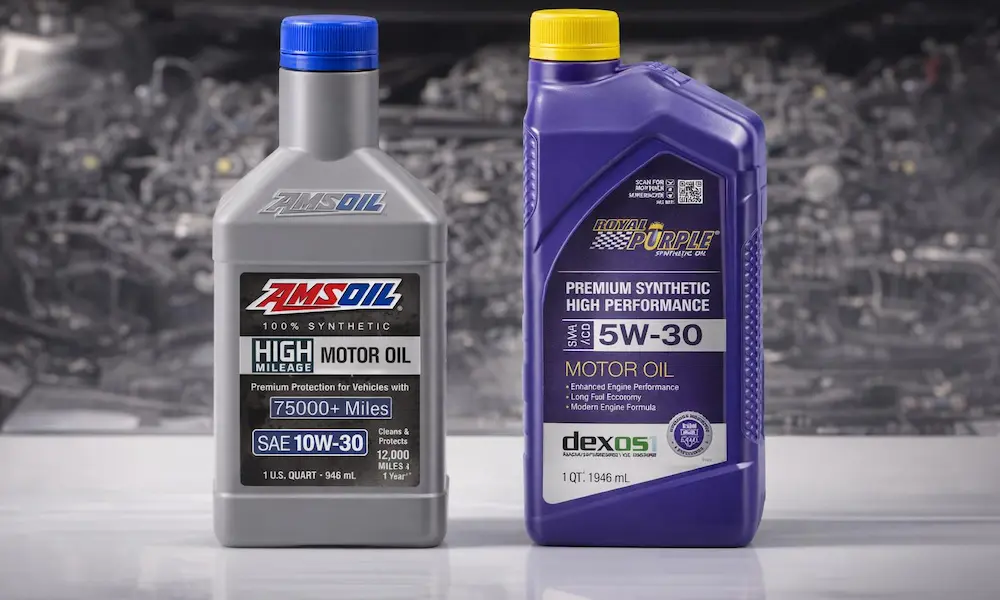
Both brands sit at the top of the synthetic oil market, but they got there through different paths.
Amsoil built its reputation on extended drain intervals and extreme cleanliness. They pioneered the first API-qualified synthetic motor oil back in 1972. Their formula relies heavily on Group IV (PAO) and Group V (Ester) base stocks—the “true” synthetics that resist breakdown under extreme conditions.
Royal Purple comes from an industrial lubrication background. Their signature Synerlec additive technology focuses on film strength and metal surface protection. They’re not chasing 25,000-mile drain intervals. Instead, they’re maximizing protection during high-stress driving.
Here’s the kicker: neither flagship product (Amsoil Signature Series or Royal Purple HPS) carries API licensing. But the reasons are totally different.
Why Amsoil Signature Series Skips API Certification
Amsoil doesn’t pursue API licensing for Signature Series because the certification limits would compromise their formulation. API specs prioritize emissions equipment longevity and fuel economy over maximum engine protection.
Signature Series exceeds what API allows in certain additive categories. Amsoil argues that meeting API’s constraints would reduce the oil’s protective capability. Instead, they back it with their own warranty—if their oil causes engine failure during proper use, they’ll cover repairs.
For new car owners worried about warranties, Amsoil offers the OE and XL lines. These carry full API SP and GM dexos1 Gen 3 licensing, keeping you covered under factory warranty while still outperforming standard shelf oils.
Why Royal Purple HPS Exceeds API Limits
Royal Purple HPS skips API certification for a different reason: it contains zinc and phosphorus levels that exceed modern environmental limits.
This isn’t a formulation oversight. It’s intentional.
HPS packs over 1,300 ppm of ZDDP (Zinc Dialkyldithiophosphate)—nearly double what API SP allows. That extra zinc creates a protective film on metal surfaces under extreme pressure, which matters hugely for aggressive camshafts, flat-tappet lifters, and high-load applications.
The tradeoff? High zinc content can reduce catalytic converter lifespan over time. Royal Purple prioritizes the engine’s mechanical components over emissions equipment in this specific product.
If you need API compliance, Royal Purple sells a gray-bottle version that’s fully dexos1 Gen 3 approved. It retains the Synerlec technology but dials back the zinc to meet modern standards.
Cold Weather Performance: The Startup Wear Test
Most engine wear happens during cold starts, when oil’s thickened in the pan and needs to reach critical components fast.
The Cold Crank Simulator (CCS) test measures how easily oil flows at frigid temperatures. Lower numbers mean faster flow and better protection.
Testing shows a massive gap here.
Amsoil Signature Series 5W-30 scores roughly 3,968 cP at -30°C. Royal Purple HPS measures between 5,719 and 6,100 cP in the same conditions—that’s 30% to 44% worse flow.
In extreme cold pour tests at -40°C and -50°C, Amsoil maintained liquid flow while Royal Purple thickened to molasses consistency. You can see this visually in independent cold flow demonstrations.
What this means for you: If you live anywhere with harsh winters—Canada, upper Midwest, mountain states—Amsoil provides quantifiably better cold-start protection. Your valvetrain gets lubrication seconds faster.
Oil Consumption and GDI Engine Deposits
NOACK volatility measures how much oil evaporates under heat. This matters enormously for modern turbocharged and direct-injection engines.
In GDI engines, oil vapors circulate through the crankcase ventilation system and flow over hot intake valves. If the oil’s volatile, those vapors bake onto valves as hard carbon deposits. Eventually, you’re paying $800+ for walnut-blasting service.
The data here strongly favors Amsoil:
| Oil | NOACK Volatility | Industry Limit |
|---|---|---|
| Amsoil Signature Series 5W-30 | 6.7% | 15% (API) / 12.5% (dexos1 Gen 3) |
| Royal Purple HPS 5W-30 | ~10.5% | 15% (API) / 12.5% (dexos1 Gen 3) |
Both pass industry standards, but Amsoil’s volatility is nearly half of Royal Purple’s. That’s a direct result of Amsoil’s high-quality PAO/Ester base stocks, which have uniform molecular structures that resist “boiling off.”
For turbocharged GDI engines—Ford EcoBoost, Subaru WRX, Hyundai Theta II, Honda 1.5T—Amsoil provides superior long-term protection against intake valve carbon buildup.
The “Hemi Tick” Phenomenon: Where Royal Purple Shines
Here’s where Royal Purple earns its loyal following.
Dodge/Ram 5.7L and 6.4L Hemi engines frequently develop a distinctive valvetrain “tick” related to lifter operation. Owners who’ve tried multiple premium oils consistently report that switching to Royal Purple quiets this noise where others don’t.
This isn’t just anecdotal marketing. It points to Royal Purple’s strength in boundary lubrication—the regime where metal surfaces make contact under load.
The Synerlec additive technology in Royal Purple forms an ionic bond with metal surfaces, effectively micro-polishing asperities (microscopic peaks and valleys). Combined with high ZDDP content, this creates exceptional film strength under shock loading.
Amsoil excels at maintaining a fluid film and keeping engines spotless. Royal Purple excels at protecting metal surfaces during metal-on-metal contact events.
The practical difference: If you’re running aggressive camshafts, dealing with lifter noise, or operating vintage flat-tappet engines, Royal Purple HPS delivers results that Amsoil’s cleaner formulation doesn’t replicate.
Extended Drain Intervals: The Hidden Cost Factor
Price per quart doesn’t tell the full story. Cost per mile does.
Amsoil Signature Series sells for roughly $11.19/quart at Preferred Customer pricing (requires $20/year membership). Royal Purple HPS runs about $6.76/quart in 5-quart jugs at retailers like Walmart.
That’s a big upfront difference. But consider drain intervals:
Standard 5,000-Mile Changes:
- Royal Purple: 5 changes over 25,000 miles = $220 total
- Amsoil Signature: 5 changes over 25,000 miles = $355 total
Royal Purple wins decisively for standard intervals.
Extended Drain Strategy:
- Royal Purple: 3 changes over 25,000 miles = $132 total
- Amsoil Signature: 1 change over 25,000 miles = $71 total
Amsoil’s 25,000-mile capability flips the economics completely.
The value proposition hinges on one question: will you actually extend your drain intervals?
Total Base Number: The Acid-Fighting Reserve
Total Base Number (TBN) measures an oil’s alkaline reserve—its ability to neutralize combustion acids over time.
Amsoil Signature Series starts with a TBN of approximately 12.5 mg KOH/g. Royal Purple HPS typically begins between 8.6 and 10.1 mg KOH/g.
That’s a 25-45% higher alkalinity reserve in Amsoil’s favor.
As your engine runs, combustion acids deplete this reserve. Once TBN drops below the oil’s Total Acid Number (TAN), the oil becomes corrosive and needs changing. Amsoil’s massive starting TBN is the chemical foundation of its extended drain guarantee.
For users changing oil every 5,000 miles, this difference is negligible. For extended intervals, Amsoil is objectively safer.
Low-Speed Pre-Ignition Protection
Modern small-displacement turbocharged engines face a destructive phenomenon called Low-Speed Pre-Ignition (LSPI). Fuel droplets ignite prematurely in the combustion chamber, creating massive cylinder pressures that can destroy pistons.
Research identified calcium-based detergents in motor oil as a primary contributor to LSPI events.
Amsoil reformulated Signature Series specifically to address this. In GM dexos1 Gen 2 compliance testing, Amsoil achieved 100% protection against LSPI—recording zero events over five consecutive tests.
Royal Purple acknowledges LSPI in their marketing and claims protection in modern formulations. But Amsoil provides concrete, zero-event test data.
For turbocharged engines—especially GM’s 2.0T, Ford’s EcoBoost family, and any modern small-displacement turbo—this is critical protection.
Warranty Considerations for New Vehicles
The Magnuson-Moss Warranty Act protects you from having your warranty voided simply for using aftermarket products. A manufacturer can’t deny a claim unless they prove the aftermarket product caused the failure.
Still, using non-API-licensed oil creates potential friction.
Amsoil bridges this gap with their Warranty Secure program. If their oil causes engine failure during proper use—even at 25,000-mile intervals—Amsoil covers repair costs. It’s effectively supplemental insurance.
Royal Purple offers a limited warranty too, but the HPS line is marketed toward vehicles “no longer under manufacturer warranty.” Because HPS exceeds API phosphorus limits, using it in a new vehicle with sensitive catalytic converters could technically give manufacturers grounds to deny emissions system warranty claims.
For brand-new vehicles: Amsoil OE/XL or Royal Purple’s API-licensed gray bottle are the safest choices. Using Amsoil Signature Series is low-risk due to corporate backing. Using Royal Purple HPS carries higher regulatory risk for emissions coverage.
Which Oil for Your Specific Engine
The data shows neither oil is universally “better.” They’re optimized for different engineering priorities.
Choose Amsoil Signature Series if you’re running:
- Modern turbocharged engines (EcoBoost, Honda 1.5T/2.0T, Subaru FA/FB)
- GDI engines prone to intake valve deposits
- Daily drivers in cold climates
- Extended drain interval strategies
- Any application where maximum cleanliness matters
Choose Royal Purple HPS if you’re running:
- 5.7L/6.4L Hemi engines with valvetrain noise
- Modified engines with aggressive camshafts
- Classic muscle cars with flat-tappet cams
- High-load applications where film strength trumps longevity
- Any engine where you prioritize immediate metal protection over extended drains
For track/racing use:
Neither street oil cuts it. Royal Purple XPR handles extreme fuel dilution better. Amsoil Dominator resists viscosity loss under sustained high-RPM operation.
The Availability Factor Nobody Talks About
Amsoil operates primarily through independent dealers and direct shipping. You can’t grab a quart at a gas station during a road trip.
Royal Purple sits on shelves at virtually every auto parts store and mass merchandiser.
This logistical reality makes Royal Purple the default “emergency premium choice” when you need immediate access.
Technical Performance Summary
| Performance Metric | Amsoil Signature Series | Royal Purple HPS | Winner |
|---|---|---|---|
| Cold flow (CCS @ -30°C) | 3,968 cP | ~5,719 cP | Amsoil |
| Volatility (NOACK) | 6.7% | ~10.5% | Amsoil |
| Total Base Number | 12.5 | ~9.0 | Amsoil |
| ZDDP content | <800 ppm | >1,300 ppm | Royal Purple (for flat-tappet) |
| LSPI protection | 100% (zero events) | Advanced/High | Amsoil (proven) |
| Valvetrain noise reduction | Good | Exceptional | Royal Purple |
| Retail availability | Limited | Ubiquitous | Royal Purple |
What the Data Actually Tells You
Amsoil Signature Series is engineered for cleanliness, efficiency, and longevity. It’s the choice for data-driven owners who want spotless internals at 200,000 miles, superior cold-start protection, and extended maintenance intervals. Its advantages in volatility control and cold flow are chemically measurable.
Royal Purple HPS is engineered for film strength and shock protection. It’s the choice for enthusiasts pushing mechanical limits, dealing with aggressive valve trains, or running vintage high-performance engines. Its Synerlec technology delivers results in boundary lubrication that Amsoil’s thinner film doesn’t match.
Both oils will protect your engine better than conventional options. The “better” choice depends entirely on what you’re protecting it from.
For modern daily drivers and turbocharged engines, Amsoil’s technical superiority is clear. For modified performance builds and noisy classics, Royal Purple’s real-world results speak louder than spec sheets.
Choose based on your actual driving conditions, not the marketing hype.