If you’re shopping at Costco and eyeing those rows of Kirkland Signature motor oil, you’re probably wondering who’s actually making this stuff. It’s a smart question—especially when you’re trusting it to protect your engine. Here’s what you need to know about the manufacturer behind this budget-friendly oil and whether it’s worth the savings.
Warren Distribution: The Powerhouse Behind Kirkland Oil
Warren Distribution Inc. manufactures Kirkland Signature motor oil. If that name doesn’t ring a bell, you’re not alone. But here’s the kicker—Warren is one of the largest independent lubricant manufacturers in North America, and they’re the same company pumping out Walmart’s Super Tech and Amazon Basics motor oils.
Founded in 1922 and headquartered in Omaha, Nebraska, Warren operates over 1,000,000 square feet of manufacturing and distribution facilities across the United States. With nearly 400 employees, they’ve built a reputation as a private-label lubricant giant that most drivers have never heard of.
The company doesn’t just slap its name on random bottles. Warren manufactures a broad range of lubricants under proprietary brands including Warren, Lubriguard, Autoguard, Itasca, Coastal, LubriGold, Saxon, and MAG 1. In 2022, Pritzker Private Capital acquired Warren Distribution alongside Highline Aftermarket, forming Highline Warren—a move that solidified their position in the automotive aftermarket industry.
What Makes Warren Distribution a Trusted Manufacturer
You might think “private-label” means “cheap knockoff,” but that’s not how it works in the lubricant world. Warren Distribution has been in the game for over a century, and they’ve mastered the art of producing quality oils at scale.
Here’s what sets Warren apart:
Volume manufacturing expertise: When you’re producing millions of quarts annually for major retailers, you can’t afford quality control issues. Warren’s facilities are strategically located across the U.S., allowing them to supply retailers efficiently while maintaining consistent product standards.
Multiple brand production: The fact that Warren produces oil for Walmart, Amazon, and Costco isn’t a red flag—it’s actually reassuring. These retailers demand consistent quality because their reputations are on the line. If Warren couldn’t deliver, they wouldn’t be supplying three of America’s largest retailers.
Industry certifications: Warren doesn’t just manufacture oil—they ensure it meets rigorous standards set by the American Petroleum Institute (API) and other industry bodies.
Certifications That Actually Matter
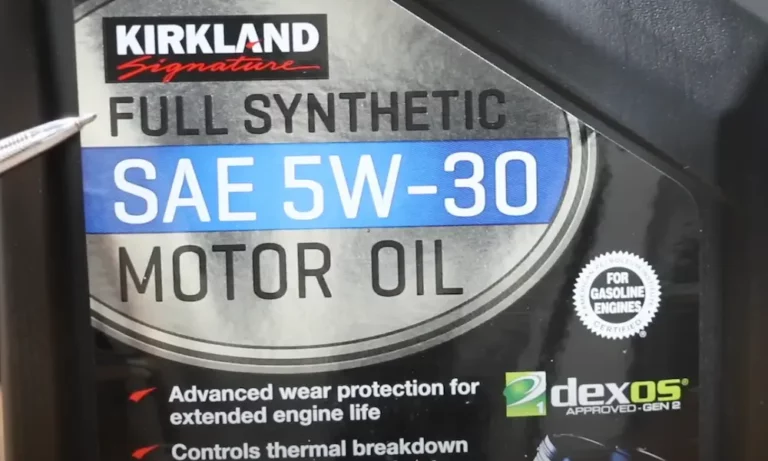
Kirkland Signature motor oil carries API (American Petroleum Institute) certification with ratings including API SP/ILSAC GF-6A for newer formulations. If that sounds like alphabet soup, here’s what it means in plain English: your oil meets the latest industry standards for protecting modern engines.
The oil also meets GM’s DEXOS 1 specifications, which is considered one of the more stringent standards in the industry. General Motors doesn’t hand out DEXOS certification to just anyone—your oil needs to pass serious performance testing.
According to testing by the Petroleum Quality Institute of America (PQIA), Kirkland motor oil meets SAE J300 specifications for its labeled viscosity grades. The oil contains appropriate levels of:
- Detergent additives (calcium and magnesium) that keep engines clean
- Anti-wear additives (zinc and phosphorus) that protect metal surfaces
- Viscosity modifiers that maintain proper flow across temperature ranges
These aren’t marketing buzzwords—they’re the actual ingredients that determine whether your oil protects your engine or leaves it vulnerable to wear.
How Kirkland Stacks Up Against Premium Brands
Independent testing tells a story that might surprise you. Project Farm’s comprehensive testing showed that Kirkland motor oil performs nearly identically to Walmart’s Super Tech oil in rigorous tests measuring evaporation loss, cold temperature flow, film strength, and other critical parameters.
Why do they perform so similarly? Because Warren Distribution manufactures both oils using very similar formulations. You’re essentially getting the same product in different bottles.
But what about comparisons to the big names? Blackstone Labs testing on vehicles using Kirkland motor oil demonstrated excellent wear protection and additive retention even after extended drain intervals of 10,000 miles. The testing showed that Kirkland oil:
- Maintained proper viscosity throughout the drain interval
- Had adequate remaining additive packages
- Provided effective engine protection comparable to premium brands like Mobil 1
Here’s a comparison of key performance metrics:
| Performance Metric | Kirkland 5W-30 | Mobil 1 5W-30 | Industry Standard |
|---|---|---|---|
| Viscosity at 100°C | 11.6 cSt | 11.2 cSt | 9.3-12.5 cSt |
| Zinc Content (ZDDP) | 870 ppm | 868 ppm | 600-1000 ppm |
| Total Base Number | 7.9 mg KOH/g | 7.8 mg KOH/g | 6.0+ mg KOH/g |
| Flash Point | 230°C+ | 232°C | 200°C+ |
| Pour Point | -40°C | -42°C | -35°C or lower |
The numbers don’t lie—Kirkland oil holds its own against premium competitors in lab testing.
The Real Cost Savings
At approximately $24.39 for a 5-quart container (often less during Costco promotions), Kirkland oil offers significant cost savings compared to premium brands. This works out to about $4.88 per quart versus $8-12 per quart for name brands.
Why can Costco sell it so cheap? Two reasons:
Bulk purchasing power: Costco leverages massive volume purchases from Warren Distribution, negotiating prices that smaller retailers can’t match.
No marketing overhead: While Mobil 1 and Pennzoil spend millions on NASCAR sponsorships and TV commercials, Kirkland relies on Costco’s reputation and word-of-mouth. You’re not paying for Super Bowl ads—you’re just buying oil.
Here’s what the savings look like for a typical driver:
| Brand | 5-Quart Price | Annual Cost (3 changes) | 5-Year Total |
|---|---|---|---|
| Kirkland | $24.39 | $73.17 | $365.85 |
| Mobil 1 | $42.99 | $128.97 | $644.85 |
| Pennzoil Platinum | $44.99 | $134.97 | $674.85 |
| Savings vs. Mobil 1 | $18.60 | $55.80 | $279.00 |
For a two-car household, you’re looking at over $500 in savings over five years. That’s not pocket change.
Available Viscosity Grades and Limitations
Kirkland Signature motor oil comes in three viscosity grades: 0W-20, 5W-20, and 5W-30. These cover most modern gasoline engines, but there’s a catch—this limited selection won’t work for every vehicle.
What’s covered: Most Japanese vehicles (Toyota, Honda, Nissan, Mazda), many domestic cars and trucks, and some European vehicles requiring these specific grades.
What’s not covered:
- Vehicles requiring 0W-16 (newer Hondas and Toyotas)
- High-performance applications needing 0W-40 or 5W-40
- Diesel engines requiring specialized formulations
- European luxury vehicles with manufacturer-specific approvals
The oil is formulated as 100% synthetic with advanced wear protection and helps prevent low-speed pre-ignition (LSPI) in modern turbocharged engines. LSPI is a destructive phenomenon in direct-injection turbocharged engines that can cause catastrophic engine damage—so this protection matters.
Who Should Use Kirkland Motor Oil
Kirkland oil is particularly well-suited for:
Daily commuter vehicles: If you’re driving a Camry, Accord, F-150, or Silverado with regular maintenance intervals, Kirkland delivers excellent protection at a fraction of the cost.
High-mileage drivers: When you’re changing oil frequently due to high annual mileage, the cost savings add up quickly without sacrificing protection.
Older vehicles: For cars with 100,000+ miles that don’t require specialized formulations, Kirkland provides solid protection at budget-friendly prices.
Budget-conscious car owners: If you maintain regular oil change schedules (every 5,000-7,500 miles) and want to reduce maintenance costs, Kirkland makes financial sense.
Who Should Think Twice
Kirkland oil might not be the optimal choice for:
High-performance engines: Track cars, heavily modified engines, or vehicles operating under extreme conditions may benefit from premium oils with more robust additive packages.
Luxury vehicles with specific requirements: European manufacturers often specify oils meeting proprietary standards (BMW LL-04, Mercedes-Benz 229.5, VW 502.00). Kirkland doesn’t carry these certifications.
Extended drain intervals: While Kirkland performs well at standard intervals, if you’re stretching changes beyond 7,500 miles, premium oils with extended-life formulations might provide better protection margins.
Diesel applications: Kirkland’s current lineup focuses on gasoline engines. Diesel owners need oils with different additive packages.
Expert Opinions and Real-World Feedback
Automotive professionals generally regard Kirkland motor oil as a quality product that provides adequate protection for most gasoline engines when changed at appropriate intervals. The consensus is clear: while it may not offer the advanced formulations or extended drain capabilities of top-tier synthetic oils, it represents excellent value for cost-conscious consumers who maintain regular oil change schedules.
Real-world user experiences across automotive forums and communities reveal predominantly positive feedback:
High-mileage success stories: Multiple users report trouble-free operation in vehicles exceeding 150,000-250,000 miles with no increase in oil consumption or engine noise.
Fleet applications: Commercial users have reported cost savings exceeding 60% compared to premium brands without observed performance degradation.
Daily driver satisfaction: Consistent positive feedback from users conducting 5,000-7,500 mile oil change intervals, with used oil analyses confirming excellent remaining condition.
Some mechanics express reservations about using Kirkland in high-stress applications like sustained highway towing or track use, but these concerns apply to most budget oils—not specifically to quality issues with Kirkland.
The Warren Advantage: Consistency Matters
One underappreciated aspect of Warren Distribution’s manufacturing is batch-to-batch consistency. When you buy Kirkland oil today and again in six months, you’re getting the same formulation from the same manufacturer using the same processes.
This consistency matters because:
Predictable performance: You know what you’re getting every time, eliminating the wild variations sometimes seen with smaller manufacturers.
Reliable testing results: Independent oil analyses remain consistent across different production batches, confirming quality control standards.
Supply chain reliability: Warren’s extensive distribution network means Costco locations stay stocked, unlike some boutique oil brands with availability issues.
Making the Smart Choice for Your Engine
So who makes Kirkland motor oil? Warren Distribution—a century-old manufacturer with the scale, expertise, and certifications to produce quality lubricants at competitive prices. They’re supplying the same oil to multiple major retailers, and independent testing confirms it performs on par with premium brands in standard applications.
For most drivers with mainstream vehicles, Kirkland Signature motor oil delivers premium protection without the premium price tag. You’re not compromising on quality—you’re just refusing to pay for marketing budgets and brand names that don’t improve what’s actually protecting your engine.
The key is knowing whether your vehicle falls within Kirkland’s sweet spot. Check your owner’s manual for the required viscosity grade and specifications. If Kirkland matches what your manufacturer recommends, you’ve found a budget-friendly option backed by a reputable manufacturer.
Your engine doesn’t care about brand names or slick marketing campaigns. It cares about proper lubrication, adequate additive packages, and regular maintenance intervals. Kirkland oil, manufactured by Warren Distribution, delivers all three at a price that won’t drain your wallet.