You’ve probably heard conflicting advice about protecting your car’s paint. Your buddy swears by ceramic coating, the dealer pushes PPF, and now you’re stuck wondering which one’s worth your money. Here’s the truth: they’re different tools for different jobs. By the end of this, you’ll know exactly which makes sense for your car and wallet.
What’s the Real Difference Between Ceramic Coating and PPF?
Let’s cut through the marketing noise.
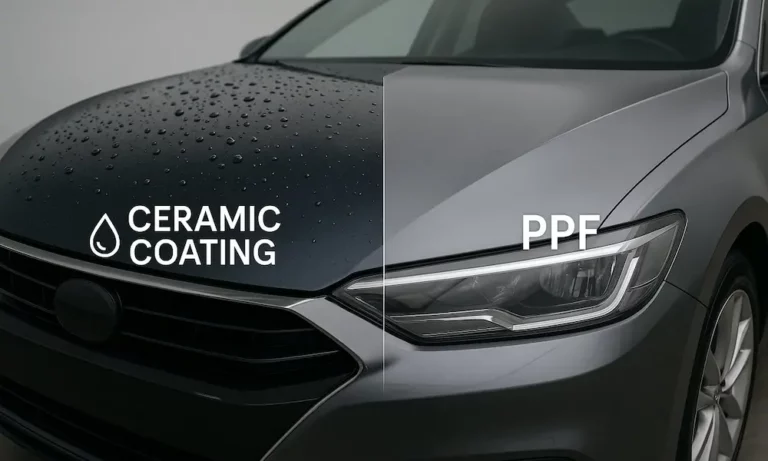
Paint Protection Film (PPF) is a thick, clear plastic shield—think of it like a phone screen protector for your car. It’s typically 8-10 mils thick (that’s over 200 microns), made from thermoplastic polyurethane. When a rock hits your bumper at highway speed, the film absorbs the impact and saves your paint.
Ceramic coating is liquid nanotechnology. You wipe it on, it chemically bonds to your clear coat, and forms a glass-like layer about 2 microns thin—roughly 100 times thinner than PPF. It won’t stop a rock chip, but it makes your car incredibly easy to clean and protects against chemical damage.
The bottom line: PPF is physical armor. Ceramic coating is chemical armor. They don’t compete—they complement.
How PPF Actually Works (The Science Made Simple)
Modern PPF uses aliphatic thermoplastic polyurethane. Don’t let the fancy name intimidate you—here’s what matters.
Early PPF yellowed within two years because it used aromatic chemistry that broke down under UV light. Modern aliphatic formulas don’t have that problem. That’s why premium brands like XPEL and 3M now offer 10-year warranties against yellowing.
The film has a molecular structure with “soft” and “hard” segments. The soft parts give it flexibility. The hard parts provide toughness. When a rock hits, the film stretches and absorbs energy instead of cracking like paint would.
The Self-Healing Thing Actually Works
Here’s the cool part: minor scratches disappear with heat.
The top layer is a specialized polymer that’s always trying to return to its smoothest state. When you scratch it, you’re just displacing the molecules temporarily. Add heat (from the sun, hot water, or a heat gun), and the molecules slide back into place.
But there’s a catch. Research shows the healing ability degrades with repeated cycles in the same spot—dropping from 99% effectiveness to about 62% after five healing cycles. And if the scratch cuts through the top coat into the base layer, it’s permanent.
How Ceramic Coating Actually Works
Ceramic coatings are silicon dioxide (SiO2) suspended in a liquid carrier. When you apply it, the solvent evaporates and triggers a chemical reaction.
The coating forms covalent bonds with your clear coat—that means it’s chemically locked on, not just sitting on top like wax. The result is a super-hard, super-smooth surface that water can’t stick to.
You’ll see contact angles over 100 degrees, which means water beads up tight and rolls off, carrying dirt with it. That’s why coated cars stay cleaner longer and wash easier.
What Ceramic Coating Actually Protects Against
Ceramic coating excels at chemical defense:
- Bird droppings and bug splatter: These are highly acidic. On bare paint, they can etch permanently within hours. Ceramic coating resists acid penetration, buying you time to clean it off.
- UV oxidation: The coating blocks UV rays from degrading your clear coat, preventing that chalky, faded look old cars get.
- Water spots: The slick surface makes it harder for minerals to bond when water evaporates.
But let’s be clear: ceramic coating adds virtually zero impact resistance. A rock will chip right through it.
Ceramic Coating vs PPF: Performance Head-to-Head
Here’s how they stack up on what actually matters:
| What You’re Protecting Against | Paint Protection Film (PPF) | Ceramic Coating |
|---|---|---|
| Rock chips and road debris | Excellent—absorbs impact | Zero protection |
| Scratches from brushes/keys | Self-healing on minor scratches | Resists light marring only |
| Chemical etching (bird poop, bugs) | Good resistance | Excellent resistance |
| UV fading | Excellent (blocks UV) | Excellent (blocks UV) |
| Water beading/ease of cleaning | Moderate (unless top-coated) | Outstanding |
| Thickness added to paint | 200+ microns | 1-2 microns |
| Lifespan | 5-10 years | 2-5 years |
The thickness difference tells the whole story. PPF is thick enough to physically block damage. Ceramic coating is so thin it only changes surface chemistry.
The Real Cost Breakdown (2025 Prices)
Let’s talk money. PPF is expensive because the material costs a fortune and installation is brutally labor-intensive.
Paint Protection Film Costs
A 100-foot roll of quality PPF costs shops $1,500-$1,600. Installation requires a dust-free room and skilled techs who can stretch 2D film over 3D curves without creating bubbles or stretch marks. A full vehicle wrap can take 4-5 days.
Real-world PPF pricing:
- Front bumper only: $900-$1,500
- Full front (bumper, hood, fenders, mirrors): $1,800-$3,000
- Full vehicle: $5,000-$9,000+
The wide range reflects quality. High-end shops disassemble parts (lights, handles) to wrap edges completely. Budget shops use pre-cut kits that stop short of edges, leaving visible lines.
Ceramic Coating Costs
The liquid itself is cheap—maybe $100-$200 per bottle. What you’re paying for is the prep work. Ceramic coating locks in whatever condition your paint is in. That means pros spend hours doing paint correction (removing swirls and scratches) before coating.
Real-world ceramic coating pricing:
- Entry-level (minimal prep): $500-$800
- Mid-tier (light correction): $1,000-$1,500
- Premium (full correction): $1,500-$3,000
Should You DIY or Go Professional?
DIY Ceramic Coating: Possible But Risky
Consumer ceramic kits run $50-$150. You can do it yourself if you’re meticulous, but here’s the risk: if you apply it unevenly, you’ll get dark “high spots” that cure into the paint. Removing them requires wet sanding—which you probably don’t want to attempt.
Professional-grade coatings flash (cure) too fast for amateurs to handle. They’re not sold to consumers for good reason.
DIY PPF: Don’t
Unless you’re wrapping something flat like door handles, DIY PPF is a bad idea. You’ll trap dust, create bubbles, or stretch the film until it fails. The margin for error is razor-thin.
The Hybrid Approach: PPF Plus Ceramic Coating
Here’s what smart car owners do: combine both technologies strategically.
Apply PPF to high-impact zones (front bumper, hood, fenders, mirrors) where rock chips happen. Then ceramic coat the entire car, including over the PPF.
Why does this work? The ceramic coating enhances the PPF’s water-shedding properties and chemical resistance. And don’t worry—research confirms ceramic coating doesn’t interfere with PPF’s self-healing. The ceramic layer is too thin to prevent the thicker TPU from doing its thermal recovery thing.
Some manufacturers now offer PPF with ceramic properties baked in (like XPEL Ultimate Fusion). These save you a step, but dedicated ceramic coating over standard PPF might still offer better longevity.
Maintenance: What You’re Actually Signing Up For
Neither option is “install and forget.” Here’s what ongoing care looks like.
PPF Maintenance
- Curing period: Don’t wash for 7-14 days after install
- Washing: Use pH-neutral soap. Avoid automatic car washes with brushes—they can catch edges and cause peeling
- Pressure washing: Keep the nozzle 12-18 inches from edges to prevent water intrusion under the film
- Chemical restrictions: No petroleum-based bug removers, no harsh solvents, no abrasive polishes
Ceramic Coating Maintenance
- Curing period: Don’t wash for 7-14 days
- Washing: Same pH-neutral soap requirement. Touchless washes are safer than friction washes
- Annual inspections: Many “lifetime” warranties require annual paid inspections ($100-$300) where they decontaminate and apply a booster. Skip it, void the warranty
Warranty Reality Check
PPF warranties from XPEL, 3M, and SunTek typically cover 10 years against yellowing, cracking, and delamination. They’ll even cover labor costs for replacement if the failure is a material defect.
Ceramic coating “lifetime” warranties are trickier. They usually require annual maintenance visits. It’s more like a service contract than a true warranty.
Does This Stuff Affect Resale Value?
It depends on what you’re driving.
For normal daily drivers, don’t expect dollar-for-dollar ROI. A $5,000 PPF job on a Honda won’t add $5,000 to resale. But it might help you sell faster or avoid a “Fair” condition rating.
For luxury and exotic cars, original paint is sacred. A repainted panel tanks value. PPF preserves factory paint status, which matters when you’re selling a Porsche or Ferrari.
For leased vehicles, full PPF is usually overkill. You’re protecting an asset you’ll return in three years. Basic front coverage or ceramic coating makes more sense to avoid excess wear charges.
Insurance and Claims: The Fine Print
Here’s something most people don’t know: standard auto insurance typically doesn’t cover aftermarket protection.
If you get in an accident and have $6,000 worth of PPF, your insurer might only pay to repaint the panels—not replace the film. You need a specific “custom equipment” or “aftermarket parts” rider.
Some insurers offer cashless accidental coverage for PPF, but you must declare it upfront. If the other driver is at fault, include PPF replacement costs in your claim against their insurance.
Matte PPF: The Game-Changing Option
Want to completely transform your car’s look while protecting it? Matte PPF (like XPEL Stealth) turns glossy paint into a satin finish.
This is genius for one reason: factory matte paint is a maintenance nightmare. You can’t polish it to remove scratches—polishing creates glossy spots. With matte PPF over gloss paint, you get the matte look with normal maintenance. If the film scratches, it self-heals or you replace it.
The catch? Installation costs more because every edge must be perfectly tucked. Any exposed gloss paint ruins the effect.
Which One Should You Actually Get?
Stop thinking “either/or.” Think about your real-world needs.
Get ceramic coating if:
- You want easier washing and sick water beading
- You park outside and need UV/chemical protection
- Your budget is $1,000-$2,000
- You don’t do much highway driving
- You’re okay with rock chips happening eventually
Get PPF if:
- You commute on highways with lots of debris
- You own a high-value vehicle where paint condition matters
- You have soft paint (Tesla, Subaru, some BMWs)
- You can budget $2,000-$8,000
- You want physical scratch and chip protection
Do both if:
- You want maximum protection
- You drive an expensive car you plan to keep long-term
- Your budget allows it
The smart hybrid: PPF on the front clip (bumper, hood, fenders, mirrors) plus ceramic coating over the whole car. You get impact protection where it matters and easy maintenance everywhere.
Don’t let dealers pressure you into packages you don’t need. If you’re leasing a Camry, skip the $7,000 full PPF. If you’re buying a 911 you’ll own for 10 years, it’s probably worth it.
The best protection is the one that matches your actual driving habits and budget—not the one with the flashiest marketing.