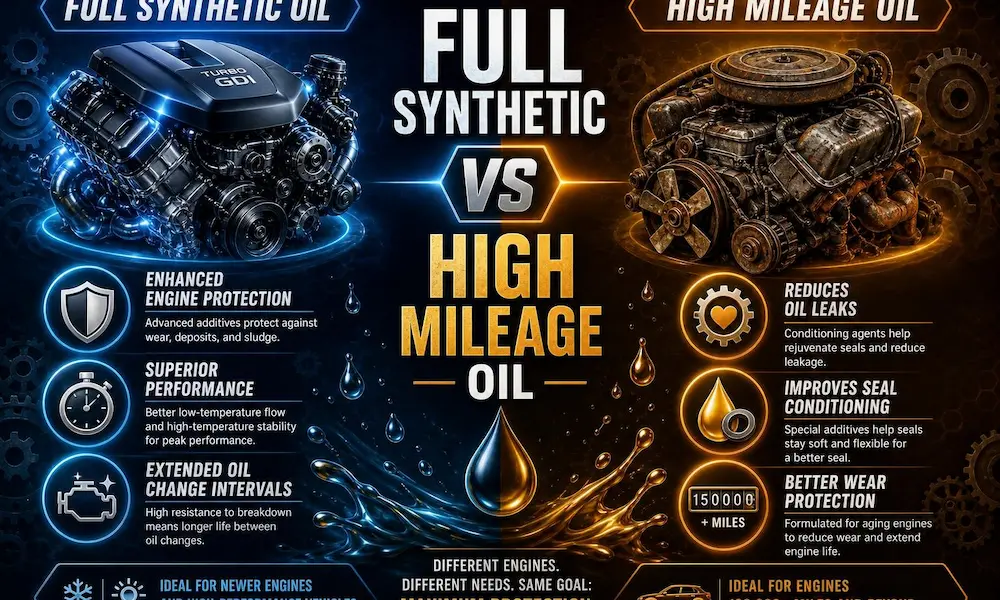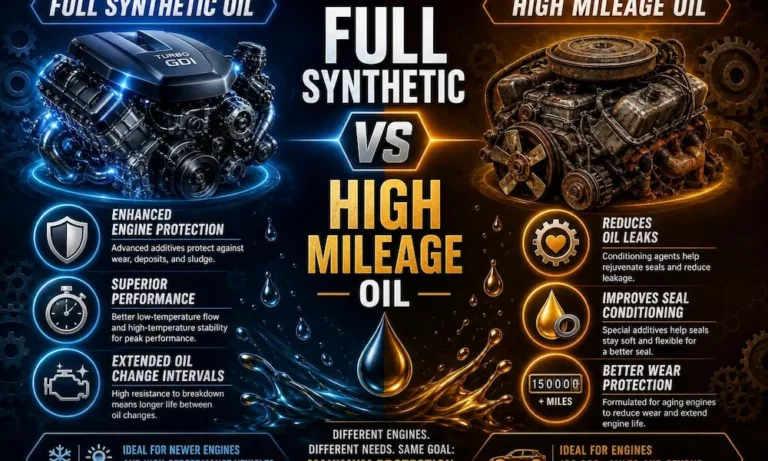
Picking the wrong motor oil won’t blow up your engine overnight — but it can quietly cost you thousands over time. Whether your car’s fresh off the lot or pushing 150,000 miles, the full synthetic vs high mileage debate matters more than most people think. Stick around, and you’ll know exactly which oil fits your engine before your next oil change.
What’s Actually in Your Motor Oil?
Before you choose between full synthetic vs high mileage oil, you need to know what you’re buying. Motor oil isn’t just oil — it’s a blend of base stocks and additives carefully engineered for specific jobs.
The American Petroleum Institute classifies base oils into five groups. Groups I through III come from refined petroleum. Groups IV and V get chemically engineered from scratch.
Here’s how they stack up:
| Base Oil Group | How It’s Made | Best Used For |
|---|---|---|
| Group I | Solvent-refined petroleum | Budget conventional oils |
| Group II | Hydro-cracked petroleum | Standard conventional oils |
| Group III | Severely hydro-cracked | Premium blends, some “synthetics” |
| Group IV (PAOs) | Chemical synthesis | High-end full synthetics |
| Group V (Esters) | Specialty synthesis | Racing additives, specialty oils |
Full synthetic oils use Group IV or V base stocks. High mileage oils can use any group, but they always pack a heavier additive package designed specifically for older engines.
Full Synthetic Oil: What It Does and Why It Matters
Full synthetic oil gets engineered at the molecular level. Instead of filtering impurities out of crude oil, chemists build the molecules from scratch. That means no sulfur, no paraffin wax, no nitrogen — none of the garbage that turns into sludge inside your engine.
The result? Every molecule is nearly identical in size and shape. They slide over each other cleanly, reduce internal friction, and create a consistent protective film even under intense pressure.
Cold Starts and Extreme Heat
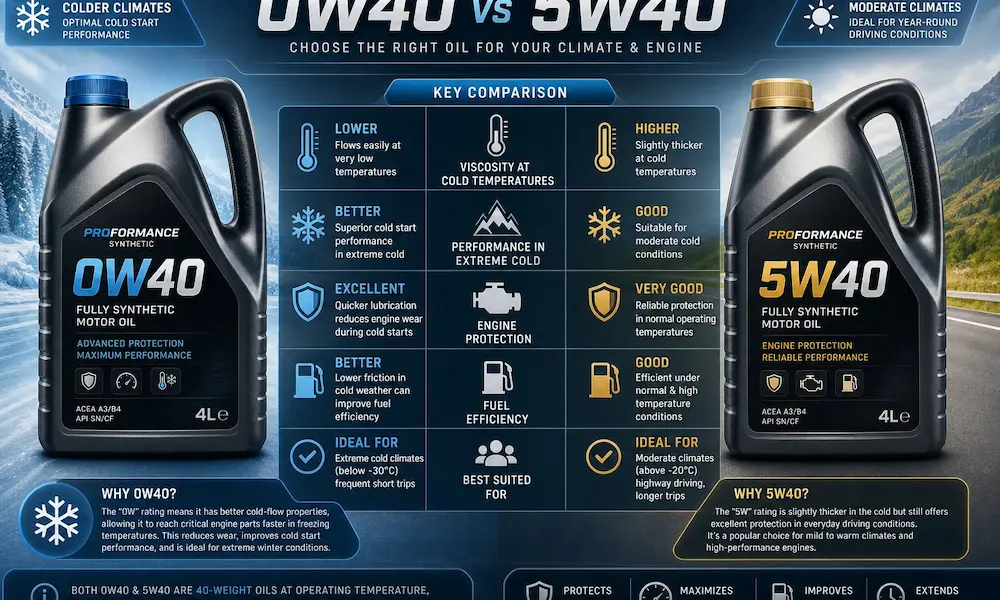
Cold starts kill engines. When temperatures drop, conventional oil thickens and moves slowly. Your oil pump struggles to push it to the top of the engine in those first critical seconds. Most engine wear happens right there, before the oil reaches moving parts.
Full synthetic stays fluid at much lower temperatures, so it flows faster on startup and protects your engine when it’s most vulnerable.
On the flip side, conventional oil can start to oxidize and break down in extreme heat — like towing in Arizona summer traffic. Full synthetic resists breakdown at temperatures above 400°F, which makes it essential for protecting turbocharger bearings that spin at over 200,000 RPM.
Extended Oil Change Intervals
Full synthetic oil typically lasts 7,500 to 15,000 miles between changes. Conventional oil maxes out around 5,000. That’s a big difference in how often you’re booking service appointments.
Yes, a synthetic oil change costs more upfront — sometimes 60% more than conventional. But fewer changes per year means you often come out ahead on total cost.
| Performance Metric | Full Synthetic Advantage |
|---|---|
| Wear protection | 47% better than conventional |
| Drain interval | 2x to 3x longer |
| Fuel efficiency improvement | 8% to 15% |
| Engine sludge reduction | 40% less buildup |
AAA research confirmed synthetic oils perform nearly 50% better than conventional oils in lab tests for deposit formation and oxidation resistance. Still, about 45% of American drivers remain skeptical — usually because of myths or the higher price tag at the counter.
High Mileage Oil: What It Does and Why Older Engines Need It
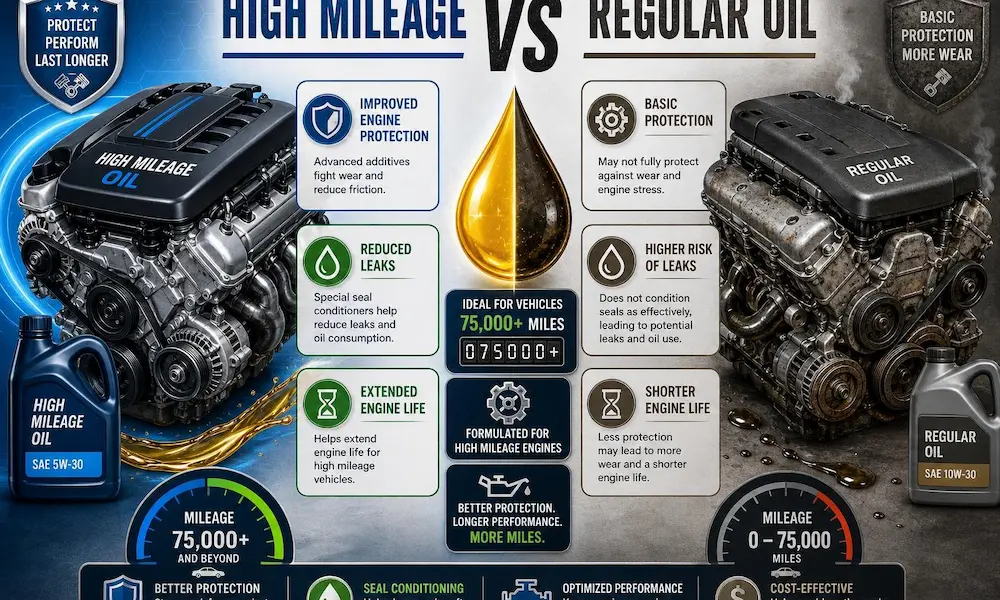
High mileage oil isn’t just regular oil with fancy branding. It’s a specialized formulation built for the specific problems that come with age — shrinking seals, wider gaps between moving parts, and increased oil consumption.
The 75,000-Mile Benchmark
Most manufacturers and mechanics point to 75,000 miles as the threshold for switching to high mileage oil. That’s not a hard rule — it’s a general benchmark based on average wear patterns.
A city-driven car with lots of stop-and-go traffic might show aging symptoms at 60,000 miles. A highway-commuter vehicle could stay “young” past 100,000. Your driving history matters more than just the odometer number.
The goal of high mileage oil isn’t performance gains. It’s stability — keeping an aging engine sealed, clean, and protected as it racks up more miles.
Seal Conditioners: The Real Reason to Switch
The most important ingredient in high mileage oil is the seal conditioner. Over hundreds of heat cycles, rubber seals and gaskets lose their plasticizers. They shrink, harden, and start seeping oil.
Seal conditioners penetrate those elastomers and cause them to swell slightly and regain elasticity. That stops minor leaks and prevents new ones from forming — which protects your oil pressure and keeps oil away from components like your alternator or serpentine belt.
They can’t fix a torn gasket or a blown rear main seal. But for the slow, age-related seepage most older engines develop, they work well.
Tackling Oil Consumption
Burning oil is a common complaint in older engines. Oil slips past worn piston rings or dried-out valve guide seals and burns off in the combustion chamber. You end up topping off between changes and dealing with blue exhaust smoke.
High mileage oils use specialized viscosity modifiers and sometimes slightly thicker base stocks to bridge the larger gaps that worn parts create. Industry data shows high mileage formulations can reduce oil consumption by up to 35% in engines with significant internal wear.
Less burning oil also means less carbon buildup on your valves and a healthier catalytic converter — a win-win for emissions and engine longevity.
Full Synthetic vs High Mileage: Head-to-Head Comparison
Here’s where it gets practical. You need to match the oil to your engine’s actual condition — not just the mileage number.
| Maintenance Factor | Full Synthetic | High Mileage |
|---|---|---|
| Per-change cost | $75 – $100 | $50 – $80 |
| Changes per 15,000 miles | 1 to 2 | 3 to 5 |
| Seal leak reduction | Standard protection | Up to 60% reduction |
| Engine life extension | High performance | Up to 35% extension |
| Best for | Efficiency and peak power | Minimizing repair costs |
One important thing to know about full synthetic in very old engines: it can sometimes be too good. Synthetic oil’s powerful detergents can dissolve sludge that’s been acting as an accidental seal in neglected engines. When that sludge disappears, pre-existing leaks reveal themselves. That’s where the myth that “synthetic causes leaks” comes from — it doesn’t cause them, it exposes them.
High mileage oil, especially a conventional or synthetic blend version, is more forgiving in these situations. The seal conditioners counteract the cleaning effect and keep everything sealed.
The Best-of-Both-Worlds Option
If your vehicle sits in that 75,000 to 120,000 mile window and you’re not sure which way to go, consider a full synthetic high mileage oil. It combines the thermal stability and cold-start flow of a synthetic base with the seal conditioners and heavy-duty detergents of a high mileage formula. You get protection on both fronts without compromise.
How to Read Your Engine’s Warning Signs
Your engine tells you which oil it needs — you just have to pay attention.
Signs you should switch to high mileage oil:
- Oil stains or drips on your driveway
- A faint burning oil smell after driving
- Blue-tinted smoke from the exhaust, especially at startup
- Unusual engine noise or rattling
- Needing to add more than a quart of oil every 2,000 miles
Signs you should stay with full synthetic:
- Engine is under 75,000 miles
- You have a turbocharged engine
- You drive in extreme heat or cold
- No leaks, no burning oil, no unusual noises
- The engine has been on synthetic oil since new
The DIY Dipstick Check
Check your oil level once a month on a cold engine, parked on a flat surface. Track how much you’re adding between changes. If you’re consistently topping off, that pattern tells you more than any mileage number.
You can also try the blotter spot test: drop a bit of used oil on cardstock and let it sit for a few hours. A dark center with a clear outer ring means your dispersants are doing their job. A solid, greasy dark spot means the oil is saturated — change it now.
During every oil change, look at the underside of your engine. Widespread dampness around the valve cover, timing cover, or oil pan gasket signals hardening seals. That’s your cue to move to a high mileage formula with seal conditioners at the next service.
What It Costs to Get This Wrong
Ignoring these signals isn’t just inconvenient — it’s expensive. A single gasket replacement in the US can run between $800 and $2,000 depending on your engine’s complexity.
The slightly higher cost of the right oil — whether that’s full synthetic or high mileage — pays for itself many times over when it keeps you out of the repair shop.
Average US vehicles now exceed 12 years of age. With vehicle replacement costs higher than ever, keeping your current engine healthy with the right lubricant isn’t just smart maintenance — it’s the most cost-effective thing you can do for your budget.
The choice between full synthetic vs high mileage oil doesn’t need to feel complicated. Check your mileage, look for the warning signs, and match the oil to where your engine actually is — not where you wish it was.