Picking the wrong engine oil can quietly destroy your engine over time. The difference between 0W40 vs 5W40 might look like one number, but that number tells you a lot about cold starts, shear stability, and long-term wear protection. This guide breaks down exactly what separates these two oils — and which one your engine actually needs.
What Do Those Numbers Even Mean?
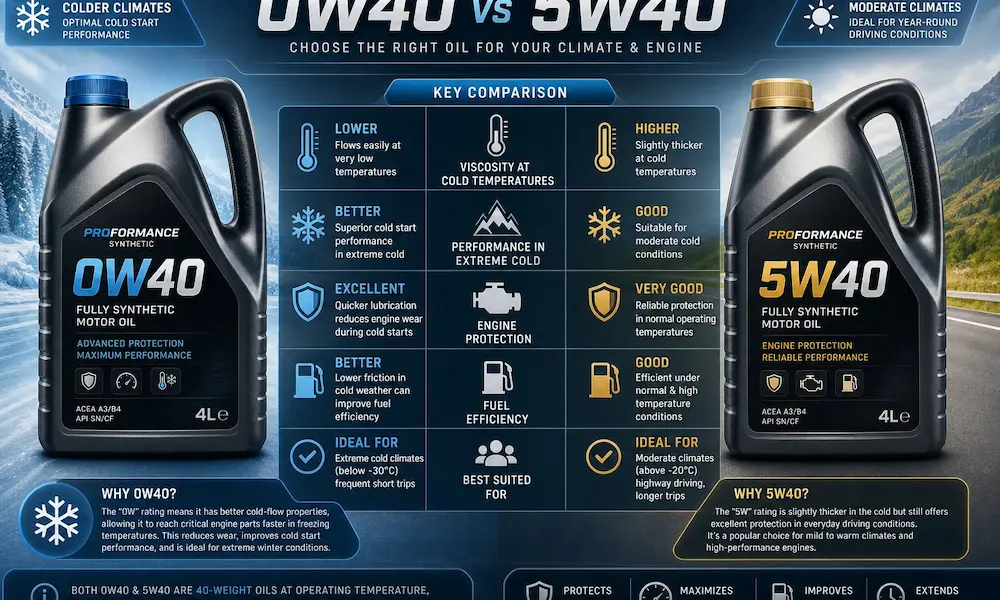
The “W” stands for Winter. The number before it tells you how the oil flows in cold temperatures. The number after tells you how thick it stays when your engine runs hot.
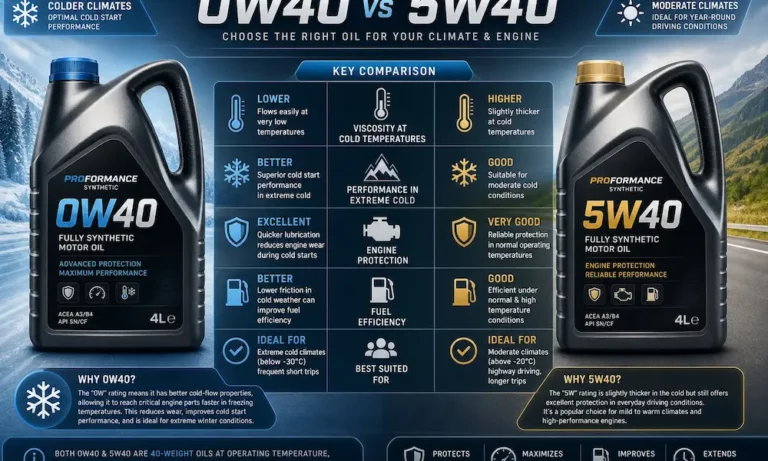
So 0W40 flows more easily in freezing temps than 5W40. But once your engine reaches normal operating temperature? Both oils behave like a 40-weight lubricant — they’re essentially identical in thickness at that point.
Here’s the quick breakdown from the SAE J300 viscosity classification system:
| Property | 0W40 | 5W40 |
|---|---|---|
| Max cold cranking viscosity | 6,200 mPa·s at -35°C | 6,600 mPa·s at -30°C |
| Max pumping viscosity | 60,000 mPa·s at -40°C | 60,000 mPa·s at -35°C |
| Kinematic viscosity at 100°C | 12.5–16.3 mm²/s | 12.5–16.3 mm²/s |
| Min HTHS viscosity at 150°C | 3.5 mPa·s | 3.5 mPa·s |
The cold-start gap matters most. A 0W40 pumps to your turbo bearings and valvetrain noticeably faster on a -20°F morning than a 5W40 does. That’s the window where most engine wear happens.
The Chemistry Difference Nobody Talks About
Both oils protect your engine at operating temperature. But they get there through very different chemistry — and that affects how long they stay effective.
0W40 Uses More Polymer Additives
To flow freely at -35°C and stay thick enough at 150°C, 0W40 starts with a very thin, low-viscosity synthetic base stock. Formulators then add a high concentration of viscosity index improvers — polymer chains that coil up in the cold and expand when hot to thicken the oil.
The problem? Those polymer chains break down over time under mechanical stress. This is called permanent shear degradation. Your oil gets permanently thinner as you rack up miles.
5W40 Starts Thicker and Stays Stronger
5W40 uses a heavier synthetic base stock from the start. It needs fewer polymer additives to hit the 40-weight target at operating temperature. Fewer polymers means less shear degradation over a 10,000-mile drain interval.
If you tow heavy loads, run track days, or push your engine hard in hot weather — 5W40 holds its protective film longer.
| Property | 0W40 | 5W40 |
|---|---|---|
| Base stock viscosity | Ultra-thin (Group III/IV synthetic) | Medium-thick synthetic |
| Viscosity index improver load | Very high | High |
| Shear degradation risk | Higher over long intervals | Lower, more stable |
| Best for | Cold climates, short trips | Heavy loads, warm climates, track use |
Cold Start Protection: Where 0W40 Wins
The first 10 seconds after you turn the key are the most dangerous for your engine. Oil hasn’t reached your turbocharger bearings or valvetrain yet. Metal touches metal. That’s where wear accumulates.
A 0W40 reaches critical engine components significantly faster during cold starts than a 5W40 — especially when temperatures drop below 0°F.
If you live in Minnesota, Wisconsin, or anywhere that sees brutal winters, 0W40 is worth the slight premium.
Short-trip drivers get an extra benefit too. Trips under 20 minutes rarely let the engine reach full operating temperature. That means water condensation and fuel dilution build up in the crankcase. A 0W40 with a high Total Base Number neutralizes the corrosive acids this creates before they eat your valvetrain.
Fuel Economy: Does It Actually Matter?
Honestly, the difference is small. At normal operating temperature, both oils behave identically in terms of viscous drag.
The gap only appears during warm-up. Because 0W40 is thinner during cold starts, it reduces parasitic drag on the crankshaft and oil pump during those first few minutes of driving. For someone doing mostly short city commutes, this adds up.
One interesting real-world example: the Ford 2.3L EcoBoost gets specified 5W-30 or 5W-50 in the US to meet Corporate Average Fuel Economy mandates. Ford specifies 0W40 or 5W40 for the exact same engine in Europe. Same hardware, different regulatory priorities. That tells you a lot about how much politics shapes oil recommendations.
European Import Vehicles: Which Grade Is Right?
If you drive a VW, Audi, BMW, Mercedes-Benz, or Porsche, viscosity alone doesn’t cut it. You need the right OEM approval stamped on the bottle.
European manufacturers design engines that run hotter and tighter than most domestic platforms. Their oil specs control Noack volatility, sulfated ash, phosphorus, and sulfur levels. These matter because high ash content clogs diesel particulate filters and poisons catalytic converters.
Here’s what to look for:
| OEM Specification | Brands Covered | Viscosity Grades |
|---|---|---|
| VW 502.00 / 505.00 | Volkswagen, Audi | 0W40, 5W40 |
| MB-Approval 229.5 | Mercedes-Benz | 0W40, 5W40 |
| BMW Longlife-01 | BMW, Mini | 0W40, 5W40 |
| Porsche A40 | Porsche | 0W40, 5W40 |
For VW Passat or Audi Q3 owners in cold northern states, 0W40 with the VW 502.00 approval is the smarter pick. In warmer climates like Texas or Arizona, a 5W40 with the same approval offers better shear stability year-round without the cold-start penalty mattering much.
High-Performance American Engines Have Their Own Rules
Dodge SRT Hellcat and Viper: Chrysler MS-12633
Chrysler’s SRT division doesn’t mess around. Supercharged engines in the Challenger Hellcat, Charger SRT, Grand Cherokee SRT, and Dodge Viper require a 0W40 meeting the Chrysler MS-12633 specification. Pennzoil Ultra Platinum 0W40 is the go-to product here, built from natural gas through a process that produces a 99.5% pure synthetic base oil with lower volatility and excellent cold flow down to -40°F.
Chevrolet Corvette: GM dexosR
GM developed the dexosR specification for dual-duty use — daily driving and high-speed track sessions. Mobil 1 Supercar 0W40 is the only dexosR-approved oil. It features advanced aeration control to stop oil foaming under extreme lateral G-forces and a low sulfated ash content of just 0.8%. Running anything else in a Corvette voids GM’s engineering intent.
Diesel Truck Owners: Don’t Confuse These Oils
If you own a Duramax, Cummins, or Powerstroke diesel, you need a completely different product category. A passenger car 5W40 is not a substitute for a heavy-duty diesel 5W40.
Heavy-duty diesel oils like Shell Rotella T6 5W40 carry API CK-4 or CJ-4 ratings. They pack higher concentrations of soot dispersants and around 1,200 ppm of zinc-based wear protection. These engines produce massive soot loads through EGR systems and operate under torque levels that would shred a passenger car formulation quickly.
Typical capacities: 10 quarts for the 6.6L Duramax, 12 quarts for the 6.7L Cummins, and 13 quarts for the 6.7L Powerstroke. Using the right API-rated diesel oil in winter gets critical oil pressure to your engine far faster than a 15W40 and cuts startup wear significantly.
What About Mixing 0W40 and 5W40?
You can do it. API guidelines confirm that all certified gasoline engine oils of the same API rating are compatible. Mixing equal parts gives you roughly a 2.5W40 — an intermediate viscosity with no chemical instability.
That said, mixing isn’t a substitute for choosing the right oil. You lose the specific OEM approvals of both products, and the resulting viscosity is harder to predict across extreme temperatures. It’s fine in a pinch, but don’t make it a habit.
Low-Speed Pre-Ignition: The Hidden Oil Chemistry Problem
Modern turbocharged gasoline direct injection engines face a nasty issue called Low-Speed Pre-Ignition (LSPI). This happens when tiny oil droplets enter the combustion chamber and ignite before the spark plug fires. The pressure spike can crack pistons and bend connecting rods.
Calcium-based detergents — common in older oil formulations — actually trigger LSPI events. Modern 0W40 and 5W40 formulations replace much of that calcium with magnesium-based detergents and add oil-soluble molybdenum complexes to suppress pre-ignition chemistry.
The API SP and ILSAC GF-6 specifications now mandate LSPI protection. Always look for these ratings on the bottle if you drive a modern turbocharged engine.
Quick Buying Guide: Which Oil for Which Situation
Choose 0W40 if:
- You live in a cold-winter state (think Minnesota, Michigan, Montana)
- You take lots of short trips under 20 minutes
- Your vehicle requires Chrysler MS-12633 or GM dexosR
- You drive a European import requiring the VW 502.00 or MB 229.5 approval
Choose 5W40 if:
- You live in a warm or mild climate
- You tow heavy trailers regularly
- You run track days or push your engine hard
- You want maximum shear stability over long drain intervals
- You own a diesel pickup needing API CK-4 certified oil
Top picks by use case:
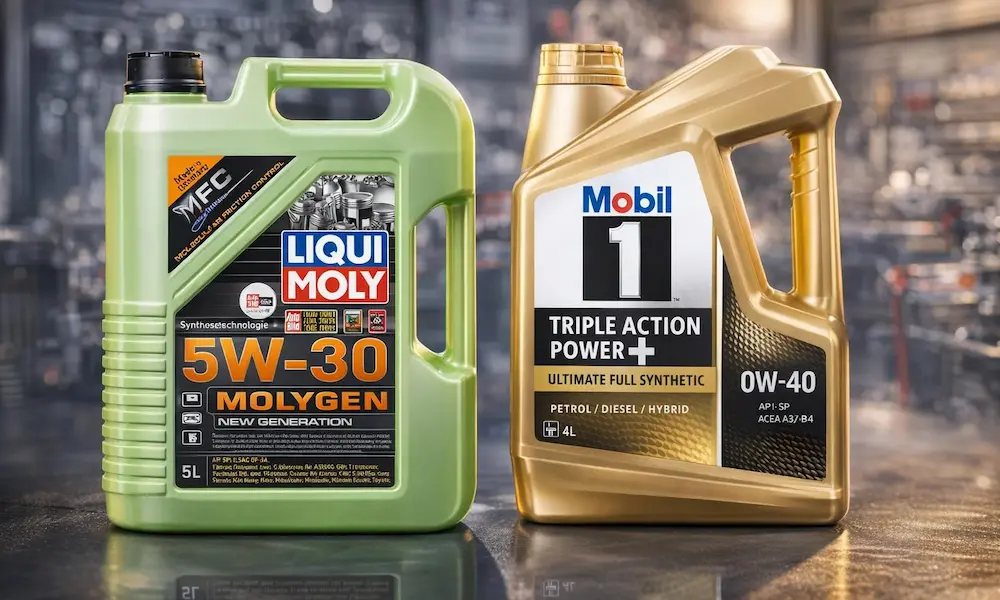
- European imports (cold climate): Mobil 1 FS European Car Formula 0W40
- European imports (warm climate): Castrol Edge 5W40 A3/B4 or Valvoline European Vehicle 5W40
- Dodge SRT engines: Pennzoil Ultra Platinum 0W40
- Chevrolet Corvette: Mobil 1 Supercar 0W40
- Diesel pickups: Shell Rotella T6 5W40
- Budget-friendly import owners: Valvoline European Vehicle 5W40 at $6–$8 per quart
Always check your owner’s manual first. Then verify the specific OEM approval on the bottle. A 0W40 without the right factory stamp is just an expensive mistake waiting to happen.