Got a nail in your tire and wondering if a patch will actually hold? You’re probably getting wildly different answers depending on who you ask. The truth is, how long a patched tire lasts depends on a handful of factors that most people never think about. Stick around — by the end of this post, you’ll know exactly what to expect from your repair.
The Short Answer: Up to 25,000 Miles (But There’s a Catch)
A properly patched tire can last seven to ten years or around 25,000 miles. That sounds great, right? But here’s the catch — that’s the maximum under ideal conditions.
In reality, most of the time a good patch will simply outlast the tire itself. The average tire hits its wear limit or age limit before the patch ever becomes the weak link. So if your tire is in decent shape and the repair is done correctly, you probably won’t think about that patch again.
The problem is when the repair isn’t done correctly. That’s when things get dicey.
The Only Repair That Actually Lasts: The Plug-Patch Combo
Not all tire repairs are equal. There are three common methods you’ll encounter:
- Plug only (the quick roadside fix)
- Patch only (applied to the inner liner)
- Plug-patch combination (also called a mushroom repair)
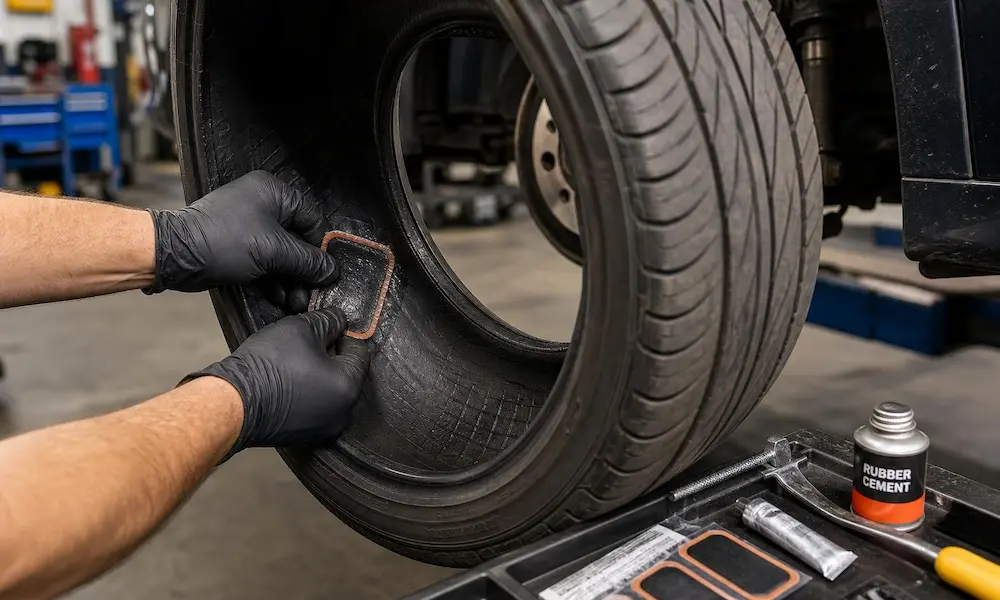
The plug-patch combination is the industry gold standard, and it’s the only method that qualifies as a permanent repair. Here’s why it works so well:
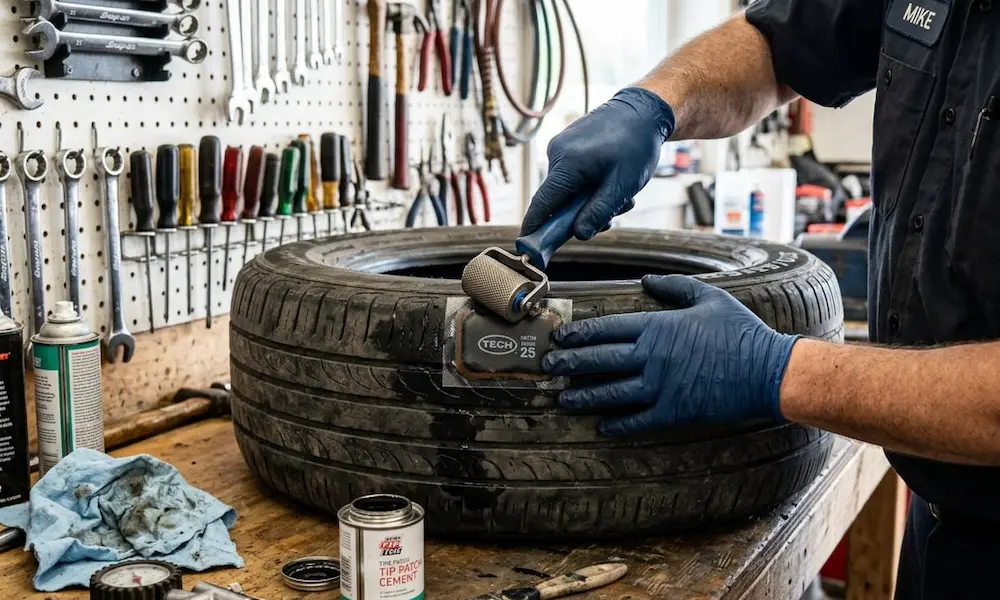
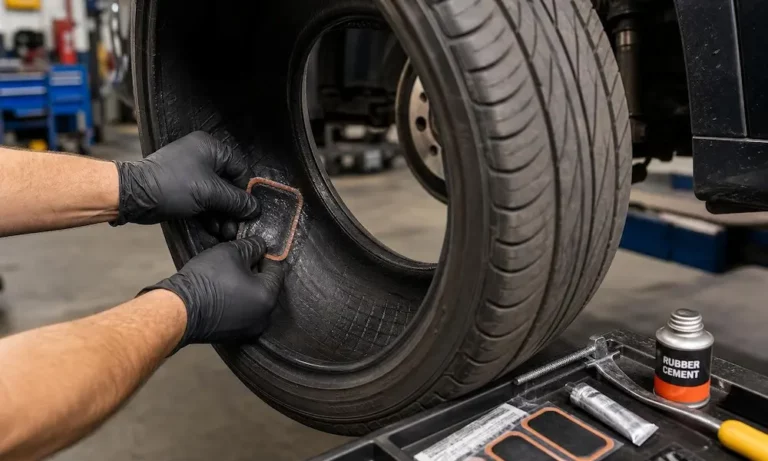
The rubber plug fills the puncture channel and protects the steel belts from moisture and road salt. If water reaches those severed steel cords, rust sets in and the tire starts delaminating from the inside. The vulcanized patch then bonds chemically to the inner liner, essentially fusing with the tire’s rubber. It’s not just stuck on — it becomes part of the tire.
A DIY plug kit? That’s a temporary fix. It relies on a mechanical fit and a sticky coating. Under highway heat and speed, those plugs are far more likely to fail under thermal stress, especially in summer.
| Repair Component | What It Does | Why It Matters for Longevity |
|---|---|---|
| Rubber Stem (Plug) | Fills the puncture void | Stops steel belt rust and oxidation |
| Vulcanized Patch | Seals the inner liner | Keeps air in and prevents delamination |
| Buffing Process | Preps the inner rubber surface | Creates a strong chemical bond |
| Stitching Tool | Removes air pockets | Eliminates weak spots in the bond |
Where the Nail Landed Matters More Than You Think
The location of the puncture is a make-or-break factor for how long a patched tire lasts. The Tire Industry Association is clear on this: only punctures in the center three-quarters of the tread are repairable.
Here’s the breakdown:
| Tire Zone | Location | Repairable? | Longevity Outlook |
|---|---|---|---|
| Crown (Tread) | Center 3/4 of tread surface | ✅ Yes | Can last the full tire life |
| Shoulder | Where tread meets sidewall | ❌ No | High risk of heat failure |
| Sidewall | Side surface of the tire | ❌ No | Structural failure likely |
| Bead | Where tire meets the rim | ❌ No | Mechanical seal can’t hold |
The sidewall flexes thousands of times per mile. A rigid patch simply can’t keep up with that movement. It will eventually delaminate — and that’s not a matter of “if” but “when.” Continental Tires and most major manufacturers agree: sidewall and shoulder punctures mean you need a new tire, full stop.
The Quarter-Inch Rule You Need to Know
Here’s a rule that applies everywhere in the US: if the puncture is bigger than one-quarter inch (6mm) in diameter, the tire can’t be safely repaired.
This isn’t just an arbitrary guideline. A hole larger than 6mm severs too many steel cords. Even if you seal the air leak, the structural damage remains. Over time, internal air pressure pushes against that weak spot and you get a bulge or bubble. That bubble is your tire telling you it’s done. A bulge is a precursor to a blowout — don’t ignore it.
Long gashes and irregular cuts also fall into the “no repair” category, even if they’re small in width. They disrupt the radial tension of the entire tire carcass.
What Happens When You Drive on a Flat Before Getting It Fixed
This one catches a lot of people off guard. You notice a slow leak, drive on it for a few days, and assume the shop can just patch it. But driving on an underinflated tire crushes the sidewalls between the rim and road, generating intense internal heat.
That heat destroys the inner liner — a condition called “marbling.” Technicians find rubber dust or charred rubber inside the tire once it’s pulled off the rim. The tire looks fine on the outside, but the inside is toast.
Patching a tire with internal heat damage is pointless. The patch won’t hold, and a sidewall blowout becomes a real possibility. This is exactly why a proper repair always requires removing the tire from the wheel for a full internal inspection — no exceptions.
Speed, Heat, and Your Patched Tire
Heat is the enemy of any tire repair. When you drive at highway speeds — 70 to 80 mph is common across the US — your tires flex thousands of times per minute. That flexing generates heat through internal friction. If your patch wasn’t bonded with a perfect vulcanized seal, that heat will eventually cause the adhesive to fail.
Hot climates make this worse. If you’re in the Southwest and your car sits in the sun all day before a highway drive, your tire temperatures are already elevated before you leave the driveway. High ambient temperatures accelerate aging in both the rubber and the repair material.
| Operational Factor | Effect on the Patch | Impact on Lifespan |
|---|---|---|
| High-Speed Driving | More internal heat from friction | Speeds up bond degradation |
| Overloading | Excess sidewall flex | Stresses patch edges |
| Hot Climates | Higher baseline tire temp | Softens vulcanizing agents |
| Rough Terrain | Sharp repeated impacts | Can dislodge a poorly seated plug |
Does Your Tire Brand Affect the Repair?
Yes, actually. Your tire’s speed rating — that letter on the sidewall (H, V, W, Y) — tells you how fast the tire is designed to safely run. A puncture technically voids that rating because the structural integrity has changed.
Different manufacturers handle post-repair speed ratings very differently:
| Manufacturer | Speed Rating After Repair | Repair Limits |
|---|---|---|
| Michelin | Maintained | Max 3 repairs, min 90° apart |
| Goodyear | Maintained (H rating and above) | Max 1 repair for high rating |
| Bridgestone | Voided | Max 2 repairs, min 16 inches apart |
| Continental | Maintained | Repairs must not overlap |
| Firestone | Voided | Max 2 repairs, min 16 inches apart |
| Yokohama | Voided | Repairs must not overlap |
If your tire’s speed rating gets voided after a repair, driving at the tire’s original rated speed becomes unsafe. Always check your manufacturer’s guidelines — or ask the shop directly.
Can You Patch a Tire More Than Once?
Yes, but there are firm limits. Most industry guidelines cap repairs at two to three per tire, and the spacing matters just as much as the number. If two punctures are less than 16 inches apart (or within 90 degrees of each other around the tire’s circumference), the stress zones from both repairs overlap and the whole area becomes structurally compromised.
Each repair also adds a small amount of weight and stiffness, which can throw off your tire balance and accelerate uneven tread wear. Multiple patches don’t just affect the repair sites — they affect the tire’s overall performance.
How to Make Your Patched Tire Last as Long as Possible
Once you’ve got a proper repair, your job isn’t over. Here’s what actually extends the life of a patched tire:
Check your tire pressure monthly. A patched tire is more sensitive to pressure changes than an undamaged one. A microscopic leak from a weak bond leads to underinflation, which generates heat, which destroys the patch and eventually the tire. Set a reminder and check pressure every 30 days.
Don’t skip pressure checks in winter. Cold air contracts, so tire pressure drops naturally when temperatures fall. For patched tires, this cold-weather contraction can reveal a weak bond that held up fine all summer. Your TPMS light coming on in January might be pointing right at that repair.
Watch for bulges near the repair site. Run your hand around the tire periodically. Any lump, bubble, or visible deformity near the patch means the repair is failing. Get it inspected immediately.
Keep your alignment in check. Poor wheel alignment causes uneven wear that can put extra stress directly on the repair area. A vehicle alignment check every 12,000 miles is a simple way to protect your tires — patched or not.
The 10-Year Rule: When Age Beats Mileage
Here’s something worth knowing even if your patched tire looks and feels perfect: rubber degrades with age regardless of how much tread is left. Most tire manufacturers set a maximum lifespan of six to ten years from the date of manufacture — not the date of purchase.
You can find your tire’s birth date on the sidewall. Look for the DOT code — the last four digits tell you the week and year of manufacture. A tire made in the 15th week of 2017 shows “1517.”
Once a tire hits ten years old, replace it. It doesn’t matter how good the patch is or how much tread remains. The rubber itself becomes brittle and prone to cracking. No repair can reverse that.
Run-Flat Tires: A Different Story Entirely
Run-flat tires have reinforced sidewalls that let you drive up to 50 miles after a complete pressure loss. That sounds like a great feature — and it is — until you need a repair.
The heat generated during that “run-flat” period often destroys the internal structure, even if the tire looks intact from the outside. Most major retailers including Discount Tire advise against repairing a run-flat that’s been driven in a severely underinflated state. Some brands allow one repair if pressure never dropped below 15 psi, but in most cases, a run-flat tire that’s been driven flat needs replacement — not a patch.
Is a Patch Worth It Financially?
A professional plug-patch repair costs between $30 and $60. A new quality tire runs $150 to $400. The math is easy.
But that savings only makes sense if the repair is safe. A bad repair that fails at highway speed can cause thousands in vehicle damage, not to mention serious safety consequences. The cheapest option isn’t always the smart option — and sometimes, the shop refusing to patch your tire is doing you a genuine favor.
When the repair meets industry standards — puncture in the center tread zone, under 1/4 inch, no internal damage, done with a proper plug-patch combo — it’s absolutely worth it. When it doesn’t meet those standards, replacement is the only safe call.