Got a nail in your tire and wondering if Costco can fix it? The answer isn’t a simple yes or no — it depends on your membership, where you bought your tires, and the damage itself. Read to the end so you don’t waste a trip.
Yes, Costco Does Repair Tires — But There Are Conditions
Costco does repair tires, but not for everyone. You need an active Costco membership to access the tire center at all. No membership, no service — full stop.
Here’s where it gets interesting: if you bought your tires at Costco, flat repair is included for free as part of the Costco Advantage package. That’s a lifetime perk bundled into your original purchase.
If your tires came from somewhere else, many Costco locations will still patch them — but you’ll pay a nominal fee. That fee typically runs between $10.99 and $14.00, which is still well below the $20–$50 that most independent shops charge.
Just know that some locations tell members upfront that they only service Costco-purchased tires. It varies by location, so call ahead before you drive over.
What Costco Includes With Tire Purchases
Before diving into repair specifics, it helps to understand what you’re actually getting when you buy tires at Costco. The value is stacked.
| Service | Costco-Purchased Tires | Third-Party Tires |
|---|---|---|
| Flat Repair | Free (lifetime) | ~$10.99–$14.00 |
| Tire Rotation | Free (lifetime) | Not typically available |
| Nitrogen Inflation | Included | Included with repair |
| Road Hazard Warranty | 60-month coverage | No coverage |
| New Tire Installation | Available | Generally not permitted |
How Costco Decides If Your Tire Is Repairable
Costco follows the United States Tire Manufacturers Association (USTMA) repair standards — the same guidelines that serious tire professionals follow across the industry. These aren’t arbitrary rules. They exist because a bad repair at highway speeds can be fatal.
Here’s what Costco looks at before agreeing to fix your tire.
Location of the Damage
The puncture must sit in the tread face — the flat center section of your tire between the outer grooves. Costco won’t repair damage in the shoulder or sidewall. Those areas flex constantly while you drive, and a patch there won’t hold.
Size of the Puncture
The hole can’t be larger than 1/4 inch (6mm) in diameter. Anything bigger compromises the steel belts inside the tire. At that point, the tire needs to come off the road entirely.
Other Factors That Can Kill a Repair
Even if the size and location check out, Costco can still say no based on these:
| Constraint | Requirement |
|---|---|
| Tread Depth | Minimum 2/32 inch remaining |
| Tire Age | Generally 5–10 years max (manager’s call) |
| Prior Repairs | No overlapping repairs allowed |
| Puncture Angle | Maximum 25-degree entry angle |
| Internal Damage | No liner degradation or run-flat damage |
The Two-Piece Repair Method Costco Uses
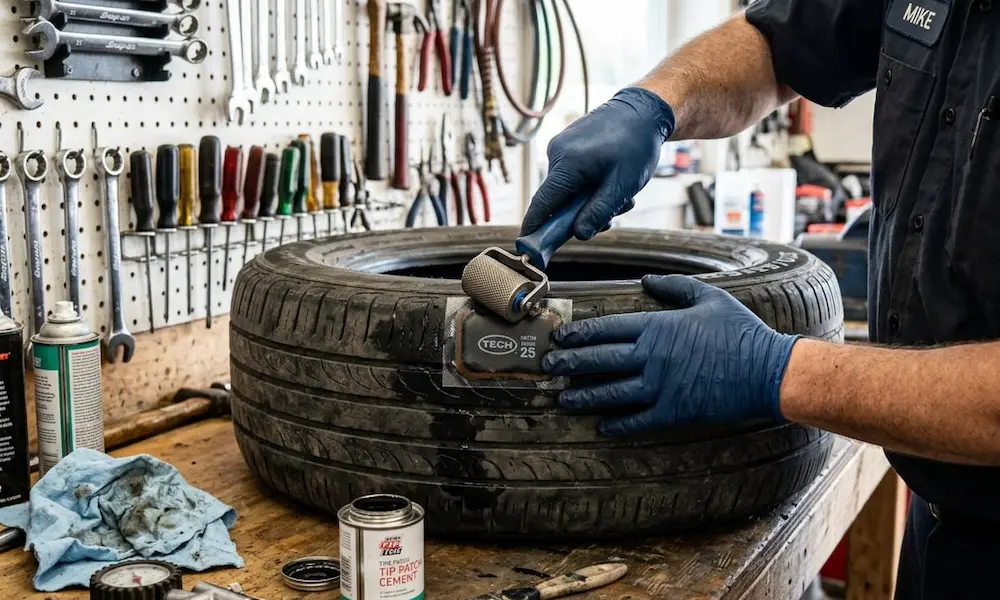
Costco doesn’t just jam a plug in and send you on your way. They use a two-piece repair method that meets USTMA standards — and it takes longer because of it.
Here’s the process:
- Remove the tire from the wheel — An internal inspection is mandatory. You can’t see internal damage from the outside.
- Clean and ream the puncture channel — This preps the hole for a proper seal.
- Insert a rubber stem — This fills the puncture channel and blocks moisture from reaching the steel belts. Moisture causes belt corrosion and separation.
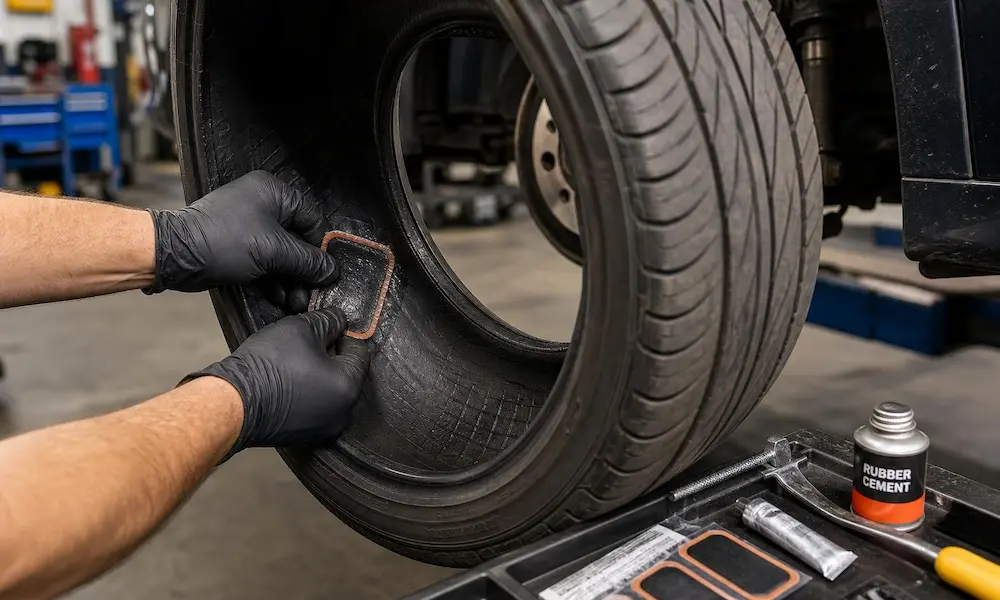
- Apply a patch to the inner liner — The liner gets buffed first, then the patch bonds permanently through vulcanization.
If someone previously stuck a plug-only repair in your tire, Costco will likely refuse to service it. A single plug inserted from the outside doesn’t seal the inner liner — and it may have already damaged the interior structure.
Does Costco Repair Tires That Were Plugged Before?
This comes up a lot. If your tire has a temporary string plug in it, Costco may refuse the repair entirely. The concern is that the internal liner might already be compromised, and a proper two-piece repair can’t guarantee safety on top of a prior improper fix.
Some locations will remove the plug, inspect the interior, and proceed if everything looks good. Others won’t touch it. Again — call ahead.
Also worth noting: if you’ve used a fix-a-flat sealant product, that can make the tire non-repairable and may even void your road hazard warranty.
The Costco Road Hazard Warranty Explained
If you bought your tires at Costco and they can’t be repaired, don’t panic. The Road Hazard Warranty covers you for 60 months from purchase — as long as you still have at least 2/32 inch of tread left.
How the Prorated Credit Works
This isn’t a free replacement deal. It’s a prorated credit based on how much usable tread is left on your damaged tire.
The math: Usable tread = original depth minus the 2/32-inch wear limit. The credit you get equals the percentage of usable tread remaining, multiplied by what you originally paid for the tire.
Example: If you paid $200 for a tire and 60% of the tread is still usable, you get a $120 credit toward a new one.
What You’ll Still Pay
Even with the warranty, you’ll cover:
- Installation fee (~$19.99)
- TPMS service pack replacement (~$2.99)
- State tire disposal fees and taxes
- Any price increase since your original purchase
What Voids the Warranty
- Using fix-a-flat sealants
- Racing, off-road, or commercial vehicle use
- Intentional damage or accident damage
- Skipping regular rotations or running tires underinflated
- Transferring vehicle ownership
How Long Does a Costco Tire Repair Take?
Let’s be real — Costco isn’t fast. This is a high-volume warehouse operation, not a specialized tire shop.
| Service | Estimated Time |
|---|---|
| Flat Repair | 45 minutes – 1.5 hours |
| Rotation & Balance | 30 minutes – 1 hour |
| Full Installation (4 tires) | 1.5 – 2 hours |
| Seasonal Tire Swap | 2+ hours |
The two-piece repair process itself takes time because of the mandatory internal inspection, buffing, and vulcanization steps. That’s the trade-off for a repair done properly.
Appointments vs. Walk-Ins at Costco Tire Center
Schedule your appointment at CostcoTireAppointments.com. It’s a separate portal from the main Costco site. Scheduled customers get priority — always.
Walk-ins are technically accepted, but the reality is hit or miss. High-volume locations often fill up before the warehouse even opens. If you walk in at noon on a Saturday, expect to be turned away or face a 3–4 hour wait.
Tips for a smoother experience:
- Book online at least a few days in advance
- Show up early if you must walk in — arrive before opening
- Avoid peak season — first frost of winter means massive demand for snow tire installs
What Costco Won’t Fix (And What That Means for You)
There are some limits worth knowing about before you commit to Costco for all your tire needs.
Wheel alignment — Costco doesn’t offer it. At all. You’ll need a third-party shop for that. This matters because misalignment is a top cause of uneven tire wear, and some tire manufacturer warranties require documented alignment records.
Older tires — Many locations won’t install or repair tires older than 10 years. Some are now applying a 5-year rule for seasonal tires. Rubber degrades over time regardless of tread depth, and aged tires can fail catastrophically at highway speeds. The manager has final say.
Non-repairable damage — Sidewall punctures, damage beyond 1/4 inch, impact breaks, and tires with run-flat damage all get rejected. That’s not unique to Costco — it’s industry standard.
TPMS Service at Costco
Under the TREAD Act, all newer vehicles need functioning Tire Pressure Monitoring Systems (TPMS). Costco handles this as part of tire service.
Every time a tire comes off the rim, Costco replaces the TPMS service pack — the rubber grommets and O-rings that seal the sensor. That runs $2.99 per wheel. If your sensor’s battery has died (usually after 7–10 years), full sensor replacement costs $45–$65 per wheel at Costco versus $300+ at a dealership.
Some newer vehicles — like certain 2024–2025 Hyundai models — have software issues that require dealer-level reprogramming after sensor replacement. Costco will refer you back to the manufacturer in those cases.
Nitrogen Inflation: Why Costco Uses It
Costco inflates all tires with nitrogen instead of compressed air — and it’s included at no extra charge.
Nitrogen offers three real benefits:
- Slower pressure loss — Nitrogen molecules are larger than oxygen, so they seep through rubber more slowly. Your tires hold pressure longer.
- Less moisture and corrosion — Compressed air contains water vapor that corrodes rims from the inside. Nitrogen is dry and inert.
- More stable pressure in temperature swings — This reduces false TPMS warnings during cold snaps in fall and winter.
Many Costco locations also have self-service nitrogen stations so you can top off between visits without waiting for a tech.
Costco vs. Discount Tire: Which Is Better for Repairs?
Both are solid options, but they serve different needs.
| Feature | Costco | Discount Tire |
|---|---|---|
| Flat repair (purchased tires) | Free | Often free |
| Repair for non-purchased tires | ~$10.99–$14.00 | Often free |
| Wait time | 1.5–4+ hours | 30 min–1 hour |
| Road hazard warranty | Prorated credit | Optional replacement cert |
| Wheel alignment | Not offered | Not offered |
| Walk-in priority | Low | Higher |
If you bought your tires at Costco and have the road hazard warranty, stick with Costco — the lifetime maintenance perks are genuinely hard to beat. If you just need a fast flat fix on a random Tuesday, Discount Tire will likely get you out the door faster.
Special Rules for AWD and 4WD Vehicles
If you drive an all-wheel or four-wheel drive vehicle, Costco has stricter requirements. All four tires must have nearly identical circumference to avoid stressing the differential.
- New tires must match the exact brand, model, and size of existing tires
- The circumference difference between old and new can’t exceed 1.5 inches
- If your existing tires are too worn, Costco may require you to replace all four
When only two tires are replaced, Costco installs the new ones on the rear axle — regardless of drivetrain. This is standard safety practice supported by tire manufacturers to prevent oversteer and fishtailing in wet conditions.