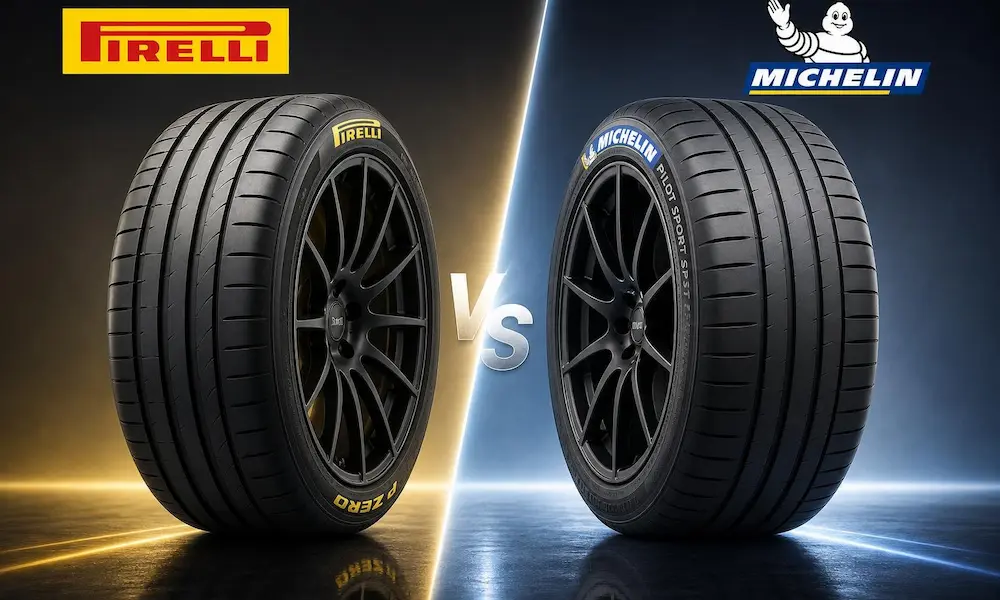
Choosing between Pirelli vs Michelin feels like picking a side in a decades-old rivalry. Both brands are premium, both are trusted, and both have loyal fans. But they’re built for different drivers. Read to the end — the right choice might surprise you.
Two Brands, Two Very Different Philosophies
Before comparing tread compounds and lap times, you need to understand what each brand actually stands for.
Michelin was founded in 1889 in France. Their big claim to fame? Inventing the radial tire in 1946. That single invention changed how tires handle heat, wear, and fuel efficiency forever. Today, Michelin’s entire engineering philosophy revolves around what they call “Total Performance” — meaning a tire shouldn’t excel at one thing by sacrificing another. Safety, longevity, and efficiency all matter equally.
Pirelli, founded in Milan in 1872, took a different road. Their identity is built around excitement. Since 2011, Pirelli has been the sole tire supplier for Formula 1. That motorsport connection isn’t just marketing — it’s a genuine engineering pipeline that feeds race-derived technology directly into consumer tires. Pirelli’s OEM partners include Ferrari, Lamborghini, Bentley, and Aston Martin.
| Dimension | Michelin | Pirelli |
|---|---|---|
| Founded | 1889, France | 1872, Italy |
| Core Goal | Balanced Total Performance | High-Octane Grip & Handling |
| Motorsport | Le Mans, Formula E | Formula 1, World Superbike |
| Brand Perception | Safe, Durable, Reliable | Sporty, Precise, Stylish |
| Main US Segment | Commuters, SUVs, Trucks | Luxury Sedans, Sports Cars |
Noise Reduction: Who’s Quieter on the Highway?
Road noise is a real issue on American concrete highways. Both brands tackled it differently.
Michelin uses Acoustic Technology — a layer of polyurethane foam bonded inside the tire. It absorbs vibration before it travels through your suspension into the cabin. Testing shows it can cut interior noise by up to 20%. That’s especially noticeable in EVs and luxury sedans where engine noise doesn’t mask tire hum.
Pirelli’s answer is the Noise Cancelling System (PNCS), which uses a similar open-cell foam insert. The difference? Pirelli often tunes their system for specific vehicle platforms — Audi, Land Rover, and similar chassis. Consumer feedback gives Michelin a slight edge for consistency across road textures, while Pirelli performs better on rough, uneven surfaces.
Bottom line: If you drive mostly smooth highways, Michelin’s quieter. Rough roads? Pirelli holds its own.
Run-Flat and Puncture Protection
Nobody wants to be stranded on the side of the road. Both brands offer two layers of protection: sealant technology and run-flat reinforcement.
Michelin:
- Selfseal Technology fills punctures up to 6mm in diameter instantly
- Zero Pressure (ZP) reinforced sidewalls let you drive up to 50 miles at 50 mph after a total blowout
Pirelli:
- Seal Inside works on the same self-sealing principle
- Run Forward Technology was built specifically for EVs and heavy luxury vehicles — it handles the extra weight and torque demands those vehicles create
One trade-off worth knowing: Pirelli’s run-flat tires tend to ride stiffer, which improves emergency steering precision but can make daily driving less comfortable. Michelin’s sidewalls feel more compliant.
Head-to-Head: Pilot Sport 4S vs. P Zero PZ4
This is the matchup performance enthusiasts actually care about. The Michelin Pilot Sport 4S uses a dual-compound tread — a hybrid elastomer for dry grip, plus silica-loaded polymer for wet conditions. The result is a tire that’s both fast and safe in the rain.
The Pirelli P Zero PZ4 uses F1-derived bead compounds and asymmetric tread geometry. Large rigid outer blocks resist lateral deformation in corners. The inner shoulder handles water evacuation.
| Performance Metric | Michelin Pilot Sport 4S | Pirelli P Zero PZ4 |
|---|---|---|
| Dry Braking | 32.7m (Benchmark) | 33.0m |
| Wet Braking | 33.5m | 35.6m |
| Dry Handling Lap Time | 69.3s | 69.6s |
| Subjective Handling Score | 60.75 | 56.50 |
That 2.1-meter gap in wet braking is significant. At highway speeds, it’s the difference between stopping before or after an obstacle. Michelin wins on pure safety metrics.
But here’s the thing — many drivers actually prefer the Pirelli. It’s described as more “accessible” at the limit. Non-professional drivers find it more forgiving and engaging. Both tires are exceptional. The Michelin is safer. The Pirelli is more fun.
All-Season Performance: Snow Belt Drivers, Listen Up
If you live where it actually snows, the Michelin Pilot Sport All Season 4 and Pirelli P Zero AS Plus 3 are the tires worth comparing.
In head-to-head winter testing, the Pirelli AS Plus 3 stopped 1.3 feet shorter on ice. Cold-weather compound flexibility gives it an edge in pure ice braking. But the Michelin was 8% faster in overall snow lap times, meaning its tread pattern clears slush and deep snow more effectively.
The Pirelli AS Plus 3 also runs noticeably quieter on the highway — something Reddit’s tire community consistently points out when comparing the two brands head-to-head. Michelin’s V-shaped CrossClimate 2 tread can produce a noticeable thrumming sound at speed.
Choose Michelin if: You drive through heavy snow regularly and need overall winter performance.
Choose Pirelli if: You encounter icy conditions more than deep snow, and want a quieter daily ride.
Long-Distance Value: Defender 2 vs. P7 AS Plus 3
Most Americans aren’t buying performance tires. They want something that lasts.
The Michelin Defender 2 is built around longevity. It carries a UTQG treadwear rating of 840 and an 80,000-mile warranty. Some independent projections push it toward 100,000 miles. For high-mileage commuters, that’s genuinely impressive cost-per-mile math.
The Pirelli P7 AS Plus 3 targets comfort over longevity. It comes in 20-25% cheaper than the Michelin equivalent and offers a 70,000-mile warranty. If you don’t plan on keeping your car for 10 years, it’s a smart buy.
| Feature | Michelin Defender 2 | Pirelli P7 AS Plus 3 |
|---|---|---|
| Warranty | 80,000 miles | 70,000 miles |
| UTQG Treadwear | 840 | 740 |
| Price | Premium | Moderate |
| Best For | High-mileage commuters | Comfort-focused daily drivers |
SUV and Truck Fitments
America runs on SUVs and trucks. Both brands have deep lineups for these vehicles.
Michelin’s Defender LTX M/S2 is the go-to for full-size trucks and heavy-duty SUVs. It handles high torque, towing loads, and resists the “squirm” under heavy cargo. For SUV owners prioritizing durability and towing stability, it’s hard to beat.
Pirelli’s Scorpion AS Plus 3 consistently ranks as one of the most comfortable SUV tires available, especially for unibody crossovers where ride quality matters more than payload. The Scorpion All Terrain Plus features self-cleaning groove cones that resist stone drilling — great for gravel and light trails.
| SUV Category | Best Michelin | Best Pirelli |
|---|---|---|
| Highway Comfort | Latitude Tour | Scorpion AS Plus 3 |
| Towing & Durability | Defender LTX M/S2 | Scorpion MS |
| Performance SUV | Pilot Sport 4 SUV | Scorpion Zero AS+3 |
| Light Off-Road | LTX A/T2 | Scorpion AT Plus |
EV-Specific Technologies
EVs weigh 20-30% more than traditional cars and deliver instant torque. Standard tires wear faster and can slip during hard acceleration.
Michelin’s EV-focused designs prioritize rolling resistance reduction. They claim up to 7% more range from EV-specific rubber compounds. Less energy lost to heat and deformation means more miles per charge.
Pirelli’s ELECT designation focuses on immediate grip and load capacity. Reinforced internal structures handle instantaneous torque without slipping. ELECT tires are also specifically tuned for cabin quietness — critical when there’s no engine to drown out road noise.
The Real Cost of Ownership
Tire rolling resistance accounts for roughly 20% of your fuel consumption. That’s not a small number.
Michelin’s focus on low rolling resistance typically delivers 3-5% fuel savings over a tire’s lifetime. A set of Michelin tires costs $150-$300 more upfront than comparable Pirelli options. But if the Michelin lasts twice as long — 80,000 miles versus 40,000 — the math strongly favors the Michelin for long-term ownership.
| Economic Factor | Michelin | Pirelli |
|---|---|---|
| Initial Cost | High | Moderate to High |
| Average Tread Life | 55,000–85,000 miles | 40,000–60,000 miles |
| Max Warranty | 90,000 miles | 85,000 miles |
| Fuel Efficiency | High | Moderate |
| Best Value For | Long-term drivers | Performance enthusiasts |
So, Who Wins the Pirelli vs Michelin Debate?
It genuinely depends on what you’re driving and why.
Go with Michelin if you want:
- Maximum tread life and lowest cost-per-mile
- Consistent wet-weather safety across all conditions
- Peace of mind for family vehicles and daily commuters
- Strong all-season and light snow capability
Go with Pirelli if you want:
- Sharper steering feel and driver engagement
- OEM-matching performance for luxury and sports cars
- Superior ride comfort in touring applications
- Cutting-edge EV grip technology
According to J.D. Power, Michelin ranks highest in luxury and utility vehicle satisfaction, while Pirelli tops passenger car satisfaction scores. Neither brand loses — they just solve different problems.
The safest tire on wet roads is Michelin. The most engaging tire on a mountain road is Pirelli. Pick the one that matches your actual driving life, not the one with the flashiest marketing.