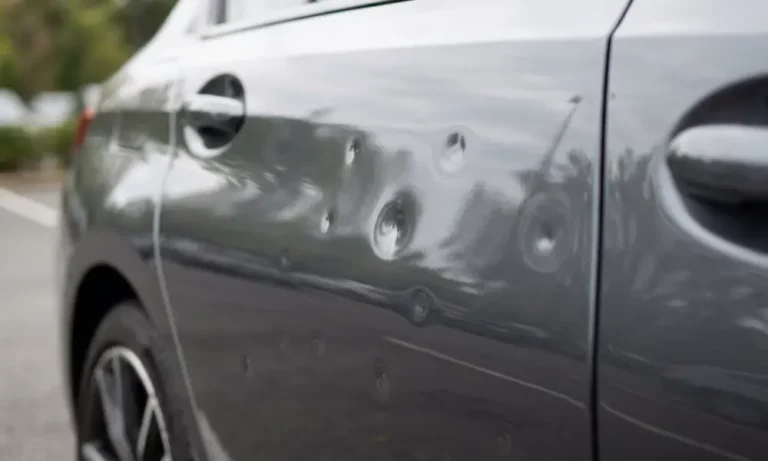
Got a dent staring back at you every time you walk to your car? Fixing it might cost $75 or it might cost $1,500+. The gap is huge, and a few key factors explain everything. Read on to find out exactly what you’ll pay — and what’s worth skipping.
The Two Ways to Fix a Car Dent
Before pricing anything, you need to know which repair method applies to your dent.
Paintless Dent Repair (PDR) is the go-to fix for most everyday dents. A technician uses specialized steel rods and LED light panels to massage the metal back into shape from behind the panel. No paint. No filler. No mess. It’s 40–70% cheaper than traditional repair and preserves your factory paint finish.
Traditional body shop repair handles the serious stuff — cracked paint, deep creases, structural damage, or dents near body reinforcements. Technicians pull the metal, fill it with polyester resin, sand it smooth, then repaint the whole panel. It’s labor-heavy and expensive.
Here’s a quick side-by-side comparison:
| Repair Attribute | Paintless Dent Repair (PDR) | Traditional Body Shop |
|---|---|---|
| Average Cost | $50–$500+ per dent | $300–$1,500+ per panel |
| Turnaround Time | 20 min–4 hours | 2–7 days (or more) |
| Paint Preserved? | Yes | No — stripped and resprayed |
| Resale Value Impact | Maximized | Often reduced |
| Environmental Impact | Low | High (solvents, paint waste) |
PDR handles most parking lot dings, hail damage, and minor panel dents. Traditional repair takes over when the paint’s broken or the metal is severely stretched.
How Much Does It Cost to Fix a Dent? PDR Price Breakdown
Here’s where most people get confused. PDR isn’t one flat price. Technicians calculate cost based on several physical factors.
Dent Size Is the Starting Point
Most shops start at $150–$175 for the first inch of damage, then add $50–$75 per additional inch. A small door ding sits at the low end. A palm-sized panel dent costs considerably more.
Here’s a realistic pricing guide by dent size:
| Dent Size | Base PDR Cost | With Body Line (+25%) | With Aluminum Panel (+25–50%) | Deep Dent (+35%) |
|---|---|---|---|---|
| 1 inch (door ding) | $150–$175 | +$38–$44 | +$38–$88 | +$53–$61 |
| 2 inches | $200–$250 | +$50–$63 | +$50–$125 | +$70–$88 |
| 3 inches | $250–$325 | +$63–$81 | +$63–$163 | +$88–$114 |
| 4 inches | $300–$400 | +$75–$100 | +$75–$200 | +$105–$140 |
| 5–6 inches | $475–$550 | +$119–$138 | +$119–$275 | +$166–$193 |
| 6+ inches | $600+ | Variable | Variable | Variable |
Steel vs. Aluminum Panels
Modern cars use aluminum panels to save weight. But aluminum is trickier to work with than steel. It hardens fast during reshaping, cracks more easily, and requires specialized tools or glue-pulling techniques. Because of that, shops charge a 25–50% surcharge for aluminum panels.
If your hood, door, or fender is aluminum, expect to pay noticeably more.
Body Line Location Adds Cost
Dents that land on a stamped body crease are the hardest to fix. The metal resists reshaping, and overcorrecting by even a hair creates a secondary crease. That complexity adds another 25–50% to your base rate.
Restricted Access = More Labor
If a technician can’t reach the dent through a standard panel port or window opening, they’ll need to remove trim pieces. Shops bill that at roughly $65/hour in teardown time, based on standardized labor time guides.
Multiple Dents? You Might Get a Break
Got several dings on the same door from a parking lot incident? Most shops discount additional dents on a single panel by 30–50%, since the access work is already done.
How Location Affects What You’ll Pay
Where you live matters a lot when figuring out how much to fix a dent in your car. Labor rates vary significantly across the country.
| State | Independent Shop Rate | Body Shop (Collision) Rate | Key Cost Drivers |
|---|---|---|---|
| California | $155–$200/hr | $110–$150/hr | High cost of living, strict environmental rules |
| New York | $135–$180/hr | $95–$140/hr | Dense metro areas, high real estate costs |
| Texas | $120–$150/hr | $85–$120/hr | Rural-urban mix, high competition |
| Florida | $130–$160/hr | $90–$130/hr | High metro density, tourism-driven collision rates |
| Michigan | $115–$145/hr | $80–$115/hr | Competitive independent network |
| Illinois | $125–$140/hr | $95–$135/hr | Chicago metro influence, unionized shops |
| North Carolina | $85–$135/hr | $60–$95/hr | Large rural market, lower overhead |
| Iowa | $130–$145/hr | $80–$110/hr | Lower cost of living, agrarian economy |
Source: AAA Average Mechanic Labor Rates 2026
Also worth knowing: dealerships charge $20–$40 more per hour than independent shops. You’re paying for factory-trained techs and OEM tooling.
The Hidden Cost Most People Don’t Expect: ADAS Calibration
This is the part that catches a lot of drivers off guard.
Modern cars are packed with Advanced Driver Assistance Systems (ADAS) — radar sensors, cameras, ultrasonic transmitters, and lidar units. These power features like automatic emergency braking, blind spot monitoring, and lane-keep assist.
Here’s the problem: even a minor dent near a sensor mounting point can shift that sensor by a fraction of a degree. That tiny shift can degrade system performance enough to cause a late emergency braking response — or worse, no response at all.
Vehicle manufacturers now require full ADAS recalibration after any repair involving panels that house these sensors.
What Calibration Costs
There are two types:
- Static calibration — Done inside a controlled shop using target boards at precise distances. Costs $150–$400 per system.
- Dynamic calibration — A tech drives the vehicle on public roads while a scan tool maps real-world landmarks. Costs $250–$600.
Many vehicles need both. That can push your “simple dent repair” past $1,000 fast.
| ADAS Component | Function | Calibration Time | Independent Cost | Dealership Cost |
|---|---|---|---|---|
| Windshield Camera | Lane Keep / Traffic Signs | 3.3 hrs | $250–$500 | $400–$600+ |
| Front Radar | Adaptive Cruise / Emergency Braking | 1.6 hrs | $250–$450 | $400–$600+ |
| Blind Spot / Rear Radar | Lane Change Alert | 1.6 hrs | $200–$350 | $300–$500+ |
| Ultrasonic Sensors | Park Assist | 1.6 hrs | $100–$250 | $150–$300+ |
| Surround Camera | 360° Park Assist | 3.3 hrs | $350–$450 | $450–$600+ |
Skipping calibration to save money isn’t just risky — it’s a liability. If a sensor you bypassed fails during an accident, your insurance claim could be denied.
Should You File an Insurance Claim for a Dent?
This decision hinges on your deductible and the cause of the damage.
Collision coverage handles dents from impacts — another car door, a shopping cart, a parking barrier.
Comprehensive coverage handles weather events, vandalism, falling objects, and animal strikes.
Here’s the critical math most people miss: standard collision deductibles run $500–$1,000. A simple PDR fix costs $75–$150. That repair falls entirely below your deductible. Filing a claim for it gets you zero payout and risks a rate increase.
How much can a claim raise your rate? Filing an at-fault collision claim can trigger an average annual premium increase of 44% — that’s potentially $1,100+ per year in extra premiums.
| Damage Scenario | Estimated Cost | Coverage Type | Smart Move | Why |
|---|---|---|---|---|
| Minor door ding | $150 | Collision ($500–$1,000 deductible) | Pay out of pocket | Below deductible. Filing raises your rate for nothing. |
| Deep scratch from vandalism | $400 | Comprehensive ($250 deductible) | File the claim | Insurance covers the $150 gap. Low premium risk. |
| Bumper dent near radar sensor | $1,200 | Collision ($500 deductible) | Calculate first | $700 above deductible, but a 44% rate hike over 3 years may cost more. |
| Widespread hail damage (10+ panels) | $3,000+ | Comprehensive ($250–$500 deductible) | File immediately | Major payout. Weather claims are typically rate-protected by state law. |
One more rule: multiple dents from a single event like a hailstorm get processed under one deductible. Separate incidents on different days? Each one carries its own deductible.
What Happens If You Skip the Repair?
Ignoring dents isn’t free. Here’s what it actually costs you.
Lease return fees: Dealerships charge excess wear-and-tear fees of $200–$500 per dent at lease end. A quick PDR session before you return the car costs far less.
Private sale losses: A car with visible dings looks neglected. Buyers negotiate harder. Spending $200–$300 on PDR can boost your private sale price by $800–$1,500. Ignoring those dents can cost you up to $1,500 in lost resale value — especially if moisture eventually gets under micro-cracks in the clear coat and starts rusting the metal.
Safety liability: Any unresolved dent near a sensor array that goes uncalibrated creates direct legal and financial exposure if that system fails in an accident.
The Bottom Line on Dent Repair Costs
So how much does it cost to fix a dent in your car? Here’s the fast summary:
- Small PDR dent (1–2 inches, easy access, steel panel): $150–$250
- Medium PDR dent (3–4 inches, body line or restricted access): $300–$500
- Large or complex PDR dent (5+ inches, aluminum, deep crease): $500–$700+
- Traditional body shop repair: $300–$1,500+ per panel
- ADAS calibration added on top: $150–$600+ per sensor system
The smartest move is always to get two or three in-person quotes. Pricing varies by shop, region, and the exact characteristics of your dent. What you see in a photo quote often shifts once a tech gets eyes on the actual damage.