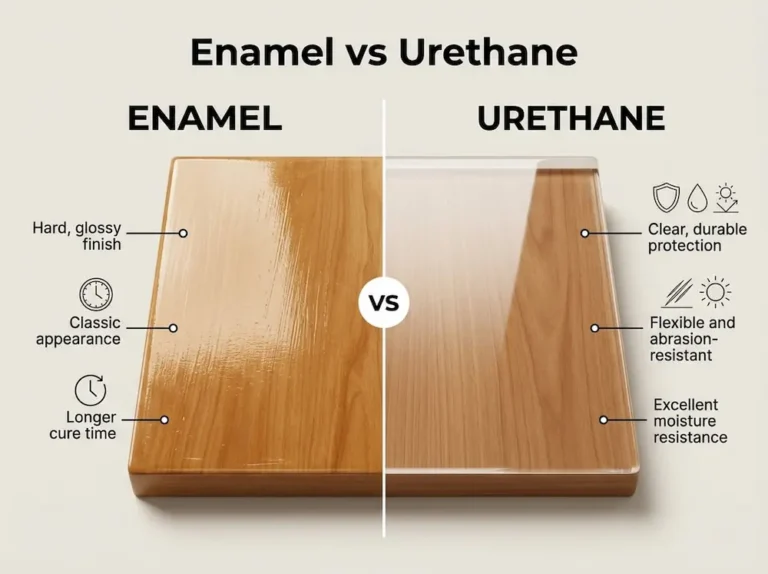
Picking between enamel and urethane paint feels confusing because both promise a “hard, glossy finish.” But they’re not the same thing, and picking the wrong one can mean repainting your cabinets, car, or boat way sooner than you’d like. This guide breaks down exactly how these two coatings differ, where each one shines, and how to avoid an expensive redo. By the end, you’ll know which one fits your project.
What’s the Real Difference Between Enamel and Urethane?
Enamel and urethane cure in totally different ways. That’s the whole story, honestly.
Enamel dries through evaporation and, in the case of alkyd enamel, a slow chemical reaction with oxygen in the air. Urethane (short for polyurethane) cures through a direct chemical reaction between a resin and a hardener. That reaction creates a dense, tightly bonded film that’s much tougher than anything enamel can produce.
How Enamel Cures
Alkyd enamel dries in two steps. First, the solvents evaporate, leaving a tacky film. Then oxygen reacts slowly with the resin to harden it further. This process never fully stops. Over years, that ongoing reaction makes the paint brittle, leading to cracking, chalking, and dull spots, especially outdoors.
Acrylic enamel skips most of that oxidation. It dries fast through solvent evaporation and physical bonding between polymer chains. It’s better at holding color but still stays fairly soft compared to urethane.
How Urethane Cures
Urethane needs two ingredients: a polyol resin and an isocyanate hardener. Mix them, and they react to form a dense network of cross-linked molecules. This is what gives urethane its legendary toughness and chemical resistance.
There are two urethane types you should know:
- Aromatic urethane is super tough but turns yellow in sunlight. It’s mostly used indoors or as a hidden primer layer.
- Aliphatic urethane resists UV rays for decades without yellowing. This is the stuff used on car clearcoats, boat hulls, and outdoor steel structures.
Urethane also comes in one-component (moisture-cured) and two-component (catalyzed) versions. Two-component urethane cures harder and lasts longer, but you’ve got a limited window to apply it before it hardens in the can — more on that later.
Enamel vs Urethane: Hardness and Abrasion Resistance
This is where urethane pulls way ahead. Industry testing backs this up clearly.
| Test | What It Measures | Enamel Result | Urethane Result |
|---|---|---|---|
| Pencil Hardness (ASTM D3363) | Scratch resistance | Softer (2B–HB) | Much harder (2H–4H) |
| Taber Abrasion (ASTM D4060) | Wear from friction | More mass loss | Very little mass loss |
| Impact Resistance (ASTM D2794) | Cracking under sudden force | Brittle, cracks easily over time | Absorbs impact, stays flexible |
| Cross-Hatch Adhesion (ASTM D3359) | Bond strength | Forgiving recoat window | Strict recoat window, but permanent bond |
| Salt Fog Test (ASTM B117) | Corrosion resistance | Fails sooner | Resists rust much longer |
Pencil hardness tests literally scratch a coating with pencils of increasing hardness until it gouges. Enamel scratches easily. Urethane shrugs it off.
For floors, garages, or anywhere with heavy foot traffic, that difference matters. Urethane floors resist scuffing and grinding far better than enamel over years of use.
Which One Bends Without Breaking?
Urethane flexes. Enamel eventually doesn’t.
Impact resistance testing (ASTM D2794) drops a weighted object onto painted metal panels to see how much force the coating can take before it cracks. Urethane’s cross-linked structure lets it absorb serious impact — often over 50 inch-pounds — without failing.
Enamel gets brittle with age because that oxidation process never fully stops. Old enamel will flake, chip, or shatter under stress that urethane would barely notice.
This flexibility matters most on surfaces that expand and contract, like wooden boat hulls, metal panels exposed to temperature swings, or high-traffic floors that take constant impact.
Gloss and Weather Resistance: Who Wins Outdoors?
Aliphatic urethane wins, hands down, for anything facing direct sun.
Manufacturers test this using accelerated weathering chambers that blast UV light and moisture to simulate years of sun exposure in weeks (ASTM G154). A good exterior enamel might hold its gloss for five to ten years before chalking sets in. Aliphatic urethane can outlast that by a wide margin, staying glossy and resisting fading long after enamel has gone powdery.
Aromatic urethane, by contrast, yellows quickly outdoors. So if you’re picking urethane for an exterior project, make sure it’s aliphatic. Check the product label or ask your supplier — this one detail makes or breaks your outdoor finish.
Best Uses for Enamel vs Urethane by Project
Different industries have already settled this debate through decades of trial and error. Here’s where each coating actually gets used.
Cars and Auto Refinishing
Modern auto shops use urethane clearcoat over a basecoat almost exclusively now. Old-school single-stage acrylic enamel is cheaper and easier for beginners to spray, but it fades fast and can’t handle color-sanding without ruining metallic flake patterns.
Urethane clearcoat needs precise spray equipment — usually a 1.3 to 1.5mm nozzle tip — to avoid that dimpled “orange peel” texture. It’s harder to apply right, but the payoff is a finish that resists chips, fading, and chemical fallout far longer.
Boats and Marine Coatings
Wooden boats still lean on alkyd enamel because wood expands and contracts constantly with moisture. Enamel flexes with it. But you’ll be repainting every one to three years.
Fiberglass, aluminum, and steel boats do much better with two-part aliphatic urethane. It resists fuel spills, abrasion from docks, and relentless sun exposure — though it’s trickier to touch up if scratched.
Kitchen Cabinets and Trim
This is where things get interesting. Traditional oil enamel yellows over time and doesn’t meet modern chemical resistance standards. The Kitchen Cabinet Manufacturers Association’s ANSI/KCMA A161.1 standard requires cabinet finishes to survive a 24-hour hotbox test plus exposure to vinegar, lemon juice, and alcohol without damage.
Hybrid urethane alkyd enamels (like Behr’s Urethane Alkyd line) meet this well for everyday trim and doors. But for true furniture-grade durability, two-component waterborne urethane is becoming the go-to for high-end cabinet refinishing, easily beating KCMA testing standards.
Industrial Steel and Structural Coatings
For bridges, tanks, and factory equipment, the standard setup is an epoxy primer topped with an aliphatic urethane topcoat. Epoxy handles adhesion and corrosion resistance but breaks down in UV light. Urethane sits on top as the sacrificial shield that takes the sun damage instead.
Plain alkyd enamel shows up in cheap, low-exposure interior jobs, but it needs constant recoating and costs more over time despite the lower sticker price.
VOC Rules and Why They Matter for Your Project
If you’re buying paint in the US, especially in California, environmental rules are already shaping what’s on the shelf.
The EPA sets baseline limits on volatile organic compounds (VOCs) in paint — the solvents that evaporate and contribute to smog. Compliance gets tested using EPA Method 24, a lab process that measures exactly how much volatile material is in a can of paint.
The South Coast Air Quality Management District (SCAQMD) sets the toughest rules in the country under Rule 1113 for architectural coatings and Rule 1151 for auto refinishing. Because California is such a huge market, most manufacturers formulate their entire national product line to meet these limits anyway.
This is actually why hybrid urethane alkyds and waterborne polyurethane dispersions exist. They meet ultra-low VOC limits (50 grams per liter or less for architectural paint) without sacrificing performance. Old-school oil enamels mostly can’t hit those numbers, which is pushing them out of the market entirely.
Safety Gear You Actually Need
This part isn’t optional, especially with urethane.
Enamel’s health risks are the usual paint stuff: dizziness, nausea, skin irritation from solvents. A standard respirator with organic vapor cartridges and decent ventilation handles it fine.
Urethane is a different story because of the isocyanate hardener. Spraying it creates an invisible mist that’s a known cause of occupational asthma. Once someone becomes sensitized to isocyanates, even tiny future exposures can trigger serious asthma attacks.
Here’s the big one: standard cartridge respirators are not legal for spraying two-component urethane. OSHA standard 1910.134 requires a full written respiratory protection program, and the only acceptable gear is a supplied-air respirator — basically a full-face hood connected to clean breathing air, not just a filter mask.
You’ll also need a proper spray booth if you’re doing this regularly. OSHA 1910.107 requires power-ventilated booths with exhaust systems that vent outside, since urethane solvents are highly flammable too.
If you’re a weekend DIYer doing a small furniture piece, a hybrid urethane alkyd enamel with decent ventilation is usually fine. If you’re spraying two-component urethane regularly, budget for real safety gear. It’s not a place to cut corners.
Cost vs Lifespan: Which One Saves You Money
Enamel costs less upfront. Urethane costs less over time. That’s the short version.
Enamel is cheaper per gallon and easier to apply, which is why it still shows up in budget projects and situations needing flexibility, like wooden boats. But it needs recoating more often — sometimes every one to three years in tough environments.
Urethane costs more to buy and apply. You need better spray equipment, stricter timing for pot life and recoat windows, and proper safety gear. But it can last years or decades longer without fading, cracking, or losing gloss. For anything with high stakes — a car, a boat hull, structural steel, or cabinets you don’t want to redo — urethane usually wins on total cost, even with the higher price tag upfront.
One practical note: two-component urethane has a strict pot life. Once you mix the hardener in, you’ve got a limited window before it hardens in the cup or your spray gun. Plan your application time accordingly, especially in warmer weather when curing speeds up.
Final Thoughts
Enamel and urethane both have their place. Enamel works when you need flexibility, an easier application, or you’re on a tight budget for a low-stakes project. Urethane wins when you need serious durability — outdoor exposure, heavy wear, or chemical resistance that has to last for years, not months.
If you’re still unsure, think about how much punishment your project will take and how long you want it to last before repainting. That answer usually points you straight to the right coating.