You’ve grabbed the WD-40 can a hundred times. Squeaky hinge? Spray it. Rusty bolt? Spray it. Stiff lock? You guessed it. But here’s the thing — most people don’t actually know what WD-40 does or whether it’s truly a lubricant. That confusion leads to real mechanical mistakes. Stick around, because the answer is more interesting (and more useful) than you’d expect.
So, Is WD-40 a Lubricant? The Short Answer
Yes — but it’s complicated.
WD-40 officially classifies itself as a “unique, special blend of lubricants.” Technically, that’s accurate. The petroleum base oils left behind after the solvent evaporates do reduce friction between surfaces. That’s lubrication by definition.
But calling WD-40 a lubricant the same way you’d call motor oil or lithium grease a lubricant? That’s where things go sideways.
WD-40 is primarily a water displacer and penetrating solvent that also provides light, temporary lubrication. Understanding that distinction saves you from some expensive mistakes.
What WD-40 Actually Does: 5 Core Functions
The formula — perfected on the 40th attempt by chemist Iver Norman Lawson in the early 1950s — works on five separate levels:
- Water displacement — It’s hydrophobic. It pushes moisture away from metal surfaces, leaving a dielectric barrier that prevents rust and short circuits.
- Penetration — The low-viscosity solvents creep into microscopic gaps, helping free seized bolts, rusted hinges, and frozen fasteners.
- Cleaning — The hydrocarbon solvents dissolve grease, grime, adhesives, and tar. It removes sticky label residue, road tar, and scuff marks effortlessly.
- Corrosion protection — After the solvents evaporate, a thin film of petroleum oil remains. This film temporarily blocks atmospheric moisture and oxygen that cause rust.
- Light lubrication — That residual oil does reduce friction on low-load, low-speed metal parts like hinges, linkages, and pivots.
Notice that lubrication sits at number five. It’s real, but it’s not the star of the show.
Why the “Not a Lubricant” Myth Exists
Here’s the truth people argue about constantly.
WD-40 contains up to 60–70% highly volatile aliphatic hydrocarbons by volume. Those solvents evaporate. What’s left is a microscopically thin layer of light petroleum oil — nothing like the thick, cohesive film you get from dedicated lubricants.
In high-load environments — think wheel bearings, gear sets, or motorcycle chains — a lubricant needs to maintain a thick film that physically separates moving metal surfaces. That’s called hydrodynamic lubrication. WD-40’s thin residual layer gets displaced under mechanical pressure almost immediately.
Once that film breaks, you get metal-on-metal contact. That means heat, wear, and eventually component failure.
There’s a second problem. The residual oil stays wet and tacky. It attracts dust, dirt, and airborne grit like a magnet. Over time, that mixture of thin oil and abrasive particles becomes a lapping compound that grinds your components from the inside out.
So WD-40 IS a lubricant — just a light, temporary, boundary-layer one. Use it like motor oil and you’ll pay for it.
Where WD-40 Works Brilliantly
Used correctly, WD-40 is genuinely excellent. Here’s where it shines:
- Squeaky hinges and pivots (low load, low speed — perfect match)
- Rusty, frozen bolts (penetration + light lubrication to break them free)
- Drying out wet electrical systems — it has a dielectric strength of up to 38,000 volts per 2.5mm
- Removing adhesive residue, tar, scuff marks, and stickers
- Preventing rust on tools, blades, and metal surfaces stored short-term
- Freeing stuck LEGO bricks — yes, really. ABS plastic resists the solvents, so it just lubricates the clutch gap
Where WD-40 Will Actually Make Things Worse
This is where people get into trouble.
Door Locks and Pin-Tumbler Mechanisms
Locksmiths universally warn against using WD-40 in locks. Here’s what happens:
The solvents flush out dirt initially, and the lock feels smooth. Temporary win. But the oily residue coats every pin and spring inside. Every time you insert a key, it drags in lint and dust. That debris sticks. Within months, the accumulated grime turns into black sludge. Springs gum up. Pins don’t drop. The lock seizes completely.
If the lock already has dry graphite lubricant inside, WD-40 turns it into concrete paste instantly.
Better alternative: Flush the lock with fast-evaporating brake cleaner, let it dry, then apply PTFE dry lubricant (like Tri-Flow) or dry graphite powder. Dry lubricants don’t attract dust, so they keep working for years.
Heavy Rust on Seized Fasteners
WD-40 has modest penetrating ability, but it’s chemically outmatched by dedicated penetrating oils when bolts are fused solid.
Products like PB Blaster use aggressive solvents, specialized surfactants, and chelating agents that actively break down iron oxide at a molecular level. WD-40 coats around rust. PB Blaster eats through it.
Independent torque-reduction testing consistently shows dedicated penetrants require significantly less force to free a seized bolt than WD-40.
Use WD-40 to prevent rust from forming. Use PB Blaster or Kroil when rust has already fused your fasteners.
Automotive Paint
WD-40 does remove tree sap, bird droppings, tar, and adhesive from clear coats — safely, when used carefully. But it aggressively strips wax, paint sealants, and ceramic coatings from the treated area. It also leaves a greasy, tacky residue that attracts road grime fast.
If you use it on paint: wash immediately with car soap, dry thoroughly, and re-wax the area to restore protection.
Material Compatibility: What WD-40 Destroys
The aliphatic hydrocarbon solvents in WD-40 are aggressive toward certain materials. Here’s a clear breakdown:
| Material | Compatibility | Key Warning |
|---|---|---|
| Steel, Aluminum, Cast Iron | ✅ Excellent | Safe for rust prevention and moisture displacement |
| Crystalline Plastics (Nylon, Polypropylene, HDPE) | ✅ Good | Resistant molecular structure handles contact well |
| Amorphous Plastics (Polycarbonate, Polystyrene) | ❌ Poor | Causes crazing, embrittlement, and structural failure |
| Resistant Rubbers (Nitrile, Neoprene, Hypalon) | ⚠️ Fair | Short contact tolerated; avoid prolonged soaking |
| Vulnerable Rubbers (Natural, Silicone, EPDM) | ❌ Poor | Causes swelling, softening, and cracking |
| Automotive Clear Coat | ⚠️ Fair | Strips wax and sealants; wash and re-wax after use |
The polycarbonate warning is serious. Headlight lenses, safety glasses, and machine guards are all polycarbonate. WD-40 will permanently cloud and crack them.
For rubber components, the solvents absorb into the material and leach out the manufacturing plasticizers. What’s left is brittle, hardened rubber that cracks under stress. Use silicone-based lubricants instead for anything rubber-adjacent.
Safety: Things You Genuinely Need to Know
WD-40 is classified as an extremely flammable aerosol (Category 1). Some important facts:
- Flash point: approximately 113–138°F (44–59°C)
- Never store in hot vehicles or above 120°F (50°C) — the canister can rupture violently
- Never spray near live circuits, sparks, or pilot lights — the mist is highly flammable
- Aspiration hazard: if swallowed and vomited, the low-viscosity hydrocarbons can enter lungs and cause chemical pneumonitis. Don’t induce vomiting — get emergency help immediately
- Use nitrile gloves with prolonged contact; the solvents defat skin and cause dermatitis
And despite the dielectric properties, never spray WD-40 on energized circuits. The aerosol is flammable. Disconnect power first, spray, ventilate, then reconnect.
When the Original Formula Isn’t Enough: The Specialist Line
WD-40 eventually acknowledged its limitations by launching the Specialist product line — dedicated formulations that genuinely outperform the original in specific tasks:
- White Lithium Grease → heavy hinges, load-bearing gears, garage door tracks
- Silicone Lubricant → rubber seals, EPDM weatherstripping, plastic guide rails (no solvent damage)
- Dry Lube with PTFE → locks, bicycle chains, table saw tracks (leaves zero wet residue)
- Fast Drying Contact Cleaner → circuit boards, MAF sensors, electrical contacts (evaporates completely clean)
- Corrosion Inhibitor → raw metal storage protection up to 2 years indoors, 1 year outdoors
Think of the original WD-40 as your versatile first-responder. Think of the Specialist line as the specialized tools you call in when the job needs more.
Frequently Asked Questions
Does WD-40 have an expiration date?
No. The manufacturer states the formula has an almost indefinite shelf life because it’s made from stable petroleum distillates sealed in a pressurized steel canister. It stays effective for many years as long as the can stays undamaged and away from extreme heat.
Can WD-40 treat arthritis or joint pain?
Absolutely not. The manufacturer explicitly debunks this myth. WD-40 is an industrial petroleum solvent. Putting it on your skin causes drying, cracking, and dermatitis with prolonged contact. It has zero medical properties.
Is WD-40 safe on firearms?
Yes, on metal components. It won’t damage gunmetal, bluing, or resistant synthetic rubber seals. However, it’s not ideal for long-term gun lubrication — the thin residual film evaporates too quickly. Dedicated gun oils like Breakfree CLP offer better long-term protection and carbon cleaning.
What’s the Smart Straw and why does it matter?
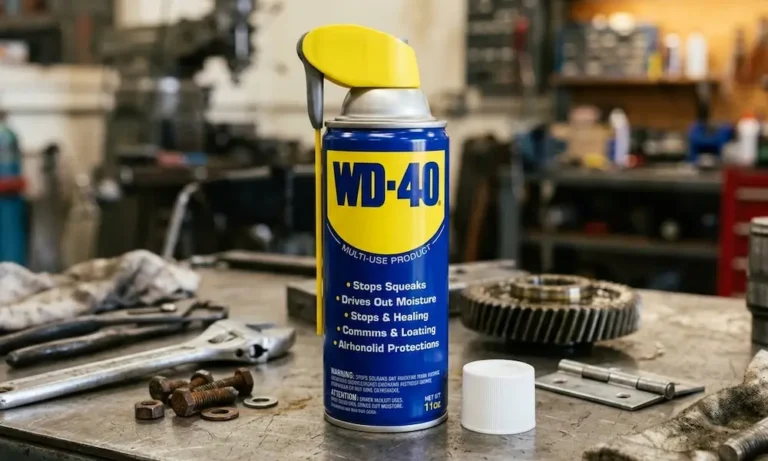
The “Smart Straw” is WD-40’s patented hinged nozzle system that eliminates the perpetually lost red straw problem. It folds flat for a wide fan spray and flips up and locks for a precision stream. One nozzle, two spray modes — no more digging around in the junk drawer.
Does WD-40 damage the ozone layer?
No. Modern formulations use carbon dioxide as the propellant instead of the ozone-depleting CFCs used in older aerosols. The manufacturer explicitly confirms the formula is CFC-free.
Can you recycle an empty WD-40 can?
Yes — once the can is completely empty of both liquid and propellant (fully depressurized), it’s generally no longer classified as hazardous waste and you can drop it in standard metal recycling. Never toss a pressurized can in the bin.