Worried your engine oil looks “off”? You’re right to check — oil colour tells a story about what’s happening inside your engine. This guide breaks down every colour you might see, what it means, and what to do about it. Stick around, because one colour on this list means stop driving immediately.
The Short Answer: What Colour Should Car Oil Be?
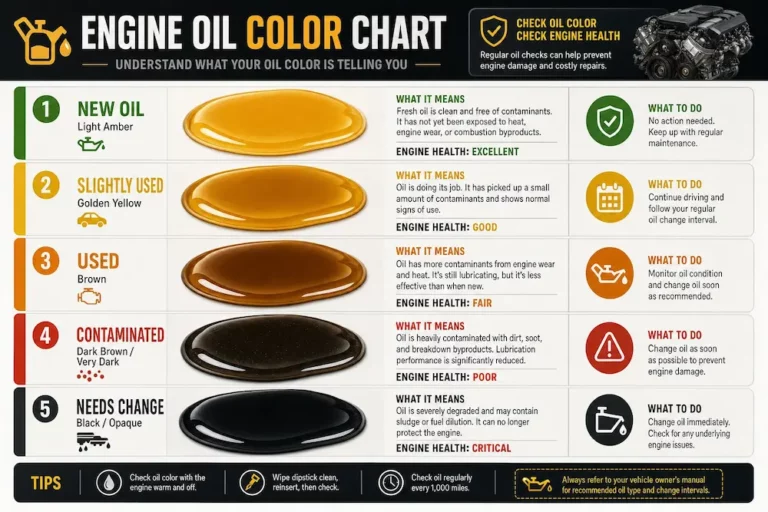
Fresh engine oil should look golden or light brown and slightly translucent. That’s your healthy baseline. As the oil does its job, it darkens — moving through amber, brown, and eventually black. Most of that darkening is completely normal.
The colours that actually demand your attention? Milky white, frothy, or anything resembling chocolate milk. More on that in a moment.
Fresh Oil: What Golden Actually Looks Like
New engine oil straight out of the bottle typically ranges from pale gold to light amber. Hold your dipstick up to natural light — you should see through it easily, almost like diluted honey.
This golden colour tells you the oil is clean, free from combustion byproducts, and ready to protect your engine. If your oil looks this good after 500 miles? That’s a good sign your engine is clean inside.
But if the gold fades to dark brown within days of an oil change, pay attention. That suggests either extremely high operating temperatures or a lot of old, dirty residual oil stayed behind when you drained it.
Does the Type of Oil Change the Starting Colour?
Yes, slightly. Here’s what to expect fresh out of the bottle:
- Conventional oil — Refined directly from crude oil. It starts with a richer, slightly darker amber due to natural impurities. Typically needs changing every 3,000–5,000 miles.
- Synthetic blend — A mix of conventional and synthetic base stocks. Colour closely mirrors conventional oil, but it lasts a bit longer.
- Full synthetic — Engineered in a lab with highly uniform molecules. Starts exceptionally clear and pale gold. Resists darkening longer than the other two.
High-mileage synthetic formulas often include extra seal conditioners to protect older gaskets. These additives rarely change the golden colour, but they do make a real difference for engines with over 75,000 miles.
Why Oil Turns Amber and Brown (And Why That’s Fine)
Once your oil starts doing its job, it darkens. That amber-to-brown shift is normal and expected. Two things drive it: heat cycles and detergent activity.
Heat Cycles and Oxidation
Every time you drive and park, your engine goes through a full heat cycle — from cold to around 195–220°F, then back down to ambient temperature. Do that twice a day, five days a week, and you’ve run 50+ heat cycles in a single month.
Those repeated temperature swings cause thermal degradation and oxidation. Oxidation is the same chemical process that turns sliced apples brown or makes iron rust. It darkens the oil and slowly depletes its alkaline reserves. Full synthetics resist this far better than conventional oils because of their more uniform molecular structure.
The Detergent Effect
Modern engine oil actively cleans your engine. Its detergent additives break loose carbon deposits, varnish, and sludge from internal surfaces. Once those deposits come free, dispersant additives grab them and hold them in suspension within the fluid.
Dark brown oil is often proof this is working correctly. The oil got darker because it’s doing its job — capturing gunk so it doesn’t stick to your engine.
Black Oil: The Big Myth You Need to Drop
Here’s the most common misconception in DIY car maintenance: black oil is bad oil that needs changing immediately.
That’s not true. Black oil is not automatically dead oil.
Soot Is the Culprit — and It’s Not Actually Dangerous
The main reason oil turns black is soot. Soot is a carbon-rich particle produced when fuel doesn’t burn completely. Individual soot particles are incredibly tiny — sub-micron up to about 5 microns. For reference, a human hair is roughly 70 microns wide.
At that size, individual soot particles can’t scratch engine bearings. The problem only starts when they clump together into larger, abrasive masses. That’s where dispersant additives step in — they coat each particle and prevent clumping.
When you see black oil on the dipstick, you’re often looking at billions of tiny soot particles safely trapped in suspension by your oil’s dispersants. That’s the additive package working exactly as intended.
Why Can’t the Oil Filter Just Remove the Soot?
Your standard oil filter captures particles above 20–30 microns. Sub-micron soot particles sail straight through the filter media without getting caught. Even advanced bypass filtration systems — which filter down to 2 microns — can’t capture all of it.
So your oil will always look black once it’s accumulating miles. That’s normal.
When Black Oil Actually Is a Problem
Black oil combined with a gritty or thick texture is a different story. Rub a drop between your fingers. If it feels abrasive — like there’s fine sand in it — your oil filter has likely clogged and entered bypass mode, circulating unfiltered oil directly through the engine.
At that point, abrasive particles are actively wearing your bearings. Change the oil and filter immediately.
Why Diesel Oil Turns Black So Fast
If you’ve just switched from a gas-powered car to a diesel truck, seeing pitch-black oil within a few hundred miles of a fresh change can feel alarming. It’s not. It’s actually normal for diesel engines.
Diesel engines run on compression ignition — no spark plugs, just extreme pressure that spontaneously combusts the fuel. That process generates far more soot per combustion event than a gasoline engine.
On top of that, most modern diesel engines use Exhaust Gas Recirculation (EGR). This system routes exhaust gases back into the intake to lower combustion temperatures and reduce nitrogen oxide emissions. The side effect? More soot enters the cylinders and blows past the piston rings into the oil.
When you do an oil change on a diesel, fresh oil immediately mixes with residual soot-laden oil that couldn’t drain from the block. The dispersants grab that residual soot instantly. Result: black oil before you’ve left the driveway.
| Engine Type | Primary Blackening Cause | Time to Turn Black | What Black Oil Means |
|---|---|---|---|
| Standard Gasoline | Heat cycles, moderate soot | Thousands of miles | Normal — dispersants working |
| Direct-Injection Gas | Higher soot from fuel delivery | Moderate mileage | Normal — robust dispersants active |
| Heavy-Duty Diesel | High-compression blow-by, EGR soot | Immediately or within 100–200 miles | Normal — heavy-duty additives doing their job |
The Colours That Mean Stop Driving
Not every colour change is benign. Two visual warning signs demand immediate action.
Milky, Frothy, or “Chocolate Milk” Oil
If your dipstick shows milky, frothy, or opaque white-brown oil, stop driving. Don’t even start the engine.
This colour means water or coolant has mixed with the oil. Oil and water don’t naturally mix, but the violent agitation inside a running engine forces them to emulsify. The result looks like a chocolate milkshake — and it destroys your engine’s ability to lubricate.
Here’s what happens: the emulsified oil creates foam bubbles. When those bubbles reach your engine bearings under pressure, they rupture and leave metal surfaces completely unprotected. Rapid, severe bearing damage follows.
The most likely culprit is a blown head gasket. The gasket seals the coolant channels away from the oil galleries. When it fails, pressurised coolant pushes directly into the oil.
Do not drive the vehicle. Continued operation will destroy the engine.
White Residue Under the Oil Cap (The Non-Emergency Version)
There’s an important distinction here. If you remove the oil filler cap and see a small amount of white or yellowish goop stuck to the underside — but the actual dipstick oil looks normal — you likely don’t have a head gasket problem.
In cold climates, condensation forms inside the valve cover when a hot engine cools down in freezing air. Moisture in the air condenses on the cold plastic and metal surfaces. If you only drive short trips, the engine never gets hot enough to burn it off.
Fix: Take the car on a sustained highway drive for 30–45 minutes. The elevated oil temperature will evaporate the moisture.
The Special Case of Coloured and Dyed Oils
Some oils don’t start golden at all. If you see unusual colours in fresh oil, here’s what’s going on:
Purple oil — Royal Purple adds a synthetic dye purely for brand identity. The colour fades quickly once the oil circulates through a hot engine. It’ll turn brown and black like any other oil. The dye does nothing for lubrication performance.
Red tint — Certain synthetic oils with high concentrations of molybdenum-based friction modifiers have a natural reddish hue from the additive chemistry. As it heats through cycles, it darkens to rusty brown. Totally normal.
Greenish-blue — Some European synthetic oils formulated to meet specific Volkswagen standards have this colour due to mandated additive packages.
Fluorescent green — Oils like Liqui-Moly Molygen use a glowing green dye that serves a real purpose: making oil leaks easier to spot in a dark engine bay. If your engine wasn’t filled with fluorescent green oil and you see it, that’s a contamination warning.
| Oil Colour (Fresh) | Why It Looks That Way | Should You Be Concerned? |
|---|---|---|
| Golden / Light Amber | Normal refined base stock | No — this is ideal |
| Purple | Artificial dye (e.g., Royal Purple) | No — fades quickly during use |
| Reddish | Molybdenum-based friction modifiers | No — normal for those formulations |
| Greenish-Blue | European OEM-mandated additives | No — by design |
| Fluorescent Green | Diagnostic dye (e.g., Liqui-Moly) | Only if you didn’t put it in |
| Milky / Frothy | Water or coolant contamination | Yes — stop driving |
How Often Should You Actually Change Your Oil?
Visual colour checks alone won’t tell you when to change your oil. Black oil might have thousands of miles of life left. Golden oil with invisible fuel dilution might be chemically ruined.
The 3,000-mile rule is outdated. It made sense for older engines using early conventional oils, but modern engines and modern synthetics have made it obsolete. Most vehicles today run comfortably on 5,000–10,000 mile intervals. Some premium synthetic formulations are rated for up to 15,000–25,000 miles under ideal conditions.
Trust Your Oil Life Monitor
Most modern vehicles have an onboard Oil Life Monitoring system. It’s not a simple mileage countdown — it’s an algorithm tracking real driving data: engine revolutions, temperatures, cold start frequency, idle time, and load.
A highway commuter might see 10,000 miles before the alert triggers. A city driver doing daily 3-mile cold-start trips might see 5,000 miles from the same vehicle. The algorithm accounts for the difference.
When your dashboard monitor conflicts with the sticker on your windshield from a quick-lube shop — trust the monitor, provided you’re using the exact oil spec your manufacturer requires.
Severe Conditions Shorten Everything
Even the best synthetic oil degrades faster under tough conditions. Severe service includes:
- Frequent short trips under 5 miles — Engine never reaches temperature, moisture builds up, sludge forms faster
- Stop-and-go city traffic — Constant load fluctuations and heat spikes stress the oil
- Heavy towing or hauling — Extreme cylinder pressures accelerate blow-by and oxidation
- Dusty or unpaved roads — Abrasive particles can bypass air filtration
- Very low annual mileage — Oil oxidises just sitting in the crankcase; change it every 12 months regardless of miles
If any of these apply to you, follow the shorter interval in your owner’s manual — not the maximum mileage on the bottle.
The Most Accurate Method: Used Oil Analysis
If you want to know exactly what’s in your oil — wear metals, contaminant levels, remaining additive strength, viscosity breakdown — send a sample to a tribology lab.
Used Oil Analysis detects elevated iron (worn cylinders), sodium or potassium (microscopic coolant leak), silicon (failed air filter), and unburned fuel — all before any visible symptoms appear. It’s the only method that removes all the guesswork.
It’s especially useful if you’re pushing extended drain intervals on a high-mileage engine or a turbocharged vehicle.
The Quick Reference: What Colour Is Your Oil?
| Oil Colour | What It Means | What to Do |
|---|---|---|
| Golden / Light Amber | Fresh, clean, healthy oil | Nothing — you’re good |
| Amber / Dark Amber | Normal early aging, detergents working | Monitor mileage and oil life monitor |
| Dark Brown | Oil actively suspending contaminants | Check interval; normal if within schedule |
| Black (smooth texture) | High soot load, dispersants working | Check mileage; change if interval is due |
| Black (gritty texture) | Filter bypassed, abrasives circulating | Change oil and filter immediately |
| Milky / Frothy / White-Brown | Coolant or water contamination | Stop driving — get it inspected now |
| Purple / Red / Blue-Green | Dyed or speciality additive formulation | No concern if that’s what you filled |
| Fluorescent Green (unexpected) | Possible coolant or fluid cross-contamination | Investigate immediately |
The simplest rule: check your dipstick every few fill-ups. You’re looking for texture and level as much as colour. Smooth, slick, and at the right level? You’re fine. Gritty, foamy, or milky? Act fast.