Choosing between a 2 stroke engine vs 4 stroke engine used to be simple. Now, with emissions laws reshaping the market and manufacturers scrambling to adapt, the stakes are higher than ever. Whether you ride dirt bikes, maintain a lawn, or run a boat, this guide breaks down exactly how each engine works, which lasts longer, and what the new regulations mean for you.
How a 4 Stroke Engine Actually Works
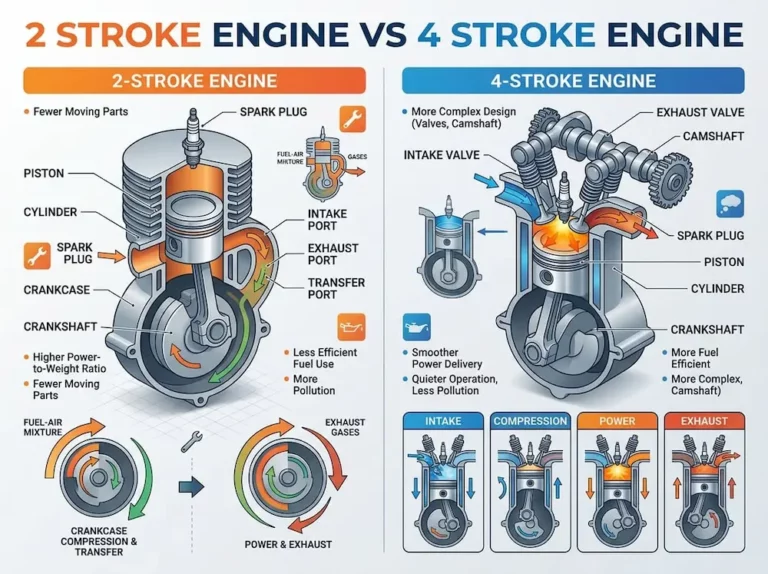
A 4 stroke engine completes one full power cycle across four distinct piston movements and two full crankshaft rotations. Each stroke has one job, and a mechanical valvetrain — camshafts, timing chains, and poppet valves — handles all the gas flow.
Here’s the sequence:
- Intake stroke: The piston drops, the intake valve opens, and the engine pulls in a fresh air and fuel mix
- Compression stroke: Both valves close, the piston rises, and squeezes that mixture tight
- Power stroke: The spark plug fires, the explosion drives the piston down hard — this is the only stroke that makes power
- Exhaust stroke: The exhaust valve opens, the piston rises again, and pushes burned gases out
Because a 4 stroke only produces power once every two revolutions, it needs a heavier flywheel to stay smooth between combustion events. That valvetrain adds weight and cost, but it also delivers broad, low-end torque that’s incredibly useful for generators, mowers, and long-distance riding.
How a 2 Stroke Engine Actually Works
A 2 stroke engine skips the dedicated valvetrain entirely. Instead, it uses ports cut into the cylinder wall, and the piston itself acts as the valve, covering and uncovering those openings as it moves.
The entire cycle happens in just two strokes — one crankshaft revolution:
- Upstroke: The piston compresses the fuel-air mix above while simultaneously drawing a fresh charge into the crankcase below
- Downstroke: Combustion drives the piston down, which opens the exhaust port first, then the transfer port, pushing spent gases out while fresh mixture rushes in — a process called scavenging
Because the engine fires on every single revolution, a 2 stroke produces twice the power pulses of an equivalent 4 stroke. That’s why a lightweight 125cc 2 stroke dirt bike can feel as snappy as a 250cc 4 stroke.
2 Stroke Engine vs 4 Stroke Engine: Side-by-Side Comparison
| Feature | 4 Stroke Engine | 2 Stroke Engine |
|---|---|---|
| Power strokes | One per two revolutions | One per revolution |
| Gas management | Mechanical valves and cams | Piston covers/uncovers ports |
| Moving parts | High complexity | Low complexity |
| Torque delivery | Smooth, strong at low RPM | Peaky, needs high RPM |
| Weight | Heavier | Lighter |
| Fuel efficiency | Better | Worse |
| Smoke output | Virtually none | Visible blue smoke |
The Lubrication Gap: Where Each Engine Really Differs
This is where the 2 stroke engine vs 4 stroke engine debate gets genuinely important for long-term costs.
4 Stroke: Closed-Loop Oil System
Four strokes run a completely isolated pressurized oil system. An oil pump circulates filtered, high-viscosity motor oil through galleries in the block and head, continuously bathing every bearing and friction point. The oil never enters the combustion chamber, so there’s no burning it off and no visible smoke. With regular oil changes, a commercial-grade 4 stroke mower engine can easily clear 1,500 hours of hard use before needing major work.
2 Stroke: Total-Loss Lubrication
Two strokes can’t use a traditional oil sump. The crankcase has to stay sealed to pressurize the fresh charge, so lubricating oil gets mixed directly into the fuel — either pre-mixed by the rider or metered by an automatic injection pump. That oil travels through the engine and gets burned with every single power stroke.
The result? Blue smoke, oil particulates in the exhaust, and much thinner lubrication overall. Combined with firing twice as often, 2 strokes wear faster. Most operators expect routine top-end rebuilds — piston and ring replacements — as part of normal upkeep.
Honda’s Fix: The Rotary Slinger System
Traditional 4 strokes can’t run sideways or upside down. Tip one over and oil floods the combustion chamber or starves the pump. That made them useless for handheld trimmers.
Honda cracked this problem with the GX25 and GX35 engines, which use a patented rotary slinger system. A spinning wheel inside a cylindrical oil tank agitates the oil into a fine mist that gets pulled through the entire engine by crankcase pressure pulsations — regardless of angle. The mist lubricates everything, condenses back to liquid in the valve chamber, and drains back to the reservoir.
The GX25 weighs just 2.78 kg, runs upside down, and meets federal emissions standards. It effectively took away one of the 2 stroke’s last exclusive advantages.
Maintenance and Lifespan: What to Realistically Expect
| Maintenance Factor | 2 Stroke Utility Engine | 4 Stroke Utility Engine |
|---|---|---|
| Lubrication maintenance | Monitor fuel-oil mix ratio constantly | Oil changes every 50–100 hours |
| Valvetrain service | None needed | Periodic valve clearance checks |
| Common failure mode | Piston ring wear, cylinder scoring | Valvetrain wear from skipped oil changes |
| Rebuild frequency | High — top-end rebuilds are routine | Low — rarely needs the head pulled |
| Expected commercial lifespan | 800–1,000 hours | 1,500+ hours |
| Repair complexity | Simple, basic hand tools | Complex, requires precision tooling |
Power Delivery: Which Engine Wins Where
2 Strokes Dominate Where Agility Matters
A 2 stroke’s peaky, high-RPM power band is a feature in the right context. Motocross racers and extreme enduro riders love them for instant throttle response and featherweight handling. No heavy valvetrain means the bike flicks around faster in technical terrain.
The catch: you have to keep the engine in its narrow power band. Let the RPM drop and you’re riding a slug.
4 Strokes Win for Sustained, Heavy-Duty Work
Four strokes produce wide, predictable torque across a broad RPM range. You don’t need to pin the throttle to get real work done. That’s why they dominate generators, agricultural pumps, riding mowers, and touring motorcycles. Consistent pulling power beats peaky bursts when you’re mowing acres or running equipment all day.
The Environmental Problem and the 2 Stroke’s Existential Crisis
Traditional carbureted 2 strokes short-circuit during scavenging — fresh fuel literally shoots across the cylinder and out the exhaust unburned. That means raw hydrocarbons hit the atmosphere directly, where they react with sunlight to create ground-level ozone and smog. Burning oil every combustion event adds fine particulate matter that damages lung tissue.
The scale of this is striking. CARB data shows that running a commercial gas leaf blower for one hour generates the same smog-forming emissions as driving a modern car over 1,100 miles. By 2020, small utility engines in California alone were pumping out 125 tons per day of reactive organic gases — more than the state’s entire fleet of passenger cars.
How Manufacturers Are Fighting Back
KTM’s Transfer Port Injection: Saving the 2 Stroke
KTM refused to let the 2 stroke die. Their Transfer Port Injection system on models like the 300 EXC TPI kills the carburetor and places twin electronic injectors directly into the transfer ports. Fuel only enters after the exhaust port closes, completely eliminating short-circuiting. A dedicated oil pump replaces manual pre-mixing.
The result: smoother power delivery, dramatically better fuel economy, automatic altitude compensation, and emissions compliance. KTM has since developed Throttle Body Injection for riders who want that crisp, aggressive throttle response back alongside easier aftermarket tuning.
Evinrude E-TEC: A Brilliant Engine That Lost the War
In marine outboards, traditional 2 strokes were dumping up to 30% of their fuel directly into waterways unburned. Evinrude’s E-TEC direct injection system fixed that beautifully — injecting fuel only after the exhaust port closed, matching four-stroke emissions while retaining 2 stroke torque and weight advantages.
Despite the engineering win, Bombardier shut Evinrude down in May 2020. The reasons? A botched G2 engine launch in 2014 with quality issues, a polarizing design that alienated dealers, no engine above 300 horsepower to compete in the lucrative offshore market, and the COVID-19 pandemic delivering the final blow. Consumers had already voted for quiet, reliable four-strokes from Yamaha, Honda, and Mercury.
The Regulatory Landscape: EPA Rules and California’s Gas Equipment Ban
EPA’s Phased Standards
The EPA regulates all nonroad small spark-ignition engines at or below 19 kilowatts through a multi-phase framework:
- Phase 1 (1995): Basic carburetor tuning improvements
- Phase 2 (2000–2007): Mandated a 70% reduction in hydrocarbon and NOx emissions — effectively forced 2 strokes out of larger nonhandheld equipment entirely
- Phase 3 (2011–2012): Added tight evaporative emission controls, requiring low-permeability fuel tanks and multi-layered fuel lines to stop gasoline vapors from seeping through plastic storage containers
Engines must also maintain compliance throughout their designated useful life — from 50 hours for small residential trimmers up to 1,000 hours for heavy commercial equipment.
California’s SORE Ban: The Biggest Shift Yet
In October 2021, California signed Assembly Bill 1346 into law. Starting January 1, 2024:
- Banned: New gas-powered lawnmowers, leaf blowers, trimmers, edgers, and chainsaws from retail sale
- Allowed: Zero-emission (battery-electric or corded) equivalents only
- Exempted: Existing equipment already owned, used equipment sales, farm implements under 175 hp, and diesel equipment
- Generators and pressure washers: Face stricter interim emissions standards now, with a full zero-emission sales mandate arriving in 2028
The commercial landscaping fallout is significant. Commercial-grade electric riding mowers frequently cost double their gas counterparts — over $20,000 per unit. Crews running 8–10 hour shifts can’t refuel from a jerrycan when a battery dies. California allocated $30 million in rebates through the Clean Off-Road Equipment Voucher Incentive Project, but industry groups argue it’s far short of what small operators need.
The ripple effect is spreading fast. New York, Illinois, Minnesota, and Washington are actively debating similar legislation. Over 100 cities — including Denver and Burlington — have already banned gas-powered leaf blowers locally. Even Texas cities like Dallas are running voluntary rebate programs to push commercial operators toward electric equipment.
Because manufacturers won’t tool up separate product lines for California and the rest of the country, what California mandates tends to become the national standard by default.
Which Engine Should You Choose Right Now?
Here’s the practical breakdown before you spend money:
Choose a 2 stroke if you:
- Race motocross or ride extreme enduro and want maximum power-to-weight
- Need a lightweight, simple engine for short-burst high-performance work
- Are comfortable with frequent top-end maintenance and don’t mind pre-mixing fuel
Choose a 4 stroke if you:
- Run commercial landscaping equipment and need reliability over hundreds of hours
- Use a generator, pump, or riding mower where steady torque matters more than weight
- Want lower long-term maintenance costs and cleaner operation
- Live in California or a state with strict emissions rules — a 4 stroke or electric is often your only legal option for new equipment purchases
The 2 stroke engine vs 4 stroke engine debate doesn’t have one universal winner. It depends entirely on what you’re doing with it, how long you need it to last, and increasingly — where you live and what the law allows.