Your engine oil is trying to tell you something. Pull out that dipstick and you’ll get an instant snapshot of what’s happening inside your engine. This guide breaks down exactly what each color means, what smells to watch for, and how to check your oil correctly — so keep reading.
The Car Oil Color Chart: A Quick Visual Guide
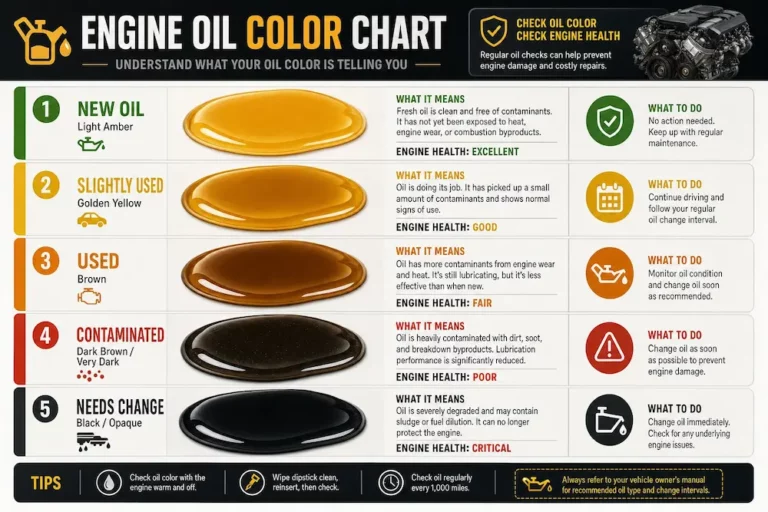
Before diving into the details, here’s your go-to car oil color chart at a glance:
| Oil Color | What It Looks Like | What It Means | What To Do |
|---|---|---|---|
| Amber / Golden | Clear, honey-like | Fresh, healthy oil | Keep driving, monitor normally |
| Dark Brown | Opaque brown, smooth | Oil doing its job | Schedule routine change by mileage |
| Black | Pitch black, thick | Saturated or overdue | Change oil immediately |
| Milky / Creamy | Frothy, coffee-milkshake look | Water or coolant contamination | Stop driving, inspect immediately |
| Gray / Metallic | Dark gray, glittery shimmer | Metal particles circulating | Stop driving, get a full inspection |
| Green | Distinct green hue | High-zinc oil or recycled base stock | Verify your oil brand |
| Purple | Deep purple tint | Royal Purple brand dye only | No action needed |
Now let’s dig into each one.
Amber and Golden Oil: You’re in Good Shape
Fresh engine oil straight from the bottle looks clear and golden — like liquid honey. That color tells you the oil is clean, uncontaminated, and working at full capacity.
At this stage, the oil’s additive package is firing on all cylinders. Modern oils contain up to 30% additives by volume — friction modifiers, anti-wear agents, antioxidants, and foam inhibitors. All of them are fresh and effective.
Here’s the thing though: that golden color won’t last long. The second your engine fires up, the oil starts cleaning internal engine surfaces. Darkening quickly doesn’t mean something’s wrong — it usually means the oil is working exactly as intended.
Dark Brown Oil: Normal and Expected
Dark brown oil is the most common thing you’ll see on a dipstick. It’s not a red flag — it’s a green light that your oil’s detergents are doing their job.
As oil circulates, it picks up carbon deposits, microscopic dirt, and soot from combustion. Chemical dispersants in the oil grab these particles and hold them in suspension, stopping them from clumping into sludge that blocks engine passages.
The result? Darker oil. That’s normal.
The only time dark brown oil demands action is when it feels gritty between your fingers or when you’re past your manufacturer’s recommended mileage interval. Base your oil change on mileage and time, not color alone.
Black Oil: Time to Act
Pitch-black, thick, sluggish oil signals that the fluid has hit its contamination limit. The dispersants can’t hold any more debris, and what’s left is dragging across your engine’s moving parts.
One important exception: diesel engines. Diesel combustion naturally produces massive amounts of soot. A diesel engine can turn fresh oil jet black within a few hundred miles — and that’s completely normal. Black oil in a diesel doesn’t equal failed oil, provided you’re using the correct heavy-duty grade and a quality filter.
For gasoline engines, watch for these warning signs alongside black oil:
- Gritty or thick texture when rubbed between fingers
- Burnt smell
- Sluggish engine performance
If you notice any of those with black oil, schedule an oil and filter change right away.
Milky or Creamy Oil: Stop Driving Now
This is one of the most serious findings on the car oil color chart. Milky, frothy, or creamy oil — the kind that looks like a chocolate milkshake — means water or engine coolant has mixed into your lubrication system.
Water destroys oil’s film strength. It can also clog narrow oil passages and starve critical engine components of lubrication.
Two main causes create this nightmare:
1. Mechanical Failure
A blown head gasket is the most common culprit. The gasket separates oil and coolant passages inside the engine. When it fails, pressurized coolant pushes directly into the oil. Other causes include a cracked engine block, cracked cylinder head, or a failed internal oil cooler. Watch for these accompanying symptoms:
- Unexplained coolant loss
- Rapid overheating
- Thick white smoke from the exhaust
2. Condensation from Short Trips
In humid climates, moisture naturally enters the crankcase. Normally, a long drive evaporates it through the Positive Crankcase Ventilation system. But frequent short trips under five miles prevent that evaporation. Over time, you’ll see milky residue — often most visible under the oil filler cap.
Short-trip condensation can sometimes clear up with a good highway drive. A mechanical coolant leak cannot. Don’t drive it until a mechanic confirms the cause.
Gray or Metallic Oil: Engine Damage Alert
Gray oil with a glittery, metallic shimmer means metal particles are circulating through your engine. These shavings typically come from failing bearings, worn camshaft lobes, damaged piston rings, or scored cylinder walls.
A small amount of microscopic wear happens naturally and gets caught by the oil filter. Visible metallic flakes or a gritty texture you can feel between your fingers? That’s a different story entirely.
Keep driving and you’ll send those metal shavings through the oil pump, scoring every surface they touch. Stop the vehicle and get a professional diagnostic immediately.
Green, Purple, and Specialty Oil Colors
Not all unusual oil colors signal a problem. Some are completely intentional.
Why Some Motor Oil Is Green
Green motor oil has a rich history in American automotive culture. The Kendall Refinery in Bradford, Pennsylvania, developed a distinctive dark green racing oil — Kendall GT-1 — using low-sulfur Pennsylvania crude. That oil became legendary in drag racing for its heat resistance and mechanical shear stability. Today, it’s sold as PennGrade 1, formerly Brad Penn.
These green racing oils contain high levels of zinc and phosphorus anti-wear additives. That’s critical for older vehicles with flat-tappet camshafts, which destroy themselves without adequate zinc levels. Modern passenger car oils drastically reduced zinc to protect catalytic converters — making high-zinc green oil essential for vintage muscle cars and race builds.
Green oil can also mean something completely different: recycled lubricant. Companies like Safety-Kleen’s EcoPower produce re-refined motor oil from reclaimed used oil. It meets standard performance benchmarks while reducing dependence on new crude extraction.
If you see unexpected green oil on a vehicle that doesn’t use a specialty product, check for coolant cross-contamination.
Why Royal Purple Oil Is Actually Purple
Royal Purple dyes its oil purple purely for brand identity — it has zero effect on performance. Founded in 1986, the company reportedly chose the color after a customer said they’d never seen purple oil before. The branding stuck so well that Royal Purple now holds a U.S. federal trademark for purple containers in the lubricant market.
As the oil heats up and accumulates mileage, the dye breaks down and the oil returns to standard dark brown. Don’t panic when the purple disappears — monitor viscosity and mileage instead.
What Your Oil’s Smell Is Telling You
The car oil color chart only covers half the diagnostic picture. Odor matters too.
Gas Smell = Fuel Dilution
A sharp gasoline odor on the dipstick means raw fuel is washing into the crankcase. Fuel dilution thins the oil severely, strips the protective film from metal surfaces, and accelerates bearing wear. Common causes include:
- Leaking or stuck-open fuel injectors
- Worn piston rings
- Engine misfires
- Constant short-distance cold starts
Minimize driving and get a mechanic to check the fuel delivery system.
Sweet Smell = Coolant Leak
A maple syrup or candy-like odor near the engine almost always means ethylene glycol — the main ingredient in engine coolant — is present where it shouldn’t be. If that sweet smell is coming directly off the dipstick, you’ve likely got a blown intake manifold gasket or head gasket leak. This usually pairs with milky oil.
Burnt Smell = Oil Burning on Hot Surfaces
A bitter, acrid burning odor usually means oil is leaking externally onto the exhaust manifold or catalytic converter. It can also mean the engine is severely overheating, or the oil level is critically low. Either way, check your oil level immediately.
Conventional vs. Synthetic: How Oil Type Affects Color Change
Not all oils darken at the same rate. Understanding oil types helps you interpret the car oil color chart more accurately.
| Oil Type | Base Stock | Typical Change Interval | Best For |
|---|---|---|---|
| Conventional | Refined crude oil | 3,000–5,000 miles | Older, simpler engines |
| Synthetic Blend | Conventional + synthetic mix | 5,000–7,500 miles | Daily commuters, modern engines |
| Full Synthetic | Uniform synthetic molecules | 7,500–15,000 miles | Turbo engines, extreme conditions |
Full synthetic oil resists thermal breakdown significantly better than conventional oil. Its uniform molecular structure means it doesn’t evaporate or oxidize as quickly. That’s why modern vehicles with turbochargers require synthetic — turbo bearings spin at over 100,000 RPM and generate extreme heat that would cook conventional oil in minutes.
The old 3,000-mile rule? It’s outdated for most modern vehicles. Today’s Oil Life Systems monitor real-time engine conditions — temperature, RPM, trip length, climate — and tell you precisely when to change your oil.
How to Check Your Oil the Right Way
Checking your oil takes under two minutes. Do it at least once a month — don’t rely solely on the dashboard warning light. By the time that light comes on, damage may already be happening.
Here’s the correct process:
- Park on level ground — a sloped surface gives a false reading
- Turn the engine off and wait 10–15 minutes for oil to drain back into the pan
- Find the dipstick — look for a brightly colored (yellow, orange, or red) handle with an oil-can symbol
- Pull it out and wipe it clean with a white rag or paper towel — the first reading is always inaccurate
- Reinsert fully, wait a second, then pull it back out
- Read the level — oil should fall between the min and max marks
- Check the color against your white cloth — note texture, opacity, and odor
If the oil is low, add the manufacturer-specified viscosity one quart at a time. Wait a few minutes and re-check before adding more.
Never overfill. Too much oil gets whipped into foam by the crankshaft, kills oil pressure instantly, and can cause engine failure just as fast as running dry.
Choosing the Right Oil: API Certifications Explained
Color and smell diagnostics only work if you’re using the right oil in the first place. When buying motor oil, skip the marketing and check the API certification marks:
- API Donut — Shows performance level (SP for gasoline, CK-4 for diesel), SAE viscosity grade (like 5W-30), and energy-conserving status
- API Starburst — Confirms the oil meets current ILSAC standards for engine protection and fuel economy
- API Shield — Applies specifically to ultra-low viscosity 0W-16 oils for maximum fuel efficiency
Two bottles from completely different brands carrying the same API Donut and Starburst have passed identical minimum performance standards. Brand prestige matters less than those symbols on the label.
Always match the SAE viscosity grade — like 5W-30 or 0W-20 — to exactly what your owner’s manual specifies. The wrong viscosity can cause sluggish performance or accelerated wear regardless of oil quality.