Picking the wrong headlight bulb wastes money, risks your safety, and might even get you a ticket. The H11 vs H7 bulb debate confuses a lot of drivers because both look similar and pull the same 55 watts. But swap one for the other, and you’re in trouble. This guide breaks down every key difference so you buy right the first time.
What Makes the H11 and H7 Different?
These aren’t just two names for the same bulb. The H11 and H7 are built around completely different engineering goals, physical designs, and regional preferences. One dominates North American and Japanese vehicles. The other rules European roads. Here’s what you need to know about each.
H11 Bulb: Built for Fog and Low Beam Duty
The H11 is a single-filament halogen bulb favored by Toyota, Honda, Ford, and Nissan for low beam and fog light applications.
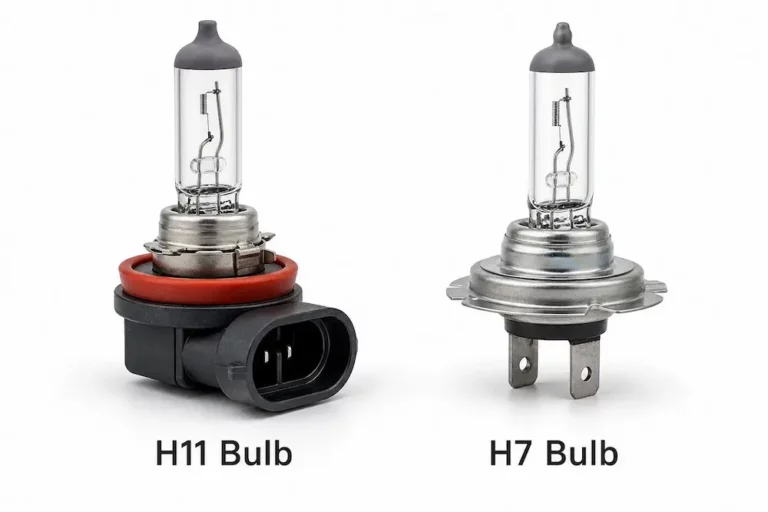
H11 Physical Design
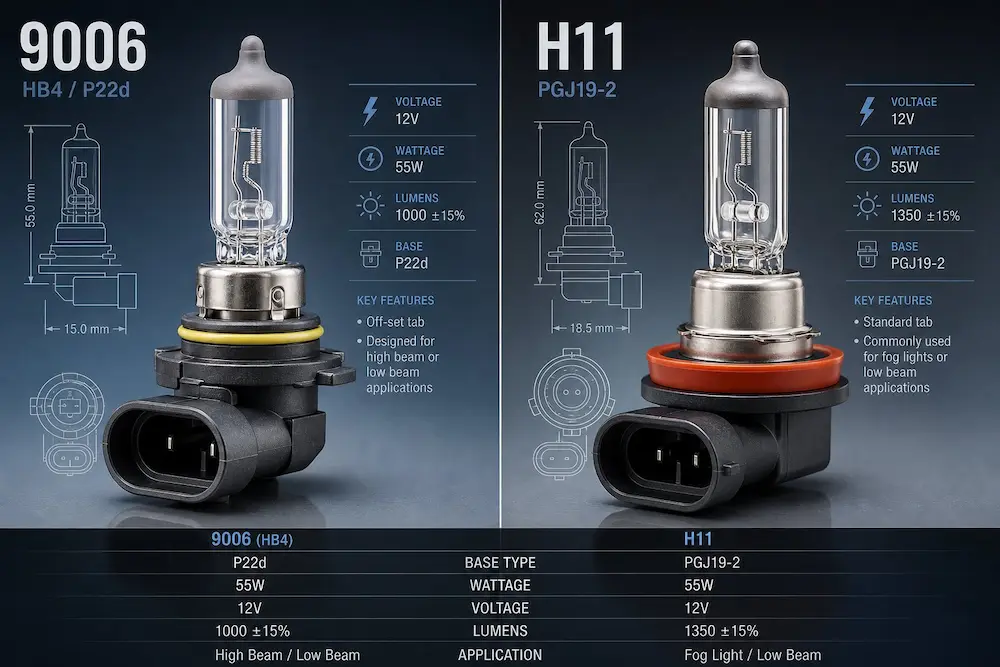
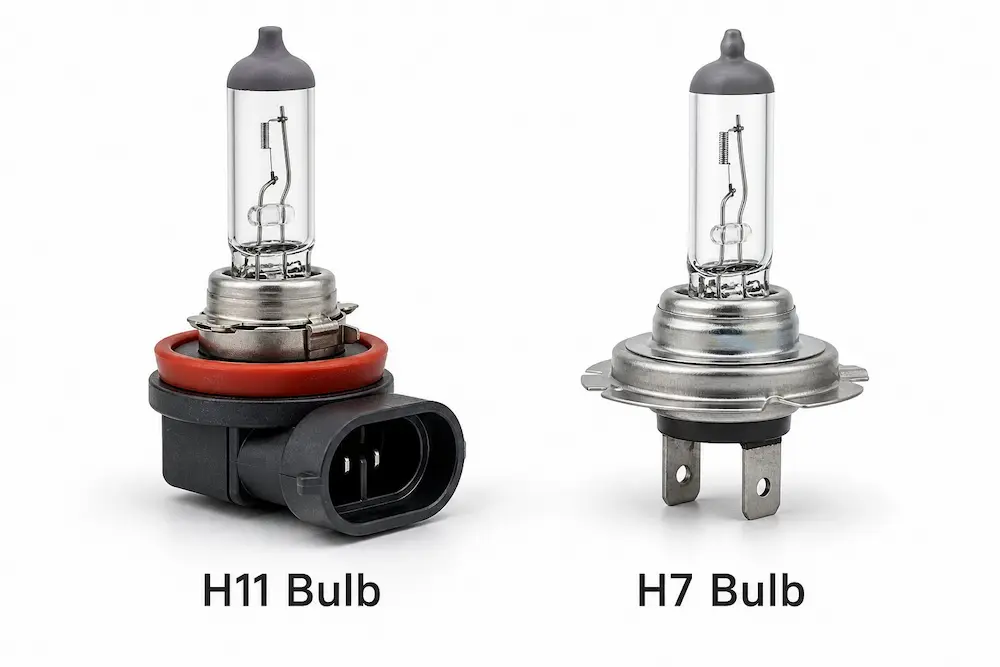
The H11 uses a PGJ19-2 base — an L-shaped plastic connector with two enclosed pins locked inside a weatherproof housing. That sealed design protects electrical contacts from road salt, rain, and debris, which matters a lot for fog lights mounted low on the bumper.
Locking it in place? A narrow, three-blade tab system with one hook-shaped locating tab. It physically prevents you from installing the wrong bulb. The overall size sits at 20.8 mm wide by 67.5 mm tall — compact enough to fit inside tight, aerodynamic headlight assemblies.
H11 Light Output and Performance
- Wattage: 55W (12-volt systems)
- Lumens: 1,200–1,350
- Color temperature: 3,000–3,200 Kelvin (warm yellowish-white)
- Lifespan: 270–800 hours
That warm color temperature isn’t a flaw. It’s intentional. Longer light wavelengths cut through fog, rain, and snow better than cool blue-white light. That’s exactly why the H11 dominates fog light sockets across millions of vehicles.
The beam pattern spreads wide and low, covering the road’s edges and foreground without blinding oncoming drivers.
H7 Bulb: Built for Distance and Dual-Beam Systems
The H7 is also a single-filament halogen bulb, but it’s been the go-to choice for European automakers since 1993. BMW, Audi, Volkswagen, Mercedes-Benz, Hyundai, and Kia all use it heavily.
H7 Physical Design
The H7 uses a PX26d base — a metallic base with two exposed, horizontal prongs sticking straight out. No plastic housing around the contacts. No snap-lock connection.
Instead, the H7 relies on a separate retention system built into the headlamp housing. You’ve got three common types:
- Spring-loaded metal wire clip — clamps over the bulb base
- Friction socket — pushes the bulb in and grips it tight
- Twist-lock adapter ring — common on VW and Mercedes models
That last type makes H7 replacement tricky. You’re working with retaining clips and adapter rings inside confined engine bays. One wrong touch of the quartz glass with your bare fingers deposits skin oils that create hot spots during operation and crack the bulb early.
The H7 is compact: 14.5 mm wide by 55 mm long, though the wide metallic collar adds width at the seating plane.
H7 Light Output and Performance
- Wattage: 55W (up to 70W on 24-volt commercial trucks)
- Lumens: 1,500–1,700
- Color temperature: 3,200–4,300 Kelvin (slightly whiter output)
- Lifespan: 300–500 hours average
The H7 pushes noticeably more light down the road than an H11. European driving conditions — think unlit motorways at high speed — demand that kind of long-range throw. The beam pattern is focused and penetrating rather than wide and soft.
That performance comes with a trade-off: shorter lifespan. Frequent high/low beam switching accelerates filament wear through thermal shock cycles.
H11 vs H7 Bulb: Side-by-Side Comparison
| Specification | H11 | H7 |
|---|---|---|
| Base Type | PGJ19-2 | PX26d |
| Connector Style | Plastic, enclosed pins, L-shaped | Metallic, two exposed straight prongs |
| Retention Method | Twist-and-lock (built into bulb) | Separate clip, friction socket, or adapter |
| Wattage | 55W | 55W (up to 70W commercial) |
| Lumens | 1,200–1,350 | 1,500–1,700 |
| Color Temperature | 3,000–3,200K | 3,200–4,300K |
| Lifespan | 270–800 hours | 300–500 hours |
| Dimensions | 20.8mm × 67.5mm | 14.5mm × 55mm |
| Primary Use | Low beam, fog lights | Low beam, high beam |
| Regional Fit | North America, Japan | Europe, Asia |
| Cross-Compatible? | No | No |
Can You Swap an H11 for an H7?
No. Not even close. The H11 and H7 are physically, mechanically, and electrically incompatible.
The H7’s broad metallic collar won’t fit inside the narrow grooved slots made for the H11’s plastic tabs. Force it in and you’ll crack the headlamp housing. Go the other way and the H11 has no metallic collar for the H7’s retaining spring to clamp onto — it’ll rattle right out.
The wiring connectors don’t match either. The H11 needs a sealed, weatherproof female connector that snaps around its L-shaped plastic housing. The H7 needs a simple block connector sliding over exposed metal prongs. These aren’t adapter problems. They’re fundamental design differences.
Anyone offering you a “simple swap” between these two bulbs is setting you up for a cracked housing and a severed wiring harness.
The H11, H8, and H9 Family: Similar Looks, Very Different Specs
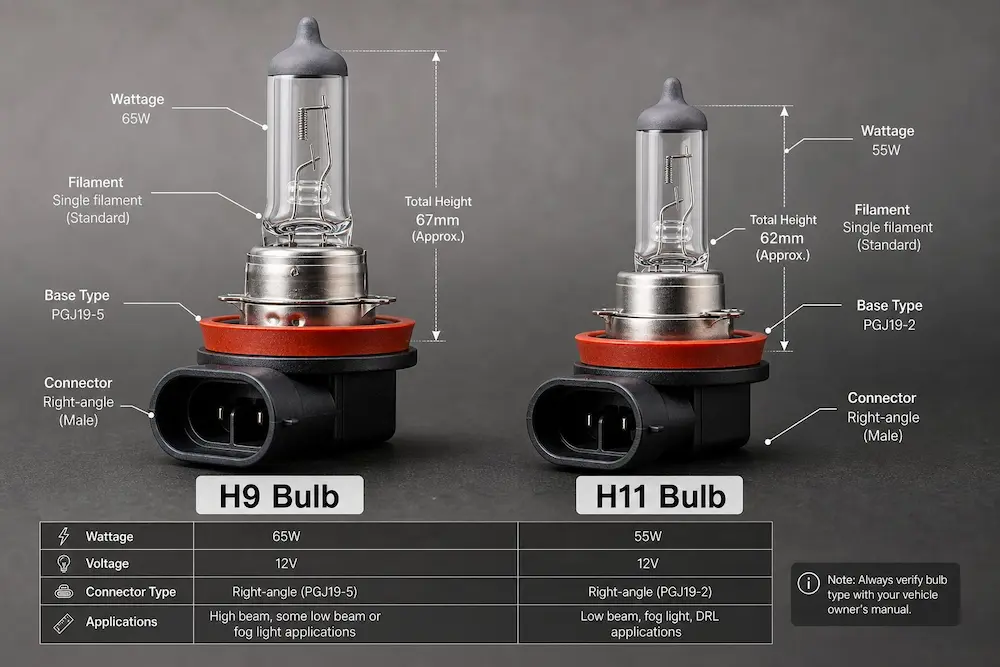
Here’s where things get genuinely dangerous. The H11 belongs to a family that includes the H8 and H9 bulbs. They all look almost identical — same L-shaped plastic housing, same two-pin layout. But their specs are completely different:
| Bulb | Wattage | Lumens | Intended Use |
|---|---|---|---|
| H8 | 35W | 700–900 | Low-intensity fog lights |
| H11 | 55W | 1,200–1,350 | Low beam, fog lights |
| H9 | 65W | ~2,100 | High beam only |
Automotive engineers added subtle mechanical differences — slightly different tab widths, different internal keyways inside the connector plug — to prevent accidental cross-installation. The H9, for example, has an internal plastic divider inside its connector that physically blocks a standard H11 wiring harness from snapping in.
Why the H9-into-H11 Modification Is a Bad Idea
A popular DIY trick involves filing down the H9’s locating tab and slicing out its internal connector keyway so it fits into an H11 low beam socket. Drivers do it chasing that 2,100-lumen output. The results look impressive at first. The consequences aren’t.
Thermal damage: An H9 draws 65W into a housing designed for 55W. That extra heat blisters the reflective coating, melts plastic sockets, and can cause localized electrical fires.
Wiring strain: More amperage through wiring gauged for less current degrades insulation, blows fuses, and triggers computerized lighting modules to cut power entirely.
Glare hazards: The H9 filament lacks the internal shielding needed to create a sharp cutoff line in a low beam housing. The result is blinding glare aimed directly at oncoming drivers.
Short lifespan: H9 bulbs are designed for intermittent high beam use. Running one full-time as a low beam burns it out in roughly 240–320 hours. You’re replacing bulbs every few months.
Skip this modification entirely.
Upgrading to LED or HID: What Actually Works
The appeal is real. LED and HID systems blow halogen out of the water on brightness, efficiency, and longevity. Here’s how the technologies stack up:
| Technology | Lumens | Color Temp | Lifespan | Efficiency |
|---|---|---|---|---|
| Halogen (OEM) | 1,200–1,700 | 3,000–4,300K | 300–1,000 hrs | Low |
| HID (Xenon) | 3,000–5,000+ | 4,300–6,000K | 2,000–8,000 hrs | Medium |
| LED (Premium) | 3,000–7,000+ | 5,000–6,500K | 30,000–50,000+ hrs | High |
HID conversion kits require external ballasts that step voltage up to ~23,000V for arc ignition. They also take 3–10 seconds to reach full brightness, making them lousy for high beam flash applications.
Premium LED bulbs are the stronger upgrade. They’re power-efficient, instant-on, and the best ones last longer than most cars. For H11 applications specifically, many aftermarket LED manufacturers design bulbs with universal collars compatible with H8, H9, and H11 sockets — no trimming required.
However, LEDs come with two engineering hurdles:
Heat management: LED chips generate intense, localized heat. Without proper cooling — aluminum heat sinks, copper thermal ribbons, and micro-turbofans — diodes degrade fast. Those cooling fans can physically conflict with H7 retention clips and adapter rings inside tight housings, making H7 LED installation particularly frustrating.
CANbus compatibility: Modern vehicles monitor electrical resistance to detect burnt bulbs. LEDs draw less power than halogens, so the car’s computer reads them as failed bulbs. You get dashboard warning lights and violent flickering. Fix this with integrated CANbus decoders that mimic the halogen’s electrical signature.
LED Headlight Legality in the United States
This is the part most upgrade guides skim over. The legal situation matters.
The NHTSA enforces Federal Motor Vehicle Safety Standard (FMVSS) 108, which governs all forward lighting on US public roads. The core issue is optical physics. Halogen reflectors are geometrically tuned around a cylindrical, 360-degree-radiating filament. LED chips emit directional light in two 180-degree hemispheres. Drop an LED into a halogen housing and light scatters above the cutoff line — blinding oncoming drivers. According to IIHS testing, 43% of aftermarket LED retrofits fail basic DOT beam pattern requirements.
The NHTSA’s position is clear: retrofitting an LED bulb into a halogen headlamp housing is not legal for US street use. “DOT Approved” labels printed on cheap imported LED bulbs don’t count. The DOT certifies complete headlamp assemblies, not individual replacement bulbs.
As of December 31, 2023, Amazon banned the sale of LED headlamp conversion kits in its US storefront for exactly this reason.
State-level enforcement adds more restrictions:
- Virginia inspectors reject vehicles with LED or HID retrofits in halogen housings
- New York caps low beams at 2,400 lumens and high beams at 3,600 lumens
- California bans blue-tinted headlights and requires auto-leveling on high-intensity setups
What’s Actually Legal
OEM LED systems: Factory-installed LED headlamps pass FMVSS 108 as complete certified assemblies.
Full assembly replacements: Swap the entire headlamp housing for a DOT/SAE-certified unit designed from scratch for LEDs. The beam pattern is controlled and legal.
Fog light exception: FMVSS 108 regulates primary headlamps, not auxiliary fog lights. Installing an H11 LED bulb into a dedicated fog light housing is generally permissible under federal law, subject to state lumen and color limits.
Off-road only: Aftermarket LED retrofits are legal on vehicles that never touch public roads — race cars, agricultural equipment, ATVs, construction machinery. If your vehicle has a license plate and uses public roads even occasionally, retrofit LED headlamp bulbs aren’t legal for it.
How to Find Out Which Bulb Your Car Takes
Don’t guess. Check the owner’s manual first — it’ll list the exact bulb type for each housing. Alternatively, use an online bulb finder tool on sites like Sylvania or Philips with your year, make, and model. The stamped code on your existing bulb also tells you everything. H11 and H7 are both printed clearly on the base collar.
If you’re upgrading rather than replacing like-for-like, check whether a full DOT-compliant LED assembly is available for your specific vehicle. It costs more upfront, but it’s legal, safer, and genuinely brighter.