Replacing a tail light or turn signal bulb sounds simple. But grab the wrong one, and you’re looking at blown fuses, dim lights, or a short circuit that fries your wiring. The 3156 vs 3157 bulb debate trips up a lot of people because these two bulbs look completely identical. Here’s what separates them — and how to avoid a costly mistake.
They Look the Same But Work Completely Differently
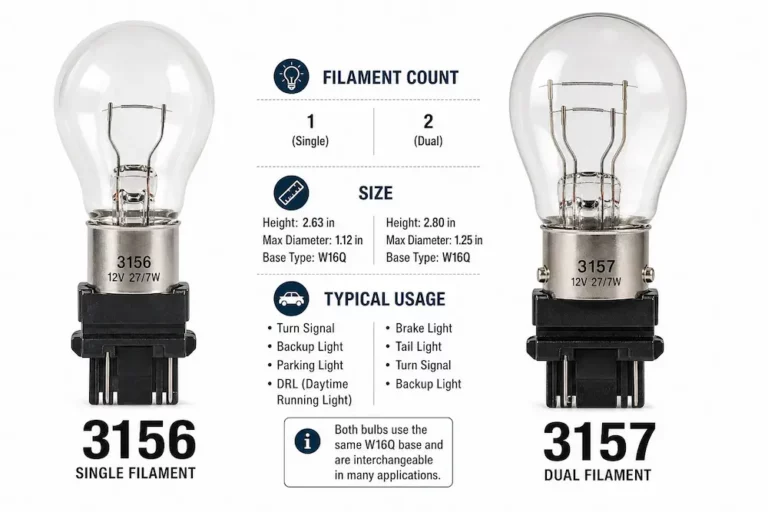
Both bulbs share the same glass shape, same wedge base width, and same physical size. You can literally press either one into the same socket. But inside? They’re built for totally different jobs.
The 3156 is a single-filament bulb. It has one job: turn on or turn off. That’s it.
The 3157 is a dual-filament bulb. It handles two separate functions inside a single housing — like running as a dim tail light and then snapping to a bright brake light the moment you hit the pedal.
That one internal difference changes everything about how these bulbs work, where they fit, and what happens if you swap one for the other.
The Core Specs Side by Side
Here’s the full breakdown before we dig deeper:
| Specification | 3156 Bulb | 3157 Bulb |
|---|---|---|
| Filament Count | Single | Dual |
| External Contact Wires | 2 (W2.5x16d) | 4 (W2.5x16q) |
| Operating Voltage | 12.8V | 12.8V (high) / 14.0V (low) |
| Power Draw | 26.9 watts | 26.9W (high) / 8.3W (low) |
| Light Output | 402 lumens | 402 lumens (high) / 38 lumens (low) |
| Color Temperature | 2800 Kelvin | 2800 Kelvin |
| Typical Use | Reverse lights, dedicated turn signals | Combined tail/brake, parking/turn signals |
What the 3156 Bulb Actually Does
The 3156 is the simpler of the two. It runs on a single circuit, draws 26.9 watts, and produces 402 lumens. One brightness level, full stop.
You’ll find the 3156 in reverse lights most often. Shift into reverse, the circuit closes, the bulb fires at full brightness. Done. No dim mode, no pulse, no secondary function.
It also shows up as a dedicated turn signal in assemblies where the blinker sits in its own housing, completely separate from the parking lights. In that setup, the 3156 just flashes on and off — no need to juggle two brightness levels.
What the 3157 Bulb Actually Does
The 3157 runs two independent circuits inside one bulb. That’s why it has four external contact wires instead of two.
The major (high) circuit draws 26.9 watts and puts out 402 lumens — identical to the 3156’s single output.
The minor (low) circuit draws only 8.3 watts and produces a gentle 38 lumens — just enough to say “I’m here.”
In a combined tail and brake light, the minor circuit stays on as your running light whenever your headlights are active. The second you press the brake, the major circuit kicks in alongside it, flooding the housing with 402 lumens of bright red. That dramatic jump in brightness tells drivers behind you that you’re stopping — fast.
The same logic applies to front parking and turn signal combos. Minor filament glows softly as a parking light. Turn signal stalk engages? Major filament pulses bright amber.
Can You Swap One for the Other?
This is where people get into trouble. And the rules here aren’t symmetric.
Putting a 3157 Into a 3156 Socket: Usually Fine
A 3156 socket only has two active terminals. When you press a 3157 in, two of its four contact wires connect properly. The other two just rest harmlessly against the plastic housing wall.
Result? The 3157 acts like a 3156. You get single-brightness operation from one filament. It’s an acceptable emergency fix — not ideal, but it won’t cause damage.
Putting a 3156 Into a 3157 Socket: Don’t Do It
This one is genuinely dangerous. A 3157 socket has four live terminals carrying power from two separate circuits. The 3156 bulb has broad contact wires that physically bridge across multiple terminals at once.
That bridging creates a direct short circuit between two active power sources. The immediate result is a blown fuse. But if someone keeps replacing the fuse without fixing the root cause, the extreme heat can melt the socket, burn the wiring harness, or damage the body control module.
Bottom line: A 3157 can temporarily replace a 3156. A 3156 must never replace a 3157.
The Hidden Problem: Standard vs. CK Socket Wiring
Here’s a wrinkle most people don’t know about — and it only matters when you’re switching to LED bulbs.
Two different wiring layouts exist for the same 3157-style socket. They look identical from the outside. But inside, the terminal positions are completely different.
Standard wiring puts the positive terminals on one side of the socket and the negative terminals on the other side.
CK (Circuit Kit) wiring groups both negative ground terminals side-by-side on the same flat face of the socket.
Why does this matter? Traditional incandescent bulbs don’t care about polarity. Current can flow either direction across a tungsten filament and it still lights up. But LEDs are polarity-sensitive. Current has to flow in one specific direction.
If you install a standard-polarity LED into a CK-wired socket, the LED’s internal circuit bridges the two ground terminals together and connects them to live power. Instant short circuit. Blown fuse at best. Melted socket and damaged control module at worst.
Which Vehicles Use CK Sockets?
| Manufacturer | Models With CK Sockets | Location |
|---|---|---|
| Toyota | Corolla (2005–2013), Tundra (2006–2019), Tacoma (2005–2015) | Front turn signals |
| Chevrolet/GM | Silverado (2019–2020), Colorado (2016–2020), Equinox (2013–2018) | Front turn signals |
| Nissan | Maxima (2009–2014), Pathfinder (2005), Xterra (2005–2011) | Front turn signals |
| Honda/Acura | Accord Coupe (2013–2015), Pilot (2010–2013), MDX (2004) | Front turn signals |
| Ford | Escape (2008), Expedition (2018–2019), C-MAX (2013–2015) | Front turn signals / tail lights |
How to Test Your Socket Before Installing LEDs
You don’t need fancy equipment. A basic digital multimeter does the job.
- Remove the bulb and turn the ignition off completely
- Set the multimeter to continuity mode
- Touch one probe to a bare metal ground point on the chassis
- Touch the other probe to each of the four terminals inside the empty socket
- Note which terminals complete the circuit (beep or reading)
If the two ground terminals sit on opposite sides of the socket, it’s Standard wiring. If they sit side-by-side on the same flat face, it’s CK wiring. Buy the matching LED type — or look for a universal non-polar LED that handles both configurations automatically.
Upgrading to LED: What You Need to Know
LED replacements for the 3156 and 3157 footprint are genuinely impressive. A quality LED pulls 5–8 watts while producing 1,500–3,000 lumens. Compare that to the original 402 lumens from 26.9 watts of incandescent power.
There’s also a response time advantage. Incandescent filaments need a brief moment to heat up. LEDs fire in nanoseconds. At 60 mph, that difference gives trailing drivers roughly an extra 19 feet of stopping distance when your brake lights activate.
The Hyperflash Problem
Here’s the most common LED upgrade complaint: your turn signals start blinking way too fast after installation.
Your vehicle’s flasher system monitors circuit resistance. A healthy incandescent 3157 draws nearly 27 watts — that load heats a bimetallic strip in the relay and controls flash speed. When an LED drops the load to 5 watts, the relay thinks the bulb burned out and doubles the flash rate as a warning.
The fix? A 50-watt, 6-ohm load resistor wired in parallel across the turn signal circuit. It mimics the incandescent load so the flasher relay behaves normally.
A few important installation notes:
- Wire it correctly. For 3157 applications, connect the resistor between the high-intensity turn signal positive wire and ground only. Tapping the wrong wire causes continuous heating.
- Solder the connections. Skip the plastic T-tap connectors. They cut copper strands and cause voltage drops. Strip the wire, solder the joint, and seal it with heat-shrink tubing.
- Mount it to metal. A 50-watt resistor running through several blinker cycles gets extremely hot. It must bolt directly to a metal surface on the chassis to dissipate heat safely. Leaving it loose against plastic or carpet is a fire risk.
Switchback LEDs for the 3157
One genuinely cool option for front turn signals is a switchback LED. These use two separate sets of diodes — white and amber — inside the same 3157 housing.
Minor circuit on? White diodes glow steadily as a parking light. Turn signal engages? The white cuts out instantly and the amber pulses. Signal off? Back to white. It’s a clean, modern look that a traditional glass bulb physically can’t replicate.
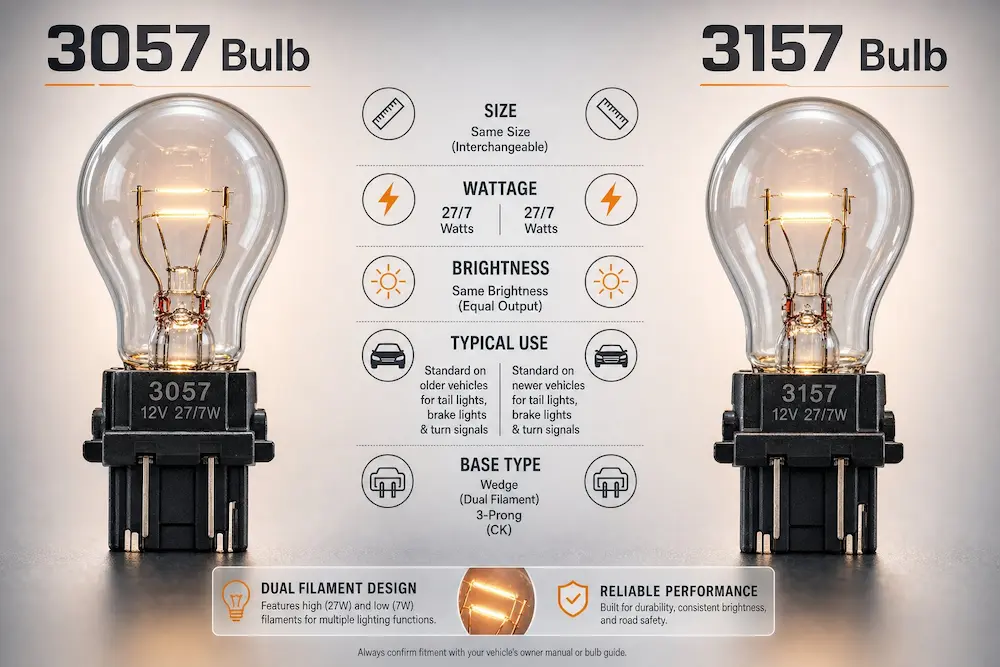
What About the 3057, 3457, and 4157?
These are close relatives of the 3157 that fit the exact same socket:
- 3057 — Dual filament, slightly lower power draw on the minor circuit. Good for fleet vehicles where energy savings matter across thousands of units.
- 3457 — Higher output on the major filament, around 500 lumens. Better for heavily tinted lenses or larger vehicles that need more visibility. Shorter lifespan as a trade-off.
- 4157 — Standard 3157 performance but filled with krypton gas instead of argon. The krypton slows tungsten evaporation significantly, giving it a longer operational life. Common in commercial fleet applications.
Any standard 3157 socket accepts all of these interchangeably. They also come in suffix variants:
- NA = Natural Amber tinted glass (required for clear-lens front turn signals in the U.S.)
- LL = Long Life, heavier filament construction for high-vibration environments
- K = Krypton gas fill for extended lifespan
Corroded Sockets and When Replacement Is Necessary
Sometimes the problem isn’t the bulb at all. Heat from continuous brake light operation can warp the plastic socket housing over years of use. Road salt and moisture that get past failing weather seals corrode the metal contact terminals from shiny conductors into black, resistive scale.
If you install a new bulb and still get dim output, flickering, or no light at all, test voltage at the socket terminals with a multimeter. A significant voltage drop across corroded terminals means the socket needs replacement — not another new bulb.
Aftermarket replacement pigtail assemblies come with high-heat nylon housings and pre-stripped copper wire leads ready for soldering. For tight spaces behind aerodynamic bumpers, right-angle socket designs route the wire leads flush against the back of the housing instead of straight out the rear — preventing dangerous bends that stress and eventually fracture the copper conductors inside.
The Short Version
The 3156 and 3157 bulbs look the same. They’re not. One filament vs. two filaments is the core difference, and getting them mixed up — especially in the wrong direction — causes real electrical damage.
If you’re swapping to LEDs, check your socket wiring type first with a multimeter. Know whether your vehicle uses Standard or CK wiring before you buy anything. And if your turn signals hyperflash after installation, a properly mounted 50-watt load resistor solves it — as long as you solder the connections and bolt the resistor to metal.
Take five minutes to identify what you’re actually working with before touching anything. It’ll save you from a frustrating afternoon chasing blown fuses.