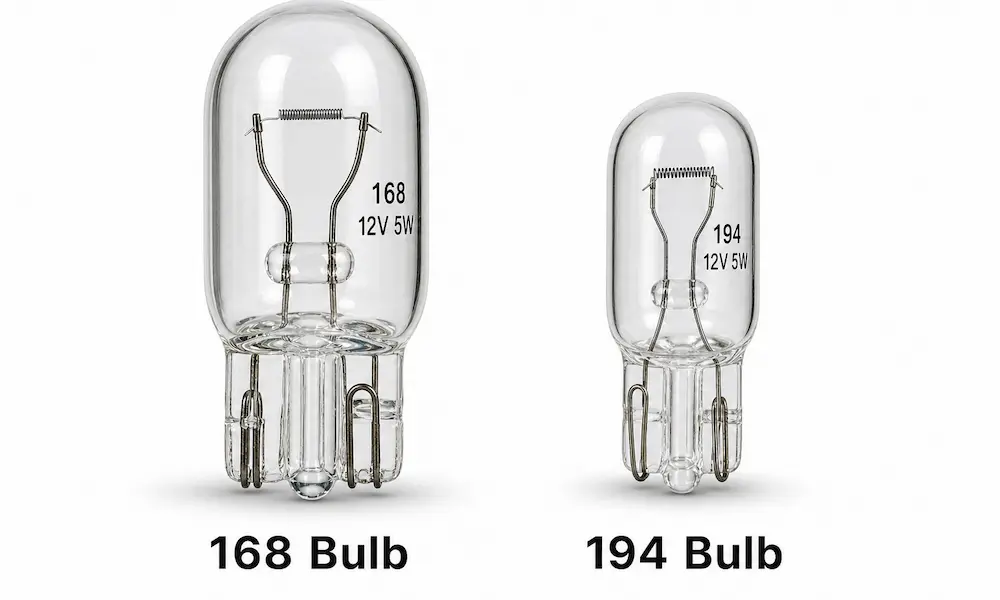
These two bulbs look completely identical. Same size, same base, same socket fit — yet swap one for the other in the wrong spot and you’re looking at melted plastic or a dimmer-than-legal marker light. This guide breaks down exactly what separates the 168 vs 194 bulb, where each one belongs, and what happens when you get it wrong. Read to the end before you buy.
They Look the Same — But They’re Not
Drop a 168 and a 194 bulb side by side on your workbench. You won’t spot a difference. Both are T-3 1/4 tubular bulbs with the same glass diameter (about 0.40 inches), the same overall length (roughly 1.06–1.10 inches), and the exact same W2.1×9.5d wedge base. They push into the same sockets across thousands of vehicle makes and models.
The difference lives inside the glass. Different wattage. Different filament support. Different heat output. Different lifespan. And very different consequences if you put the wrong one in the wrong place.
The Core Specs at a Glance
Here’s how the numbers stack up when both bulbs are tested at the standard 14.0-volt automotive rating:
| Spec | 194 Bulb | 168 Bulb |
|---|---|---|
| Shape/Base | T-3 1/4 / W2.1×9.5d Wedge | T-3 1/4 / W2.1×9.5d Wedge |
| Voltage | 12V DC (tested at 14V) | 12V DC (tested at 14V) |
| Current Draw | 0.27 Amps | 0.35 Amps |
| Wattage | ~3.8 Watts | 4.9 Watts |
| Brightness | 2.0 Candlepower (~25 lumens) | 3.0 Candlepower (~38 lumens) |
| Filament Support | Single wire | Dual wire |
| Rated Lifespan | ~2,500 hours | ~1,500 hours |
The 168 bulb pulls about 30% more power than the 194. That gap creates the 50% brightness difference — and the heat gap that determines where each bulb safely belongs.
Why Internal Construction Matters
The 194 uses a single internal support wire to hold its tungsten filament in place. At 3.8 watts, that’s plenty. The filament runs cool enough that it doesn’t need extra anchoring. It dims smoothly when you roll your dashboard dimmer knob down — which is exactly why automotive engineers chose it for instrument clusters.
The 168 uses a dual support wire structure. Running at nearly 5 watts, the filament burns hotter and expands more aggressively during thermal cycles. The second wire keeps it from sagging, warping, or snapping when the car hits a pothole at highway speed. That sturdier construction also helps the 168 handle voltage fluctuations better in exterior applications where conditions aren’t always stable.
Same glass envelope. Completely different engineering inside.
Brightness and Where It Actually Matters
The 168 produces 3.0 Mean Spherical Candlepower — roughly 38 lumens. The 194 outputs 2.0 candlepower, or about 25 lumens. Both glow in that warm 2700–2800 Kelvin range you’d recognize from a classic incandescent.
That 50% brightness jump sounds dramatic. In a dashboard gauge cluster, it’s not worth chasing. Your speedometer doesn’t need to be 50% brighter at 11 PM — it needs to be visible without blinding your eyes or glaring off your windshield. Inside a sealed glove box? Same deal. You need enough light to find your registration, not a spotlight.
On the outside of your car, though, brightness isn’t just comfort — it’s a legal requirement. The NHTSA FMVSS 108 test procedures specify minimum candlepower outputs at multiple observation angles for exterior lighting. The 168 is specifically engineered to meet those thresholds even after light passes through a colored, aged, or slightly dirty plastic lens. A 194 in that same socket might not clear the minimum legal output — making your vehicle technically non-compliant and measurably harder to see at night.
The Heat Problem Nobody Talks About
This is where swapping a 168 into a 194 socket gets dangerous.
Both bulbs convert most of their wattage to heat rather than light — that’s just incandescent physics. But a 30% increase in wattage means a significant jump in heat output inside a sealed housing. Automotive interiors give that heat nowhere to go.
Installing a 168 in a socket designed for a 194 can cause:
- Plastic deformation — Polycarbonate gauge lenses, reflector bowls, and housing shrouds can warp and melt with sustained exposure
- Optical discoloration — Clear or tinted plastic diffusers (those blue or green tints on vintage dashboards) scorch brown and lose their clarity permanently
- Socket failure — The plastic wedge socket itself becomes brittle, crumbling when you try to pull the next bulb out
- Wiring insulation damage — Enough sustained heat cracks the rubber insulation on nearby wires, creating a short circuit risk buried inside your dashboard
The 194 still generates heat. But its lower thermal envelope stays within the safety window that automotive engineers calculated when they designed the housing. The 168 blows past it.
Lifespan Trade-Off
Brighter = shorter lifespan. Every time.
The 168 runs its filament hotter, which speeds up tungsten sublimation — the slow process where the filament material evaporates and thins until it snaps. At 1,500 rated hours, the 168 burns out 40% faster than the 194’s 2,500-hour rating.
| Longevity Factor | 194 Bulb | 168 Bulb |
|---|---|---|
| Filament Degradation | Slow, controlled | Faster, due to higher heat |
| Rated Lifespan | ~2,500 hours | ~1,500 hours |
| Replacement Frequency | Low | Higher |
| Best Placement | Hard-to-reach interior spaces | Easily accessible exterior spots |
Replacing a burned-out dashboard bulb usually means pulling apart interior trim panels, steering column covers, and HVAC bezels. A 2,500-hour bulb might last a decade of normal use. A 1,500-hour bulb in that same spot means you’re doing that job much sooner than you want to.
The 168’s shorter lifespan isn’t a problem when it lives in an easily swapped exterior socket — like a license plate bracket or a side marker lens held in by a single screw.
Where Each Bulb Belongs
194: Interior and Enclosed Spaces
The 194 owns the interior of your vehicle. Factory engineers specified it here for good reason:
- Instrument cluster and dashboard — Low heat, long lifespan, smooth dimming on analog rheostat controls
- Glove compartment — Fully sealed, often packed with paper documents; the lower heat output prevents fire risk if the door switch sticks on
- Vanity mirror lights — Inches from your face; you want adequate illumination, not a 50% brightness increase at close range
- Ashtray, console, and footwell lighting — These areas just need ambient fill light, not high output
168: Exterior and Ventilated Spaces
The 168 handles exterior duties where brightness wins:
- Side marker and clearance lights — The higher output clears federal SAE J592 minimum candlepower thresholds, keeping your vehicle visible and legally compliant
- License plate lights — Washes the entire plate evenly, with no shadowed corners or characters that blur at a distance
- Trunk and cargo area lights — Large air volumes dissipate the extra heat safely; you need wide-area coverage in complete darkness
- Third brake lights (older multi-bulb arrays) — The sharper, brighter output communicates braking clearly to following traffic
Global Naming: T10, W5W, and Why It’s Confusing
You’ll see these bulbs listed under several names depending on where you’re shopping.
T10 isn’t a specific bulb — it’s a size category covering all 10mm-diameter wedge bulbs. Both the 168 and 194 live inside the T10 family, along with the dimmer 158 and others. When a manual says “T10 bulb,” it’s telling you the socket size, not the wattage. You still need to figure out which variant belongs there.
W5W is the European ECE-standard equivalent of the 168. The naming system is straightforward: W = wedge base, 5W = five watts. At 5.0 rated watts versus the 168’s 4.9 watts, the performance is essentially identical. If a European vehicle spec calls for W5W, the 168 is your direct swap. Don’t use a 194 here — you’ll lose about a third of the brightness.
T15 / 921 bulbs use the same wedge base but have a 15mm glass diameter. They won’t pass through T10-sized reflector openings, and they draw significantly more power — sometimes up to 18 watts. Don’t force one into a T10 socket.
Upgrading to LED: Better Light, New Problems
Modern T10 LED replacements make the 168 vs 194 debate partly academic. A quality LED wedge bulb can draw just 1–2 watts while producing 100–300 lumens — far beyond what any incandescent manages. Lifespans of 30,000–50,000 hours aren’t unusual. Heat output is dramatically lower, which solves the thermal damage issue when upgrading interiors.
But LEDs introduce their own complications:
Polarity sensitivity. An incandescent filament doesn’t care which direction current flows. Many LEDs do. Insert them backward and they won’t light up. Look for bulbs with built-in bridge rectifiers if you want the same plug-and-play experience.
Dimming incompatibility. Dashboard dimmer switches work by reducing voltage to the circuit. Incandescent filaments respond proportionally — less voltage, less brightness. LEDs stay fully on until voltage drops below their operating threshold, then switch off entirely. Modern vehicles use pulse-width modulation to dim LEDs properly. Trying to dim an LED with an old analog rheostat often causes flickering or complete failure.
CAN bus error codes. Modern vehicles continuously monitor current draw on every lighting circuit. Your car expects to see roughly 3.8–5 watts on a T10 socket. An efficient LED drawing 1–2 watts registers as a failed or missing bulb. The dash throws a warning light. Turn signals hyper-flash. To fix this, use “CAN bus error-free” LED bulbs with built-in load resistors that mimic incandescent draw. Just note: those resistors generate heat intentionally — so you’re back to checking thermal clearance before installing them in tight interior spaces.
Choosing the Right One
The decision isn’t complicated once you know the rules:
Use a 194 when:
- The socket is inside an enclosed plastic housing
- The bulb is hard to access and needs to last
- The application calls for steady, dimmable ambient light
Use a 168 when:
- The socket feeds an exterior marker, license plate, or cargo light
- The housing has adequate ventilation and air volume
- Meeting federal visibility standards is a requirement
Use a CAN-bus LED when:
- You want maximum brightness without the heat of a 168
- Your vehicle flags bulb-out warnings on modern diagnostics
- You’re upgrading interior lighting and need cool operation near plastic components
Don’t swap a 168 into a 194 socket chasing brighter gauges. The short-term visual upgrade isn’t worth a warped dashboard bezel or a crumbling socket housing. If you want brighter interior lights, a low-wattage LED replacement is the right answer — same socket, far less heat, no melted plastic.