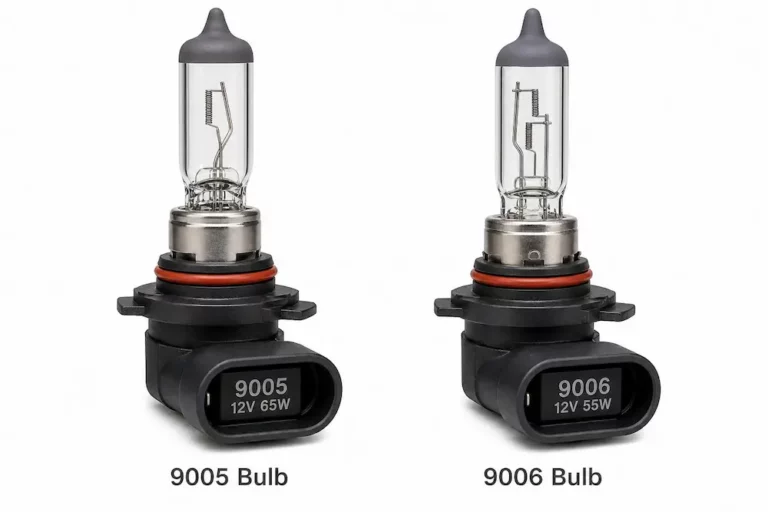
Replacing a headlight bulb sounds simple until you’re staring at two nearly identical bulbs wondering which one goes where. The 9005 vs 9006 debate trips up a lot of people, and getting it wrong can blind oncoming drivers or leave you squinting into darkness. This post breaks down every real difference, explains why swapping them is a terrible idea, and shows you the best upgrade paths available today.
They Look Identical — But They’re Not
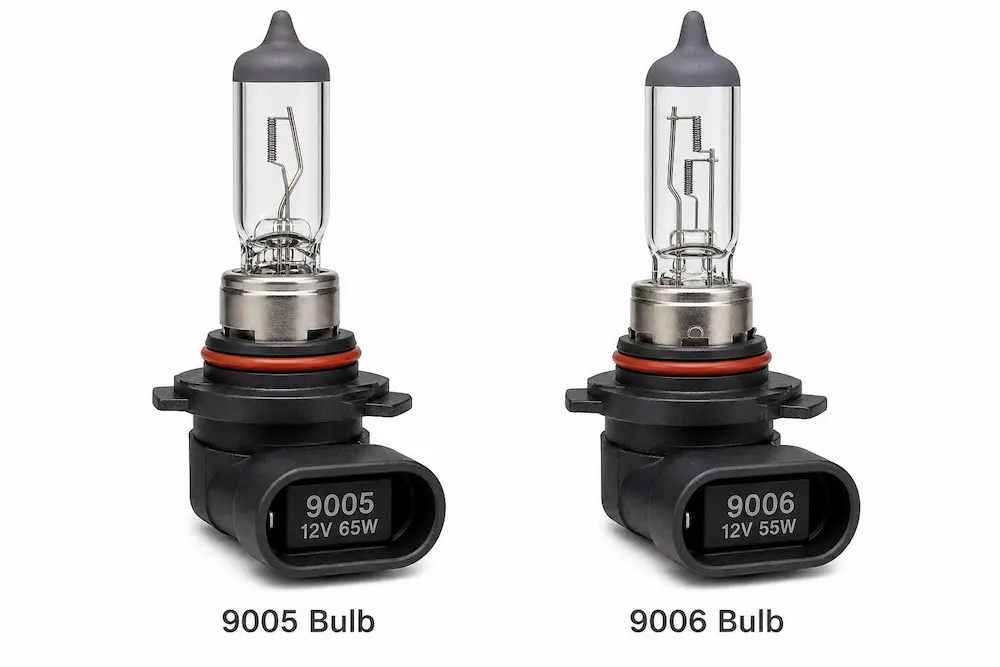
At a glance, the 9005 and 9006 are strikingly similar. Both use a 12-volt single-filament design. Both have an L-shaped plastic base with three locking tabs. Both measure 55mm long with a 16mm glass bulb diameter.
But here’s the thing — they do completely different jobs.
- 9005 (HB3): High-beam bulb. Built to blast light as far down the road as possible.
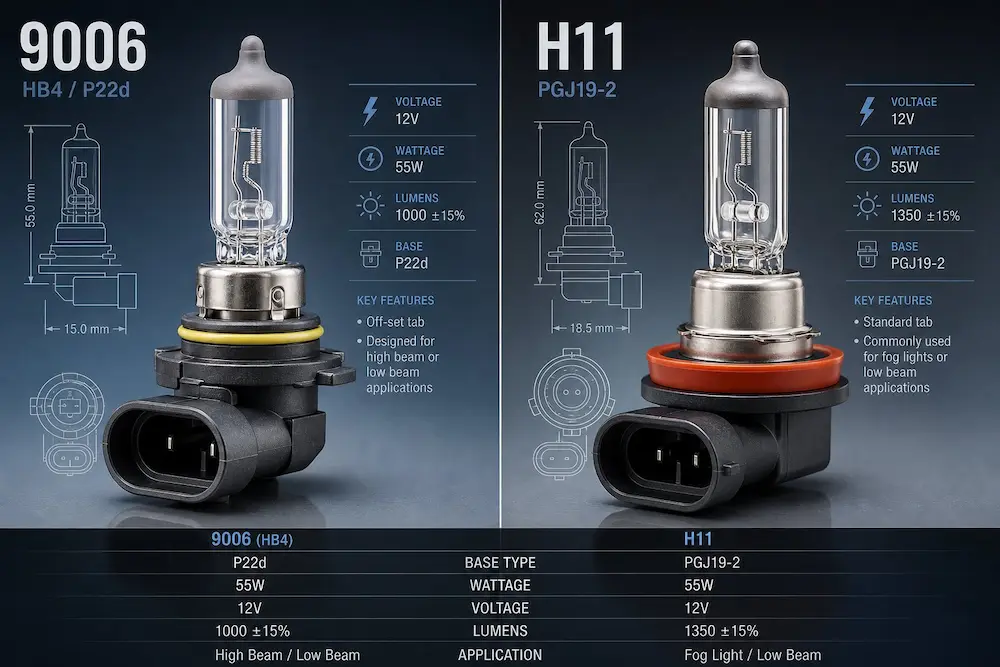
- 9006 (HB4): Low-beam and fog light bulb. Built to illuminate the road in front of you without blinding everyone else.
That distinction drives every single design difference between them.
The Base Tabs Tell the Whole Story
The most important physical difference between the 9005 and 9006 is how their base tabs are positioned.
Picture the base of each bulb as a clock face. Both share two tabs at the 10 o’clock and 2 o’clock positions. The third, smaller indexing tab is where things diverge:
- 9005: Third tab sits at the 7 o’clock position. Locks with a counterclockwise rotation.
- 9006: Third tab sits at the 5 o’clock position. Locks with a clockwise rotation.
This mirror-image offset isn’t accidental. If you try to force a 9005 into a 9006 socket, the tab physically hits the housing wall and refuses to turn. That’s by design — it’s a mechanical safeguard built into the IEC standard 60061 and ANSI C81.62 dimensional guidelines.
The electrical connectors add a second layer of protection. The 9005 socket has double center slots inside the plug, while the 9006 has a single center slot. Your car’s wiring harness physically won’t snap onto the wrong bulb.
9005 vs 9006: Specs Side by Side
| Specification | 9005 (HB3) | 9006 (HB4) |
|---|---|---|
| Primary Function | High Beam | Low Beam / Fog Light |
| Base Type | P20d | P22d |
| Third Tab Position | 7 o’clock | 5 o’clock |
| Lock Direction | Counterclockwise | Clockwise |
| Wattage | 65W | 55W |
| Lumens | ~1,700–2,000 | ~1,000–1,500 |
| Glass Tip | Clear | Black painted coating |
| Rated Lifespan | ~320 hours | ~1,000 hours |
| Plug Width | 46mm | 46mm |
| Light Center Length | 32mm | 32mm |
That 10-watt difference between them is substantial on a 12-volt circuit. More wattage means a hotter filament, which means more light — but also a shorter lifespan.
The Black Tip on the 9006 Isn’t a Flaw
New to buying headlight bulbs? You might notice the 9006 has a black painted coating on its glass tip and assume it’s damaged. It’s not.
That coating is a lumen limiter. It physically blocks stray light from scattering upward out of the reflector housing. The result is that sharp horizontal cutoff line you see on a properly aimed low beam — light hits the road, not the eyes of oncoming drivers.
The 9005 has no such coating. Its glass is completely clear, letting light spray in every direction so the reflector can capture it and throw it hundreds of feet down the road.
This one detail is the core reason you can’t swap these bulbs without causing serious problems.
Why the 9005 Lasts Less but Feels Like It Lasts Longer
On paper, the 9005 only rates for about 320 hours versus the 9006’s 1,000 hours. That sounds like the 9005 burns out faster — and in a lab, it does.
In real life, though, most drivers barely use their high beams. Research from the Insurance Institute for Highway Safety suggests only 9 to 18% of drivers actually use high beams when conditions call for it. Your low beams run every single night. Your high beams get occasional flashes on rural highways.
So your 9006 will almost always die first on the calendar, even though it’s rated for more hours. Keep a spare 9006 in your glove box before you worry about the 9005.
Don’t Put a 9005 in a 9006 Socket — Here’s What Actually Happens
Plenty of forums suggest trimming the tabs off a 9005 to fit it into a 9006 low-beam socket for “free extra brightness.” This is genuinely dangerous, and here’s why.
The glare problem: The 9005 has no black tip lumen limiter. Drop it into a low-beam housing and raw light scatters forward and upward with zero control. You’re essentially running a permanent high beam aimed directly at oncoming traffic. That’s not a minor inconvenience — it causes real driver blindness, and it will fail your state safety inspection.
The electrical problem: Your car’s low-beam circuit is wired for a continuous 55-watt load. Running a 65-watt bulb on it generates excess heat at the connector. Over time, you’ll melt the wiring harness pigtail, damage the headlight housing, or both.
The optical problem: Even if the bulb fits after modification, the 9005 has a slightly smaller shank diameter. Micro-vibrations shift the filament off the reflector’s focal point, creating ugly dark spots and hot spots in the beam pattern. You actually see worse, not better.
Doing it the other way — a 9006 in a 9005 socket — isn’t smart either. The lumen limiter cap blocks the upward light a high beam specifically needs. You lose about 700 lumens and end up with a high beam that barely outperforms a parking light.
Want More Brightness? Use the Right Upgrade Path
If you want genuinely better headlights, you’ve got two solid options that don’t involve hacking your bulb base with nail clippers.
Halogen Infrared Reflective (HIR) Bulbs: 9011 and 9012
The 9011 (HIR1) replaces the 9005 high beam. The 9012 (HIR2) replaces the 9006 low beam.
These bulbs use a coating on the glass envelope that reflects heat back onto the filament, making it burn hotter without drawing extra power.
- 9011: Still draws 65W but jumps from ~1,700 to 2,300 lumens
- 9012: Still draws 55W but jumps from ~1,000 to ~1,800 lumens — nearly doubling your low-beam output
The 9012 in particular is a genuine game-changer. It draws safe 55W, keeps the lumen limiter cap, maintains perfect filament geometry, and dramatically improves the beam. Some manufacturers specifically had specialized 9012 bulbs produced to address poor headlight performance on truck platforms.
Minor tab trimming is required to fit HIR bulbs into standard housings, but the filament geometry stays identical, so beam pattern remains sharp and safe.
LED Upgrades: Big Lumens, Long Life
Modern 9005 and 9006 LED replacements from brands like OSRAM, Philips, Morimoto, and GTR Lighting push 5,000–10,000 lumens per pair while lasting 30,000–50,000 hours. That’s essentially set-and-forget for the life of your car.
A few things to get right when going LED:
Diode orientation matters a lot. The LED chips must face 3 o’clock and 9 o’clock when locked into the housing. Turn them the wrong way and you’ll get a chaotic beam with massive dark zones and blinding glare above the cutoff line.
CANbus compatibility. Modern cars constantly monitor circuit resistance. LEDs draw far less power than halogens, so the car’s computer often throws an error code or disables the circuit entirely. Look for LED kits with built-in CANbus decoders, or add external load resistors for highly sensitive systems.
Thermal management. LEDs generate heat at the diode junction. Without proper cooling, they burn out fast. Premium models use active cooling fans or copper heat pipes. Check the physical dimensions of the cooling assembly too — oversized heat sinks can prevent reinstalling your dust caps, which invites moisture into the housing.
Color temperature. Standard halogens run around 3,000–4,000K (warm yellow). Most LEDs output 6,000–6,500K (crisp white daylight). For fog lights, a 3,000K amber LED cuts through rain and snow far better than pure white.
Full Upgrade Priority Order
If you’re upgrading both bulb positions at once, do it in this sequence:
- Low beams first (9006) — you use these 85–90% of all nighttime driving
- High beams next (9005) — matching color temperatures prevents eye strain on long drives
- Fog lights last — consider 3,000K amber for genuine weather performance
Which Vehicles Use the 9005 and 9006 Combination?
The 9005/9006 pairing is one of the most common dual-housing setups on U.S. roads.
| Vehicle | High Beam | Low Beam |
|---|---|---|
| 2017 Honda Accord | 9005 | 9006 |
| 2020 Ford F-150 | 9005 | 9006 |
| 2018 Chevrolet Silverado 1500 | 9005 | 9006 |
| 2019 Toyota RAV4 | 9005 | 9006 |
| 2015 Toyota Camry | 9005 | 9006 |
| 2016 Subaru Outback | 9005 | 9006 |
| 2015 Dodge Charger | 9005 | 9006 |
| 2016 GMC Sierra | 9005 | 9006 |
| 2014 Nissan Altima | 9005 | 9006 |
| 2017 Mazda 3 | 9005 | 9006 |
Before buying any replacement, double-check your owner’s manual or look at the markings printed on your factory bulb base. Takes 30 seconds and saves a frustrating return trip.
Installing Either Bulb: What to Get Right
Follow these steps whether you’re doing a simple halogen swap or a full LED conversion.
- Let the housing cool first — active halogen bulbs run hot enough to burn skin
- Disconnect the battery’s negative terminal — protects your car’s electronics
- Remove the dust cap — twist counterclockwise or use a trim tool to pry it off
- Unplug the harness — depress the retaining clip and pull straight down
- Rotate and pull the old bulb — 9005 turns counterclockwise, 9006 turns clockwise
- Never touch halogen glass with bare hands — skin oils carbonize at operating temperature and crack the glass. If you do touch it, wipe it down with isopropyl alcohol and a microfiber cloth before installing
- Insert and lock the new bulb — align the three tabs, rotate to seat against the O-ring seal
- Reconnect the harness — for LEDs, if the bulb doesn’t light up, flip the connector 180 degrees and try again (LEDs are polarity-sensitive)
After installation, park 25 feet from a flat wall. Your 9006 low-beam cutoff line should sit at or below the physical center height of your headlights. If light is hitting above that line, your beam is aimed too high — and you’re the person blinding oncoming traffic.
The bottom line on 9005 vs 9006: they’re two separate tools built for two separate jobs. Respect that, and you’ll have headlights that work exactly as intended — or significantly better if you take the HIR or LED upgrade path.