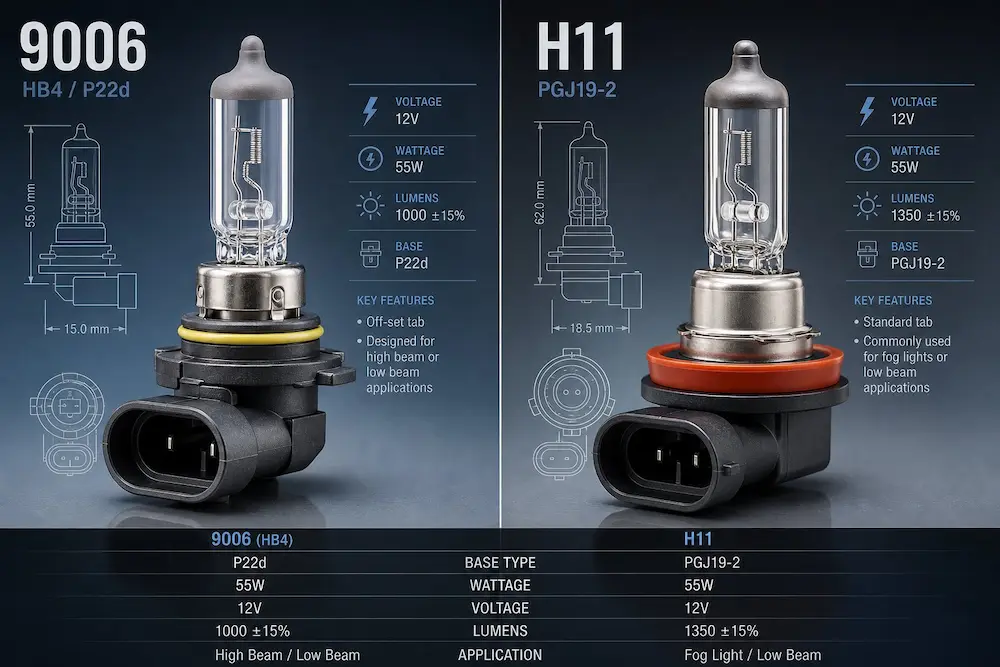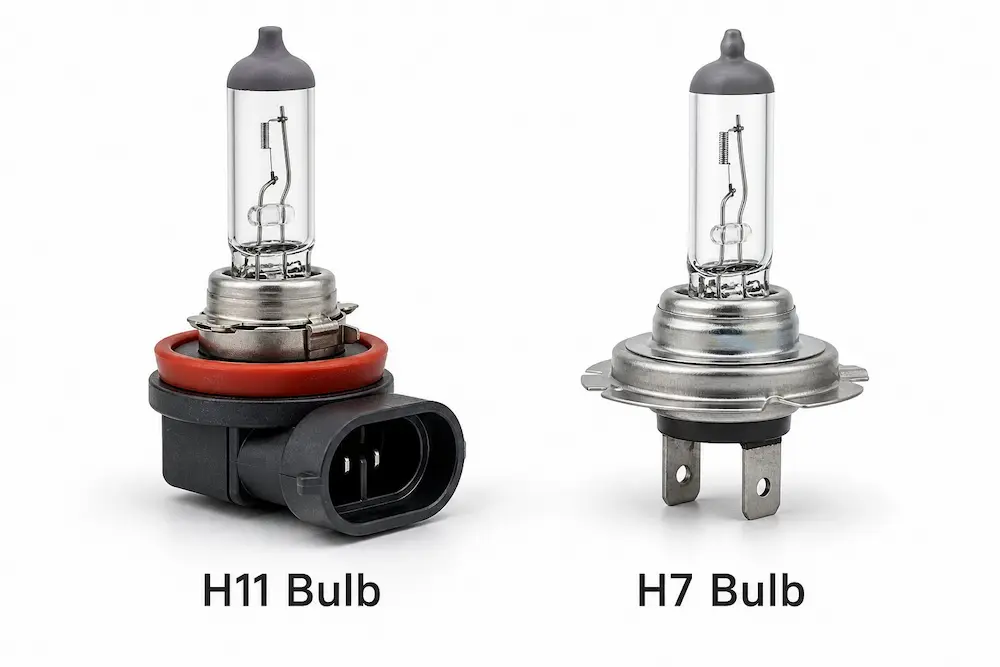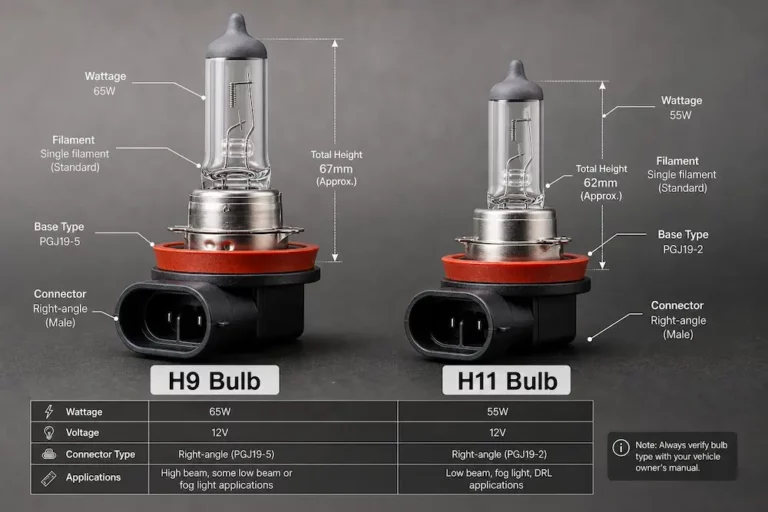
Thinking about swapping your H11 bulb for an H9? These two bulbs look nearly identical, but they’re engineered for completely different jobs. The wrong choice can melt your wiring, blind oncoming drivers, or even break federal law. Read this before you touch anything.
They Look the Same — But They’re Not
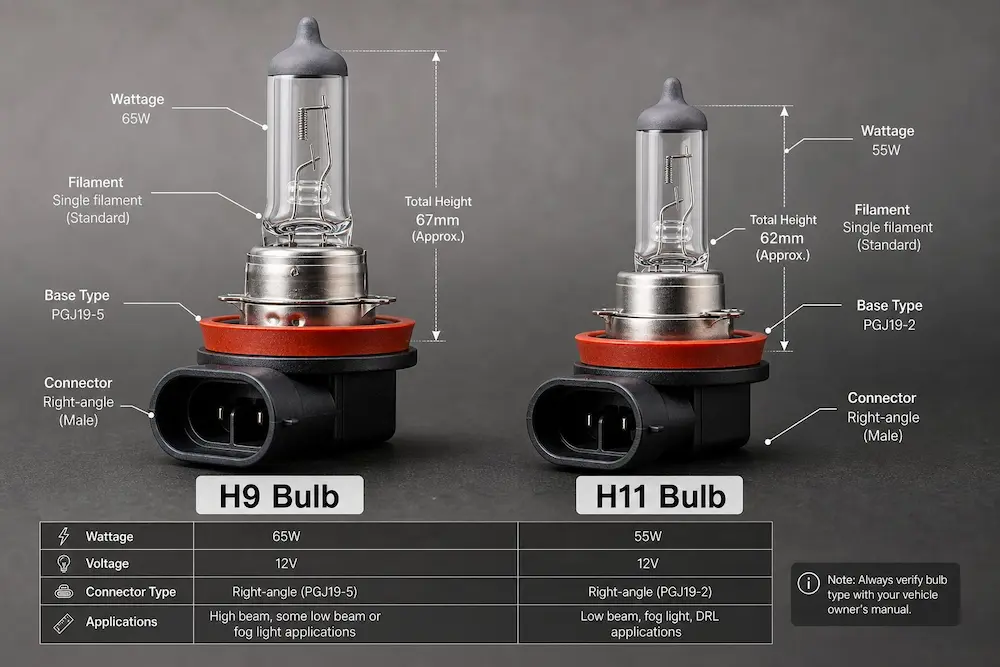
The H9 and H11 belong to the same PGJ19 base family. Same glass envelope. Same connector style. Same overall size. But underneath that familiar shape, these two bulbs are built for very different tasks.
The H11 is a low-beam workhorse — designed for long life and controlled light output. The H9 is a high-beam specialist — built for raw brightness with no concern for lifespan.
Here’s why the distinction matters more than most people realize.
Physical Differences: Same Shell, Different Keys
Both bulbs share identical optical dimensions. The light center length is exactly 25mm on both, meaning the filament sits at the exact same focal point. That’s actually why the H9 swap works optically — the light source lands precisely where the reflector expects it.
But the base hardware tells a different story.
| Dimensional Metric | H11 (PGJ19-2) | H9 (PGJ19-5) |
|---|---|---|
| Light Center Length | 25mm | 25mm |
| Maximum Overall Length | 43mm | 43mm |
| Glass Envelope Diameter | 12mm | 12mm |
| Filament Type | Single, Axial | Single, Axial |
| Base Type | PGJ19-2 | PGJ19-5 |
The two physical differences that prevent accidental swapping are:
- The metal locking tab — The H9’s top tab is about 3mm wider, blocking it from seating in an H11 housing
- The plastic connector ridge — The H9 socket has an offset internal tab that stops the H11 wiring harness from plugging in
These aren’t manufacturing quirks. Engineers put them there deliberately.
Performance: Where the Real Gap Shows Up
This is where the H9 vs H11 bulb debate gets interesting. The numbers look similar on paper, but the real-world difference is massive.
| Performance Metric | H11 | H9 | Difference |
|---|---|---|---|
| Operating Voltage | 12V | 12V | None |
| Power Consumption | 55W | 65W | +10W |
| Current Draw | ~4.6A | ~5.4A | +0.8A |
| Luminous Flux | 1,350 lumens | 2,100 lumens | +750 lumens |
| Brightness Increase | Baseline | +55.5% | — |
That 55% brightness jump explains the appeal. But the extra 10 watts isn’t free — it brings serious consequences that most people don’t consider.
Why 10 Watts Causes So Much Trouble
In a kitchen, 10 extra watts is nothing. Inside a sealed automotive headlamp housing with zero ventilation, it’s an 18% increase in thermal load. That heat has nowhere to go. Over time, it blisters the chrome reflector coating, degrades the housing, and attacks the plastic wiring connector behind the bulb.
Reddit’s Ford Fusion community documented this firsthand — melted bulb connectors are a common result of H9 swaps gone wrong. The fix? Cut the factory plastic connector off and replace it with a heat-resistant ceramic pigtail. Ceramic connectors handle the extra heat without melting. Your upstream wiring is still at risk, but at least you won’t fuse the connector to the bulb.
Lifespan: The Trade-Off Nobody Talks About
The H9 filament runs hotter to hit those 2,100 lumens. That’s great for brightness. It’s terrible for longevity.
| Bulb Type | Typical Lifespan | Primary Focus |
|---|---|---|
| H11 | 270–2,000 hours | Durability, consistent output |
| H9 | 240–500 hours | Maximum brightness |
As a high-beam bulb, the H9’s short life is fine. Most drivers use high beams less than 10% of nighttime driving hours. A 300-hour H9 in that role could outlast the car.
Dropped into a low-beam socket running continuously? You’re replacing it every 6–12 months instead of every 3–4 years. The physics are non-negotiable — a hotter filament burns out faster, full stop.
The Glare Cap Problem: Clear vs. Coated Tips
Here’s a detail most H9 swap guides skip entirely.
H11 bulbs have a painted tip. That opaque black or silver coating blocks direct forward light, forcing all illumination through the reflector. Without it, raw axial light escapes the housing and blinds oncoming drivers.
H9 bulbs have a clear tip. As a dedicated high-beam bulb, the H9 needs every photon it can produce. Glare control is irrelevant when no other cars are present.
What does this mean when you put an H9 in an H11 socket?
- Reflector housing — Disaster. The missing cap lets unfocused light blast straight out of the housing, creating a glare zone that destroys the engineered low-beam cutoff line. Oncoming drivers get hammered.
- Projector housing — Much better. The projector’s internal metal cut-off shield physically blocks upward light. The H9’s clear tip becomes less of an issue because the housing handles the cutoff itself.
Even with a projector housing, there’s still a problem — it’s called foreground pooling. The extra 750 lumens floods the road immediately in front of your bumper. Your pupils constrict to handle the brightness. And suddenly your actual distance vision gets worse, even though everything feels brighter. Automotive lighting engineers deliberately design low beams to focus further down the road for exactly this reason.
How the H9 Swap Actually Works
The modification itself is straightforward — which is why it’s so popular among Tacoma, F-150, and Subaru Outback owners.
- Trim the metal tab — Remove about 3mm from the wide locking tab using metal shears or a rotary tool. This lets the H9 seat and twist into the H11 housing.
- Remove the plastic ridge — Slice away the offset dividing ridge inside the connector with a hobby knife. Now the H11 wiring harness plugs directly onto the H9’s prongs.
The whole process takes minutes to complete. Mechanically, the bulb now fits perfectly. Electrically and optically? That’s where things get complicated.
Modern Cars Add Another Layer of Complexity
Older vehicles send steady 12V directly to the headlights. Modern cars don’t.
Today’s Body Control Modules use Pulse Width Modulation (PWM) — rapidly pulsing electricity to extend bulb life. The H9’s thick, low-resistance filament needs aggressive, steady current to reach operating temperature. A PWM signal often prevents that, which stops the halogen cycle from activating. The result: rapid blackening of the glass envelope and a shorter lifespan than even the standard H9 rating.
The Body Control Module also monitors current draw. It expects 4.6 amps from an H11. The H9 pulls 5.4 amps. Some vehicles interpret that as a short circuit and shut the headlight circuit off entirely to prevent an electrical fire. You’d need an OBD tool just to restore function — and that’s assuming the software even allows it.
Is the H9 Swap Legal in the US?
Short answer: No.
Under FMVSS 108, the federal standard governing all US automotive lighting, an H11 low-beam housing is certified as a complete optical unit — housing, reflector, lens, and the specific H11 bulb. The maximum allowable wattage is 59W, and the maximum luminous flux is 1,350 lumens.
The H9 runs at 65W and produces 2,100 lumens. Both figures exceed the federal limits for that housing. Driving with this setup on public roads violates FMVSS 108.
Practically speaking, enforcement is patchy. The bulb looks identical to an H11, and since projector housings maintain a proper cutoff line, most state inspections won’t catch it. But in a nighttime collision, if investigators find non-compliant lighting contributed to the incident, the civil liability falls on you.
What About LED Bulbs?
You’ve probably seen H8/H9/H11 LED kits sold as a single universal unit. That universal fit works because LEDs use a molded plastic collar that bypasses the base tab restrictions entirely.
LEDs solve the thermal and wiring problems — a 25-30W LED generates far less heat than a 65W halogen. But they create a different, arguably worse problem: optical mismatch.
Halogen housings are designed around a cylindrical, omnidirectional tungsten filament. An LED chip is flat and directional. That geometry breaks the parabolic reflector’s math. The result is scattered beam patterns, dark spots, and glare aimed directly at oncoming traffic — even worse than a poorly installed H9.
The NHTSA has taken notice. In late 2023, major online retailers began removing LED headlight conversion kits from US storefronts due to FMVSS 108 non-compliance. By strict federal law, replacing a halogen source with an LED in a halogen-certified housing is illegal on public roads.
Better Options That Actually Work
If you want genuinely brighter low beams without voiding your legal compliance, two approaches actually deliver:
Premium H11 halogen bulbs — High-efficacy H11s push the legal wattage ceiling using tightly wound thin-wire filaments and advanced gas mixtures. They stay within the 59W limit while delivering noticeably better focus and distance projection. They burn out faster than standard H11s, but they’re legal and optically correct.
Relay harness upgrade — This one surprises most people. Older vehicles lose significant voltage through degraded wiring. Since lumen output scales exponentially with voltage, even a 1V drop at the connector can cut brightness by 20–30%. Installing a relay harness that pulls power directly from the battery via thick-gauge wire restores full factory voltage to the bulb. Your stock H11 might already be brighter than you realized — it just hasn’t been getting the power it needs.
Both methods are fully FMVSS 108 compliant, thermally safe, and invisible to your vehicle’s electronics.