Got a Honda with a CVT and wondering if you really need that pricey dealer fluid? Good news — you’ve got options. This guide breaks down every credible Honda HCF-2 transmission fluid equivalent, explains what the spec actually means, and tells you exactly which bottle to grab based on your situation.
What Is Honda HCF-2 Fluid (And Why It’s Different)
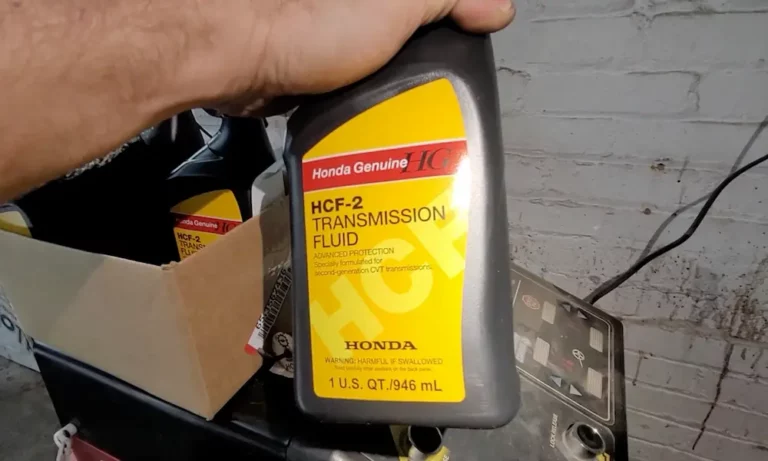
Honda HCF-2 is the second-generation CVT fluid Honda developed for its “Earth Dreams” transmission lineup. It replaced the older Honda Multi-Matic Fluid (HMMF) when Honda switched from a multi-plate starting clutch to a torque converter design around 2013–2015.
That’s not a small change. These are fundamentally different transmissions that need completely different fluids.
Here’s the key difference at a glance:
| Feature | Gen 1 CVT | Gen 2 CVT (HCF-2) |
|---|---|---|
| Launch Mechanism | Multi-plate Starting Clutch | Hydraulic Torque Converter |
| Fluid Spec | HMMF / CVTF | HCF-2 |
| Primary Failure Mode | Starting Clutch Judder | Belt Slippage / Pressure Loss |
| Fluid Color | Red/Pink | Yellow/Light Brown |
Never mix these two fluids. Putting old-school HMMF into an HCF-2 system causes immediate hydraulic malfunction. Same deal in reverse. If the fluid in your transmission isn’t yellow-brown, something is wrong.
Which Vehicles Need Honda HCF-2?
Before you buy anything, confirm your car actually needs HCF-2. Here’s the full application list:
- Honda Accord — 2013 to present (9th, 10th, 11th gen, including 1.5T and Hybrid)
- Honda Civic — 2014–2015 select models, 2016 to present all CVT models
- Honda CR-V — 2015 to present
- Honda HR-V — 2016 to present
- Honda Fit / Jazz — 2015 to present (GK chassis)
- Honda Insight — 2014 Hybrid, 2019–2022
- Honda Clarity — 2017–2021
- Acura ILX Hybrid — 2013–2014
Still unsure? Check the filler neck or drain plug area — Honda stamps an “HCF-2” label right there.
What Makes HCF-2 Special: The Science in Plain English
You don’t need a chemistry degree here, but understanding what HCF-2 does helps you pick a real equivalent rather than something that just looks right on a shelf.
Viscosity: Getting the Flow Right
HCF-2 runs thinner than traditional automatic transmission fluids. That reduces drag and improves fuel economy. Premium synthetic equivalents, like Ravenol’s CVT HCF-2, achieve a Viscosity Index as high as 265 using Polyalphaolefin (PAO) base oils. That means the fluid stays consistent whether it’s a hot summer highway run or a cold winter startup.
Friction Modifiers: The Secret Ingredient
This is where most generic fluids fail. A CVT doesn’t use gears — it transfers power through friction between a steel belt and pulley sheaves. The fluid needs to maintain a precise level of grip. Too much slip and the belt overheats. Too little and the torque converter’s lock-up clutch shudders.
That anti-shudder performance is non-negotiable for a smooth-feeling Honda CVT.
Here’s a Quick Technical Comparison of Top HCF-2 Fluids
| Property | Ravenol HCF-2 | Idemitsu Type H2 | Castrol Universal |
|---|---|---|---|
| Base Oil | Synthetic (PAO) | Synthetic | Full Synthetic |
| Color | Yellow-Brown | Light Brown | Red |
| Viscosity Index | ~265 | ~180 | ~160 |
| Dedicated HCF-2 Formula | ✅ Yes | ✅ Yes | ⚠️ Universal |
| Flash Point | High | High | Moderate-High |
The Best Honda HCF-2 Transmission Fluid Equivalents, Ranked
1. Idemitsu CVTF Type H2 — Best OEM Alternative
If you want genuine Honda performance without the dealer price tag, Idemitsu Type H2 is your answer. Idemitsu is widely considered the actual OEM supplier for Honda-branded fluid, meaning both products likely come from the same facility to the same spec.
It nails the anti-shudder durability, torque transfer characteristics, and friction modifier profile that Honda’s CVT demands. Cost runs $12–$15 per quart versus $14–$22 for the genuine Honda 08200-HCF2. That’s meaningful savings over multiple drain-and-fill cycles.
Best for: Anyone wanting OEM-equivalent chemistry at a fair price.
2. Ravenol CVT HCF-2 — Best for Extreme Conditions
Ravenol’s dedicated HCF-2 fluid isn’t a universal formula stretched to fit. It’s a purpose-built formulation using premium PAO base stocks with a Viscosity Index of 265 — well above the standard ~180 range.
It lists explicit compatibility with the Accord X (2017+), Civic X, CR-V IV/V, and more. If you drive in genuinely extreme temperatures — scorching summers, bitter winters — this fluid’s thermal stability gives you extra protection.
Best for: Enthusiasts, extreme climates, high-performance applications.
3. Eneos Import CVT Model H — Factory-Fill Grade
Eneos Import CVT Model H is an exact-match fluid developed in direct collaboration with Japanese automakers. Eneos serves as a factory-fill supplier for most Asian manufacturers, which gives this product serious credibility.
They also offer Eneos Eco CVT Fluid, a broader synthetic option covering Honda HCF-2, Nissan NS-3, and Toyota FE specs. Internal testing suggests up to a 5% reduction in transmission noise versus conventional CVT fluids.
Best for: Owners who prioritize factory-grade chemistry and long-term quietness.
4. Amsoil Synthetic CVT Fluid — Best for Hard-Working Vehicles
Amsoil’s Synthetic CVT Fluid takes a performance durability angle. In the JASO LVFA Anti-Shudder Durability Test, their formulation reportedly lasted six times longer than certain OEM fluids. In FZG wear testing (ASTM D5182), Amsoil hit an 11-stage pass versus a 7-stage pass for standard NS-2 benchmarks.
It’s also marketed as “Warranty Secure” — covered under the Magnuson-Moss Warranty Act, which prohibits manufacturers from voiding warranties simply because you used a qualified aftermarket fluid.
Best for: Towing, stop-and-go city driving, high-mileage vehicles.
5. Valvoline Full Synthetic CVT / Castrol Transmax Universal — Best Budget Options
Valvoline Full Synthetic CVT and Castrol Transmax ATF/CVT Universal are widely available, often under $10 per quart in gallon containers.
Both list HCF-2 compatibility. Castrol’s “Smooth Drive Technology” targets friction durability across the drain interval, though it excludes 2001–2007 Honda starting-clutch models. Some high-mileage users (250,000+ miles) report occasional warm-up vibration with Valvoline when the transmission already has significant internal wear — but this is a transmission condition issue, not necessarily a fluid failure.
Best for: Budget-conscious routine maintenance on lower-mileage, healthy transmissions with frequent change intervals.
How Much Fluid Do You Need?
Getting the volume right matters. Overfilling causes aeration and foaming. Underfilling leads to cavitation and belt slip.
| Service Type | Liters | US Quarts |
|---|---|---|
| Routine Drain and Fill | ~3.0–3.5 L | ~3.2–3.7 qt |
| Minor Overhaul | ~5.0–6.0 L | ~5.3–6.3 qt |
| Full Dry Fill (Complete Overhaul) | ~7.0–8.0 L | ~7.4–8.5 qt |
Standard service procedure: warm the engine to full operating temperature, drain for at least 5 minutes, and replace the 18mm sealing washer (Part #90471-PX4-000). Drain plug torque spec is around 39 N·m (29 lb-ft).
How Often Should You Change HCF-2 Fluid?
Honda’s official schedule suggests 60,000-mile intervals. Most experienced Honda techs recommend 30,000 miles instead, especially under “Severe Service” conditions:
- Short trips where the transmission never fully warms up
- Heavy traffic or frequent idling
- Towing or load-carrying (especially CR-V owners)
- Extreme heat or cold consistently
Honda CVTs earn a reputation as “maintenance queens.” They reward regular service and punish neglect. Using the right fluid on a lazy schedule isn’t much better than using the wrong fluid on time.
The Bottom Line on HCF-2 Equivalents
The brand on the bottle matters less than two things: HCF-2 certification and how often you change it.
Here’s the fast decision guide:
- Tightest budget? → Valvoline or Castrol, changed every 25,000–30,000 miles
- Best value OEM match? → Idemitsu Type H2
- Extreme weather or performance driving? → Ravenol CVT HCF-2
- High-stress urban or towing use? → Amsoil Synthetic CVT Fluid
- Zero risk, no debate? → Genuine Honda HCF-2 (08200-HCF2)
What you must never do: grab a generic DEXRON/MERCON ATF or an old-generation HMMF and pour it in. That’s the fastest route to catastrophic belt failure — and a transmission replacement bill that’ll hurt far more than a bottle of proper fluid ever would.