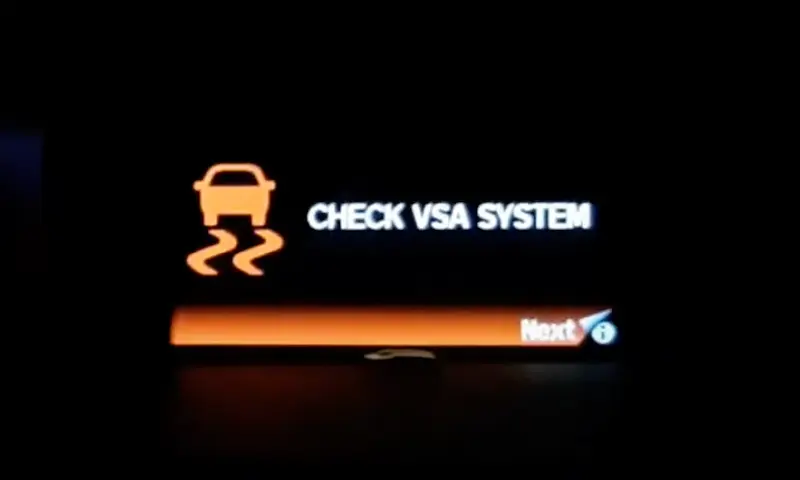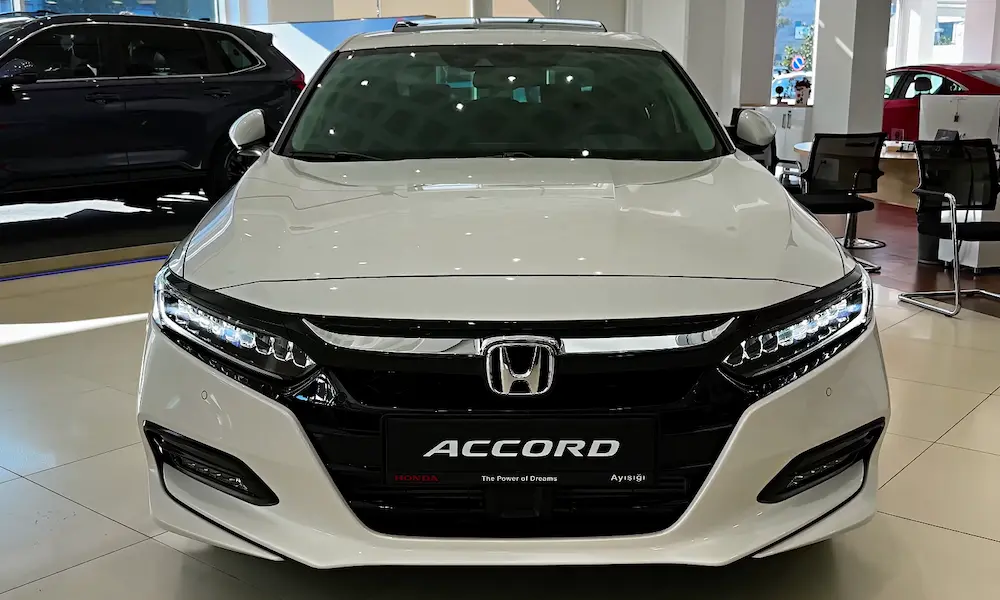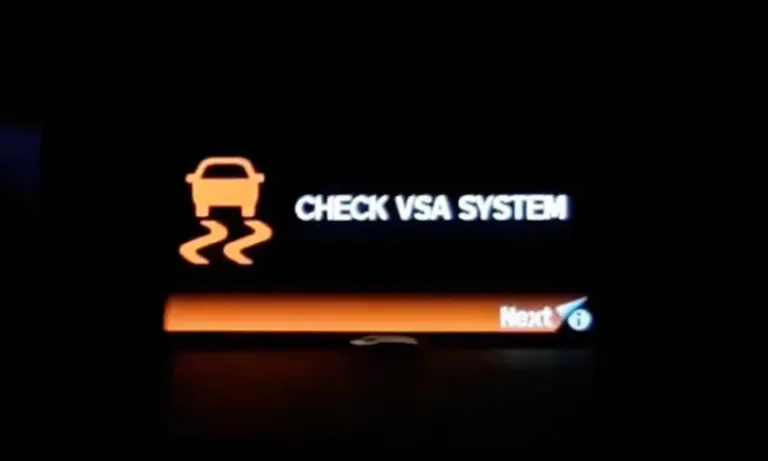
That little amber glow on your dashboard isn’t just annoying — it means your Accord’s safety net is offline. This guide covers every reason your Honda Accord VSA light turns on, what each warning pattern means, and exactly what it costs to fix. Read to the end before you spend a single dollar.
What the Honda Accord VSA Light Actually Means
VSA stands for Vehicle Stability Assist — Honda’s electronic stability control system. It continuously watches your steering angle, wheel speeds, and yaw rate. When it spots a difference between where you’re steering and where the car is actually going, it selectively brakes individual wheels and cuts engine torque to keep you pointed straight.
When the VSA light stays on, that safety system is either offline or actively fighting a fault. Your brakes still work, but you’ve lost the electronic safety layer underneath them.
Flashing vs. Solid: They Mean Very Different Things
The light’s behavior tells you which situation you’re in:
- Flashing amber light — The system is working right now. It’s modulating brakes and throttle during a low-traction moment. You might feel brief engine hesitation or pedal pulsation. This is normal.
- Solid amber light — The system is fully disabled. Either you pressed the dashboard VSA switch manually, or a fault forced it offline.
- Solid light plus other warning lights (ABS, EPS, Check Engine) — A deeper system fault. Multiple safety systems have entered safe mode because a shared sensor or power source failed.
If you pressed the VSA switch intentionally (useful in deep snow or sand), press it again to bring the system back online. If the light stays on after that, you have an actual fault to diagnose.
Which Honda Accord Models Have VSA?
Not every Accord has always had it. Here’s the rollout history:
- 2006–2007 (7th Gen): VSA available only on V6 trims
- 2008+ (8th Gen onward): Standard on every trim level
- 7th and 8th Gen dash: An amber triangle with an exclamation mark signals active intervention or a fault
- 9th Gen (2013+) onward: Honda switched to the international skidding-car icon
The Most Common Reasons Your Honda Accord VSA Light Is On
Most VSA faults trace back to one of these eight causes. Start with the cheap and easy ones first.
| Cause | What Happens | Fix |
|---|---|---|
| Low tire pressure or puncture | Underinflated tire spins faster, faking a wheel slip signal | Check cold pressure, repair puncture, run TPMS calibration |
| Mismatched tire sizes | Speed differential across axles confuses wheel sensors | Match all four tires in size and tread depth |
| Low brake fluid | Reduced hydraulic pressure limits automated wheel braking | Inspect pads for wear, top up with approved fluid |
| Weak battery (under 12.4V) | Voltage drop disrupts module initialization, logs false codes | Clean terminals, test battery, replace if needed |
| Brake light switch failure | Module can’t confirm pedal input, disables ABS and VSA | Replace switch at top of brake pedal arm |
| Damaged reluctor ring | Cracked or dirty tone ring sends erratic speed pulses | Clean or replace affected hub or axle assembly |
| Blown multi-fuse (fuse #3) | Complete power loss to the VSA modulator | Swap fuse in under-hood box with identical-rated replacement |
| Electromagnetic interference | Signal noise mimics sensor failures | Inspect wiring harness shielding and ground connections |
The Tire Pressure Connection You Probably Missed
There’s an important difference between older and newer Accords here. Older models use a direct TPMS system with physical pressure sensors inside each wheel. Those sensors run on internal batteries that last five to ten years. A dead battery stops sending pressure data, which can trigger a VSA fault.
Newer Accords use an indirect TPMS system — no wheel sensors at all. It estimates pressure from wheel speed data. Any tire rotation, inflation change, or replacement on an indirect system requires a manual calibration reset, or you’ll get false VSA warnings.
The 2008–2012 Accord’s Hidden Weak Spot: The APP Sensor
Eighth-generation Honda Accord owners (2008–2012) deal with a specific problem that almost nobody expects. The Accelerator Pedal Position sensor on these cars sits in the engine bay on the passenger-side firewall — not inside the cabin like most vehicles.
Engine heat and vibration wear down the sensor’s internal potentiometers. When the two voltage circuits inside it fall out of correlation, the engine computer throws code P2138 and caps engine speed in limp-home mode to prevent unintended acceleration. Because it can’t verify your throttle input, it immediately kills the VSA system too.
You’ll see the VSA light and check engine light come on together, and the engine will feel sluggish and restricted. Replacing the sensor typically costs $225–$400 in parts and labor — far cheaper than chasing the wrong problem.
VSA Modulator Failures in 8th and 9th Gen Accords
This is the most expensive and most misunderstood failure pattern on 2008–2017 Honda Accords. The VSA modulator-control unit combines a hydraulic valve body, a pump motor, and an attached electronic module. Under-hood heat and road vibration eventually crack the solder joints and aluminum wire bonds on the circuit board inside the electronic module.
The fault often shows up intermittently at first — appearing after the engine reaches normal operating temperature, then disappearing after the car cools down. That thermal pattern is a strong indicator of internal circuit board degradation.
Here are the specific trouble codes tied to this failure:
| Code | Fault Description | Generation | Root Cause |
|---|---|---|---|
| 81-19 | Yaw Rate Sensor Circuit Malfunction | 9th Gen | Internal circuit board separation |
| 81-20 | Acceleration Sensor Circuit Malfunction | 9th Gen | Cracked solder joints on accelerometer circuit |
| 121-11 | Solenoid Valve Malfunction | 8th & 9th Gen | Micro-wiring failure at solenoid interface |
| 122-11 | Solenoid Valve Malfunction | 8th & 9th Gen | Bond wire fracture inside control unit |
| 123-11 | Solenoid Valve Malfunction | 8th & 9th Gen | Solder breakdown on solenoid valve circuit |
| 124-11 | Solenoid Valve Malfunction | 8th & 9th Gen | Open or short circuit inside module |
| 31-11 to 36-11 | ABS Solenoid Valve Malfunction | 8th & 9th Gen | Connection failure on ABS driver pins |
One important note: generic OBD2 scanners can’t read these codes. You need a bi-directional scanner like a Foxwell or Autel device, or the factory Honda Diagnostic System, to pull manufacturer-specific chassis codes.
How to Reset the Honda Accord VSA Light Yourself
Before spending money on parts, try these reset procedures. They clear false codes logged by temporary voltage drops.
Manual OBD Port Reset (No Scanner Needed)
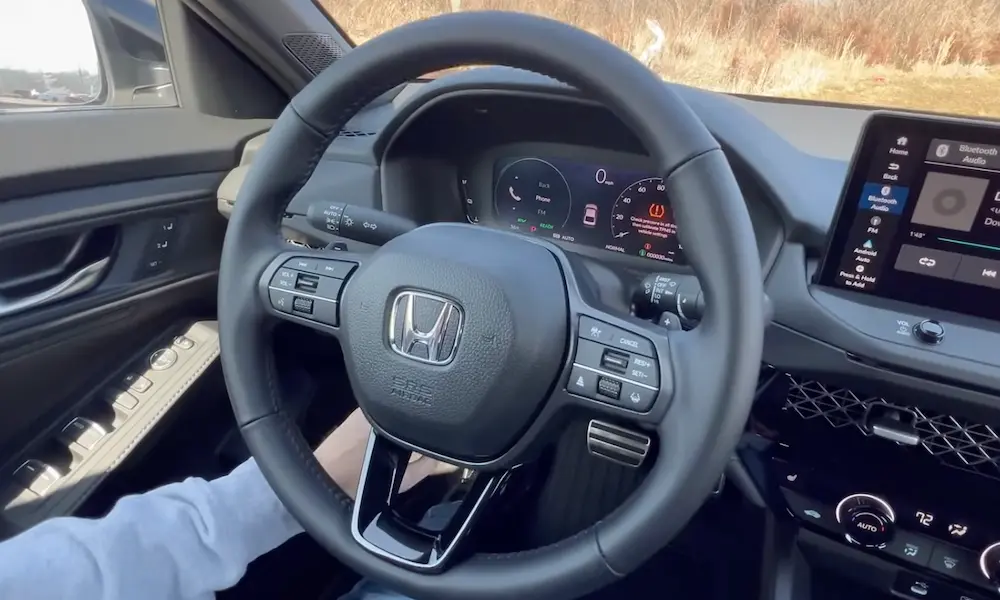
This manual reset method uses a jumper wire on the diagnostic port under your driver-side dashboard:
- Turn the ignition off and remove the key
- Connect a jumper wire between pins 4 or 5 (ground) and pin 9 (service check signal) on the OBD port
- Lightly press the brake pedal, then turn the ignition to position two (don’t crank the engine)
- When the ABS light turns off, immediately release the brake pedal
- The light will turn back on — depress and hold the brake pedal again
- When the light turns off a second time, release the pedal
- A successful reset shows the light blinking twice, then going off
For push-button start models: press the start button once without touching the brake to enter accessory mode, then press the brake pedal and press start again to reach ignition-on state.
Steering Angle and Yaw Rate Sensor Calibration
After a wheel alignment, suspension work, or module replacement, you must recalibrate the sensors on a level surface:
- Short the diagnostic connector across pins 4 and 9
- Turn the ignition on without touching the brake
- Wait for the VSA indicator to turn off (about 2 seconds)
- Within half a second of the light turning off, press and release the dashboard VSA override switch once
- As soon as the light turns back on, press and release the switch again within half a second
- Two blinks followed by the light turning off confirms a successful calibration
Indirect TPMS Calibration Reset
On touchscreen-equipped models: ignition on → Home → Vehicle Settings → Tire Pressure Calibration → Calibrate. On non-touchscreen models, press and hold the calibration button under the steering column until the indicator blinks twice. Then drive at a steady speed for 10–30 minutes to let the system map new wheel speed baselines.
Federal Safety Recalls Involving the VSA System
Check these against your VIN. You may be entitled to free repairs.
2021 Accord VSA Software Recall
Honda recalled approximately 45,000 Accord vehicles after a software bug in the ECU caused the VSA warning light to activate intermittently — disabling active safety features with no actual hardware fault. The fix is a dealer-level software update at no charge.
2022–2023 Modulator Recall (Recall 23V-430)
In June 2023, Honda issued a stop-sale order and safety recall covering certain 2022 Accord, 2022 Accord Hybrid, and 2023 Civic vehicles. During assembly by supplier Continental Automotive Systems, a foreign object damaged a ball valve inside the modulator.
The NHTSA recall report 23V-430 details the risk: a compromised seal can cause brake fluid to leak inside the modulator. If a leak develops while Brake Hold is active, the car may roll unexpectedly. You may also notice increased pedal travel. Dealers replace the entire VSA modulator assembly free of charge.
2023–2025 Accord Hybrid Recall (Recall 25V785)
In November 2025, Honda recalled 256,603 Accord Hybrid vehicles built between November 11, 2022, and October 24, 2025. A software error in the Integrated Control Module caused the CPU to misread normal communication noise as an internal fault under heavy electrical loads. The CPU resets itself mid-drive, cutting all drive power instantly. Dealers reprogram the module with corrected software at no cost.
What It Actually Costs to Fix the Honda Accord VSA Light
Here’s an honest breakdown of every repair path, from cheapest to most expensive:
| Repair | Parts Cost | Labor Cost | Total Range |
|---|---|---|---|
| Professional diagnostic scan | — | $100–$209 | $100–$209 |
| Wheel speed sensor replacement | $30–$40 | $50–$100 | $80–$140 |
| APP sensor replacement (2008–2012) | $150–$250 | $75–$150 | $225–$400 |
| VCM solenoid service (V6) | $500 | $300–$500 | $800–$1,000 |
| Mail-in electronic module rebuild | $150–$350 | $150–$300 | $300–$650 |
| Dealer OEM modulator replacement | $1,101–$1,700 | $200–$500 | $1,301–$2,200 |
The Module Rebuild Option: Worth Knowing About
When a dealer diagnostic scan confirms an internal circuit failure in the modulator, the standard dealer move is to replace the entire electro-hydraulic assembly — often quoted between $1,154 and $3,600.
But the hydraulic valve block and pump motor rarely fail physically. The failure is almost always in the small black electronic module bolted to it. Specialized rebuild services remove only that electronic module, repair the cracked solder joints and broken wire bonds on the circuit board, and send it back. The brake lines stay sealed throughout the process — no brake fluid flush needed.
Because your original module goes back in, the factory programming stays intact. It’s completely plug-and-play, no dealer reprogramming required. Total cost: $150–$350 for the rebuild, versus $1,100+ for a new OEM unit.
Is It Safe to Drive With the VSA Light On?
The answer depends on what else is happening in the car.
Safe to drive to a shop: The VSA light is on, but your brake pedal feels firm and normal. Your hydraulic brakes still work. The active electronic stability and traction control features are offline, which makes the car much more vulnerable to skidding in rain or snow — but you can carefully drive it to a repair facility.
Don’t drive it: The VSA light is on and your brake pedal feels spongy or soft. That’s a sign of active hydraulic fluid loss from a damaged modulator valve — exactly the scenario described in the 2022–2023 NHTSA recall. Also don’t drive it if the engine is stuck in limp-home mode with capped throttle or if it’s stalling unexpectedly. Have it towed.
The Honda Accord VSA light has a clear diagnostic path once you know what to look for. Start with tire pressure and battery voltage — they’re free to check. If those are fine, grab a proper scanner, pull the manufacturer-specific codes, and work through the table above from cheapest fix to most expensive. Most VSA faults land somewhere between a $30 sensor and a $350 module rebuild. Only a small fraction actually need a $3,600 dealer job.