Your Honda needs the right coolant — not just any blue fluid from the shelf. Use the wrong one, and you’re looking at gelled radiators, swollen seals, and a repair bill that hurts. This guide breaks down every verified Honda type 2 coolant equivalent so you can make the right call without overpaying at the dealership.
What Makes Honda Type 2 Coolant Different?
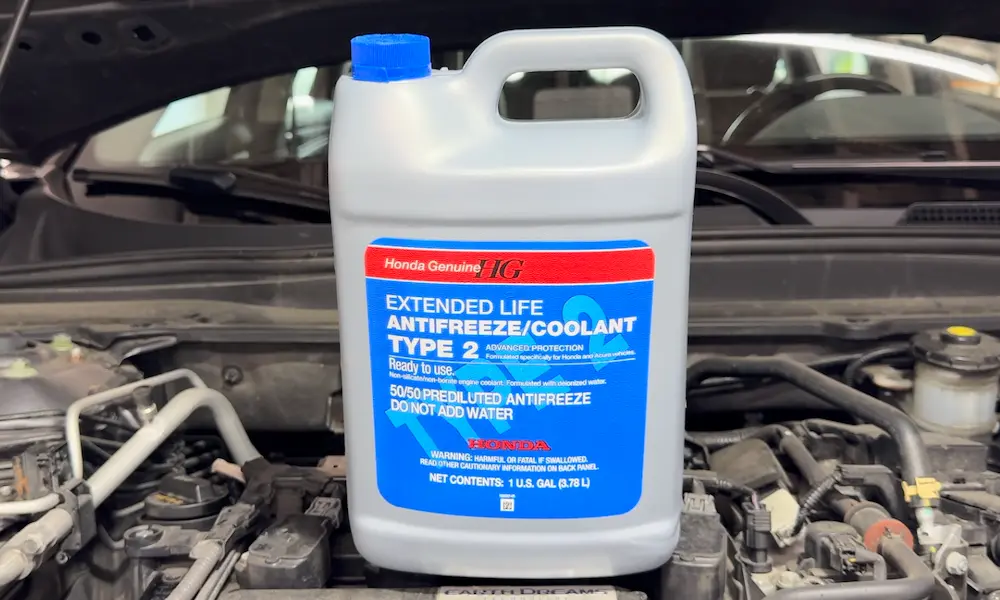
Honda Type 2 isn’t just blue coolant with a Honda sticker on it. It uses a specific chemistry called Phosphated Organic Acid Technology (P-OAT), which falls under the broader category of Hybrid Organic Acid Technology (HOAT).
Here’s why that matters. Older “green” coolants used silicates to protect metal surfaces fast. That worked fine for cast iron engines, but silicates break down in modern aluminum engines. They form abrasive deposits that chew through water pump seals and clog the narrow passages in aluminum radiators.
Honda switched to P-OAT because it uses organic acids for long-term corrosion protection while adding phosphates for quick aluminum passivation. According to Planet Honda, this chemistry applies to nearly every Honda and Acura model from 2001 onward.
The result? A coolant that’s silicate-free, borate-free, and built specifically for the aluminum-heavy engines Honda has used for decades.
The One Ingredient That Will Wreck Your Honda
Before you grab a “universal” or “all-makes” coolant, check the label for 2-ethylhexanoic acid (2-EHA).
2-EHA is a common organic acid inhibitor used in many European-style and universal coolants. It works well in hard water and at low pH levels. The problem? As MOTOR Magazine explains, 2-EHA acts as a plasticizer that attacks the silicone rubber and specialized plastics Honda uses in its radiator tanks, gasket seals, and water pump components.
What happens when 2-EHA gets into a Honda cooling system:
- Seals soften, swell, or shrink
- System pressure drops as seals fail to hold
- Coolant leaks develop at gaskets and hose connections
- Long-term gasket integrity gets compromised
Honda replaced 2-EHA with sebacate as the primary organic acid inhibitor. Any legitimate Honda type 2 coolant equivalent must explicitly state it’s 2-EHA free. If the product doesn’t say it, don’t use it.
Honda Type 2 Chemical Breakdown
The official Safety Data Sheet from College Hills Honda confirms the fluid’s composition. CCI Manufacturing IL Corporation produces the OE Honda fluid. Here’s what’s inside:
| Chemical Component | Concentration | Function |
|---|---|---|
| Ethylene Glycol | 43% – 53% | Freeze and boil protection |
| Deionized Water | 45% – 55% | Heat transfer medium |
| Diethylene Glycol | < 3% | Co-solvent for stability |
| Potassium Hydroxide | < 3% | pH stabilizer (targets 7.9) |
| Proprietary Inhibitor Salts | < 5% | Corrosion protection |
| Bittering Agent | > 30 mg/kg | Prevents accidental ingestion |
One thing worth noting: the water component must be deionized. Tap water carries calcium and magnesium ions that react with phosphates to form scale deposits. Those deposits clog radiator cores and cause localized overheating. The Honda TechInfo service manual is clear on this — always use distilled or deionized water if you’re mixing concentrate versions.
Verified Honda Type 2 Coolant Equivalents
The good news: several aftermarket brands use the exact same P-OAT formula as the OEM fluid. Some are even made by the same manufacturer — CCI Manufacturing — just sold under different labels.
AISIN ACB003
AISIN’s ACB003 Engine Coolant is widely considered the closest OEM match available. AISIN supplies OEM water pumps and cooling components directly to Honda, so their coolant formulation isn’t a guess — it’s engineered to the same spec. Reddit’s Honda community consistently recommends it as essentially the same fluid in different packaging.
Zerex Asian Vehicle Blue
Valvoline’s Zerex Asian Blue is probably the most widely available Honda type 2 coolant equivalent at retail. It’s silicate-free, borate-free, and explicitly 2-EHA free. Zerex publishes a technical bulletin confirming compatibility with Honda, Acura, Nissan, and Infiniti vehicles.
Pentosin Pentofrost A3
Pentofrost A3 from Pentosin meets ASTM D-3306 standards and is specifically formulated for Asian nameplates requiring blue P-OAT coolant. The product data sheet from CRP Automotive confirms it’s mixable with other phosphate OATs and free of incompatible additives.
Beck/Arnley Extended Life Blue
Beck/Arnley’s Extended Life Blue is a 50/50 prediluted formula designed specifically for Asian nameplate vehicles. It contains no silicates, amines, or borates — matching the Honda Type 2 spec precisely.
Here’s how the main options compare:
| Brand | Product | Technology | 2-EHA Free | Silicate Free |
|---|---|---|---|---|
| Honda | Type 2 Long Life | P-OAT / HOAT | ✅ | ✅ |
| AISIN | ACB003 | P-OAT / HOAT | ✅ | ✅ |
| Zerex | Asian Vehicle Blue | P-OAT / HOAT | ✅ | ✅ |
| Pentosin | Pentofrost A3 | P-OAT / HOAT | ✅ | ✅ |
| Beck/Arnley | Extended Life Blue | P-OAT / HOAT | ✅ | ✅ |
| Peak | OET Asian Blue | P-OAT / HOAT | ✅ | ✅ |
Which Honda Models Need Type 2?
Almost every Honda and Acura built after 2001 requires P-OAT chemistry. Here’s a quick reference:
| Model | Required Fluid | Top Equivalent Options |
|---|---|---|
| Honda Accord | Type 2 Blue | Zerex Asian Blue, AISIN ACB003 |
| Honda Civic | Type 2 Blue | Pentofrost A3, Beck/Arnley Blue |
| Honda CR-V | Type 2 Blue | AISIN ACB003, Peak OET |
| Honda Fit | Type 2 Blue | Zerex Asian Blue, Pentofrost A3 |
| Honda Pilot | Type 2 Blue | AISIN ACB003, Zerex Blue |
| Acura MDX/RDX | Type 2 Blue | Pentofrost A3, Zerex Blue |
For Honda Fit and Civic owners especially, the aluminum block and head design makes P-OAT chemistry non-negotiable. These engines run tight thermal tolerances, and the wrong coolant causes problems faster than you’d expect.
Why Mixing Coolants Is a Bad Idea
This deserves its own section because it’s where most coolant problems start.
Mixing P-OAT with silicated IAT coolants triggers a chemical reaction that produces a thick gel. That gel clogs radiator cores, heater cores, and narrow engine block passages. The result is localized overheating and — worst case — a blown head gasket.
Even mixing two “compatible” OAT coolants can cause inhibitor precipitation. Those particles act like sandpaper on your water pump’s ceramic seals. Pentosin’s SDS documentation and multiple community discussions on the Honda subreddit confirm this risk.
If you’re switching brands, do a proper flush with distilled water first. A simple drain-and-fill only removes 50–60% of the old fluid — the rest stays trapped in the block and heater core.
Does Using Aftermarket Coolant Void Your Warranty?
Short answer: no, not legally.
The Magnuson-Moss Warranty Act of 1975 protects you here. It prohibits manufacturers from requiring you to use their branded products to keep your warranty valid. Under Section 102(c) of the Act, Honda can’t deny a warranty claim just because you used Zerex instead of OEM coolant — unless they prove the aftermarket fluid directly caused the failure.
The FTC backs this up — routine maintenance including fluid changes can happen at independent shops or at home without touching your warranty. Just keep your receipts.
The Price Difference Is Real
Genuine Honda Type 2 coolant runs $22–$40 per gallon at dealerships depending on location and markup. Zerex Asian Blue and Peak OET typically land between $15–$20 per gallon at retailers like Target.
For a 5-year/60,000-mile service interval, the total savings aren’t dramatic for a single vehicle — but for fleet operators or high-mileage drivers who change coolant more frequently, the math adds up fast. The chemistry in a verified equivalent like AISIN ACB003 or Zerex Asian Blue is functionally identical to what’s in the Honda-labeled jug.
If you live somewhere with extreme cold, Honda also offers a concentrate version (Part No: OL999-9020) that you mix with distilled water to hit a stronger freeze protection ratio. Several aftermarket equivalents offer concentrates too — just remember to use deionized or distilled water, never tap.
The Bottom Line on Honda Type 2 Equivalents
The Honda Type 2 spec comes down to three non-negotiables:
- P-OAT / HOAT chemistry — phosphates plus organic acids, no silicates
- No 2-EHA — this one additive causes seal damage and coolant leaks
- Deionized water — either in a pre-mix or when diluting concentrate
Products like AISIN ACB003, Zerex Asian Vehicle Blue, and Pentofrost A3 hit all three criteria. They’re not “good enough” substitutes — they’re chemically equivalent fluids made to the same standard, often by the same manufacturer. The Honda badge on the jug doesn’t change what’s inside.
Use the right chemistry. Flush the system before switching brands. And skip anything labeled “universal” unless it explicitly confirms P-OAT technology with no 2-EHA.