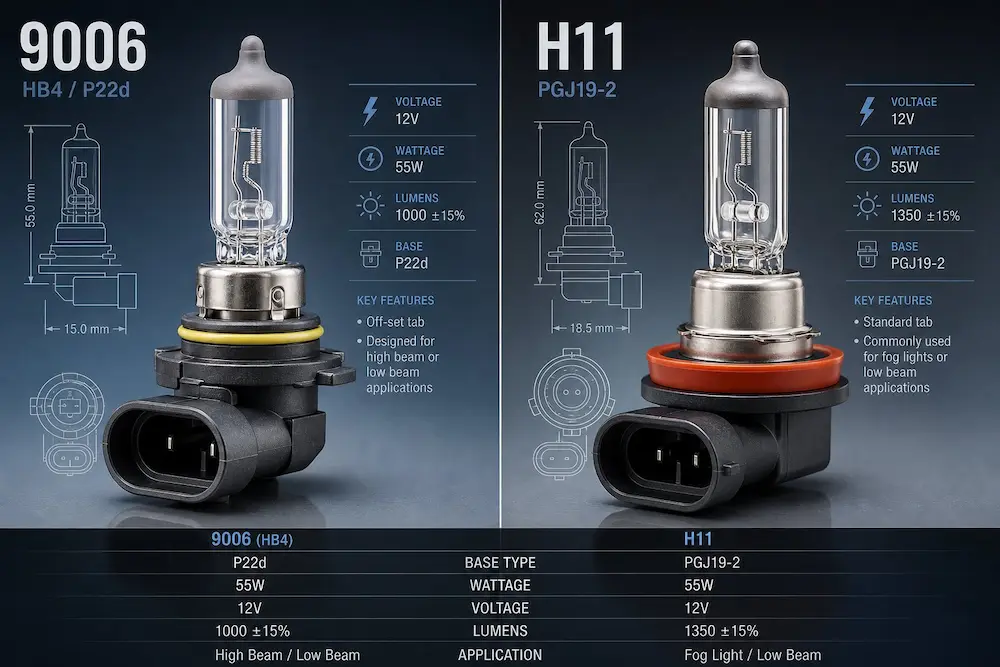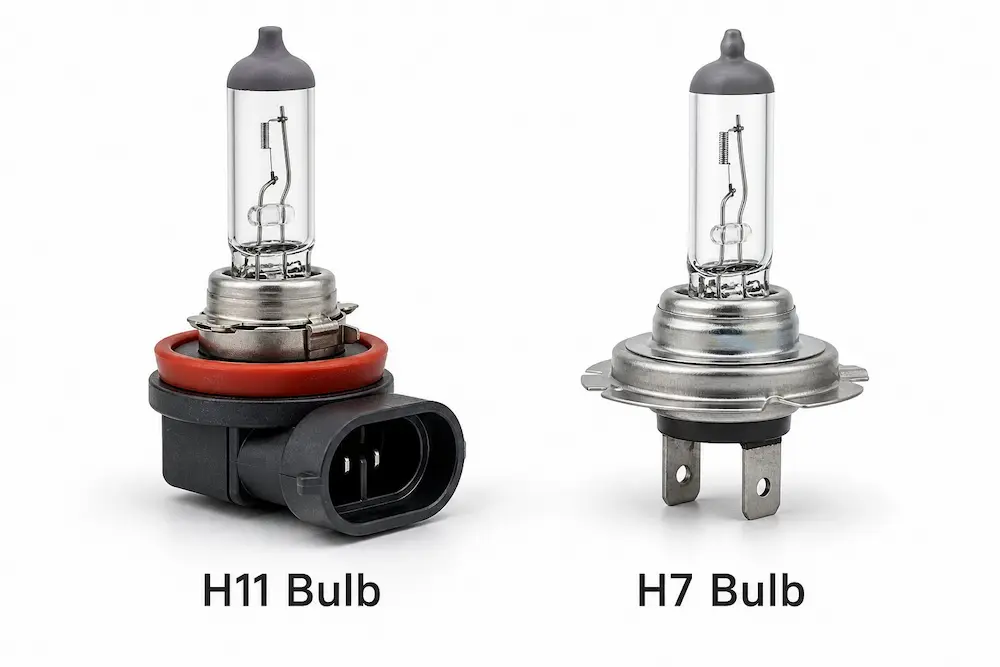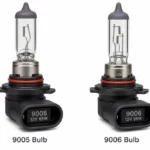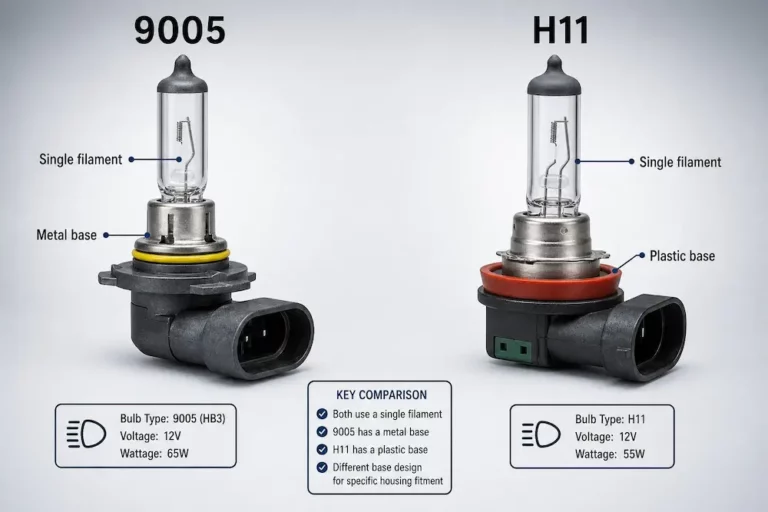
Wondering if your 9005 and H11 bulbs are secretly the same thing? They look similar, but swapping them can melt your wiring, blind other drivers, or get you a ticket. This guide breaks down exactly what separates these two bulbs, what happens when people try to force them together, and what upgrades actually work.
What Is a 9005 Bulb?
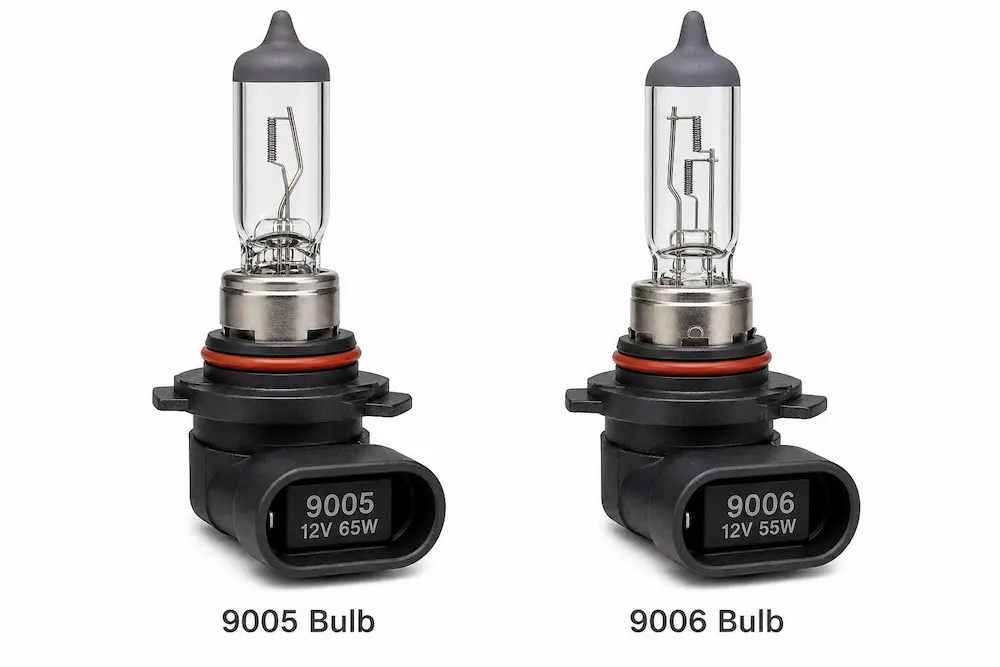
The 9005 (also called HB3) is a high-beam bulb. Its entire job is to throw light as far down the road as possible when you’re on an empty highway at night.
Here’s what you’re working with on a standard 9005:
- 65 watts of power draw
- ~1,700 lumens of output
- ~3,100–3,200K color temperature (warm white)
- ~320-hour rated lifespan
- Clear glass tip — no cap, no light blocking
- P20d base with a wide 46mm connector plug
That clear tip matters. It lets light blast straight forward into the reflector bowl without any obstruction, creating the intense central “hotspot” you see with high beams.
The 9005 also shows up in Daytime Running Light (DRL) circuits on vehicles like the Ford F-150, Toyota Tacoma, Honda Accord, and Chevy Silverado. In DRL mode, the car’s computer uses pulse-width modulation to dim the bulb to a safe intensity, so it doesn’t blind anyone during the day.
Premium variants like the Philips WhiteVision Ultra push color temps up to 4,100–4,200K for a crisper look, but that comes with shorter lifespans (100–150 hours) due to thinner filaments burning hotter.
What Is an H11 Bulb?
The H11 is a low-beam and fog light bulb. It doesn’t care about distance — it cares about a clean, controlled beam that lights up the road ahead without blinding oncoming drivers.
Key specs for a standard H11:
- 55 watts of power draw
- ~1,345–1,350 lumens of output
- ~3,100–3,200K color temperature
- 270–1,000-hour rated lifespan
- Opaque painted tip — blocks forward light scatter
- PGJ19-2 base with a compact 24mm connector plug
That painted tip is the H11’s defining feature. It physically blocks light from escaping straight out the front of the bulb, forcing everything through the reflector. The result is a sharp horizontal cutoff line — the crisp top edge of a low beam that keeps light on the road and out of oncoming drivers’ eyes.
The H11 runs continuously every night you drive, so longevity matters more here than raw output. Long-life variants like the CEC Industries H11 Long Life reach up to 1,000 hours.
9005 vs H11: Side-by-Side Comparison
| Specification | 9005 (HB3) | H11 |
|---|---|---|
| Primary Use | High beam, DRL | Low beam, fog lights |
| Wattage | 65W | 55W |
| Lumens | ~1,700 | ~1,345–1,350 |
| Lifespan | 300–320 hours | 270–1,000 hours |
| Base Type | P20d | PGJ19-2 |
| Connector Width | ~46mm | ~24mm |
| Max Length | 76.2mm | 58–66.8mm |
| Light Center Length | 30.5mm | ~25.4mm |
| Glass Tip | Clear / uncapped | Opaque / painted cap |
| Beam Pattern | Long-range hotspot | Sharp cutoff, wide spread |
The 5mm difference in Light Center Length might sound minor, but it completely changes how light interacts with the housing’s reflector. More on that below.
Can You Swap a 9005 Into an H11 Socket?
No — and here’s why it goes wrong fast.
The bases aren’t just different, they’re intentionally incompatible. The 9005 uses a P20d base with a 46mm wide connector. The H11 uses a PGJ19-2 with a 24mm connector. You literally can’t plug one into the other’s socket without destroying something first.
The 9005 also uses a two-tab locking system clocked at different rotational positions than the H11’s three-tab design. A 9005 won’t seat and lock into an H11 housing without physically grinding down the tabs.
The “Tab Shaving” Modification — Why People Do It and Why It’s Risky
Some car enthusiasts grab a rotary tool, shave down the 9005’s plastic locking tabs, and force it into the H11 housing. The goal? Getting 1,700 lumens in a spot that normally runs 1,350. Sounds like a simple brightness upgrade. It isn’t.
Problem 1: Thermal overload
Your H11 wiring circuit handles 55 watts continuously. A 9005 draws 65 watts. That’s an 18% electrical overload running through wiring gauged for a lower load. The excess current generates heat in the connector and harness. Over weeks of night driving, the plastic H11 socket discolors, gets brittle, and eventually melts. Once melting starts, you get high electrical resistance in the connector, thermal runaway, and a real risk of a wiring harness fire.
Problem 2: Optical disaster
The H11 reflector is built around a filament sitting at 25.4mm from the base. The 9005 filament sits at 30.5mm. That 5mm mismatch means the filament sits too far forward in the bowl. Light strikes the wrong reflector angles and scatters everywhere instead of forming a clean beam.
Worse, the 9005’s clear, uncapped tip lets raw light escape straight out the front — completely bypassing the reflector. You lose the horizontal cutoff line entirely. The result is blinding, unfocused glare aimed directly at oncoming drivers. Essentially, you’re driving with permanent high beams that aren’t even aimed correctly.
The extra heat from the uncapped 65W bulb can also bubble and flake the chrome plating inside your reflector housing, permanently ruining it.
The H11 to H9 Swap: A Closer (But Still Risky) Alternative
If you’ve read about the tab-shaving mod on forums, you’ve probably also heard about swapping H11s for H9 bulbs. This one lives in the same PGJ19 base family, so the modification is less drastic — but the risks are nearly identical.
What Makes the H9 Different
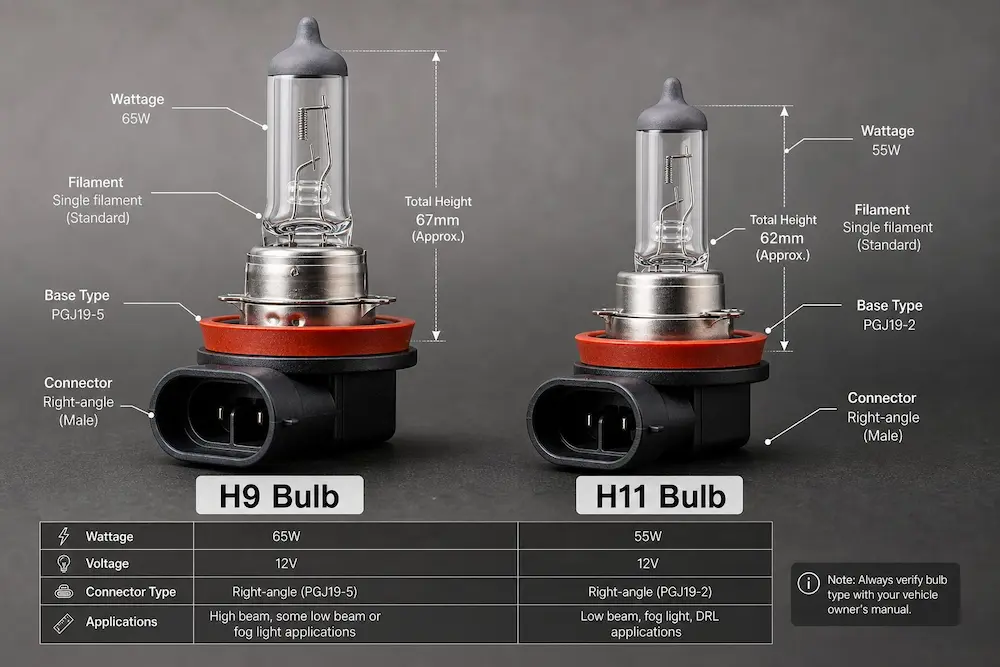
The H9 is an H11-sized high-beam bulb. It uses a PGJ19-5 base (vs. the H11’s PGJ19-2), draws 65 watts, and produces 2,100 lumens — about 50% more than a standard H11. Like the 9005, it has a clear, uncapped tip.
To fit an H9 into an H11 housing, you need to:
- Trim ~3mm from the top metal tab on the H9 base
- Carve out the secondary plastic alignment keyway inside the H9’s connector plug
After that, it clicks right in. This mod is popular with Toyota 4Runner, Tacoma, Honda CR-V, and Mazda 6 owners who want noticeably brighter low beams without buying a full LED kit.
What Can Go Wrong
The same two core problems apply:
| Risk | H11 → 9005 | H11 → H9 |
|---|---|---|
| Wattage overload | 55W → 65W (18%) | 55W → 65W (18%) |
| Lumen jump | ~1,350 → ~1,700 | ~1,350 → ~2,100 |
| Mechanical work needed | Heavy tab shaving | Minor tab trim + keyway removal |
| Wiring harness risk | Extreme (melting, fire risk) | High (needs ceramic adapter) |
| Optical disruption | Severe (wrong focal length, zero cutoff) | Moderate–High (increased glare from uncapped tip) |
Some aftermarket kits like Runnin4Tacos Bulbzilla include ceramic connector adapters and heavier-gauge wiring to handle the 65W load safely. That fixes the melting socket problem — but it doesn’t fix the optical issue. An uncapped 2,100-lumen bulb in a housing designed to control glare from a capped 1,350-lumen source still scatters light above the cutoff line.
The One Halogen Upgrade That Actually Makes Sense
If your vehicle uses a 9005 for high beams and you want more light without the drama, the 9011 (HIR1) is the move.
The 9011 shares the exact same P20d base and 30.5mm Light Center Length as the 9005. It draws the same 65 watts. Your housing, reflector, and wiring don’t know the difference. But the 9011 produces 2,300 lumens vs. the 9005’s 1,700 — a 35% brightness increase with zero electrical overload and perfect optical alignment.
According to Candle Power Forums, minor plastic tab trimming is required to seat it properly, but there’s no focal point deviation, no wiring risk, and no glare penalty. It’s the cleanest halogen upgrade available.
What About LED Retrofit Bulbs?
LED retrofits are everywhere, and the specs sound incredible. Premium kits like the Novsight N30 claim 10,000–25,000 lumens per bulb, 6,000–6,500K color temps, and lifespans of 30,000–50,000 hours — far beyond what any halogen can deliver. They also draw less power, so there’s no risk of overloading an H11 circuit the way a 9005 would.
The best LED designs engineer their diode arrays to sit at the exact Light Center Length of the halogen they replace — 30.5mm for a 9005 replacement, 25.4mm for an H11. Advanced thermal management with aluminum heatsinks and micro-fans spinning up to 12,000–13,000 RPM keeps temperatures in check.
Modern LED kits also include CAN bus decoders — inline resistors that mimic a halogen’s electrical resistance signature. Without them, your car’s computer sees the low current draw of an LED and throws a “bulb out” warning or causes the light to flicker.
Interestingly, many manufacturers use the same aluminum body for both their 9005 and H11 LED kits — the only real difference is the plastic base collar. That’s why it’s easy to accidentally order the wrong one.
The Legal Problem With LED Retrofits in the US
Here’s where things get complicated. LED retrofits for headlights are not street-legal in the United States under the current federal framework.
All US automotive lighting falls under FMVSS 108, enforced by the NHTSA. FMVSS 108 treats a headlamp as a complete optical system — the bulb, reflector, and lens are certified together as one unit. Swap the bulb type, and you void the assembly’s compliance.
The core issue: halogen filaments emit light in 360 degrees like a tiny glowing sphere. LED chips emit light from a flat surface. Even when positioned at the correct focal length, an LED diode can’t perfectly replicate a halogen’s omnidirectional output inside a housing designed for spherical emission. This alters the photometric output of the entire assembly — making it non-compliant.
The NHTSA has confirmed that the “make inoperative” provision under the National Traffic and Motor Vehicle Safety Act prohibits repair shops and mechanics from installing LED retrofits into halogen headlamp housings on road-going vehicles. Any marketing claim of “DOT Approved” on aftermarket LED headlight kits is misleading — the bulbs may meet color temperature specs, but installing them into a halogen housing still violates federal law.
Enforcement falls to local police and state inspection programs. Overly bright, uncontrolled LED beams regularly trigger citations for improper lighting, and vehicles will fail safety inspections when the beam pattern doesn’t meet photometer standards.
Two legal exceptions exist:
- Fog lights — H11 fog lamps aren’t classified as federally required safety equipment under FMVSS 108, so LED upgrades in fog light positions are generally legal at the federal level (check your state laws)
- Off-road-only vehicles — ATVs, UTVs, racing vehicles, and dedicated off-road machines are exempt from FMVSS 108 entirely
Mixed-use trucks and SUVs that also drive on public roads don’t qualify for the off-road exemption — they’re still street vehicles in the eyes of the DOT.
For fully legal LED headlights, the only route is a complete housing replacement with a DOT-certified integral-beam LED assembly — where the LEDs are permanently sealed inside and the entire unit is tested as a system. Adaptive Driving Beam systems, legalized in the US in 2022, represent the cutting edge of this technology — but they’re factory-installed OEM systems, not drop-in replacements.
The Straightforward Answer on 9005 vs H11
These two bulbs aren’t interchangeable — not because of some arbitrary rule, but because they do completely different jobs with different electrical loads, focal lengths, and light control designs.
If your vehicle uses a 9005 for high beams and you want more out of it, the 9011 upgrade is the clean, safe choice. If you’re tempted by the H11-to-H9 swap for brighter low beams, go in with your eyes open — use a ceramic harness adapter, understand the glare trade-off, and know your state’s lighting laws. And if you want LED performance that’s fully road-legal, your best bet is a factory-style integral-beam housing replacement rather than a drop-in retrofit.