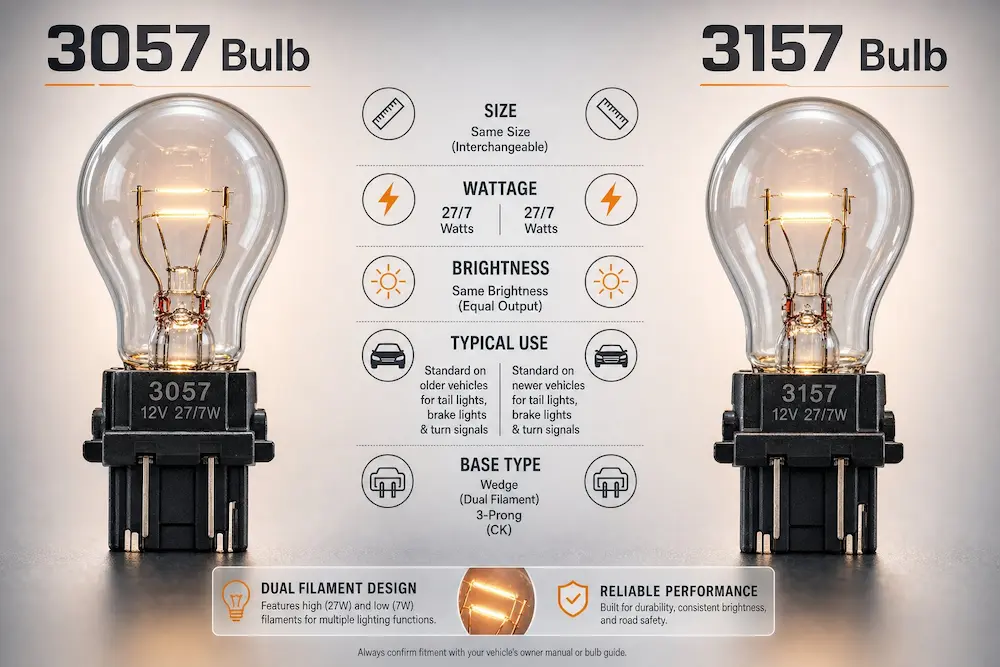
These two bulbs look identical. They fit the same socket. But swap the wrong one in, and you could blow a fuse or melt a housing. This guide breaks down the real differences between 3057 vs 3157 bulbs — brightness, lifespan, socket types, LED upgrades, and how to avoid costly mistakes. Read to the end before you buy anything.
They’re Twins With One Key Difference
Both the 3057 and 3157 share the same W2.5x16q wedge base and miniature S-8 glass envelope. They fit the same sockets. They handle the same jobs — tail lights, brake lights, turn signals, and parking lights.
Each bulb has two filaments inside:
- Major filament — high-intensity mode for braking and turn signals
- Minor filament — low-intensity mode for running lights and parking
Here’s the thing: both bulbs perform identically on the major filament. The only real difference sits in that minor filament. The 3157 burns brighter in low-intensity mode. That’s it. That’s the whole story — almost.
Brightness and Power: The Numbers Side by Side
When you hit the brakes or flip on a turn signal, you’d never notice a difference between these two bulbs. Both major filaments draw 2.1 amps at 12.8 volts, producing 32 candle power and around 400 lumens. Identical.
The gap shows up when the minor filament kicks in for continuous running light operation.
| Electrical Parameter | 3057 | 3157 | Difference |
|---|---|---|---|
| Major filament wattage | 26.88–26.9W | 26.88–27.0W | None |
| Minor filament wattage | 6.7–6.72W | 8.3–9.0W | 3157 draws more |
| Major filament current | 2.1A | 2.1A | Identical |
| Minor filament current | 0.48A | 0.59–0.593A | 3157 draws 23% more |
| Major filament brightness | 32 CP | 32 CP | Identical |
| Minor filament brightness | 2 CP | 3 CP | 3157 is 50% brighter |
That 50% brightness boost on the minor filament helps the 3157 stand out better during fog, rain, and low-light conditions. But that extra power also generates more heat. In small, sealed plastic housings with poor ventilation, the 3157’s continuous heat load can warp or soften the socket over time.
Bottom line: If your vehicle spec calls for a 3057, don’t automatically drop in a 3157 thinking “brighter is better.” Heat damage to your housing isn’t worth a marginal visibility boost.
Lifespan and Specific Bulb Models
Standard 3057 bulbs last 1,200 to 2,000 hours. The 3157 standard is built tougher, rated for 2,000 to 10,000 hours depending on the product line. Neither uses krypton gas — that’s reserved for heavy-duty variants like the 4157.
Here’s how the popular options from Sylvania and GE stack up:
| Bulb Model | Part Code | Color Temp | Rated Life | Key Feature |
|---|---|---|---|---|
| Sylvania 3057 Basic | 3057.TP Basic | 2800K | 1,200 hrs | Standard OEM replacement |
| Sylvania 3057 LongLife | 3057LL.BP2 | 2800K | 1,200 hrs | Extended life design |
| GE 3057 Amber | GE 18391 NA | Warm Amber | ~1,200 hrs | Amber coat for front turn signals |
| Sylvania 3157 Basic | 3157.TP Basic | 2800K | 1,200 hrs | Standard dual-filament |
| Sylvania 3157 SilverStar | 3157ST.BP2 | 3200K | 250 hrs | Whiter light, much shorter life |
Notice that SilverStar lifespan — 250 hours. Sylvania achieves the whiter, crisper 3200K output through a modified filament, proprietary gas, and a blue lens coating. You get a styling upgrade but sacrifice longevity dramatically. Worth it for show cars, questionable for daily drivers.
One quick diagnostic tip: the 3057’s outer filament measures around 800 ohms (running lights), while the inner filament sits around 400 ohms (brake and turn signal). That resistance difference is exactly how one circuit delivers two distinct light levels.
Standard vs CK Sockets: The Mistake That Blows Fuses
This is where most people get burned. Literally.
Standard and CK sockets look completely identical from the outside. Same physical opening, same bulb base. But the internal terminal wiring is completely different — and mixing them up can blow a fuse or melt your wiring harness.
Standard socket: Both ground terminals sit on the left side. Both positive terminals sit on the right side.
CK socket (also called SCK, SACK, or SRCK): Ground terminals move to the top. Positive terminals drop to the bottom.
When you seat the wrong bulb type in a CK socket, a positive power line connects directly to a ground terminal. Activate the headlights or tap the brakes — instant short circuit. Best case, you blow a fuse. Worst case, you melt wiring or damage the body control module.
| Socket Type | Left Terminals | Right Terminals | Top Terminal | Bottom Terminal |
|---|---|---|---|---|
| Standard 3157 | Both Grounds | High & Low Positives | N/A | N/A |
| CK / SRCK Socket | N/A | N/A | Ground | High & Low Positives |
Which Vehicles Use CK Sockets?
CK wiring shows up more often than you’d think. Here’s a partial list of known CK-configured vehicles:
| Vehicle | Location | Socket Type |
|---|---|---|
| 2005–2011 Nissan Xterra | Front turn signal | 3157CK |
| 2002–2007 Toyota Camry | Front turn signal | 3157CK |
| 2005–2013 Toyota Corolla | Front turn signal | 3157CK |
| 2008 Ford Escape | Front turn signal | 3157CK |
| 2005–2015 Toyota Tacoma | Front turn signal | 4157CK |
| 2006–2019 Toyota Tundra | Front turn signal | 4157CK |
| 1988–1999 Chevrolet/GM Trucks | Center brake/tail assembly | 3157CK |
| 1992–1998 Pontiac Grand Am | Tail light | 3157CK |
| 1995–2001 Chevrolet Cavalier | Tail light | 3157CK |
How to Test Your Socket Type
Grab a multimeter set to resistance mode (or a 12-volt test light connected to positive battery).
- Remove all turn signal bulbs from that circuit first — filament feedback skews readings
- Probe the metal contacts inside the socket
- If grounds sit on opposite sides of the socket, it’s standard
- If ground terminals are side by side on the same side, it’s CK
Upgrading to LED: Brighter, Faster, More Efficient
Swapping to LED is the smartest upgrade you can make to your T25 lighting. A standard halogen 3157 burns 27 watts and puts out 402 lumens. A high-quality LED retrofit uses 5.4 to 8.4 watts and produces 510 to 800 lumens — twice the light at a fraction of the power draw.
There’s also a safety advantage that doesn’t get talked about enough. Incandescent filaments need time to heat up. LEDs illuminate instantly, giving the driver behind you extra milliseconds of reaction time. In a rear-end situation, those milliseconds matter.
Here’s how the main LED options compare:
| LED Model | Wattage | Output | Color Temp | Socket Compatibility |
|---|---|---|---|---|
| Sylvania 3057 LED | 0.18A draw | 145 lumens | 6000K | Standard only |
| Sylvania 3157 LED | 2.3W | 145 lumens | 6000K | Standard only |
| Diode Dynamics XP80 | 5.4W | 510 lumens | 6000K / Custom | Standard & CK |
| Auxito 54H Series | 5.5W | High SMD | White / Red / Amber | Standard & CK |
| Auxito 14K Series | 8.4W | High SMD | White / Red / Amber | Standard & CK |
Watch Out for Hyperflashing
LEDs draw so little current that your vehicle’s flasher relay may think a bulb is dead. This causes the turn signal to blink rapidly — called hyperflashing — or triggers a bulb-out warning on the dash.
Two fixes:
- Load equalizer resistors — plug in externally to simulate halogen resistance
- CAN-bus compatible LEDs — integrated chips that decode the signal properly without added resistors
For CK-wired vehicles specifically, choose polarity-insensitive LEDs with smart internal IC drivers that route power and ground correctly regardless of socket orientation.
What It Costs
- Standard halogen 3057: $2–$5 per bulb
- Standard halogen 3157: $3–$6 per bulb
- LED 3057: $8–$15 per bulb
- LED 3157: $10–$20 per bulb
The upfront LED cost is higher, but reduced replacement frequency and lower power draw make it worth it over time.
Installation and Maintenance Tips You Shouldn’t Skip
Always replace in pairs. Don’t just swap the one that burned out. The surviving bulb has degraded filaments and reduced lumen output. Mismatched bulbs create uneven signaling visibility — a real safety issue at highway speeds.
Keep your fingers off the glass. Skin oils transfer to the glass envelope. When the bulb heats up, those oil deposits create thermal hot spots. The glass expands unevenly, which leads to premature cracking, gas leakage, or filament failure. Always use clean gloves or a shop towel.
Check your owner’s manual first. Your OEM spec exists for a reason. If the manual calls for a 3057, installing a 3157 in a small, sealed plastic housing adds unnecessary continuous heat. Over time, that warps the socket or discolors the lens.
For LED installs, socket type is non-negotiable. Confirm standard vs CK wiring before you order anything. A polarity-insensitive, dual-compatible LED with CAN-bus integration covers all your bases — correct signaling timing, no fuse failures, no hyperflashing.