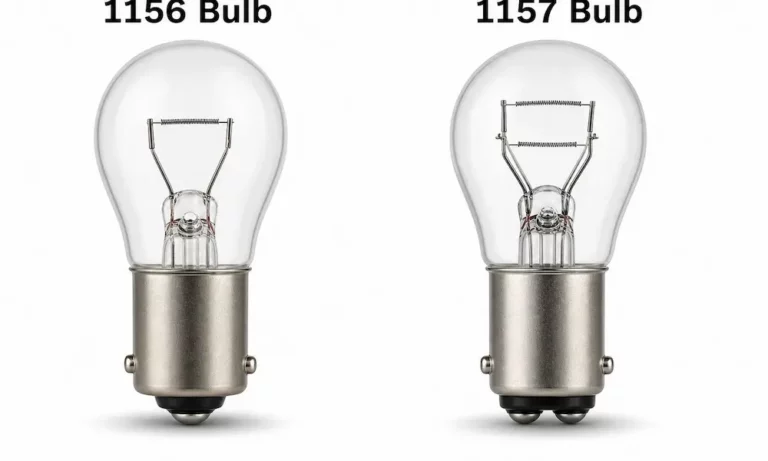
Grab the wrong bulb at the auto parts store and you’re either driving home empty-handed or installing something that could create a real safety hazard. The 1156 vs 1157 bulb debate trips up a lot of drivers, but once you understand the core difference, it clicks instantly. Let’s break it down so you get the right bulb the first time.
They Look Almost Identical — So What’s the Real Difference?
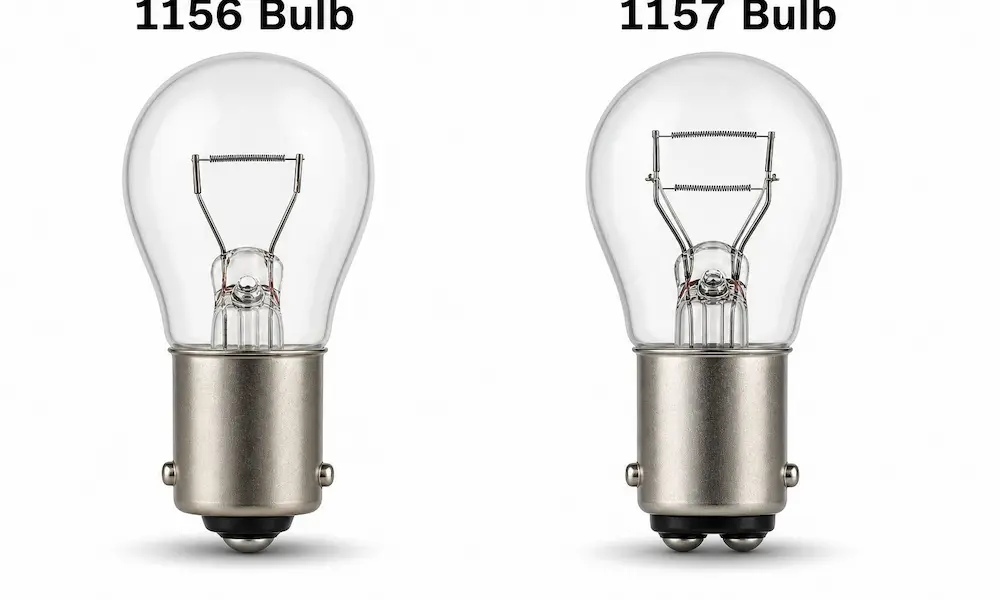
Here’s the short answer: the 1156 is a single-filament bulb and the 1157 is a dual-filament bulb.
That’s the whole game. One does one job. The other does two.
The 1156 handles dedicated tasks — reverse lights, standalone turn signals, or stop lights. The 1157 pulls double duty, running as a dim tail light during normal nighttime driving and snapping to full brightness when you hit the brakes or signal a turn.
Both bulbs share the same S-8 glass envelope shape, the same 2.00-inch maximum length, and the same 26.5mm diameter. That’s why they’re so easy to confuse at a glance.
The Base Is the Dead Giveaway
Flip the bulb over and look at the metal base. This is where the 1156 and 1157 part ways completely.
The 1156 uses a BA15S base — a standard bayonet mount with two pins sitting at the exact same height on opposite sides. You can drop it into the socket in either direction and it’ll work fine, because there’s only one electrical contact at the bottom center.
The 1157 uses a BAY15D base — same 15mm diameter, but the two side pins sit at different heights. One pin sits higher, one sits lower. The socket only accepts the bulb in one specific orientation. This isn’t accidental.
The offset pin design ensures the high-intensity filament always connects to the brake or turn signal circuit — not the running light circuit. If you could install it backwards, your tail lights would blaze at full brightness while your brake lights flickered dimly. That’s a rear-end collision waiting to happen.
Quick Visual Guide: 1156 vs 1157 Base
| Feature | 1156 (BA15S) | 1157 (BAY15D) |
|---|---|---|
| Base type | Single contact | Dual contact |
| Side pins | Level / parallel | Vertically offset |
| Install orientation | Any direction | One direction only |
| Filaments | One | Two |
| Glass envelope | S-8, 26.5mm | S-8, 26.5mm |
| Max length | 2.00 inches | 2.00 inches |
The Electrical Numbers Behind Each Bulb
What the 1156 Delivers
At 12.8 volts, the 1156 draws 2.10 amps and consumes roughly 27 watts. That single filament pumps out 32 candlepower, which translates to about 402 lumens. It burns bright and burns briefly — think turn signals flashing or a reverse light glowing for a few seconds at a time. The rated lifespan sits around 1,200 hours.
What the 1157 Delivers
The 1157 runs two separate circuits. Here’s how they compare:
| Circuit | Voltage | Current | Wattage | Output | Lifespan |
|---|---|---|---|---|---|
| Minor (tail light) | 14.0V | 0.59A | 8.26W | 3 candlepower | 5,000 hours |
| Major (brake/turn) | 12.8V | 2.10A | 26.88W | 32 candlepower | 1,200 hours |
That gap between 3 candlepower and 32 candlepower isn’t random. It creates a contrast ratio that exceeds 10:1, which the Department of Transportation requires for tail and brake lights. Without that dramatic jump in brightness, drivers behind you might not register that you’re actually stopping.
Can You Swap One for the Other?
No — and don’t try to force it.
The mechanical difference between the BA15S and BAY15D bases physically prevents a clean swap. If you try to insert a 1156 into a 1157 socket, the parallel pins on the 1156 won’t align with the offset slots in the 1157 housing. The bulb won’t lock in place.
Even if you muscle it in, the single contact pad on the 1156 bridges both positive terminals in the 1157 socket. That creates an electrical short between your running light and brake light circuits. The result? Your dashboard lights flash when you hit the turn signal, or your headlights flicker when you apply the brakes. Fuses blow. Modules get confused. It’s a mess.
Going the other direction — 1157 into a 1156 socket — causes a different failure. The offset pins don’t engage the parallel slots, so the bulb doesn’t lock in. If the major filament doesn’t make proper contact, you might get a faint 3-candlepower glow when you’re trying to signal a turn. That’s dangerously dim.
The BAU15S: A Third Option You Shouldn’t Ignore
There’s a third bulb in this family that catches people off guard — the BAU15S. It uses the same 15mm bayonet base but with pins spaced at 150 degrees instead of 180 degrees.
This design exists specifically to prevent a clear 1156 bulb from being accidentally installed into a turn signal housing that uses a clear lens with an amber-coated bulb. Modern vehicles often use clear plastic lenses for aesthetics, so the amber color lives on the bulb itself. Install a clear bulb there, and your turn signal flashes white — which violates federal signaling regulations.
The offset pin geometry makes physical installation impossible unless you have the correct amber BAU15S bulb.
Alternatives Worth Knowing About
Several bulbs fit the same 1156 and 1157 sockets but offer different performance profiles. This matters when you’re trying to optimize brightness or extend bulb life.
1156 Alternatives
- P21W / 7506 — European equivalent, same BA15S base, functionally identical output
- 3497 — Slightly higher efficacy, popular for brighter dedicated turn signals
1157 Alternatives (BAY15D Socket)
| Bulb | Low Filament | High Filament | High Filament Life | Why Choose It |
|---|---|---|---|---|
| 1157 | 3 CP | 32 CP | 1,200 hrs | Standard OEM replacement |
| 2057 | 2 CP | 32 CP | 1,200 hrs | Reduces alternator load |
| 2357 | 3 CP | 40 CP | 400 hrs | Maximum brake light brightness |
| 2397 | 2 CP | 40 CP | 400 hrs | Best contrast ratio, short life |
The 2357 gives you 40 candlepower on the high filament — noticeably brighter than the standard 1157 — but burns through that filament in roughly 400 hours. If you drive a vintage vehicle with faded or tinted tail light lenses, the extra punch is worth it. If longevity matters more, stick with the 1157 or 2057.
The 3496 is a halogen variant that fits the BAY15D socket and runs on a halogen cycle — the gas redeposits tungsten back onto the filament as it cools, keeping the bulb brighter longer without the glass envelope blackening over time.
Should You Upgrade to LED?
LED replacements for both the 1156 and 1157 platforms are widely available and genuinely worth considering — especially for trailers, motorcycles, and RVs.
Here’s what LED actually delivers versus incandescent:
| Spec | Incandescent | LED Replacement |
|---|---|---|
| Power draw | ~27 watts | 1.5–6.5 watts |
| Response time | 200–300 milliseconds | 1–5 milliseconds |
| Vibration resistance | Low (fragile filament) | Extremely high |
| Lifespan | 1,200–5,000 hours | 30,000–50,000 hours |
That faster response time has a real-world impact. At highway speeds, the difference between a 200ms and 5ms response means trailing drivers get several extra feet of stopping distance. That gap can prevent a collision.
The Hyper-Flash Problem
Here’s the catch: your vehicle’s flasher relay was designed for a 27-watt load. Swap in a 2-watt LED and the relay interprets the low current draw as a burned-out bulb. The result is hyper-flashing — a rapid, frantic blink that’s more annoying than helpful.
The fix is either a load resistor wired in parallel (which mimics the original 27-watt draw) or replacing the thermal flasher with a modern electronic flasher that doesn’t care about current load.
Get the LED Color Right
Don’t install a cool-white LED behind a red lens. A white LED emits strong blue wavelengths, and a red lens filters almost all of it out. You’ll end up with a dim, pinkish glow instead of a bright red light.
The rule is simple: match the LED color to the lens color. Red LED behind a red lens. Amber LED behind an amber lens. When the wavelengths match, light passes through with almost no loss — and the result is dramatically brighter than any incandescent option.
Where These Bulbs Actually Show Up
Passenger vehicles: The 1157 appears in Chevrolet, Dodge Ram, Hyundai, Kia, BMW 325i, Mercedes E350, and dozens of other platforms as the combined tail and brake light.
Harley-Davidson motorcycles: Front turn signals on older Harleys typically use the 1157 — the dim minor filament acts as an amber daytime running light, and the major filament flashes when you signal. Rear indicators often use the 1156 as a dedicated turn signal only.
Trailers and RVs: Standard square trailer tail light boxes almost universally use the 1157 for running light, brake, and turn signal in a single BAY15D socket. Vibration from unsuspended trailers destroys incandescent filaments fast — this is one of the strongest cases for switching to LED.
Marine vessels: BAY15D bulbs serve as navigation lights on boats, including port, starboard, and anchor lights. Marine LED replacements are engineered to handle wide voltage ranges (10–30V) and protect against the voltage spikes that marine alternators generate. Replacing a 25-watt anchor light with a 2.5-watt LED equivalent can keep your navigation lights running all night without draining the starting battery.
The Light Center Length No One Talks About
Both bulbs share an identical Light Center Length of 1.25 inches — the distance from the base to the geometric center of the filament. This matters because automotive reflector housings use a parabolic design with a specific focal point. The filament has to sit exactly at that focal point to produce the correct beam pattern.
Because both bulbs share the same Light Center Length, manufacturers can build one reflector housing and simply swap the socket type depending on whether the application needs single or dual-function lighting. It’s a clever piece of standardization that keeps parts costs low across multiple vehicle platforms.
The Bottom Line on 1156 vs 1157
The 1156 goes where one job is needed — a reverse light, a standalone turn signal, a dedicated stop light. The 1157 goes where two jobs share one housing — running light and brake light, or running light and turn signal.
The offset pins on the 1157’s BAY15D base aren’t just a design quirk. They’re a safety lock that keeps a dim tail light from accidentally connecting to the brake circuit and leaving the driver behind you with almost no warning when you stop.
When you’re replacing either bulb, check the socket type before you buy. Look at the pins — level means 1156, offset means 1157. And if you’re making the jump to LED, remember to match the color to the lens and solve the hyper-flash issue before you button everything back up.