Trying to order parts for your Dana axle without knowing exactly what you’ve got? That’s a fast track to wasted money and wrong parts sitting on your doorstep. Whether you’re rebuilding a differential, swapping gear ratios, or just trying to figure out what’s under your rig, this guide walks you through every Dana rear end identification method — from factory tags to cover bolts to carrier breaks.
Why Your Vehicle’s Year and Model Aren’t Enough
Here’s the thing most people don’t realize: two trucks sitting next to each other on the same assembly line can have completely different axles. Same year. Same badge. Totally different internals.
Ford, GM, Jeep, and Dodge all changed axle specs based on engine torque, towing packages, and mid-year engineering tweaks. So relying on year and model alone is universally insufficient for ordering replacement parts or rebuilding differentials.
You need the actual axle identification number — and this guide shows you exactly where to find it.
The Bill of Material Number: Your Most Reliable Tool
The Bill of Material (BOM) number is the gold standard for Dana rear end identification. It tells you:
- The exact axle model
- The original factory gear ratio
- Whether it’s open or limited-slip
- Every internal component used at assembly
Dana started using BOM numbers around 1965. Even a minor factory change — a different bearing size, a new seal design, a different spline count — gets its own unique number.
Traditional BOM format: Six digits, a dash, then one or two more digits. Example: 610604-2
- First two digits are almost always 60 or 61
- The digits after the dash tell you the factory gear ratio
- A tag reading “3994-1” actually means “603994-1” — the first two digits are sometimes dropped to save space
After mid-2004: Dana switched to a seven-digit number starting with the digit 2. Same purpose, new format.
Where to Find the BOM Number
Check the Differential Tag First
The BOM number lives on a thin metal tag bolted to the differential housing by two cover bolts. It’s your quickest starting point.
You’ll often find a second smaller tag secured by a single cover bolt showing the gear ratio. If your axle has a limited-slip differential, that ratio tag includes the letter “L” between the digits — like 3.73L — plus a separate tag reminding you to use friction modifier in the fluid.
Look for the Axle Tube Stamping
Differential covers come off all the time for fluid changes and inspections. Tags get tossed. That’s why Dana also stamps the BOM directly into the axle tube steel.
Here’s where to look:
- Solid rear axles: Rear-facing side of the right (passenger side) axle tube
- Solid front axles: Front-facing side of either axle tube
- IFS axles: Right-hand support arm tag, left-hand support arm, or stamped directly into the carrier nose
Heavy grime, rust, and layers of undercoating routinely hide these stampings. Use a metal scraper or chemical solvent to expose the digits. Don’t use a wire wheel on an angle grinder — you’ll smear the soft steel and destroy the stamping permanently.
Secondary ID Methods: Ford and GM Codes
Ford’s Identification System
Ford uses a small metal tag on one differential cover bolt listing the ring gear size in inches — which directly tells you the axle model. Ford vehicles from 1990 onward often have a white data decal on the right axle tube showing the BOM number, Ford axle code, serial number, Ford part number, and build date. These decals eventually peel on high-mileage trucks, so don’t count on finding one.
GM Regular Production Option (RPO) Codes
General Motors uses three-character RPO codes printed on the Service Parts Identification sticker. It’s usually inside the glove box, center console, or near the spare tire. On 2018+ GM vehicles, it’s a scannable matrix code on the driver-side door pillar.
When hunting axle specs, look for codes starting with F, G, or H. Common ones to know:
- G80 = Factory locking or limited-slip differential
- GU6 = 3.42 gear ratio
- GT4 = 3.73 gear ratio
These codes only work if nobody’s swapped the axle or changed the gears since the truck left the factory.
Visual Identification: Reading the Cover
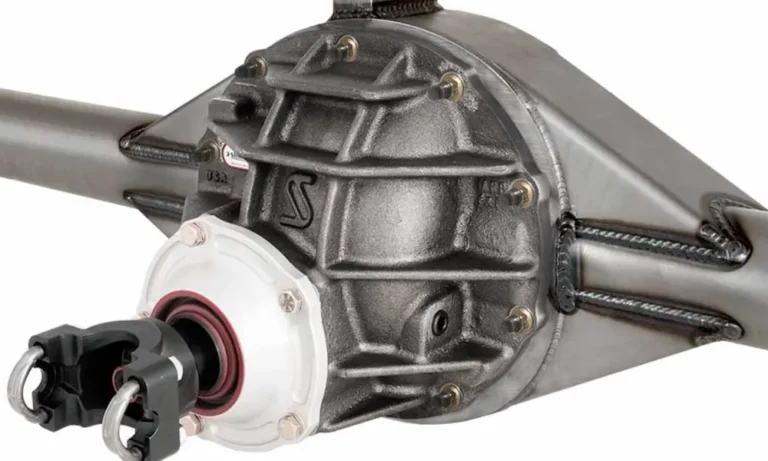
When all the tags are gone and the tube stamping is unreadable, you go hands-on. The differential cover shape, bolt count, and ring gear diameter tell you exactly what you’re working with.
Many Dana housings also have the model number cast directly into the iron — look for raised or recessed digits like 44, 60, or 70 after cleaning the surface.
Here’s the complete visual identification breakdown:
| Axle Model | Cover Bolt Count | Ring Gear Diameter | Cover Shape Notes |
|---|---|---|---|
| Dana 25 / 27 | 10 bolts | 7.125 in | Symmetrical round — identical to Dana 30 |
| Dana 30 | 10 bolts | 7.125 in | Perfectly symmetrical round, no flat edges |
| Dana 35 / 35C | 10 bolts | 7.56 in | Oval, slightly wider than tall |
| Dana 44 | 10 bolts | 8.5 in | Asymmetrical hexagonal with distinct flat sides |
| Dana 60 | 10 bolts | 9.75 in | Asymmetrical; cover flange height ~1.0 inch |
| Dana 70 | 10 bolts | 10.5 in | Looks like Dana 60; flange height ~1.25 inches |
| Dana 80 | 10 bolts | 11.25 in | Massive cover, pronounced rounded bottom |
| GM 10-Bolt | 10 bolts | 8.5 or 8.6 in | Smooth oval, zero flat sides |
| GM 14-Bolt | 14 bolts | 10.5 in | Wide base, heavy-duty commercial profile |
| Ford 8.8 | 10 bolts | 8.8 in | Flat top, flat bottom, straight vertical sides |
| Ford 9-Inch | No cover | 9.0 in | Dropout third-member design, round rear housing |
Pro tip for Dana 60 vs. Dana 70: They look nearly identical from the outside. Measure the cover flange height. A 60 measures roughly 1.0 inch; a 70 measures roughly 1.25 inches. Pull the cover and measure the ring gear if you’re still unsure — 9.75 inches means Dana 60, 10.5 inches means Dana 70.
Semi-Float vs. Full-Float: What’s the Difference?
This isn’t just trivia — understanding axle architecture directly affects parts compatibility, payload ratings, and failure modes.
Semi-Floating Axles
In a semi-float design, the wheel bolts directly to a flange on the axle shaft itself. The shaft carries vehicle weight, cornering loads, and rotational torque all at once. Shafts are held in by internal C-clips or outboard retainer plates.
The vulnerability: if a semi-float shaft snaps, the wheel can slide right out of the housing. That’s a serious safety problem on the trail or the highway.
Semi-float axles suit vehicles with a Gross Axle Weight Rating up to about 4,500 pounds. Think standard half-ton trucks, Jeep Wranglers, and most SUVs.
Full-Floating Axles
In a full-float design, the wheel bolts to an independent iron hub. That hub rides on two large tapered roller bearings mounted on a fixed spindle bolted to the axle housing. The shaft’s only job is transmitting torque — it carries zero vehicle weight.
If a full-float shaft breaks, you lose power to the wheel, but the wheel stays on the truck. You can also pull the shaft out for service without jacking the vehicle at all.
Full-float axles are standard on three-quarter-ton and one-ton trucks, commercial platforms, and anything with a Gross Axle Weight Rating approaching 10,000 to 11,000 pounds. They traditionally use an eight-lug wheel bolt pattern.
Axle-by-Axle Breakdown
Dana 44: The Most Famous Rear End in America
The Dana 44 has been in continuous production since the late 1940s. You’ll find it in classic Chevy Blazers, solid-axle Ford F-150s, Scout IIs, and modern Jeep Rubicons. That distinctive asymmetrical hexagonal cover with flat sides is its calling card.
Dana 44A (Aluminum Center Section): This variant was used exclusively in Jeep Grand Cherokees (ZJ, WJ, WK) and the Jeep Commander. The internals match a standard Dana 44, but the center housing is cast aluminum to save weight. The problem? Aluminum deflects under severe loads and gouges easily on rocks. A heavy-duty steel differential cover acts as a structural girdle and helps prevent the housing from flexing.
Dana 60: The Off-Road Benchmark
The Dana 60 is the entry point to serious heavy-duty territory. It’s deployed in rear three-quarter-ton setups and serves as the premier solid front axle for military and severe off-road builds. A 9.75-inch ring gear with 12 ring gear bolts. Available in both semi-float and full-float configurations depending on the OEM application.
Dana 80: The Heavyweight
Introduced in 1988, the Dana 80 is exclusive to the heaviest trucks — Ford F-350/F-450, Dodge Ram 3500, Chevy/GMC 3500, and heavy motorhome platforms. It’s always full-float, with axle tubes 3.5 to 4.0 inches thick and an 11.25-inch ring gear. Factory shafts run 35 or 37 splines. Gross Axle Weight Ratings fall between 10,000 and 11,000 pounds.
Common Dana 80 failure points to watch:
- Carrier bearing wear from heavy towing — causes gear whine at highway speeds
- Pinion bearing failure from shock loads on steep grades
- Carrier journal ovaling on extremely high-mileage commercial units
- Shaft twisting in high-horsepower diesel applications
The Modern Era: Dana AdvanTEK (M-Series)
Modern fuel economy standards pushed Dana to completely redesign its axle lineup. The result is the AdvanTEK series — better metallurgy, advanced gear profiles, and lower friction, all in a stronger package.
The old numeric names are gone. The new naming uses metric ring gear diameter:
- M186 / M200 — Dana 30/35 equivalents; standard on Jeep JL Wrangler
- M210 / M220 — Dana 44 equivalents; standard on Jeep Rubicon, Jeep Gladiator, and Ford Bronco
- M256 — Super 60 equivalent; Ford Super Duty front axle
- M275 / M300 — Severe-duty commercial rear axles
Critical point: AdvanTEK parts don’t interchange with older Dana axles, despite sharing marketing names. A traditional Dana 44 ring and pinion won’t fit an M210 housing. Different pinion diameters, gear offsets, and bearing bores — full stop.
Carrier Breaks: What They Are and Why They Matter
If you’re re-gearing for bigger tires, the carrier break is the concept that can save you hundreds of dollars — or cost you a fortune if you ignore it.
How Carrier Breaks Work
A differential carrier is the iron assembly that holds the spider gears and carries the ring gear. Carriers are designed to accommodate a specific range of gear ratios. As you go to numerically higher (lower speed) ratios, the pinion gear shrinks. The ring gear has to get thicker to fill the gap. At a certain threshold, the carrier must be redesigned with a different deck height to keep using a standard-thickness ring gear. That threshold is the carrier break.
Cross the carrier break without swapping carriers, and your gears simply won’t mesh correctly.
Standard Carrier Break Thresholds
| Axle Model | Low-Ratio Range | Break Point | High-Ratio Range |
|---|---|---|---|
| Dana 30 | 3.54 & numerically lower | 3.54 / 3.73 | 3.73 & numerically higher |
| Dana 35 / 35C | 3.31 & lower | 3.31 / 3.55 | 3.55 & higher |
| Dana 44 | 3.73 & lower | 3.73 / 3.92 | 3.92 & higher |
| Dana 60 | 4.10 & lower | 4.10 / 4.56 | 4.56 & higher |
| Dana 70 | 4.10 & lower | 4.10 / 4.56 | 4.56 & higher |
| Dana 80 | 3.73 & lower | 3.73 / 4.10 | 4.10 & higher |
| GM 14-Bolt | 4.10 & lower | 4.10 / 4.56 | 4.56 & higher |
The Thick Ring Gear Solution
Here’s the smart workaround: aftermarket manufacturers make “thick” ring gears with extra material machined onto the back flange. That extra steel makes up the spatial difference a higher-deck carrier would normally provide. Install a thick gear set, and you can run a 4.88 or 5.13 ratio on a factory low-ratio carrier.
Use a thick gear when: You just want to re-gear an open differential and keep costs down.
Buy the correct carrier when: You’re installing a locker or limited-slip at the same time. You’ll need the right carrier for the locker to fit properly anyway, so do it right the first time.
Setup Tolerances That Actually Matter
Getting these numbers right during a rebuild isn’t optional — it’s what separates a long-lasting axle from one that destroys itself six months later.
For AdvanTEK M275 and M300 axles, Dana’s setup specifications are extremely precise:
- Pinion bearing preload: 20 to 30 inch-pounds
- Ring gear backlash: 0.006 to 0.010 inches
- Bearing cap torque (M275 left side): 201 foot-pounds
- M210/M220 ring gear bolt torque: 155 foot-pounds
On front steer axles, kingpin and tie-rod deflection must be measured with a dial indicator. More than 0.060 inches of movement at the tie-rod ends means immediate replacement. More than 0.040 inches at the kingpin means a full overhaul — both sides simultaneously, to keep steering geometry symmetrical.
Proper Dana rear end identification is the foundation of every repair, upgrade, and rebuild decision you make. Get the BOM number first. Use the cover dimensions to confirm what you’re seeing. Understand the carrier break before you order gears. Follow the setup specs when you reassemble. Do all that, and your Dana axle will handle whatever you throw at it.