Yes, 2 stroke engines absolutely need oil — but not the way you might think. Skip the oil and you’ll destroy your engine in seconds. This guide breaks down exactly how 2 stroke lubrication works, what happens when it fails, and which oil your engine actually needs.
Why 2 Stroke Engines Can’t Run Without Oil
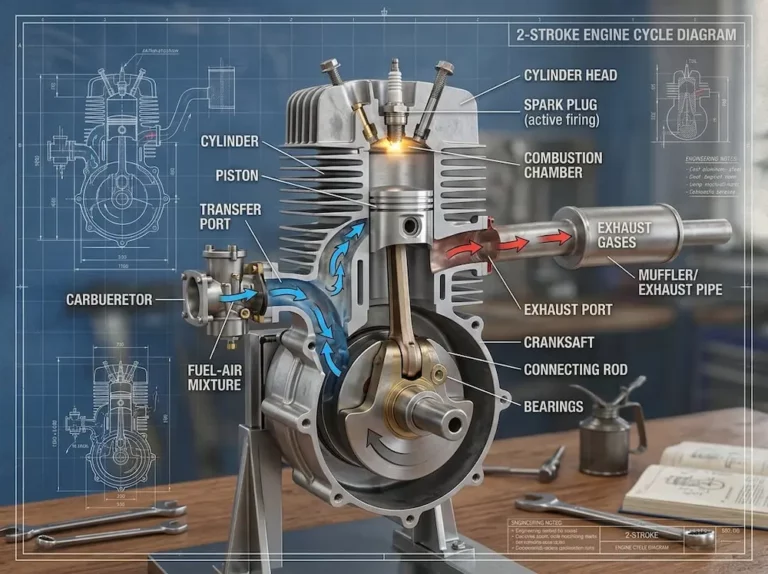
Here’s the problem: a 2 stroke engine uses its own crankcase as a pumping chamber to pull in the air and fuel mixture. That means there’s no room for a standing pool of oil down below — unlike a 4 stroke engine with its sealed sump and dedicated oil pump.
Because the crankcase is constantly swept by high-velocity air and gasoline vapor, any pooled oil would get sucked straight into combustion in massive, uncontrolled amounts. So instead, 2 stroke engines run a total-loss lubrication system. The oil mixes with the fuel, coats the internal components as a fine mist, then burns off with every combustion stroke.
No oil in the mix? You’ve got metal grinding against metal at thousands of RPM. That engine won’t last seconds.
How the Oil Actually Protects the Engine
The suspended oil mist isn’t just one thing doing one job. It’s doing several critical jobs at once across different parts of the engine.
Down in the crankcase: The spinning crankshaft and connecting rod bearings drag oil droplets into a microscopic wedge. That wedge generates internal pressure that physically separates the metal surfaces — this is called hydrodynamic lubrication. The metal parts never actually touch.
At extreme pressure points: Where bearing rollers contact the crankshaft pin, the pressure gets so intense that the oil momentarily turns semi-solid. This is elastohydrodynamic lubrication — it stops the bearings from friction-welding at 10,000+ RPM.
Up in the combustion cylinder: No thick oil film survives direct flame contact. Here the engine relies on boundary lubrication, where chemical additives in the oil bond directly to the cylinder wall. The piston rings shear that chemical layer instead of tearing away raw metal. Because the oil only lasts a fraction of a second before it burns, these chemical additives need to work instantly.
Two Ways Oil Gets Into a 2 Stroke Engine
Pre-Mix: You Do It Yourself
With pre-mix, you blend oil and gasoline in a separate container before filling the tank. The ratio matters enormously. Use the wrong ratio and you’re either starving the engine of oil or drowning it in unburned residue.
| Fuel-to-Oil Ratio | Oil Per US Gallon | Typical Application |
|---|---|---|
| 20:1 | 6.4 oz | Vintage and classic racing engines |
| 32:1 | 4.6 oz | Older motorcycles, high-performance watercraft |
| 40:1 | 3.2 oz | Modern chainsaws, professional landscaping tools |
| 50:1 | 2.6 oz | Late-model residential equipment, modern outboards |
Always check your owner’s manual. Older equipment often runs richer ratios than modern machines.
The big advantage of pre-mix? Zero mechanical failure points. No pump, no hoses, no sensors. High-stress racing machines like the Yamaha Banshee shipped from the factory pre-mix only for exactly this reason.
The downside: the oil ratio stays fixed at idle and at full throttle. At low speed, you’re over-oiling. That means heavy smoke, spark plug fouling, and carbon buildup. There’s also a weird tuning quirk — adding more oil to the mix actually leans out your air-fuel combustion ratio, which runs the engine hotter.
Oil Injection: The Engine Handles It
Modern scooters, outboards, snowmobiles, and personal watercraft often use automatic oil injection. The gas tank holds pure gasoline. A separate reservoir holds oil. A pump — driven by the crankshaft — meters oil delivery based on throttle position and RPM.
At idle, injection systems can lean the ratio all the way to 120:1. At wide-open throttle, they ramp up to 20:1. This dynamic metering prevents plug fouling, reduces smoke dramatically, and gives the engine exactly what it needs when it needs it.
The risk? If a vacuum line cracks, a pump gear strips, or you forget to check the oil reservoir, the engine runs on pure gas with zero lubrication. Complete engine destruction follows immediately. That’s why many owners of older bikes disable their injection pumps entirely and switch back to pre-mix.
What Happens When a 2 Stroke Runs Without Oil
This is where things get brutal. The failure sequence moves fast and it’s irreversible.
Stage 1 — Oil film breaks down: The boundary film on the cylinder wall disappears. The aluminum piston skirt contacts the cylinder wall directly at thousands of RPM. Localized temperatures spike past the melting point of aluminum.
Stage 2 — Galling and scoring: Molten aluminum tears away from the piston and welds onto the harder cylinder wall. That raised material then gouges deep vertical scratches into the piston skirt on every stroke. The engine may still run at full power while this is happening — it’s destroying itself from the inside.
Stage 3 — Ring locking: The molten debris migrates into the piston ring grooves and solders the rings flat. Rings can no longer press against the cylinder wall. Compression drops to zero. The engine stalls instantly.
Different failure patterns point to different root causes:
| Seizure Type | Location | What It Means |
|---|---|---|
| Exhaust-side seizure | Piston skirt near exhaust port | Lean mixture, exhaust blockage, or extreme heat |
| Intake-side seizure | Piston skirt near intake port | Direct oil starvation or ingested dirt |
| Four-corner seizure | All four outer corners equally | Cold engine run at full throttle, or tight machining clearances |
| Total oil starvation | Uniform band around entire skirt | Engine ran on pure, unmixed gasoline |
Beyond the piston, bearing cage failure scatters hardened steel fragments through the crankcase. Those fragments travel up through transfer ports and get crushed between the piston and combustion chamber roof — destroying both simultaneously.
Choosing the Right Type of 2 Stroke Oil
Not all 2 stroke oils are the same. Using the wrong type is one of the most common and expensive mistakes people make.
Air-Cooled vs. Marine: Don’t Mix Them Up
Air-cooled engines (chainsaws, dirt bikes, string trimmers) run extremely hot. They need oils with low-ash metallic detergents that survive extreme temperatures and keep piston ring grooves clean under intense heat.
Marine outboard engines run cool — they constantly draw in cold water through their cooling jackets. They need ashless organic detergents that burn completely clean at low temperatures. Marine oils also carry heavy rust inhibitors and anti-foam agents to handle saltwater exposure.
Put marine oil in an air-cooled engine: the detergents burn off too fast, protection fails, seizure follows. Put air-cooled oil in a marine engine: metallic detergents won’t burn cleanly, spark plugs foul, pre-ignition destroys the engine.
Mineral, Synthetic, or Semi-Synthetic?
Mineral oil is refined from crude petroleum. It’s affordable and widely available, but its inconsistent molecular structure means it breaks down faster under heat. It produces visible smoke and leaves carbon deposits in exhaust ports and ring grooves. Fine for low-stress vintage equipment with frequent maintenance.
Full synthetic oil is built molecule by molecule in a lab. Every molecule is identical in size and weight — this gives it exceptional shear strength and thermal stability. It burns nearly clean, produces almost no visible smoke, and lets you safely run leaner ratios like 50:1 or 60:1 without risking seizure. The cost is higher, but the engine life and fuel efficiency gains usually make up for it.
Semi-synthetic blends split the difference — some synthetic stability at a lower price point. A solid choice for recreational snowmobiles, standard motorcycles, and mid-range equipment.
Oil Certification Standards: What the Labels Actually Mean
You can’t judge oil quality by looking at it. These certification codes on the bottle tell you what the oil has actually proven it can do:
JASO Standards (the ones that actually matter for modern engines):
| JASO Rating | Performance Level | Best For |
|---|---|---|
| JASO FA | Minimum baseline — mostly obsolete | Light vintage applications only |
| JASO FB | Medium performance, moderate smoke | Older machinery |
| JASO FC | Low smoke, clean-burning, semi-synthetic | Modern chainsaws, landscaping equipment |
| JASO FD | Highest standard — maximum detergency, ultra-low smoke | High-performance engines, direct injection |
NMMA TC-W3 is the required certification for all marine 2 stroke oils. Achieving it means passing 100-hour continuous endurance tests on real outboard motors — including checks for ring sticking, scuffing, and carbon buildup. If a marine oil bottle doesn’t show the official TC-W3 trademark, don’t use it.
The Ethanol Problem and Pre-Mixed Canned Fuels
Modern pump gasoline contains up to 10% ethanol. That’s a serious problem for 2 stroke equipment that sits in storage between uses.
Ethanol absorbs moisture from the air. After a few months in a can or tank, it absorbs enough water to physically separate from the gasoline — a process called phase separation. The heavy water-ethanol layer sinks to the bottom, taking the oil with it. When the equipment starts, the engine runs on un-lubricated water and alcohol. The result: rusted carb internals, degraded fuel lines, and piston seizure.
The solution is ethanol-free premixed canned fuel:
| Brand | Ratio | Key Features | Shelf Life |
|---|---|---|---|
| TruFuel | 40:1, 50:1 | 92+ octane, ethanol-free, JASO FD synthetic oil, fuel stabilizers | 5 years sealed / 2 years opened |
| STIHL MotoMix | 50:1 | Alkylate fuel, HP Ultra synthetic oil, biodegradable | 10 years sealed / 2 years opened |
| VP Racing Fuels | 40:1, 50:1 | Ethanol-free, prevents gum and varnish buildup | Extended shelf life |
These products cost more per ounce than mixing your own. But they guarantee exact lubrication ratios, eliminate ethanol damage, and stay chemically stable for years in storage. For seasonal equipment, that protection is worth it.
The EPA’s Role in Changing 2 Stroke Technology
Traditional carbureted 2 stroke engines have a brief moment during each cycle when both the intake and exhaust ports are open simultaneously. During that window, up to 20-30% of the incoming fuel and oil mixture escapes directly out the exhaust unburned. That raw discharge dumps benzene, toluene, polycyclic aromatic hydrocarbons, and carbon monoxide straight into the air and water.
The EPA used authority under Section 213 of the Clean Air Act to mandate a 75% reduction in hydrocarbon emissions from small engines and outboards. That forced manufacturers to adopt Direct Fuel Injection — where only clean air scavenges the cylinder, and fuel and oil inject directly into the sealed combustion chamber at the last possible moment. No unburned hydrocarbons escape. Modern DFI 2 strokes are dramatically cleaner than their predecessors while keeping the power-to-weight advantage the design is known for.
The same regulatory pressure drove lubricant manufacturers to develop the ultra-clean JASO FD synthetic esters now standard in professional equipment — largely because unburned oil particles near an operator’s breathing zone were identified as a direct health concern.
The short answer to “do 2 stroke engines need oil” is yes — always, without exception. Get the ratio right, use the correct oil type for your specific engine, and check your certifications before you buy. Your engine’s life depends on it.