Frame rust is one of those problems that sneaks up on you. One day it’s a little surface discoloration, the next it’s a structural nightmare. But how do you actually know when you’ve crossed the line? This post breaks down exactly how much frame rust is too much — from the early warning signs to the hard thresholds that mean your vehicle is unsafe to drive.
The Three Stages of Frame Rust (And Why Stage Three Is the Point of No Return)
Not all rust is equal. The automotive repair industry breaks corrosion into three distinct stages. Knowing which stage your frame is at tells you everything about how much danger you’re actually in.
| Rust Stage | What It Looks Like | Structural Threat | What to Do |
|---|---|---|---|
| Stage 1: Surface Rust | Light reddish-brown discoloration, minor paint blistering | Low — metal is still fully intact | Clean, apply rust converter, repaint |
| Stage 2: Scale Rust | Flaking, rough, pitted surfaces | Moderate — metal thickness is measurably reduced | Grind it back, apply encapsulant, consider patch welding |
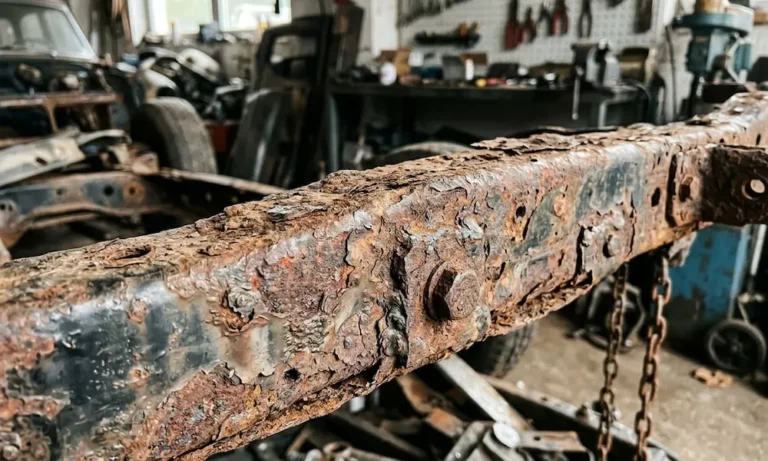
| Stage 3: Penetrating Rust | Holes, crumbling edges, structural separation | Severe — load-bearing capacity is gone | Full section or component replacement, or scrap the vehicle |
Stage three penetrating rust is the unambiguous answer to how much frame rust is too much. Iron oxide has virtually zero tensile strength. Once it eats through the full thickness of a frame rail or cross-member, that component can’t manage load, resist flex, or protect you in a crash.
Body-on-Frame vs. Unibody: The Threshold Isn’t the Same for Both
Your vehicle’s construction type changes everything when it comes to evaluating rust severity.
Body-on-Frame Trucks and SUVs
Heavy-duty pickups and large SUVs use a separate ladder frame. The body bolts on top. That means the outer door skin, fenders, and quarter panels aren’t primary load-bearing structures.
Heavy scale rust on a door panel isn’t great, but it doesn’t compromise the frame. The frame rails, cross-members, and body mount brackets? Those are the critical components. Penetrating rust in any of those areas means the vehicle’s core skeleton is compromised.
Unibody Cars and Crossovers
Most modern passenger cars and crossovers use unibody construction — there’s no separate frame. The floor pan, roof, pillars, and rocker panels are all welded together into one structural shell.
Here’s the critical difference: an outer rocker panel on a unibody vehicle is a load-bearing structural component. Penetrating rust on a unibody rocker panel, strut tower, or floor pan compromises the engineered crumple zones, disrupts airbag sensor timing, and throws off suspension geometry. What’s a cosmetic issue on a body-on-frame truck is a catastrophic failure on a unibody car.
How to Actually Test Frame Rust Severity
A visual check alone won’t tell you the full story. Fresh undercoating can hide fatal rot underneath. Thick surface rust can make a solid frame look destroyed. Here’s how professionals determine the real condition.
The Screwdriver Puncture Test
This is the most widely used field test, and it’s brutally simple.
Grab a sturdy flathead screwdriver and press it firmly into areas showing scale rust or discoloration. Healthy steel resists the pressure. You’ll scrape off surface oxide and find solid metal underneath.
If the screwdriver punches through, crumbles the metal, or sends thick flakes falling away — the frame fails the test. Full stop. A frame that fails the screwdriver test is structurally compromised and unsafe to drive.
The Tap Test
The tap test is a non-destructive way to evaluate internal density using sound.
A small hammer struck against solid steel produces a sharp, clear ring. The energy travels cleanly through the metal. A severely corroded frame produces a dull, muffled thud. The delaminated rust layers absorb and kill the vibration.
If the hammer blow physically caves in the metal or knocks holes through it — that’s penetrating rust confirmed, and the component needs immediate replacement.
Visual Red Flags You Shouldn’t Ignore
Beyond the physical tests, these signs point to serious underlying structural damage:
- Paint bubbling on frame rails — Rust often starts inside hollow sections and works outward. By the time paint blisters on the exterior, the inside is already heavily compromised
- Uneven door or hood gaps — A frame weakened by rust can sag under its own weight, warping panel alignment
- Pulling or dog-tracking — Rust deterioration around control arm mounts or strut towers shifts suspension geometry, causing chronic alignment and handling issues
- Excessive or uneven tire wear — Another symptom of rust-distorted suspension geometry
What State Safety Inspections Actually Say About Frame Rust
If you’re in a state with mandatory vehicle inspections, there are legal thresholds defining exactly when frame rust becomes a failure. Here’s how several states handle it:
| State | Frame Failure Criteria | Floor Pan / Exhaust Intrusion | Cosmetic Rust |
|---|---|---|---|
| New York | Breaks, cracks, or severe rust at suspension attachment points | Perforation allowing exhaust into cabin = automatic fail | Acceptable unless protruding sharp edges exist |
| Pennsylvania | Frame not in solid condition, rotted components, deteriorated body mounts | Floor pan rusted through = immediate rejection | Cosmetic rust alone doesn’t fail unless it creates a hazard |
| Virginia | Rust holes, sagging frame, corroded engine or body mounts | Perforated floor pans that allow gas intrusion = rejection | Exterior hazards from rust = rejection |
| Maine | Frame members cracked, sagging, or rusted to structural weakness | Holes permitting fumes into cabin = rejection | Surface rust explicitly NOT a cause for rejection |
| New Hampshire | Frame broken, cracked, or rusted to a degree that affects safety | Rust allowing exhaust entry = rejection | Protruding metal hazards = rejection |
The Exhaust Gas Intrusion Rule Is Universal
Every regulated state treats floor pan integrity as a hard pass/fail line. Carbon monoxide from a perforated floor pan is lethal. A vehicle with rust holes in the floor, inner rockers, or trunk floor that could allow exhaust entry fails inspection in every state that has one — regardless of how structurally sound the rest of the vehicle appears.
Brake Lines Deserve Serious Attention Too
Steel brake lines routed along the undercarriage are extremely vulnerable to deep pitting. A brake line wall thinned by rust can rupture under hydraulic pressure during hard braking, causing total brake failure. State inspectors reject brake lines showing flaking, bulging, or imminent failure potential. Brake rotors with deep pitting or rust covering more than 25% of the friction surface also earn an immediate rejection.
The Toyota Frame Rust Recall: A Real-World Threshold
The most well-documented case study on frame rust thresholds in U.S. automotive history involves millions of Toyota trucks — Tacoma, Tundra, and Sequoia models built between 1995 and 2017.
Engineering investigations found that frames supplied by Dana Holding Corporation had inadequate factory corrosion protection. In salt-belt states, the frames developed severe penetrating rust that compromised rear leaf spring mounts, creating risk of spring detachment, fuel tank puncture, and brake line severing. Spare tire carriers were rotting through and dropping spare tires on highways at speed.
Toyota’s NHTSA-documented Limited Service Campaign defined the failure threshold with clinical precision:
A rust perforation hole measuring 10mm or greater = structurally compromised and unsafe.
Technicians used the screwdriver and hammer method to break away scale rust and check for perforations. Vehicles that met the 10mm threshold received complete frame replacements — new frame, new lower control arms, new leaf springs — at no cost to the owner. The repair ran up to 50 labor hours and cost Toyota upwards of $15,000 per truck.
If a manufacturer is willing to spend $15,000 replacing frames rather than let owners drive on compromised ones, that tells you everything about how seriously penetrating frame rust should be taken.
Repair vs. Replace: The 50-70% Rule
If frame rust is caught early enough to repair, the economics still need to make sense. Industry consensus is straightforward: if rust repair costs exceed 50–70% of the vehicle’s market value, you’re looking at a total economic loss. Replacement is the smarter call.
There’s also a metallurgical constraint that closes the door on repair entirely in some cases. Modern vehicles use Advanced High-Strength Steel and Ultra-High-Strength Steel in critical structural areas. Welding heat irreversibly alters the grain structure of UHSS, destroying the tensile strength that makes it safe in a crash.
I-CAR standards are explicit: if the OEM doesn’t publish an approved sectioning procedure for a specific structural component, you can’t patch it. No exceptions. The entire component must be replaced at the factory seams, or the vehicle gets scrapped. A rusted UHSS frame rail that gets cut and patched by a well-meaning welder may look fixed — but it’s now a predictable failure point in a collision.
How to Keep Frame Rust From Reaching “Too Much”
Prevention is dramatically cheaper than any repair option.
Flush your undercarriage properly. A standard car wash doesn’t cut it. Magnesium chloride brine is sticky and hygroscopic — it keeps pulling moisture from the air even when parked. You need high-pressure undercarriage flushing that blasts brine out of frame cross-members, wheel wells, and suspension pockets. And don’t park a salt-coated vehicle in a heated garage without washing first. The warm, moist environment turns your garage into a rust accelerator.
Choose the right undercoating product. This distinction matters more than most people realize:
- Oil-based and lanolin compounds stay viscous, creep into crevices, displace moisture, and self-heal over chips. These are the right choice for used vehicles
- Rubberized and asphalt coatings harden over time, crack from chassis flex, and trap moisture against the steel underneath. Applied over existing surface contamination, they accelerate the exact corrosion they’re meant to prevent
The Hard Lines: When Frame Rust Is Definitively Too Much
Frame rust crosses into unacceptable territory when any of the following are true:
- The screwdriver or hammer punches through the frame rail — the steel wall thickness is gone
- Rust holes exist in the floor pan or inner rockers — exhaust gas intrusion is now a risk
- Penetrating rust is located at suspension mounts, subframe brackets, or strut towers — steering and suspension failure become live possibilities
- The vehicle uses UHSS construction and the OEM prohibits sectioning — no safe repair exists, and replacement or scrapping is the only compliant option
- Repair costs exceed 50-70% of the vehicle’s market value — the math doesn’t support fixing it
The frame is the last line of structural defense between you and the forces of a collision. When rust eliminates that defense, no amount of surface treatment or cosmetic repair changes the underlying reality. The vehicle is unsafe, and the threshold has been crossed.