Your car smells like something died in the back seat, and regular air fresheners just make it smell like something died wearing a pine tree. Ozium actually eliminates the bacteria causing the odor instead of masking it. This guide shows you exactly how to use Ozium in a car the right way — including the HVAC trick most people skip.
What Ozium Actually Does (It’s Not Magic Spray)
Ozium isn’t your average air freshener. It’s an EPA-registered air sanitizer (Registration No. 51838-2) that attacks airborne bacteria rather than burying them under synthetic fragrance.
Its two active ingredients — triethylene glycol and propylene glycol, each at 4.4% concentration — work by latching onto moisture droplets carrying bacteria. Once attached, the glycols disrupt the water activity inside those droplets, essentially desiccating the bacteria’s cell walls until they’re neutralized. The heavier combined particle then sinks to the floor, pulling the contamination out of the air you breathe.
This is why Ozium works best in a sealed, enclosed space — like a closed car cabin.
Quick reality check: Ozium is an air sanitizer, not a disinfectant. The EPA defines these differently. It temporarily reduces airborne bacteria. It doesn’t sterilize surfaces, and it doesn’t keep working after it settles. New odor sources need a new application.
Safety Rules You Can’t Skip
This part matters more than the application steps. Ozium’s aerosol contains up to 60% isopropyl alcohol and difluoroethane propellant. That combination is both highly flammable and capable of causing serious central nervous system effects when inhaled in a confined space.
Never do these things:
- Spray Ozium while sitting in the car
- Use it while the car is in motion
- Spray it near an open flame, cigarette, or hot surface
- Leave the canister in a parked car on a hot day
That last point deserves its own section.
Don’t Leave the Can in Your Car
On a summer day, the interior of a parked car can reach 150°F or higher. The can’s rated limit is 122–130°F. Past that temperature, internal pressure builds until the canister ruptures — violently. Store it at home or in a climate-controlled space.
Also protect your eyes and skin. The aerosol is a severe eye irritant. If it makes contact, flush with water for 15–20 minutes and remove contacts after the first five minutes. Repeated skin exposure can strip natural oils and cause irritation, so gloves are smart if you’re detailing professionally.
Which Ozium Format Should You Use?
| Format | Best For | Watch Out For |
|---|---|---|
| Standard aerosol spray (0.8 oz, 3.5 oz, 8 oz) | Quick cabin deodorization; HVAC treatment | Use short bursts only — a small car needs less than you think |
| Single-shot fogger (2 oz) | Deep one-time treatments; post-smoking saturation | Higher staining risk; needs a protective surface beneath it |
| Gel tub | Ongoing passive maintenance between treatments | No instant knockdown; slow release only |
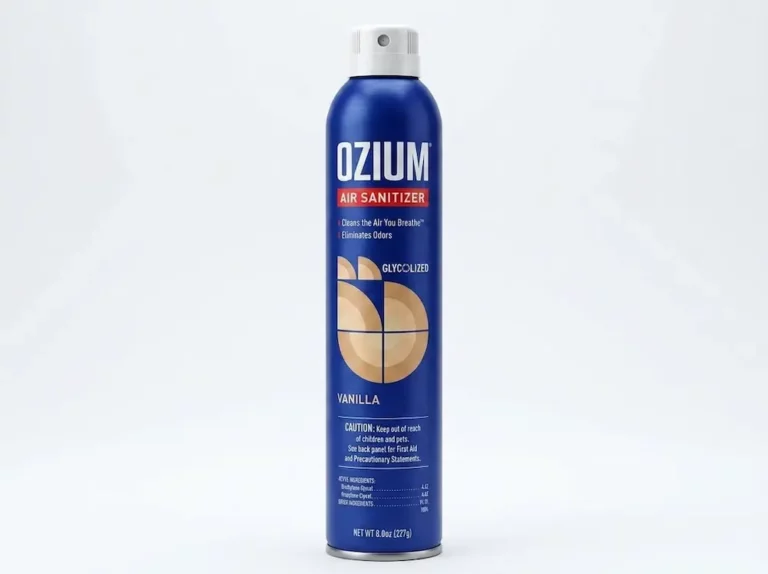
For scent, the product comes in several options — Original, That New Car Smell, Vanilla, Citrus, Carbon Black, and others. The sanitizing mechanism is identical across all of them. Pick whichever scent you (or your client) can live with.
How to Use Ozium in a Car: Standard Method
This works for light to moderate odors — a passenger who smoked once, leftover food smell, wet dog, that kind of thing.
Step 1: Clear the car. Get all humans and pets out. Close every window. Leave one door slightly open as your access point.
Step 2: Shake the can. Shake it well for several seconds. This blends the glycol compounds with the propellant for an even spray.
Step 3: Aim at the upper center of the cabin. Reach into the car and point the nozzle toward the headliner — the highest, most central point you can target. Don’t aim at the dashboard, seats, or screens. The manufacturer warns that direct surface contact causes staining and chemical damage.
Step 4: One to two seconds. That’s it. A one-second burst is formulated to treat roughly 140 square feet. Your car cabin is far smaller. More product doesn’t mean faster results — it means sticky residue and wasted money.
Step 5: Close the door immediately. Don’t linger. Shut the car and walk away.
Step 6: Wait 15–20 minutes. This dwell time is what actually does the work. The glycol cloud drifts through the cabin, neutralizes bacteria, and settles to the floor.
Step 7: Open all four doors. Ventilate for several minutes before you or anyone else gets back inside.
The HVAC Method (For That Musty A/C Smell)
If your car blasts musty air the second you turn on the A/C, the problem is in your evaporator core — not just the cabin air. Bacteria and mold grow on the moisture-covered fins inside your dashboard, and spraying the cabin alone won’t touch them.
This three-phase approach uses your own blower motor to carry Ozium through the ductwork.
Phase 1: Spray Into the Exterior Cowl Intake
The cowl intake is the plastic grille at the base of your windshield, under the wiper arms. When your HVAC pulls fresh air, it comes through here.
- Start the engine and engage the parking brake.
- Roll all windows up.
- Set the fan to maximum speed.
- Turn recirculation OFF. This forces the system to pull 100% outside air through the cowl.
- Walk outside to the base of the windshield. Spray a continuous 3–4 second burst directly into the cowl grille.
The blower motor pulls the mist through the intake duct, across the evaporator fins, and through the entire duct system — neutralizing the biological buildup at the source.
Phase 2: Recirculation Loop
- Get back in briefly and switch recirculation ON.
- Set airflow to all zones — dash vents, floor vents, and defroster simultaneously.
- Point the can toward the lower footwell areas where the recirculation intakes sit.
- Spray another 1–2 second burst into those areas.
- Exit the car, close the doors, and let it idle for 5–10 minutes.
The HVAC cycles the glycol-treated air in a closed loop, hitting every corner of the ductwork.
Phase 3: Dry Out the Evaporator and Replace the Filter
This step prevents the mold from coming straight back.
- Turn the A/C compressor off but leave the fan running on maximum. Pull in warm fresh air for several minutes. This dries the evaporator fins, removing the moisture mold needs to survive.
- Replace the cabin air filter. It’s usually behind the glove box. If mold has been growing in your system, that filter is loaded with spores. Leaving it in re-seeds the whole system immediately. A new filter with an activated carbon layer is worth the extra few dollars.
- Open all doors and ventilate fully before driving.
Ozium vs. Ozone Generators: Clear Up the Confusion
A lot of people think Ozium is basically “canned ozone.” It contains zero ozone. They’re completely different technologies.
Ozone generators split oxygen molecules using high-voltage electricity to create ozone gas. It’s a powerful oxidizer — but it doesn’t distinguish between bacteria and your dashboard. Ozone degrades leather, cracks vinyl, dries out rubber seals, and can create corrosive byproducts if moisture is present. The EPA has also issued clear warnings that ozone concentrations capable of eliminating odors far exceed safe health standards.
| Technology | How It Works | Interior Safe? | Best For |
|---|---|---|---|
| Ozium (glycol aerosol) | Osmotic neutralization of airborne bacteria | Yes, if aimed correctly | Routine maintenance, transient odors, HVAC treatment |
| Ozone generator | Oxidizes bacteria and odor molecules | No — damages leather, vinyl, rubber | Severe embedded odors only; use with extreme caution |
| Chlorine dioxide gas kit | Selective oxidation via chemical reaction | Mostly yes — less corrosive than ozone | Heavy smoke or biological contamination |
For routine use and quick turnaround, Ozium wins. For a car that smells like it survived a disaster, chlorine dioxide is a better deep-treatment option than ozone.
One Thing Ozium Can’t Fix
If years of smoke or pet contamination have soaked deep into seat foam, carpet backing, or headliner fabric, Ozium won’t solve it alone. The product treats the air, not the physical substrate.
You need to clean the surfaces first — hot water extraction, enzymatic shampoo, physical agitation. Once the physical source is removed, then deploy Ozium to handle the residual atmospheric contamination. Skipping this step means the surfaces keep off-gassing odors right back into the air you just cleaned.
The Short Version
Knowing how to use Ozium in a car correctly comes down to three things: seal the cabin, use a tiny amount, and never be inside when you spray it. One or two seconds is all it takes. The HVAC method is the real game-changer for musty A/C smells — most people never try it and keep wondering why the odor comes back. Add a fresh cabin air filter at the end, and you’ve actually solved the problem instead of just delaying it.