Your Q50 is stuck in third gear, the check engine light is on, and the transmission jolts every time you shift into Drive. Sound familiar? This guide breaks down exactly what’s failing, why it’s expensive, and how the replacement actually works — so you don’t get blindsided at the shop.
What the Valve Body Actually Does
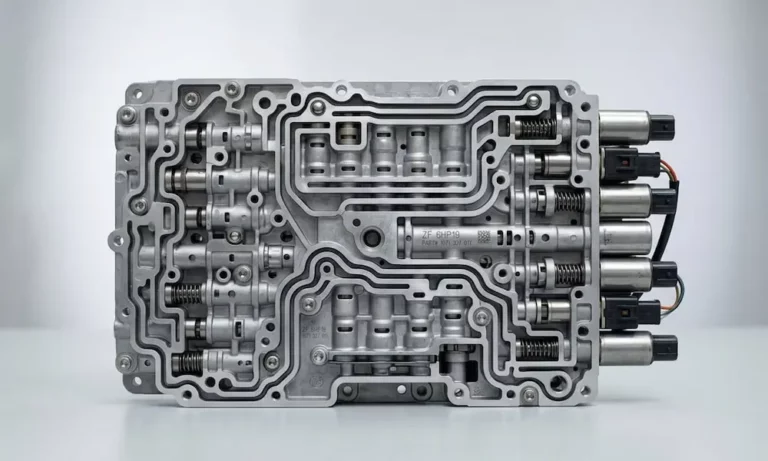
The valve body is the hydraulic brain of your Q50’s seven-speed automatic transmission (the RE7R01A). It routes pressurized fluid through a cast aluminum maze, telling the right clutch packs when to grab and when to let go.
What makes the Q50’s setup unique — and problematic — is that the Transmission Control Module (TCM) is bolted directly onto the valve body and sits inside the transmission oil pan. It’s essentially a computer submerged in hot fluid.
That design choice reduces wiring complexity, but it puts sensitive electronics in an incredibly harsh environment. Fluid regularly hits temperatures above 200°F, and that heat is the root cause of most Q50 transmission problems.
Why the Q50 Valve Body Fails
Here’s the honest answer: the aluminum casting and spool valves almost never fail. According to teardowns and diagnostic data, the failure is almost always inside the control module’s circuit board.
Specifically, the output speed sensor — which is permanently sealed inside the TCM housing — develops micro-fractures in its solder joints over time. Every time the transmission heats up and cools down, the dissimilar metals inside the module expand and contract at slightly different rates. Over tens of thousands of miles, that constant movement physically breaks the solder connection.
When the output speed sensor loses contact with the circuit board, the TCM can no longer calculate shaft speed or manage shift timing. The result is immediate and hard to miss.
Warning Signs You Need an Infiniti Q50 Valve Body Replacement
You’ll know something’s wrong fast. Here’s what to watch for:
- Limp mode — transmission locks into third gear and won’t shift
- Harsh engagement — violent jolt when moving from Park to Drive or Reverse
- No paddle shifters — manual mode completely disabled
- Check engine light alongside a transmission warning indicator
- Backup camera suddenly stops working
- “Chassis Control System Error” appearing on the dash
- Erratic shifting that comes and goes before getting worse
That last cluster of electrical warnings — camera, chassis errors, key system errors — happens because the TCM broadcasts data to other modules on the vehicle network. When it goes quiet, every other module registers a communication loss and throws its own fault.
Diagnostic Trouble Codes to Know
A proper scan with a Nissan Consult-III interface will point you toward the right codes. Here’s what they mean:
| DTC Code | Description | What It Means |
|---|---|---|
| P0720 | Output Speed Sensor Circuit | Lost shaft speed data; triggers limp mode |
| P0700 | Transmission Control System Malfunction | Generic TCM internal fault |
| P0741 | Torque Converter Clutch Performance | TCC stuck off; hurts fuel economy |
| P0776/P0777 | Pressure Control Solenoid “B” | Harsh or missing shifts |
| P0780 | Gear Ratio Error | Transmission detects slip; often a bad installation |
| U0100/U0101 | Lost Communication with ECM/TCM | Total network failure; TCM is gone |
The P0720 code is the most common trigger for an Infiniti Q50 valve body replacement. Infiniti’s own Technical Service Bulletins state clearly: you can’t just replace the sensor — you replace the entire valve body and TCM as one unit.
The sensor is permanently potted inside the module housing. And the hydraulic valve body is calibrated to match the specific solenoids and software in that exact module. Splitting them apart kills shift quality.
Clearing Codes Won’t Fix This
A generic OBD-II reader from an auto parts store can erase P0720. But the moment you put the car in gear and move, the module detects the missing speed signal again and locks the transmission back into third gear. Code-clearing is completely useless here.
OEM vs. Remanufactured: Which Should You Buy?
This is where costs split dramatically.
OEM from a dealership: A new Infiniti valve body assembly runs $1,500–$2,000+ for parts alone. Dealer labor typically pushes the total repair past $3,000. The upside is a factory-programmed module, full warranty compliance, and no guesswork.
Remanufactured aftermarket: Companies like Nexenzo sell pre-programmed units where you provide your VIN at purchase. The module arrives flashed to your vehicle’s spec for a plug-and-play install. These typically run $400–$900 depending on the year and engine.
The risk? Quality varies wildly from generic online marketplaces. Community reports frequently mention failed remanufactured units that trigger gear ratio errors immediately after install, requiring a second or third replacement before finding a good one.
If you buy a blank, unprogrammed unit to save money, the car will need to be towed to a dealer or advanced shop to have the software flashed after installation. There’s no way around it — an unrecognized TCM triggers the immobilizer and the car won’t start.
Getting the Right Part Number for Your Q50
This matters more than most people realize. There’s no universal Q50 valve body. Each powertrain gets its own unit with different hydraulic porting and software maps. Swapping the wrong one in causes immediate communication errors and gear ratio faults.
Always verify using your full VIN before ordering.
| Year | Engine | Previous Part # | Updated Part # |
|---|---|---|---|
| 2014–2015 | 3.7L V6 | 31705-X985B | 31705-X132B / 31705-X132C |
| 2016–2017 | 3.0L Twin-Turbo (Standard) | 31705-X073B | 31705-X322E |
| 2016–2017 | 3.0L Twin-Turbo (Red Sport 400) | 31705-X060C | 31705-X333E |
| 2018–2019 | 2.0L Turbo Four-Cylinder | 31705-39X1A | 31705-39X7A / 39X7B |
| 2020–2022 | 3.0L Twin-Turbo (All) | 31705-X061E | 31705-X067A / X067C |
Multiple part number supersessions on this list aren’t a coincidence. They reflect factory revisions Infiniti released to address earlier reliability problems.
How the Replacement Works: Step-by-Step
This job is doable at home for experienced DIYers, but it demands cleanliness, proper torque tools, and patience. Even a small amount of debris entering the hydraulic passages will destroy a new valve body fast.
What you’ll need beyond basic metric sockets:
- Inch-pound torque wrench (low-range, accurately calibrated)
- Gear oil transfer pump with fill port adapter
- OBD-II scan tool that reads transmission fluid temperature, or a quality infrared thermometer
The removal process:
- Let the car cool completely — transmission fluid causes severe burns at operating temp
- Disconnect the negative battery cable
- Raise the vehicle on a level lift or stable jack stands
- Remove the drain plug and drain 3–5 quarts of fluid into a catch pan
- Remove the pan bolts in a systematic pattern and lower the pan carefully
- Inspect the magnetic catchers — light gray metallic dust is normal. Large metal shards or fibrous clutch material means the planetary gearsets have failed. A valve body swap won’t save it at that point.
- Remove the transmission fluid filter
- Disconnect the external harness connector passing through the transmission case
- Document bolt locations carefully — different lengths go in specific holes. A long bolt in a short blind hole cracks the aluminum case.
- Remove retaining bolts in a spiral pattern from outside in, support the unit by hand as it drops free
Installation torque specs:
| Fastener Location | Torque (Metric) | Torque (US) |
|---|---|---|
| Control Solenoid Valve to Case | 10–11 Nm | 89–97 in-lb |
| Control Valve Body Bolts | 7 Nm | 62 in-lb |
| Fluid Filter Retaining Bolts | 10 Nm | 90 in-lb |
| Oil Pan Perimeter Bolts | 9 Nm | 80 in-lb |
When installing the new unit, check that the manual selector valve aligns perfectly with the shift linkage pin. Misalignment by even a fraction of an inch means Park and Neutral won’t engage properly — a real safety issue.
Filling and Leveling the Fluid Correctly
The Q50 has no dipstick. The RE7R01A uses a sealed, temperature-dependent overflow system underneath the car. Get this wrong and you’ll damage a perfectly good new valve body.
Use only Nissan Matic S fluid. This transmission runs ultra-low-viscosity synthetic fluid with specific friction modifiers. Some owners report success with Valvoline MaxLife as an alternative, but the tight hydraulic tolerances of a fresh valve body strongly favor OEM fluid.
The leveling procedure:
- Pump in roughly the same volume you drained (typically 3.5–5 quarts)
- Start the engine and slowly cycle through P, R, N, D — pause several seconds in each position
- Monitor fluid temperature via scan tool or infrared thermometer aimed at the pan
- Wait until temperature reaches 140°F–150°F — this is the only correct window
- Remove the 5mm hex overflow check plug on the pan bottom
- Correct level = a steady trickle of fluid coming out
- Gushing stream = overfilled, let it drain
- Nothing comes out = underfilled, pump more in until you see the trickle
- Reinstall the overflow plug immediately once correct level is confirmed
Don’t let the temperature exceed 150°F during this process.
How to Avoid This Repair in the Future
Infiniti markets the transmission fluid as “lifetime.” The Q50 community’s collective experience says otherwise.
As fluid degrades, its ability to transfer heat drops. That raises the operating temperature around the TCM, which accelerates the solder joint fatigue that causes the P0720 failure. Fresh fluid keeps temps lower and buys the electronics significantly more time.
Change your transmission fluid every 30,000–50,000 miles. That single habit is the most cost-effective thing you can do to protect a $2,000+ component.
Frequently Asked Questions
Does installing a remanufactured valve body void my warranty?
Yes, in most cases. Dealer diagnostic software detects mismatched module serial numbers or unauthorized flashes. If your Q50 is still within its powertrain warranty period — typically 6 years or 70,000 miles for Infiniti — use a certified dealer with OEM parts to stay covered.
Can an auto parts store clear the codes and fix the problem temporarily?
No. Erasing P0720 turns the light off, but the moment the car moves, the TCM detects the missing speed signal and locks back into limp mode. Code-clearing does nothing for drivability when the underlying failure is a broken solder joint.
How does a repaired valve body affect resale value?
A documented OEM repair from a certified shop has minimal impact on value. But if the car is currently symptomatic, or a dealer finds a poorly installed aftermarket unit during a trade-in inspection, expect them to deduct the full cost of a dealer repair — often $3,000 or more — from your offer.
Do I need special tools beyond a standard socket set?
Yes. You need a calibrated inch-pound torque wrench, a gear oil transfer pump with the correct fill port adapter, and a way to monitor transmission fluid temperature. Without the temperature tool, you can’t level the fluid correctly, and an incorrect fluid level will damage the new unit.
If my engine has an aftermarket tune, will a pre-programmed valve body conflict with it?
The TCM and ECM operate semi-independently, so a pre-programmed valve body won’t erase your engine tune. However, if your tune significantly increases torque output — especially on a 3.0T Red Sport — the factory transmission logic may not account for it. A dedicated transmission tune applied to the new TCM may be necessary to prevent clutch slip under the higher torque load.