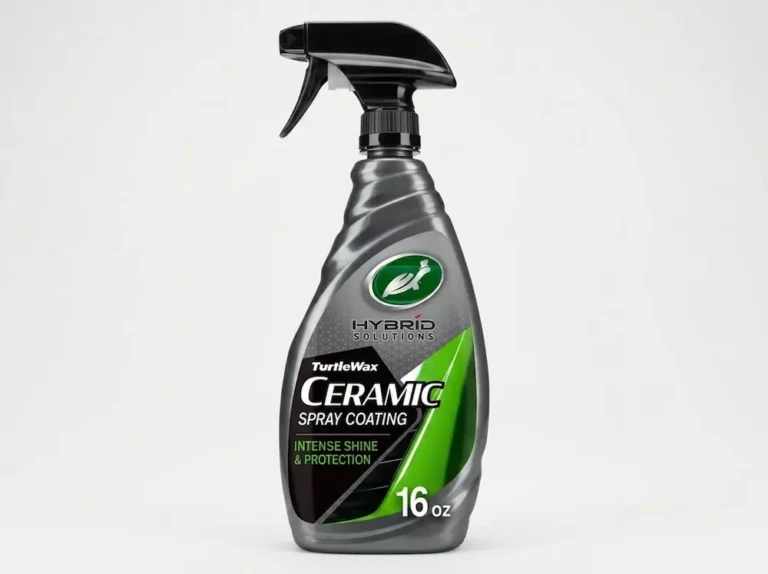
You’ve seen it on the shelf at Walmart for under $20. It says “ceramic” and “graphene” on the bottle. Now you’re wondering if it’s actually worth buying — or just clever marketing. This post breaks down every major product in the Turtle Wax Hybrid Solutions lineup so you can decide before you spend a dime.
What Makes Hybrid Solutions Different From Old-School Wax?
Traditional carnauba wax looks great for about three weeks. Then it degrades. Synthetic polymer sealants last longer but often look flat. Turtle Wax Hybrid Solutions sits in a different category entirely — it uses silicon dioxide (ceramic) and graphene nanotechnology to create a glass-like barrier on your clearcoat.
Here’s what that barrier actually does:
- Repels water aggressively — droplets bead up tight and roll off on their own
- Resists bird droppings, tree sap, and road salt — the chemical resistance is real
- Boosts gloss measurably — up to a 10–12% increase in surface reflectivity on dark paints
- Cuts your wash time — dirt releases easier from a coated surface
This isn’t your grandfather’s turtle wax. The brand quietly disrupted the prosumer detailing market by putting professional-grade chemistry into a $15 spray bottle.
The Core Ceramic Line: What Each Product Actually Does
Ceramic Spray Coating — The Flagship
This is the one everyone asks about. At around $15–$16 for 16 oz, it’s the go-to standalone sealant in the lineup.
The bottle claims up to 12 months of protection. Real-world? Expect 4–6 months on a daily driver in a harsh northern climate with road salt. In milder southern climates, users report strong water beading lasting 7+ months without any maintenance applications.
The biggest catch: it streaks on dark paint if you over-apply it. One or two sprays per panel max. Use the two-towel method — more on that below.
Ceramic Wet Wax — The Smart Drying Aid
Priced at $13–$18 for 26 oz, this one gets sprayed onto a wet car right after rinsing. You dry the car normally, and the product bonds to the paint as you wipe.
It’s nearly impossible to streak because the standing water dilutes the formula automatically. It won’t last as long as the spray coating on its own, but use it every second or third wash and it indefinitely extends your base coat. Bonus: it smells like mango, which makes washing your car weirdly enjoyable.
Ceramic 3-in-1 Detailer — Versatile but Demanding
At $13–$15 for 32 oz, this handles waterless wash, quick detail, and light protection in one bottle. The formula is unusually thick and polymer-heavy for a detailer — which is both its strength and its weakness.
On a freshly coated, smooth surface, it’s excellent. On neglected or porous paint, it grabs and fights you during buffing. Some enthusiasts dilute it heavily and use it as a rinseless wash solution — a clever workaround that works surprisingly well.
Ceramic Wash & Wax — The Foam Problem
This 48 oz bottle costs $15. It cleans and deposits a ceramic layer simultaneously. The tradeoff? It barely foams because the ceramic polymers suppress the sudsing agents.
Many detailers use a separate high-foam shampoo for the main wash, then run the Ceramic Wash & Wax through a foam cannon as a final protective rinse step before blasting it off. That approach gets you the best of both worlds.
Ceramic Polish & Wax — The Best Starting Point
For $15–$18 per 14 oz, this all-in-one removes light swirl marks and surface oxidation while depositing a ceramic base layer. Paired with a dual-action polisher, it removes up to 95% of minor paint defects in a single pass.
Critical detail: let it cure for 24 hours before getting the car wet. Apply the Ceramic Spray Coating on top after curing and the depth you get genuinely rivals professional detailing results.
| Core Ceramic Product | Retail Price | Durability | Best Use Case |
|---|---|---|---|
| Ceramic Spray Coating | $15–$16 | 4–6 months | Standalone sealant |
| Ceramic Wet Wax | $13–$18 | 1–2 months | Drying aid / topper |
| Ceramic 3-in-1 Detailer | $13–$15 | Weeks | Between-wash maintenance |
| Ceramic Wash & Wax | $15 | Inter-wash | Maintenance shampoo |
| Ceramic Polish & Wax | $15–$18 | 3–5 months | Base coat / defect removal |
The Pro Graphene Line: Is the Upgrade Worth It?
Pro Flex Wax — Maximum Versatility
At $20–$25 for 23 oz, the graphene-infused Flex Wax works three ways: dry application, wet application, or spray-and-rinse. The graphene component adds strong UV protection and reduces water spot formation by dissipating heat faster across the paint surface.
The application rules are stricter than the core line. One spray per panel, always in the shade, always use a damp leveling towel. Ignore that advice and you’ll have permanent haze baked into your clearcoat.
To The Max Wax — The Carnauba Look With Ceramic Durability
This $16–$17 liquid wax takes more time to apply — spread it, let it haze, buff it off — but it deposits a thicker layer than any spray product. The result is a warm, deep glow that looks like premium carnauba but holds up with graphene chemistry underneath. Many detailers use it as a base coat and maintain it with the Flex Wax spray monthly.
75th Anniversary Ceramic + Graphene Paste Wax — The Showstopper
This $26 paste (5.5 oz jar) blends ten waxes — natural and synthetic — with both ceramic and graphene. It’s the most forgiving product to apply in the whole lineup. It doesn’t stain black trim and wipes off easily.
Pro tip from the detailing community: scrape a thin layer directly onto a dual-action polisher pad with a plastic putty knife. Machine application gives you perfect uniform coverage and dramatically reduces product waste.
| Pro Graphene Product | Price | Notable Feature |
|---|---|---|
| Pro Flex Wax | $20–$25 | 3-way application, UV protection |
| To The Max Wax | $16–$17 | Deep carnauba-like gloss |
| 75th Anniversary Paste | $26 | 10-wax blend, extreme depth |
| Pure Bead | $20 | Maximum water contact angle |
How Does It Stack Up Against Meguiar’s and Griot’s?
Turtle Wax vs. Meguiar’s Hybrid Ceramic Wax
Meguiar’s wins on application ease — spray it on a wet car, rinse it off, done. Zero risk of streaking. But in controlled durability testing through harsh winter conditions, Meguiar’s showed significant hydrophobic failure around week 8. Turtle Wax held strong through weeks 12–14.
Visually, Meguiar’s looks better on white and silver cars. Turtle Wax delivers deeper, darker gloss on black and navy paint — with a 10–12% gloss increase vs. Meguiar’s 8–10%.
The annual cost difference is real too:
| Product | Reapplication Interval | Annual Applications | Annual Cost |
|---|---|---|---|
| Meguiar’s Hybrid Ceramic | 8 weeks | 6.5 | $30–$35 |
| Turtle Wax Ceramic Spray | 12 weeks | 4.3 | $22–$27 |
Based on average use on a mid-sized sedan in a road-salt climate.
Turtle Wax vs. Griot’s Garage Ceramic 3-in-1
Griot’s Garage outlasts both brands in extreme chemical resistance tests, which is impressive. But its water beading is average — around 100-degree contact angle, with water sheeting slowly in large runs rather than evacuating in tight spheres.
Turtle Wax beads faster, feels slicker after application, and frankly looks more dramatic in the rain. Griot’s can also feel sticky during buffing, which frustrates people mid-application.
The Streaking Problem — And How to Fix It
This is the number one complaint about Hybrid Solutions spray products. The fix is called the Two-Towel Method, and it works every time:
- Spray the product into a folded microfiber towel — not directly onto the paint
- Wipe the panel with that damp towel to distribute the polymers evenly
- Immediately follow with a second, completely dry microfiber towel to buff away excess before it cures
- Work in the shade on a cool panel — heat makes solvents evaporate before you can level the product
Following this method eliminates streaking entirely, even on black paint.
Why Your Prep Work Matters More Than the Product
Almost every negative review about Hybrid Solutions — “it washed off in two weeks,” “it didn’t do anything” — traces back to skipping prep.
Ceramic polymers need a clean surface to bond to. If your clearcoat has embedded iron brake particles, tree sap, or old degraded wax, the coating bonds to that contamination instead of your paint. When it washes away, the coating goes with it.
Do this before your first application:
- Iron remover — dissolves embedded brake dust chemically
- Clay bar — physically pulls out surface contamination
- Ceramic Polish & Wax — strips old residue and preps the surface simultaneously
Skip these steps and even a $200 professional coating won’t last as long as it should.
How the Coating Wears Unevenly — And What to Do About It
Your hood and roof take the worst beating. Direct UV radiation breaks down polymer bonds faster on horizontal surfaces. Vertical lower panels near the wheels get destroyed by road salt spray in winter.
The fix: don’t recoat the whole car every time. After routine washes, selectively apply the Ceramic Wet Wax or 3-in-1 Detailer to the areas showing early failure — hood, roof, and lower quarter panels. This keeps the whole vehicle’s protection intact without wasting product on areas that still look fine.
Hybrid Solutions vs. Professional Ceramic Coatings
Let’s be honest about what Hybrid Solutions isn’t. Professional bottle coatings from brands like Gtechniq or CarPro contain higher solids concentrations, bond semi-permanently to clearcoat, and can last 2–5 years with proper prep in a controlled environment. They also cost $100–$500 to apply and require machine polishing beforehand.
Hybrid Solutions is a “coating lite.” Lower solids, spray-friendly, forgiving application. It can’t match the scratch resistance or longevity of a professional coating. But you can reapply it in your driveway in 30 minutes every few months. Integrate the Ceramic Wet Wax into every wash, and you maintain continuous protection indefinitely — without ever booking a detailing appointment.
For most daily drivers, that’s actually the smarter play.
The Specialty Products: Wheels, Tires, and Interior
Hyper Foam Wheel Cleaner ($11–$12) — Heavy-duty formula strips baked brake dust and old silicone dressings from tires. The foam clings to vertical surfaces and dwells long enough to work. Fair warning: it smells aggressively chemical and has zero masking fragrance. Open your garage door.
Graphene Acrylic Tire Shine ($13) — This one actually solves the dreaded sling problem. Traditional silicone dressings fling off spinning tires at highway speeds and stain your paint. The acrylic formula bonds into rubber pores and dries to the touch. No sling. Deep black finish that lasts weeks instead of days.
Ceramic + Graphene Inside Job ($10) — Safe for plastic, vinyl, and coated leather. Leaves a factory-matte finish with UV protection and static-reducing dust repellency. None of that greasy 1990s dashboard shine that makes your interior look like it belongs in a rental car.
So, Is Turtle Wax Hybrid Solutions Actually Good?
Yes — genuinely. It’s not magic, and it’s not a substitute for professional coatings if you want 3-year protection. But for a $15–$20 product available at any big-box store, the performance is exceptional by any objective measure.
The ceramic spray coating outperforms Meguiar’s in durability. The wet wax is one of the best drying aids on the market. The paste wax competes with boutique products costing five times more. And the whole system costs less per year than almost any competitor when you account for reapplication frequency.
Apply it right, prep your paint first, and use the wet wax as a maintenance booster. Do those three things and your car will stay protected — and looking good — without breaking your budget or your weekend.