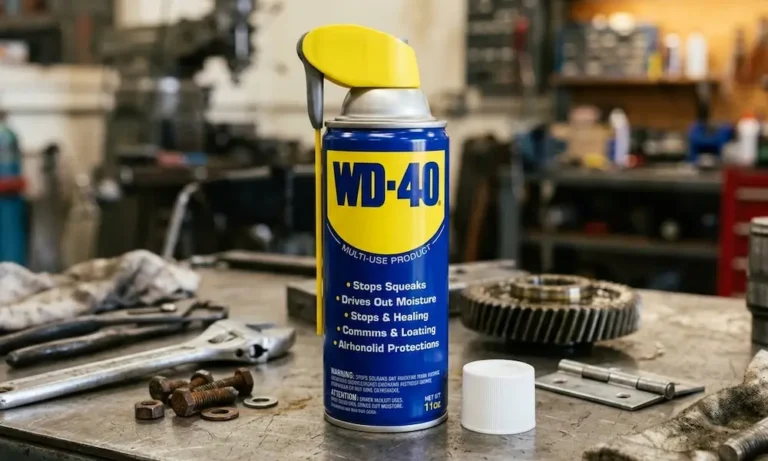
You’ve grabbed that iconic blue-and-yellow can to free a rusted bolt—only to end up frustrated. Sound familiar? Here’s the thing: most people misunderstand what WD-40 actually does. This post breaks down exactly what WD-40 penetrating oil claims are true, what’s myth, and which product actually wins against serious rust.
What WD-40 Actually Is (And Isn’t)
WD-40 is not a dedicated penetrating oil. It never was.
The formula was born in a San Diego lab in 1953 to solve a very specific aerospace problem: protecting the Atlas Missile’s thin metal skin from moisture-driven corrosion. After 39 failed attempts, chemist Iver Norman Lawson nailed the formula on try number forty. Hence the name—Water Displacement, 40th formula.
Its core jobs are:
- Displacing water from metal surfaces
- Preventing light corrosion with a thin petroleum film
- Reducing friction on lightly bound or squeaky parts
That’s it. It does those three things exceptionally well. But “dissolving heavy rust” isn’t on that list.
The Chemistry Behind the Blue-and-Yellow Can
WD-40’s formula is a proprietary blend of aliphatic petroleum distillates—primarily hydrotreated heavy naphtha as the volatile carrier solvent, making up 60–80% of the volume. The rest? Heavier petroleum base oils and performance additives that stay behind after the solvents evaporate.
Here’s what that means in plain English: the thin, oily film left on metal after spraying is the actual working barrier. It keeps oxygen and moisture away from the steel surface.
| Physical Property | Specification |
|---|---|
| Operating Temperature Range | -60°F to 300°F |
| Kinematic Viscosity | 2.5–3.7 mm²/sec at 100°F |
| Dielectric Strength | 38,000 volts per 0.10 inch |
| Wet Film Thickness | 0.002 inches |
| Coverage Area | 600–1,000 sq ft per gallon |
| Flash Point (Closed Cup) | 111°F |
| Pour Point / Freezing Point | Below -81°F |
| Solubility in Water | Insoluble |
That low pour point is a direct nod to its aerospace roots—it stays fluid in arctic conditions where standard grease would freeze solid.
Why WD-40 Struggles With Severely Rusted Bolts
Here’s the physics problem. When a steel bolt rusts inside a nut, iron oxide forms and expands inside the thread gaps. That expansion creates an enormous mechanical lock—essentially cold-welding the fastener shut.
Breaking that bond requires a fluid that can:
- Climb upward against gravity into microscopic thread gaps (capillary action)
- Chemically attack the iron oxide lattice
- Leave behind lubrication to reduce torque on the way out
Capillary action depends on two things: low viscosity and low surface tension. WD-40 has a reasonably low viscosity. But its surface tension is optimized for broad horizontal spreading—not aggressive upward capillary climbing through dense, porous rust.
The industry uses a Nail Climb Test to prove this. A penetrating fluid’s ability to travel upward through a tight crevice gets measured over time. Premium penetrating oils climb over 1.25 cm in 10 minutes. Standard WD-40? Falls well short.
What the Lab Tests Actually Say
WD-40 gets subjected to standardized tests that reveal exactly where it excels—and where it hits a wall.
ASTM D4172: Four-Ball Wear Test
This test presses a rotating steel ball against three stationary ones inside a cup of lubricant. After 60 minutes at 1,200 RPM and 40 kg of force, the wear scars on the stationary balls get measured. WD-40 scores a 0.65 mm wear scar diameter—capable for light-duty lubrication like hinges and window tracks, but not heavy machinery.
ASTM B117: Salt Spray Corrosion Test
Steel panels treated with WD-40 show zero rust after 72 continuous hours of dense saline fog exposure. Translated to real-world protection:
- Indoor/covered storage: 1 year or more
- Protected outdoor storage: 6–12 months
- Direct outdoor exposure: 30–60 days
- Marine/coastal environments: 15–30 days (needs reapplication)
| Test | Result | What It Means |
|---|---|---|
| ASTM D4172 (Wear) | 0.65 mm wear scar | Good for light use; not extreme pressure |
| ASTM D3233 (Extreme Pressure) | 0.112 friction coefficient at 1,000 kPa | Light-duty friction only |
| ASTM B117 (Salt Spray) | Zero rust at 72 hours | Reliable short-to-medium corrosion protection |
WD-40 Penetrating Oil: The Specialist Line That Actually Penetrates
WD-40 knows the standard formula has limits. That’s why they built the WD-40 Specialist Penetrant—a completely different product.
This dedicated formula uses Blu Torch Technology—proprietary synthetic additives that dramatically speed up capillary action through rust. It also leaves a non-evaporating lubricating residue behind to prevent rust from re-forming and to cut the torque needed to back out the fastener. The 8-inch flexible straw lets mechanics target tight spots in packed engine bays without overspray.
This is the product you should reach for when a fastener is genuinely stuck.
How WD-40 Specialist Stacks Up Against the Competition
Dedicated penetrating oils each take a different approach to beating rust:
| Product | Primary Mechanism | Best Use Case |
|---|---|---|
| WD-40 Multi-Use | Water displacement, light lubrication | Moisture removal, light rust prevention |
| WD-40 Specialist Penetrant | Rapid capillary action, synthetic additives | Everyday automotive and facility maintenance |
| PB B’laster | Penetrating catalyst, heavy residue | Severe automotive rust, suspension, exhaust bolts |
| Kroil | Ultra-low viscosity, deep creep | Industrial machinery, delicate fused fasteners |
| Liquid Wrench | Solid lubricants, zero VOC | Indoor shops, air-quality compliance |
| CRC Freeze-Off | Thermal shock, physical rust cracking | Extreme calcified rust, brake hardware |
One budget option machinists swear by: a 50/50 mix of acetone and automatic transmission fluid. The acetone carries the fluid deep into threads with ultra-low surface tension. The ATF provides heavy, lasting lubrication. In independent tests, it frequently matches or beats commercial products.
What WD-40 Is Genuinely Great At
Don’t undersell the standard formula where it actually shines.
Electrical restoration: With a dielectric strength of 38,000 volts per 0.10 inch, it’s completely safe for spraying into flooded ignition systems, spark plug boots, and circuit boards to drive out conductive moisture. Just make sure the equipment is fully powered off before application.
Corrosion prevention: A single coat on hand tools, blades, and stored machinery keeps rust away for months indoors.
Sticker removal: The petroleum solvents dissolve adhesive residue cleanly without scratching. Same reason it removes scuff marks from floors and crayon from walls.
Light mechanism revival: Squeaky hinges, sticky window tracks, seized scissors—perfect territory for WD-40.
What WD-40 Can Damage
The petroleum distillates aren’t safe on everything. Know these before you spray:
- Clear polycarbonate and polystyrene: The solvents cause stress crazing—microscopic fractures that cloud and weaken the plastic. Keep it away from instrument clusters, safety glasses, and device screens.
- Rubber seals and O-rings: Brief contact is usually fine, but prolonged pooling causes volumetric swelling and structural failure in many synthetic rubbers.
- Surfaces you plan to paint: WD-40 leaves a petroleum film that prevents adhesion. Remove it entirely with mineral spirits, lacquer thinner, or an alkaline degreaser before applying any coating.
Safety You Shouldn’t Skip
The aerosol version carries real hazards. WD-40 is classified as an extremely flammable aerosol under OSHA’s GHS system. Never spray near open flames, welding arcs, or hot engine surfaces.
The most critical safety point: WD-40 is a Category 1 Aspiration Hazard. If someone swallows it, the low-viscosity liquid can slip past the epiglottis into the lungs, causing severe chemical pneumonitis. Do not induce vomiting. Call poison control or get to a hospital immediately.
For extended use in confined spaces, run mechanical ventilation or use an organic vapor respirator. Nitrile gloves protect your skin during prolonged handling.
On the environmental side, WD-40 is fully compliant with all 50 states’ VOC regulations and contains zero California Proposition 65-listed carcinogens—no benzene, no toluene, no heavy metals.
FAQs
How do you remove WD-40 residue before painting?
A dry cloth won’t cut it—WD-40 leaves a petroleum film designed to stay put. Use isopropyl alcohol, mineral spirits, lacquer thinner, or a citrus-based industrial degreaser on a clean microfiber cloth. Agitate the surface, then wash thoroughly. You need a completely clean, oil-free substrate before any coating goes on.
Does WD-40 aerosol expire?
The liquid itself doesn’t chemically expire—it’s stable indefinitely. The issue is the aerosol valve. Over many years, propellant slowly seeps through the rubber seals. You might find a decade-old can with perfectly good liquid but no pressure to push it out. Store cans in a temperature-controlled space to extend valve seal life.
Can you use WD-40 on bicycle or motorcycle chains?
Don’t. WD-40 cleans chains well, but the wet petroleum film that remains actively attracts grit and road debris. That grit turns into an abrasive paste that grinds down chain links, pins, and sprocket teeth fast. Use a dedicated chain lubricant—either a dry PTFE lube or a specific chain wax—that penetrates wet but dries to a dirt-resistant finish.
Is WD-40 safe around food preparation areas?
Not without precautions. WD-40 doesn’t carry an NSF H1 food-grade certification. If you use it on equipment that contacts food, scrub the area thoroughly with detergent and rinse with potable water before resuming food processing. For commercial kitchens, use an NSF H1-registered food-grade lubricant to stay compliant and safe.