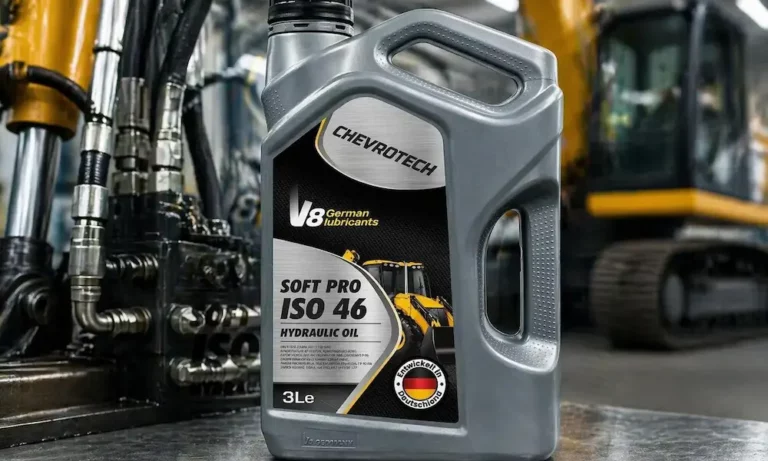
Finding the right ISO 46 hydraulic oil equivalent shouldn’t feel like defusing a bomb. But with dozens of brands, confusing spec sheets, and conflicting advice online, it often does. This guide cuts through the noise. You’ll get a clear breakdown of every major equivalent, what makes them different, and exactly which one fits your equipment.
What Does ISO 46 Actually Mean?
ISO 46 isn’t a brand — it’s a viscosity classification. The International Standards Organization defines it by kinematic viscosity measured at 40°C. Your fluid must fall between 41.4 and 50.6 centistokes to qualify.
That’s it. The number describes thickness, nothing else.
In US terms, ISO 46 roughly equals a 15W or 20W fluid in the SAE system. It sits right in the middle of the hydraulic fluid spectrum — not too thin for high-heat protection, not too thick for cold starts.
ISO 46 vs. AW 46: They’re Not the Same Thing
Here’s where most people get tripped up.
ISO 46 tells you the viscosity. AW 46 tells you the performance level. The “AW” stands for Anti-Wear. Most modern hydraulic systems — construction equipment, injection molding machines, industrial presses — need an AW 46 fluid. A basic ISO 46 without AW additives won’t protect high-pressure pumps properly.
AW additives are usually zinc-based. They form a sacrificial protective layer on metal surfaces, wearing away so your pump components don’t.
Core Physical Properties at a Glance
| Property | Typical Value | Why It Matters |
|---|---|---|
| Viscosity at 40°C | 46 centistokes | Baseline flow and pumpability |
| Viscosity at 100°C | 6.7–8.4 centistokes | Protection at operating temperature |
| Viscosity Index | 95–110 | How much it thins when heated |
| Flash Point | 428°F–473°F | Fire resistance threshold |
| Pour Point | 5°F to -49°F | Lowest temp the oil will flow |
The Major ISO 46 Hydraulic Oil Equivalents by Brand
Mobil: DTE 25 Ultra and the Nuto H Series
ExxonMobil dominates US industrial lubricants. Their flagship ISO 46 equivalent is the Mobil DTE 25 Ultra, which replaced the legacy DTE 25. It’s built with “keep-clean” technology that prevents varnish and sludge from fouling servo valves. That matters a lot in CNC machinery and aerospace manufacturing.
For less demanding applications, Mobil Nuto H 46 gives you solid anti-wear protection at a lower price point. The Mobil Hydraulic AW 46 covers general-purpose use where fluid turnover is high.
Shell: Tellus S2 MX and VX
Shell’s answer to Mobil DTE 25 is the Shell Tellus S2 MX 46. It’s engineered for long service life with strong resistance to thermal breakdown. Great choice for indoor manufacturing.
For outdoor mobile equipment, Shell offers the Tellus S2 VX 46. The “VX” means high viscosity index — it’s specifically designed for machines facing wide temperature swings, like excavators working year-round across different US climates.
Chevron: Rando HD and Clarity
Chevron Rando HD 46 is the go-to for Western US mining and construction. It handles vane, piston, and gear pumps running above 1,000 PSI without breaking a sweat.
If your system uses copper or brass components — or you’re working near waterways — Chevron Clarity AW 46 is the zinc-free version you need. Zinc-based additives can corrode yellow metals and cause problems in environmentally sensitive operations.
Primary Brand Equivalency Matrix
| Brand | Standard AW 46 | High VI Version | Zinc-Free Version |
|---|---|---|---|
| Mobil | DTE 25 Ultra | DTE 10 Excel 46 | Mobil SHC 525 |
| Shell | Tellus S2 MX 46 | Tellus S2 VX 46 | Tellus S3 M 46 |
| Chevron | Rando HD 46 | Rando HDZ 46 | Clarity AW 46 |
| Phillips 66 | Megaflow AW 46 | Powerflow HE 46 | Powerflow NZ 46 |
| Valvoline | Ultramax HLP 46 | Ultramax HVLP 46 | Ultramax AF 46 |
| Castrol | Hyspin AWS 46 | Hyspin AWH 46 | Hyspin AF 46 |
| Gulf | Harmony AW 46 | Harmony HVI 46 | Harmony NZ 46 |
| Sinopec | L-HM 46 | L-HV 46 | L-HS 46 |
Where to Buy ISO 46 Hydraulic Oil in the US
Tractor Supply Company: The Traveller Line
Farmers and contractors across rural America rely on Traveller ISO 46 Premium Anti-Wear Hydraulic Oil. It’s available in 2-gallon, 5-gallon, and 55-gallon containers, making it flexible for any scale.
One critical warning: don’t confuse it with Traveller’s Universal Tractor Trans/Hydraulic Fluid. That’s a multi-viscosity fluid for shared-sump tractors. Putting it in a system requiring dedicated ISO 46 AW oil can cause incorrect viscosity and accelerated wear.
Walmart: Super Tech and Third-Party Brands
Super Tech Anti-Wear Hydraulic Oil ISO 46 works well for light-to-medium-duty systems including log splitters, dump truck cylinders, and air compressors. It meets Eaton, Parker Denison, and Sperry Vickers requirements. Walmart also carries Starfire AW 46, which emphasizes oxidation stability and fast air and water separation.
NAPA Auto Parts: Professional-Grade Options
NAPA Premium AW46 Hydraulic Oil handles high-pressure systems running over 3,000 PSI. It’s a step up from retail brands and suits professional shops. For older or less demanding machines, NAPA Gold Band Economy AW46 provides basic protection at a lower cost. NAPA also stocks Lucas Oil AW ISO 46, rated for up to 12,000 hours of fluid life.
Retail Options at a Glance
| Retailer | Primary Brand | Sizes | Best For |
|---|---|---|---|
| Tractor Supply | Traveller | 2, 5, 55 gal | Agriculture, Construction |
| Walmart | Super Tech | 2, 5 gal | Consumer, Light Duty |
| NAPA | NAPA Premium | 5, 55 gal | Professional, Heavy Duty |
| Lowe’s | MAG 1 AW ISO 46 | 2.5, 5 gal | General Maintenance |
| Home Depot | Gold Band AW46 | 5 gal | Value-Conscious Maintenance |
Standard vs. High Viscosity Index: Which Do You Need?
This decision comes down to where your equipment works.
A standard ISO 46 AW oil — like Chevron Rando HD 46 or Mobil DTE 25 Ultra — carries a viscosity index around 100. That’s perfectly fine for indoor factories with stable temperatures.
But if your machine runs outside in Minneapolis winters or West Texas summers, a standard oil can fail you. It gets too thick in the cold and too thin in the heat. That’s where High Viscosity Index fluids like Valvoline Ultramax HVLP 46 and Shell Tellus S2 VX 46 come in. Some HVI fluids pour at -45°F, compared to 0°F for a standard oil.
| Oil Type | VI Rating | Low Temp Limit | High Temp Limit | Best Application |
|---|---|---|---|---|
| Standard AW 46 | ~100 | 50°F | 130°F | Indoor manufacturing |
| HVI / Multi-Vis 46 | 140–160 | -10°F | 180°F | Year-round outdoor equipment |
| Arctic / Low-Temp 46 | 160+ | -40°F | 120°F | Cold storage, Northern winter ops |
Industry Performance Standards You’ll See on the Label
These aren’t just marketing badges. They tell you the oil passed real-world pump tests.
- Denison HF-0 — The gold standard. Tests both vane and piston pumps under high pressure with water contamination present
- Eaton Vickers M-2950-S / I-286-S — Required for mobile and stationary Vickers pump systems, common across US industry
- Fives Cincinnati P-70 — The specific approval needed for ISO 46 oils in machine tool and manufacturing environments
- DIN 51524 Part 2 — Classifies HLP-type oils with anti-wear, anti-rust, and antioxidant additives
Retail brands like Super Tech typically won’t list Denison HF-0. Premium industrial brands like Phillips 66 Megaflow AW 46 usually do — and Phillips 66 backs theirs with 5,000+ hours of oxidation stability in standard testing.
Application-Specific Picks
Construction and earthmoving: Go with Chevron Rando HD 46 or Sinopec L-HM 46. Both handle shock loads and pass fine filtration without stripping additives.
Precision manufacturing and injection molding: Use Mobil DTE 25 Ultra or Shell Tellus S2 MX 46. Their “keep-clean” chemistry stops varnish from jamming tight-tolerance servo valves.
Food processing plants: You need an NSF H1-registered, food-grade ISO 46 fluid. Standard mineral oil doesn’t qualify. Look for white mineral oil or synthetic PAO-based options rated for incidental food contact.
Marine and waterway operations: Federal and state regulations often require environmentally acceptable lubricants (EALs) near US waterways. Biodegradable vegetable-oil or synthetic ester-based ISO 46 equivalents are the correct choice here.
Can You Mix Different ISO 46 Brands?
Technically, most mineral-based AW 46 oils won’t form a gel or solid when mixed. But you should still avoid it.
Each manufacturer balances their additive package carefully. Mixing Shell Tellus with Mobil DTE dilutes the specific chemistry of both. The result can underperform either fluid on its own. For critical systems, drain and refill with your chosen equivalent.
If you’re switching from zinc-based to zinc-free oil — flush the system first. Residual zinc reacts with ashless additives and degrades their effectiveness. Some facilities run a short-interval change with the new fluid before settling in for the full service interval.
Also verify seal compatibility before switching from mineral oil to synthetic. Some synthetic fluids cause nitrile or rubber seals to swell — leading to leaks and potential system failure.
Buying in Bulk: The Real Cost Comparison
For larger operations, packaging size has a major impact on your per-gallon cost. A 55-gallon drum of Sinopec AW 46 costs far less per gallon than buying 5-gallon pails repeatedly. Very large facilities use 275-gallon totes or bulk tanks refilled by tanker.
| Package Size | Volume | Best Use | Key Consideration |
|---|---|---|---|
| 2–2.5 Gallon Jug | ~8L | Small tractors, log splitters | Convenient retail grab |
| 5 Gallon Pail | 18.9L | Single machine oil changes | Most common farm/construction size |
| 55 Gallon Drum | 208L | Industrial shops, small fleets | Needs a drum pump and dolly |
| 275 Gallon Tote | 1,040L | Large factories, fleet centers | Requires forklift access |
How to Pick the Right Equivalent: A Quick Decision Framework
Follow this order and you won’t go wrong.
- Read the equipment manual first. It tells you if you need AW 46, HVI, or zinc-free. Don’t guess.
- Match your climate. Indoor and stable? Standard AW 46 works. Outdoor and seasonal? Go HVI.
- Think about service life. If downtime costs you thousands, spend more on a premium oil with 5,000+ hour oxidation ratings. It pays back.
- Check for OEM approvals. Retail brands cover most applications. But precision industrial pumps may need Denison HF-0 or Eaton Vickers approval — which retail brands often skip.
- Run oil analysis. It’s the only way to know what’s actually happening inside your system. It turns reactive maintenance into a planned schedule — and extends both fluid and equipment life.
The ISO 46 hydraulic oil equivalent market is wide, but it’s not complicated once you know what you’re looking for. Match the fluid to the job, not just the price tag, and your pumps will thank you for it.