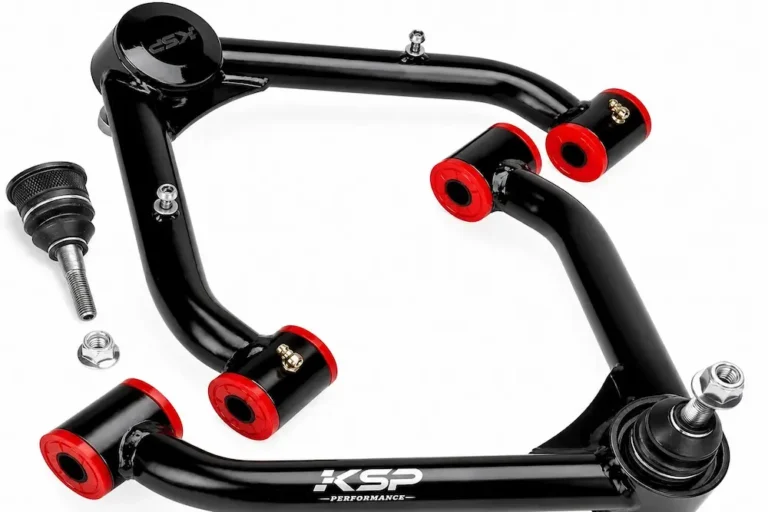
Lifting your truck sounds simple until your tires wear unevenly and your steering wanders like a lost tourist. KSP upper control arms promise to fix that geometry mess without draining your wallet. But do they actually deliver? This KSP upper control arms review breaks down everything — materials, performance, fitment, and real-world reliability — so you can decide before you buy.
Why Lifted Trucks Need Aftermarket Upper Control Arms
When you raise an independent front suspension truck two to four inches, you break the geometry the factory engineers carefully set. The chassis rises, the lower control arm drops, and the steering knuckle tilts inward at the top.
Here’s what goes wrong fast:
- Positive camber — your tires lean outward and chew through the outer tread
- Caster loss — your steering feels nervous and needs constant correction at highway speeds
- Ball joint binding — the factory arm sits at a steep downward angle, limiting suspension travel and risking joint failure
Aftermarket upper control arms fix this by repositioning the upper ball joint pivot point outward and rearward. That single change restores your alignment specs, clears bigger tires, and lets your suspension actually move the way it should.
Who Makes KSP Upper Control Arms?
KSP Performance operates under the corporate entity Goldenlion and manufactures its components in Shenzhen, China. The company uses CNC machining and automated welding to keep costs consistent across large production runs.
They ship through domestic U.S. fulfillment centers, so delivery times stay reasonable. The big question most truck owners ask is whether offshore manufacturing equals inferior quality. Based on aggregated consumer feedback and this KSP upper control arms review, the answer is more nuanced than a flat yes or no.
KSP explicitly targets trucks with two-to-four-inch leveling spacer or extended strut lift systems. They’re not compatible with drop-bracket style lift kits that use extended steering knuckles — a critical distinction we’ll revisit later.
What KSP Upper Control Arms Are Made Of
KSP uses two distinct construction methods depending on the vehicle platform.
Forged Aluminum (Toyota and Lexus Platforms)
For mid-size platforms like the Toyota Tacoma, 4Runner, FJ Cruiser, and Lexus GX, KSP builds a one-piece forged aluminum arm. Forging compresses a solid aluminum billet under immense pressure, aligning the internal grain structure along the part’s contours.
The result? No weld seams. No heat-affected zones. No weak spots where thermal stress concentrates.
KSP finishes these arms with a hard anodized coating that resists road salt, moisture, and chemical contamination. Every forged arm also goes through magnetic particle inspection during production to catch microscopic fractures before the part ships.
Drawn Over Mandrel Tubular Steel (Full-Size Truck Platforms)
For heavier platforms — Ford F-150, Chevrolet Silverado, GMC Sierra, and Ram 1500 — KSP uses 1.25-inch drawn over mandrel carbon steel tubing. The DOM process pulls an electrically welded tube through a precision die and over an internal mandrel. That smooths the internal weld seam and produces highly uniform wall thickness throughout the tube.
The tube geometry routes around large aftermarket shock bodies, preserving maximum downward suspension travel without the arm crashing into the coil spring. A powder-coated finish in red or black hammer-tone protects the steel from rust.
Ball Joints: Why KSP Skips Uniballs
A lot of premium brands use uniball spherical bearings. Uniballs handle extreme articulation angles well, but they’re open to the environment. Mud, sand, grit, and road salt infiltrate the bearing surface quickly. On a daily driver, that means premature wear and metal-on-metal clunking within a season or two.
KSP deliberately uses enclosed, traditional ball joints instead. Here’s what sets them apart:
- Heat-treated ball pins resist shearing forces
- Zinc-nickel alloy coating on the pin fights internal corrosion
- Metal-to-metal bearing surface avoids plastic internals that crack under heavy impact
- Elastomeric dust boot seals the joint against water and grit
- Greaseable zerk fittings let you push fresh grease in and flush contaminated grease out
That grease-flushing process is critical. Fresh grease forces old, abrasive grease out through the base of the dust boot, keeping the bearing surface clean. KSP notes the joints ship pre-packed with enough grease to skip the first year of lubrication.
One important warning: the zerk fittings are soft copper or brass alloy to prevent rust-seizing. Over-torquing them shears the fitting off inside the ball joint cap. Use a hand grease gun and stop tightening the moment the fitting seats.
Polyurethane Bushings: Better Steering, More Maintenance
Factory control arms use vulcanized rubber bushings. Rubber isolates road noise well, but it’s compliant. Under hard cornering or braking, the arm deflects slightly and your toe angle shifts, making the steering feel vague and slow.
KSP uses high-durometer polyurethane bushings instead. Polyurethane is significantly stiffer, which translates directly into tighter, more responsive steering. It also resists engine oil, road grime, and extreme cold — common rubber killers.
The trade-off: polyurethane squeaks loudly if it runs dry.
Unlike rubber that twists internally, polyurethane acts as a bearing — the steel sleeve rotates inside the polymer housing. If that interface dries out, friction causes squeaking and eventual binding.
KSP machines internal lubrication grooves into the polyurethane and adds zerk fittings to the bushing housings. You must grease these at every oil change using a tacky, water-resistant synthetic grease — lithium complex or marine-grade grease works well. Skip this step and the bushings shred.
Platform-Specific Fitment Guide
| Vehicle Manufacturer | Supported Platforms | Lift Compatibility | Arm Material | Key Benefit |
|---|---|---|---|---|
| Toyota / Lexus | Tacoma (2004–2023), 4Runner (2003–2023), FJ Cruiser, GX460/470 | 2–4 inches | Forged Aluminum | Native caster correction; clears factory coil spring at full droop |
| Ford | F-150 (2004–2020) | 0–4 inches | DOM Tubular Steel | Clears oversized shock bodies; restores downward travel |
| General Motors | Silverado/Sierra 1500, 2500HD, 3500HD (2007–2018, 2020+) | 2–4 inches | DOM Tubular Steel | Replaces weak factory stamped arms; supports diesel weight |
| Ram | 1500 (2009–2024) | 0–2 inches | Carbon Steel | Corrects camber for electronic stability control calibration |
| Nissan | Titan, Armada (2004–2015) | 2–4 inches | Tubular Steel | Prevents binding ball joint from damaging the knuckle |
| Jeep | Grand Cherokee WK (2005–2010) | 1–4 inches | Carbon Steel | Adjustable range prevents inner tire wear on unibody chassis |
Toyota and Lexus: The Sweet Spot for KSP
The Toyota ecosystem is where this KSP upper control arms review gets most enthusiastic. Lifting a Tacoma or 4Runner with an extended strut consistently destroys positive caster, leaving the truck wandering on the highway and alignment techs frustrated.
KSP’s forged aluminum arms correct the ball joint angle natively, letting alignment techs hit factory caster specs without drama. Reviewers consistently describe a dramatic improvement in steering feel — the “slop” common in lifted Toyotas disappears. The arms handle off-road hunting season abuse and daily commuting without geometric failure.
Ford F-150: Coil Spring Clearance Fixed
The F-150’s factory upper control arm contacts the coil spring over speed bumps or rough terrain when the truck is lifted beyond two inches. That metal-on-metal contact creates violent clunking and kills downward suspension travel.
KSP’s tubular steel F-150 arms reroute the tube geometry to maximize spring clearance. Users pairing these with Rancho Quicklift or Bilstein coil-overs report recovering up to two full inches of lost downward travel. Camber correction also lets F-150 owners run wide mud-terrain tires without shredding the inner tread.
GM Trucks: Great Arms, Questionable Ball Joint Track Record
The GM application gets more complicated. KSP’s heavy-wall tubular arms replace GM’s notoriously weak stamped steel factory arms effectively. The structural body handles heavy towing and rough terrain without issue.
However, some GM-specific users report premature ball joint failures — studs snapping or internal wear introducing dangerous steering play within months. This isn’t universal, but it’s frequent enough to mention prominently in any honest KSP upper control arms review. If you’re on a GM platform, monitor your ball joints closely and track your warranty timeline.
Installation: The Steps That Actually Matter
Installing upper control arms requires a hydraulic floor jack, calibrated torque wrench, ball joint separator, and metric socket set. Don’t skip the preparation steps.
Breaking the Ball Joint Taper Safely
Lower the truck onto jack stands. Place a floor jack under the lower control arm to support it. Remove the wheel, pull the cotter pin, and loosen — but don’t fully remove — the castle nut. Leave it threaded several turns.
Strike the reinforced area of the steering knuckle with a hammer. The shock breaks the tapered friction fit. The nut still threaded on the stud prevents the heavy knuckle and brake rotor from dropping and snapping your brake lines or damaging the CV axle.
Before removing the frame-side pivot bolts, trace the factory eccentric alignment cam positions with a marker. This gives your alignment tech a baseline to work from.
The Bushing Bind Trap (Don’t Make This Mistake)
This is the most common and most damaging installation error. Many mechanics — including professionals — tighten the frame-side pivot bolts while the truck is still in the air at full droop.
When the truck comes down, the control arm rises to ride height. The polyurethane bushing, now locked in a downward position, twists violently. That torsional stress shreds the bushing within a few thousand miles and makes the ride brutally harsh.
The fix: Leave the pivot bolts loose. Use your floor jack to compress the lower control arm upward until the suspension reaches its natural ride height. Only then torque the pivot bolts to spec.
Torque Specifications Reference
| Component | Torque Specification | Critical Notes |
|---|---|---|
| Frame Pivot Bolts | 65–75 ft-lbs | Torque only at ride height to prevent bushing bind |
| Ball Joint Castle Nut | 65–85 ft-lbs | Tighten to align cotter pin hole — never loosen to align |
| F-150 Brake Caliper Bolts | 148 ft-lbs | High torque for heavy-duty brake systems |
| Upper Strut Mounting Bolts | 35–52 ft-lbs | Secures coil-over to upper shock tower |
| Wheel Lug Nuts | 95–150 ft-lbs | Varies by platform; verify your specific spec |
After installation, a computerized four-wheel alignment is non-negotiable. Driving without one destroys tires in days.
KSP vs. The Competition
| Manufacturer | Material | Bushing Type | Price Range | Best For |
|---|---|---|---|---|
| KSP Performance | Forged Aluminum / DOM Steel | Polyurethane (Greaseable) | $240–$270 | Budget-conscious daily drivers who maintain their components |
| Freedom Off-Road | Tubular Steel | OEM Rubber | Similar budget tier | Drivers who want zero squeaking and don’t need max steering precision |
| Rough Country | Forged Aluminum / Tubular Steel | Clevite Rubber / Polyurethane | Mid-tier premium | Easier domestic warranty support with slightly higher investment |
| SPC | Forged Steel | xAxis Flex Joints | Premium | Maximum alignment adjustability for complex builds |
| JBA Offroad | Tubular Steel | Synthetic Elastomer | Ultra-premium | Domestic construction, lifetime warranty, extreme-duty applications |
KSP delivers roughly one-third the cost of premium domestic brands. For daily driving, occasional trails, and hunting season abuse, that math works. If a ball joint fails after the 12-month warranty expires, standard Moog replacement joints often press directly into the KSP housing — so you don’t need to replace the entire arm.
What Real Owners Say
The positive feedback across this KSP upper control arms review research is strong, especially for Toyota applications. Owners who grease religiously report tens of thousands of trouble-free miles. The forged aluminum units earn near-universal praise for structural rigidity and immediate camber correction.
The criticism concentrates in two areas:
- Zerk fitting breakage — soft metal strips easily if you over-torque during greasing
- GM ball joint durability — a vocal subset of Silverado and Sierra owners document premature stud failure and rapid wear
KSP’s 30-day refund and 12-month ball joint warranty help, but customer service experiences vary widely. Some owners get rapid replacements shipped with no friction. Others report ignored emails and unresponsive live chat. Managing expectations here is smart if you’re buying for a GM platform.
Frequently Asked Questions
How do I extract a broken zerk fitting from inside the ball joint cap?
Don’t drill immediately — metal shavings contaminate the bearing surface. The fitting is soft hollow metal, so tap a small reverse-threaded screw extractor (EZ-Out) into the hollow center. Slow, even counter-clockwise pressure backs the broken collar out without damaging the cap threads.
Can KSP upper control arms fix geometry damage from a collision?
No. These arms correct geometry shifts caused by vertical suspension lifts. Physical collision damage to a steering knuckle or lower control arm requires replacing those damaged components first. KSP arms can’t compensate for a bent foundational part.
Do I need to modify my brake lines or ABS wiring during installation?
No cutting or splicing required. However, factory arms have small brackets holding ABS sensor wires and brake hoses in place. Those brackets don’t transfer to aftermarket arms. Secure all wiring and brake lines to the new arm with heavy-duty zip ties or billet aluminum clamps to prevent contact with the rotating tire.
What’s the difference between a 2–4 inch leveling kit and a drop-bracket lift for control arm compatibility?
A 2–4 inch leveling kit forces factory suspension components downward, which disrupts geometry — that’s why you need extended upper control arms to fix it. A drop-bracket lift instead drops the entire lower control arm assembly using large steel subframes and uses an extended steering knuckle to bridge back up to the factory upper mount location. Because that upper mount location doesn’t change, factory upper control arms work fine. Installing KSP arms on a drop-bracket lift pushes the top of the tire too far outboard, creating an alignment problem no technician can correct.