If your dash lit up with SPN 157 FMI 18 and your truck suddenly feels weak, you’re probably wondering if this is a quick fix or a wallet-draining nightmare. The honest answer: it depends. This code means your fuel rail pressure dropped below where it should be, and figuring out why takes some detective work. Stick with me, and you’ll know exactly what’s going on, what to check first, and what it might cost to fix.
What Does SPN 157 FMI 18 Mean?
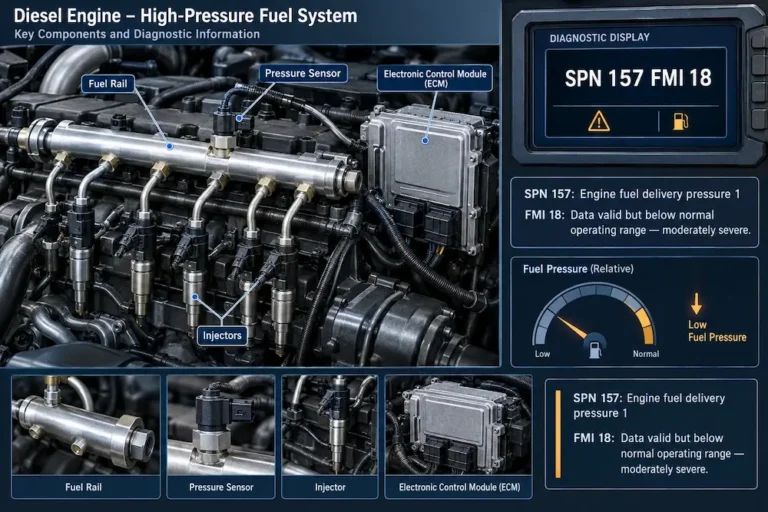
SPN 157 points to the Fuel Injector Metering Rail 1 Pressure. FMI 18 tells you the reading is valid but sitting below normal range at a moderately severe level. Put simply, your engine computer wants more fuel pressure than it’s actually getting.
This code isn’t tied to one brand. Cummins, Detroit Diesel, PACCAR, Navistar, and Caterpillar all use it. Cummins engines usually show it as Fault Code 559, but under the hood, it’s the exact same problem: low pressure in the high-pressure fuel rail.
How the Common Rail Fuel System Works
Your diesel engine runs on two connected fuel circuits. Think of it like a relay race. If the first runner drops the baton, the second one never gets to finish.
The Low-Pressure Side
Fuel starts in the tank and gets pulled through a pickup tube by a gear pump or electric lift pump. It passes through a primary filter and water separator, then a finer secondary filter, before heading to the high-pressure pump. This side typically runs between 5 and 15 psi.
Here’s the thing: if this low-pressure side can’t keep up, the high-pressure pump has nothing to work with. You can’t multiply pressure on fuel that isn’t even there. That’s why fuel filter restriction is one of the most common triggers for this exact code.
The High-Pressure Side
Once fuel clears the low-pressure circuit, it enters the high-pressure pump. A metering valve controls exactly how much fuel gets let in, and camshaft-driven plungers squeeze that fuel to insane pressures — anywhere from 5,000 psi at idle to over 30,000 psi under load.
That pressurized fuel travels through steel lines into the common rail, which acts like a storage tank and pressure buffer. A sensor on the rail reports the actual pressure back to the engine computer. At the other end sits a pressure limiting valve, a safety device that dumps excess pressure if things get dangerously high.
From there, fuel shoots to the injectors, where it’s timed and sprayed into the cylinders. Every part of this chain has to work perfectly, or you get a pressure drop somewhere.
Signs You’re Dealing With SPN 157 FMI 18
You’ll usually notice these symptoms before you even scan for codes:
- Weak acceleration — the truck feels like it’s dragging, especially uphill
- Rough idle or misfires — cylinders aren’t getting even fuel
- Hard starting or no-start — the pump can’t build enough pressure during cranking
- Random stalling, especially at stops
- Check Engine Light paired with a power derate
Speaking of derates, your engine computer isn’t messing around. A moderate pressure drop might just knock 5 mph off your top speed. A severe one can drop you to a crawl, forcing you off the road until the issue gets fixed. That’s not the computer being dramatic — it’s protecting an incredibly expensive pump from running dry and grinding itself apart.
What Causes Low Fuel Rail Pressure?
This is where things get tricky. Because the fuel system is one continuous loop, almost any weak point can cause this exact code. Here’s what typically causes it, starting with the cheapest fixes.
Clogged fuel filters. Dirty or gelled filters starve the low-pressure pump. This is the easiest thing to check and often the actual root cause.
Air in the fuel (aeration). Diesel doesn’t compress, but air does. If air sneaks into the system through a cracked suction line, a loose standpipe, or a bad filter seal, the pump just compresses air bubbles instead of building real pressure. Running low on fuel can cause the same issue since sloshing exposes the pickup tube to air.
A failing pressure limiting valve. This valve is designed to open under extreme pressure, but repeated cycles wear out its spring. Once worn, it leaks fuel back to the tank instead of staying sealed, and the pump can’t keep up with the loss.
A worn-out high-pressure pump. Water or contaminated fuel destroys the pump’s internal lubrication. That leads to scoring and metal shavings, which wreck the pump’s ability to build pressure. This kind of damage isn’t repairable — the pump has to be replaced.
Leaking fuel injectors. Injectors share the same rail. If even one injector’s internal valve wears out, it leaks fuel internally instead of spraying it into the cylinder. One bad injector can tank the pressure for the whole system.
Sensor or wiring problems. Sometimes the pressure is fine, but the sensor or its wiring is lying to the computer. Corroded connectors or worn sensor diaphragms can report false low readings.
How This Code Shows Up on Different Engines
While the physics stays the same, each manufacturer has its own quirks and diagnostic tools worth knowing about.
| Engine Platform | Diagnostic Software | Equivalent Code | Known Weak Point |
|---|---|---|---|
| Cummins ISX15/X15 | Cummins Insite | Fault Code 559 | Ceramic plunger failure (early ISX), injector leaks |
| Detroit Diesel DD15 | DiagnosticLink | SPN 157 FMI 18 | Quantity control valve, pressure limiting valve |
| PACCAR MX-13 | Davie 4 | SPN 157 FMI 18 | Deformed filter seals, sensor connector corrosion |
| Navistar MaxxForce | ServiceMaxx/NED | SPN 157 FMI 18 | High-pressure pump actuator |
| Caterpillar C15/C13 | Cat ET | SPN 157 FMI 18 | Front fueling actuator circuit |
A few worth calling out: early Cummins ISX15 engines used ceramic plungers in the high-pressure pump. They were great at handling heat, but they could shatter under stress and send debris straight into the injectors. Cummins switched to metal roller plungers to fix this for good.
On PACCAR MX-13 engines, a surprisingly common culprit is the electrical pigtail connector on the pressure sensor. Heat and vibration cause the pins to loosen over time, creating an intermittent connection that mimics a real pressure problem.
Detroit Diesel engines take it a step further by tracking how many times the pressure limiting valve has opened over the engine’s life. Cross 50 openings, and Detroit’s own service guidance says replace the valve — the spring is considered worn out at that point, period.
Codes That Show Up Alongside SPN 157 FMI 18
Your scan tool rarely shows just one code. These companion codes give you a huge diagnostic shortcut:
- SPN 1209 FMI 7 — Pressure limiting valve stuck open. Points straight to a mechanical valve replacement.
- SPN 1347 FMI 7 — Injector valve closure time too long. Tells you a specific injector is failing.
- SPN 94 FMI 15/16 — Fuel filter restricted. Fix this before touching anything else.
- SPN 1077 FMI 5/6 — Quantity control valve current issue. This is electrical, not a hydraulic leak.
If you see a wiring or sensor code alongside SPN 157 FMI 18, stop chasing mechanical parts. Fix the electrical issue first. It might be the whole problem.
How Mechanics Actually Diagnose This Code
Skipping straight to parts swapping — what techs jokingly call the “parts cannon” — almost never works here and can cost you thousands for nothing. A proper diagnosis follows a logical order.
Step 1: Check the basics. Look at fuel level (keep it above a quarter tank), inspect for contamination, and trace the lines for obvious leaks or kinks.
Step 2: Test the low-pressure side. A vacuum gauge on the pump inlet tells you if something’s restricting flow. A clear sight glass tool in the fuel line shows you if air bubbles are sneaking in — a dead giveaway for aeration problems.
Step 3: Check the data stream. Using the manufacturer’s software, compare commanded pressure against actual pressure while the engine runs. If actual pressure lags badly during acceleration, you’ve confirmed a real volume loss somewhere downstream.
Step 4: Isolate the leak. Techs disconnect the pressure limiting valve return line and watch for fuel flow — there should be none. They also measure total injector return flow, and if it’s too high, they cap off injectors one at a time to find the exact leaking cylinder, a method detailed in JustAnswer’s diagnostic breakdown.
Step 5: Test the pump. If every injector checks out and the pressure limiting valve is sealed, but the pump still can’t hit target pressure during cranking, the pump itself has failed.
This step-by-step approach isolates the real problem instead of guessing.
A Quick Warning About Fuel Pressure
Before anyone starts wrenching, here’s something worth repeating: this fuel system runs at pressures over 20,000 psi. A pinhole leak at that pressure creates an invisible jet strong enough to inject fuel straight through skin and into your bloodstream. This isn’t a scrape-and-bandage injury — it’s a surgical emergency.
Never loosen a high-pressure fitting while the engine is running or even cranking. Let the system depressurize fully first, and always wear proper eye and hand protection. If you hear hissing near the fuel lines, treat it as a serious leak, not background noise.
What Repairs Typically Cost
The price tag depends entirely on what’s actually broken. Here’s a rough breakdown of parts costs (labor not included):
| Component | Estimated Cost (USD) | What It Fixes |
|---|---|---|
| Fuel filters | $90 – $200 | Low-pressure starvation, aeration |
| Fuel rail pressure sensor | $150 – $250 | False readings from sensor drift or wiring |
| High-pressure fuel lines | $200 – $400 | Corroded or leaking single-use lines |
| Pressure limiting valve | $250 – $400 | Mechanical leak dumping pressure to tank |
| Fuel injectors | $350 – $700 each | Internal leakage, often multiple at once |
| High-pressure fuel pump | $1,200 – $1,800 | Total pump failure or worn plungers |
Notice the huge cost gap between the cheapest fix and the priciest. That’s exactly why proper diagnosis matters so much. Replacing a $1,500 pump when the real problem was a $150 filter is a rough way to learn a lesson.
How to Avoid This Code Coming Back
A little maintenance discipline goes a long way here.
- Change fuel filters on schedule — usually every 15,000 to 20,000 miles depending on your application. Stretching intervals just invites contaminants into your high-pressure pump.
- Drain water separators regularly. Water destroys fuel lubricity and causes rust inside precision components.
- Keep your tank above a quarter full. This prevents sloshing and pickup tube exposure, especially on hills or sharp turns.
- Use quality, clean fuel. Cross-contamination with gasoline or DEF is rare but devastating when it happens.
- Watch for early warning signs. Sluggish acceleration or rough idling before a code even pops is your cue to get ahead of it.
Final Thoughts
SPN 157 FMI 18 sounds scary on a dash display, but it’s really your truck telling you the fuel pressure math isn’t adding up. The fix could be as simple as a clogged filter or as involved as a failed high-pressure pump. The trick is working through the system methodically instead of guessing.
Start with the cheap, easy checks — filters, fuel level, obvious leaks — before moving into pressure testing and injector isolation. Respect the hydraulic pressure involved, because this isn’t a system where shortcuts pay off. Get the diagnosis right, and you’ll fix the real problem the first time instead of throwing parts at it and hoping something sticks.