Struggling to start car when cold? You’re probably doing a few things wrong — and one of them might be slowly killing your engine. This guide covers everything from battery science to flooded engines, frozen brakes, and EV winter tricks. Stick around — the info in here could save you a costly repair bill.
Stop Warming Up Your Car for 10 Minutes — Seriously
Here’s the thing most people get wrong about how to start car when cold: that long driveway idle isn’t helping. It’s actually hurting.
The old “warm it up first” rule came from carbureted engines — old-school tech that needed time to vaporize fuel properly. Modern fuel-injected cars don’t work that way. Your engine control unit adjusts the fuel mixture in milliseconds, no matter how cold it is outside.
What you should do instead:
- Let the car idle for 30 seconds — just long enough to buckle your seatbelt
- Drive gently for the first few minutes
- Skip aggressive acceleration until the temp gauge moves
Driving gently generates more heat than idling ever will. Your engine, transmission, and cabin heater all warm up faster under a light load than sitting still.
And prolonged idling? It forces the engine to run rich — meaning excess raw fuel washes down the cylinder walls and strips away the oil film protecting your piston rings. That’s accelerated engine wear — plus wasted fuel and extra emissions.
Why Synthetic Oil Makes a Real Difference in Winter
Cold oil is thick oil. At zero degrees Fahrenheit, conventional motor oil turns into something close to molasses. Your oil pump struggles to push it through the engine in those first critical seconds after startup — and that’s when wear happens.
Synthetic motor oils have a uniform molecular structure that stays pumpable even in extreme cold. They flow faster, reach your camshafts and valve train sooner, and put far less strain on the starter motor.
If you’re in a cold climate and still running conventional oil, switching to a full synthetic before winter is one of the best things you can do for cold-start protection.
Your Battery Is the Most Likely Reason Your Car Won’t Start
Dead or weak batteries are the number one cause of winter roadside calls. Here’s why: cold temperatures slow down the electrochemical reactions inside your battery. At 32°F, a battery loses roughly 35% of its starting power. At -20°F, it may only have 25% left.
Understanding Cold Cranking Amps (CCA)
When you’re shopping for a replacement battery, the only rating that matters for winter is Cold Cranking Amps (CCA). This is the standard set by SAE J537 — it measures how many amps your battery delivers for 30 seconds at exactly 0°F without dropping below 7.2 volts.
Don’t get fooled by the other numbers on the label:
| Rating | Test Temperature | What It Means |
|---|---|---|
| Cold Cranking Amps (CCA) | 0°F | The real winter standard — use this one |
| Cranking Amps (CA) | 32°F | Runs 20-25% higher than CCA — misleading |
| Marine Cranking Amps (MCA) | 32°F | For boats — irrelevant for winter cars |
| Hot Cranking Amps (HCA) | 80°F | Highest number, least useful in winter |
| Reserve Capacity (RC) | 80°F | Minutes of accessory runtime — not cranking power |
A high Marine Cranking Amps rating means nothing at zero degrees. Always match or exceed your manufacturer’s CCA spec when buying a winter battery.
How to Fix a Flooded Engine With Clear Flood Mode
Cold-weather short trips are a recipe for a flooded engine. Here’s what happens: you start the car, it runs rich to warm up, you shut it off before it reaches operating temp, and raw fuel pools in the cylinders. Next start attempt? The engine cranks fast with a high-pitched whine — that’s the sound of an engine with no compression because liquid fuel is in the way.
The Clear Flood Mode Fix
Almost every modern fuel-injected car has a built-in solution. It’s called Clear Flood Mode, and here’s how to use it:
- Press the accelerator pedal all the way to the floor
- Hold it there while you turn the key or press Start
- Keep cranking for no more than 10 seconds at a time
- Release the pedal once the engine begins to catch
When the computer sees wide-open throttle at cranking RPM, it shuts off the fuel injectors completely. The open throttle lets maximum airflow flush the cylinders, evaporating the pooled fuel and restoring compression. If the car doesn’t start after a few tries, wait 15–20 minutes and let the fuel evaporate naturally.
Bonus trick: Mechanics also use Clear Flood Mode right after an oil change to prime the lubrication system before the engine fires. It lets the oil pump pressurize everything without any combustion — zero dry-running on fresh bearings.
Push-Button Start Won’t Work in the Cold? Here’s Why
Your smart key fob runs on a small coin-cell battery. Cold temperatures drain these fast. When the fob’s voltage drops, the car can’t detect it — and you get a “Key Not Detected” warning with a starter that won’t engage.
The Hidden Backup That Always Works
Every push-button start vehicle has a passive RFID or NFC chip inside the fob. This chip needs zero battery power — the car’s own electromagnetic field powers it when you hold the fob close enough.
Here’s how to use it:
- Press the brake pedal
- Hold the fob directly against the Start button (or the car’s designated backup spot)
- Press the Start button normally
The car reads the chip wirelessly and authorizes startup — completely bypassing the dead coin-cell battery.
| Brand | Where to Hold the Fob |
|---|---|
| Toyota, Lexus, Nissan, Subaru | Directly against the Start/Stop button |
| Chevrolet, GMC, Cadillac | Hidden center console pocket or cup holder slot |
| Volkswagen and Audi | Marked area on the steering column |
| Ford and Lincoln | Center console pocket or under cup holder mat |
And don’t forget — every smart key hides a physical blade key under a small switch on the fob. Use it to get in through the door lock cylinder if needed.
Electric and Hybrid Vehicles in Winter: What You Need to Know
Cold weather hits EVs differently. Lithium-ion batteries slow way down in freezing temps, which limits acceleration, cuts range, and throttles fast-charging speeds to protect the cells from lithium plating — a condition that permanently damages battery capacity.
Precondition While Plugged In
The smartest move is battery preconditioning — using your car’s thermal management system to warm the battery before you leave, while it’s still plugged into your home charger. This way:
- You arrive at 100% range instead of losing charge to heating
- You can safely use DC fast chargers at full speed (cold batteries throttle charging to a crawl)
- The cabin is warm before you even open the door
PTC heaters inside EVs can pull 5–7 kilowatts just to heat the battery. Do that on battery power alone and you’ll watch your range drop before you’ve gone a mile. Plug in and let the grid do it instead.
Hybrid Owners Aren’t Off the Hook
Hybrids still use a traditional 12-volt lead-acid battery to wake up the control computers and close the high-voltage contactors. If that small battery dies in the cold, the whole car goes dark — even with a full high-voltage pack. Keep your 12-volt battery healthy and matched to the correct CCA spec, same as any conventional car.
Frozen Brakes and Door Locks: Quick Fixes
Frozen Brakes
Overnight moisture between brake pads and rotors freezes solid, especially on rusty rotor surfaces. Road salt makes it worse. If your car won’t move after a cold night:
- Don’t floor it — you’ll rip the friction material off the pad backing plate
- Try gently rocking between Drive and Reverse with light throttle
- Avoid using the parking brake in deep freezes; it locks cables that can freeze in place
To prevent it: apply the brakes gently just before parking to generate heat and evaporate moisture from the rotors.
Frozen Door Handles and Locks
Never yank a frozen handle hard — cold plastic snaps easily. Skip the boiling water too; thermal shock cracks glass and the water refreezes inside the door.
What actually works:
- Press a warm gloved hand against the handle for 30–60 seconds
- Squirt commercial de-icer or high-alcohol hand sanitizer into the seal or lock cylinder
- Gently heat the key blade before inserting it into the lock
- Coat rubber door seals with silicone spray before winter to prevent ice bonding
Driving on Snow and Ice Without Losing Control
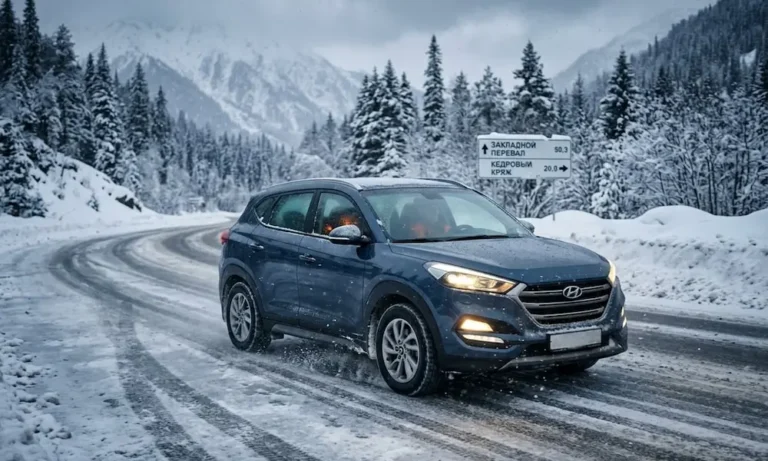
Once you’ve managed to start car when cold and get moving, your driving style matters just as much as your prep work.
- Accelerate slowly and smoothly — sudden inputs break traction instantly
- Build speed before hills and coast up using momentum rather than adding throttle mid-climb
- If you start to skid, don’t brake — steer gently into the skid and lift off the gas
- Never use cruise control on slippery roads — it can accelerate when traction drops and send you spinning
If your car gets completely stuck in a storm, stay inside. The vehicle is your shelter and your rescue beacon. Clear the exhaust pipe of snow before running the engine — a blocked pipe pushes carbon monoxide directly into the cabin. Run the engine a few minutes per hour maximum to stay warm and conserve fuel.
FAQs
How does winter weather affect tire pressure?
For every 10°F drop in temperature, tires lose about 1 PSI. A tire that’s properly inflated in a warm garage can be dangerously underinflated outside in the cold. Check pressure with a manual gauge in outdoor temps — dashboard warning lights only trigger when the drop is already significant.
What’s the freezing point of windshield washer fluid?
Standard summer washer fluid is mostly water and freezes at 32°F. That expanding ice can shatter the reservoir and split the hoses. Before winter, fully flush the system and refill with winter-grade fluid rated to -20°F or -40°F.
Do modern cars still need fuel line antifreeze?
Not really. Most U.S. gasoline already contains up to 10% ethanol, which absorbs water condensation and prevents fuel line freeze — the same job aftermarket additives used to do.
Why does steering feel heavy in the cold?
Hydraulic power steering fluid thickens in the cold, just like oil. The pump works harder to push it through the rack until friction warms it back to its normal viscosity. It usually loosens up after a few miles of gentle driving.
Why do standard wiper blades smear in winter?
Snow and ice pack into the exposed metal joints of standard blades, locking them so they lift off the glass. Winter-specific wipers encase the entire frame in a rubber boot, keeping joints clear so the blade stays pressed evenly against the windshield no matter how bad the weather gets.