Ever spotted a horse badge on a car and wondered what brand it belongs to? You’re probably looking at one of the most powerful symbols in automotive history. From million-dollar Ferraris to everyday Indian motorcycles, the horse logo means something different everywhere it appears. Stick around — there are more horse-branded vehicles out there than you’d expect.
Why Do Car Brands Use Horse Logos?
It’s not random. Car brands with equine history use the horse because it connects steel machines to something deeply human — speed, strength, loyalty, and freedom. Before engines existed, horses were the horsepower. Slapping a horse on a hood bridges that gap between biology and engineering.
Here’s how the psychology breaks down by region:
- European brands use heraldic, rearing horses to signal aristocratic heritage and racing pedigree
- American brands use galloping or bucking wild horses to project freedom and rebellion
- Asian brands use the horse to symbolize reliability, economic momentum, and cultural pride
Now let’s get into the actual brands.
European Car Brands With Horse Logos
Ferrari — The Prancing Horse (Cavallino Rampante)
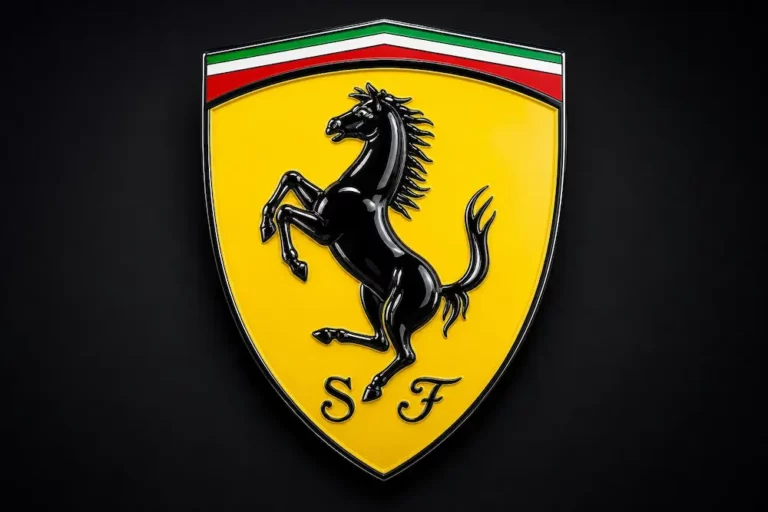
Ferrari’s black rearing stallion on a yellow background is the most recognized equine logo in the world. Its origin has nothing to do with racing at first — it came from a World War I fighter pilot.
Count Francesco Baracca was Italy’s top aerial ace in WWI. He painted a prancing horse on his fighter aircraft fuselage. After Baracca died in combat in 1918, his parents met a young Enzo Ferrari in 1923 following a race victory. Baracca’s mother suggested Ferrari use her son’s horse as a good luck charm.
Ferrari made two changes to the original symbol:
- Switched the background to canary yellow to honor his hometown of Modena
- Added the Italian tricolor (green, white, red) across the top
The prancing horse first appeared on an Alfa Romeo race car in 1932 — because Ferrari didn’t build his own cars yet. It didn’t appear on a Ferrari-branded vehicle until the 1947 Ferrari 125 S.
Today, Ferrari uses two badge formats:
- SF shield on front fenders (Scuderia Ferrari racing heritage)
- Rectangular Ferrari badge on the hood
Porsche — The Stuttgart Crest
Porsche’s horse sits dead center in an elaborate crest alongside the word “Stuttgart.” That placement isn’t decorative — it’s geographical history.
Stuttgart’s name traces back to around 950 AD, when the city was a Stuotgarten — Old High German for a horse-breeding estate. The horse became the city’s official symbol, and when Ferdinand Porsche built his company there in 1931, that civic pride came with it.
The modern crest was formalized in 1952. Some accounts say American importer Max Hoffman sketched the basic concept on a napkin to persuade Ferry Porsche to create a distinctive badge for the U.S. market. Official Porsche records credit engineer Franz Xaver Reimspiess with the final design.
The red and black stripes plus deer antlers surrounding the horse come from the coat of arms of Württemberg-Hohenzollern — the surrounding region. It’s centuries of German identity compressed into one badge.
Carlsson — The Leaping Silver Horse
Carlsson Automobile was a German Mercedes-Benz tuning firm that operated from 1989 to 2023. Its logo featured a leaping silver horse mid-jump, placed inside a three-dimensional silver ring.
The horse connection here is literal. In 1994, Carlsson moved to Gut Wiesenhof — a historic aristocratic stud farm once used to breed elite racehorses. The founders drew a direct line between breeding champion horses and tuning champion engines.
The company was named after Swedish rally driver Ingvar Carlsson, who served as their chief test driver until 2009.
Other European Marques Worth Noting
- Lancia: An early logo iteration showed a horse-drawn carriage — a literal transition symbol from animal transport to motorized vehicles
- Pegaso: This Spanish manufacturer named itself after Pegasus, the winged divine horse of Greek mythology. Because Mobil Oil had already trademarked the winged red horse, Pegaso’s logo showed a leaping horse without wings
- Corre La Licorne: A French brand founded in 1901 that adopted a rampant unicorn after the aristocratic Lestienne family (who saved the company in 1907) had a unicorn on their family crest
American Cars With Horse Logos
Ford Mustang — The Galloping Pony
The Ford Mustang’s galloping horse is arguably the most recognized automotive emblem in North America. When Ford launched the Mustang in April 1964 at the New York World’s Fair, it created an entirely new vehicle category — the “pony car.”
Designer Phil Clark spent over 100 days sketching horse variations before landing on the final galloping stallion. The horse faces left — a deliberate departure from European heraldic tradition where animals typically face right. This design choice signals a wild horse running free across open plains, unconstrained by aristocratic rules.
Ford division general manager Lee Iacocca said it plainly: “The Mustang is a wild horse, not a trained racer.”
The Mustang’s logo has evolved significantly over six decades:
| Year | Key Logo Change |
|---|---|
| 1964 | Phil Clark designs original left-facing galloping horse |
| 1965 | Tricolor horse (red, white, blue) added to fuel cap |
| 1974 | Mustang II introduces more upright horse in a “Coral” design |
| 1979–1993 | Horse removed from front grille during Fox Body era |
| 1994 | Horse returns to fenders with smaller head and kinked tail |
| 2010 | Major redesign gives horse sharper, more muscular definition |
| 2019 | “Old Crow” edition draws design cues from P-51 fighter planes |
The modern Mustang Dark Horse variant uses a front-facing horse head badge rather than the traditional side-profile gallop — mounted on the grille, fenders, and rear decklid to set it apart visually.
Ford Bronco — The Bucking Horse
Introduced for the 1966 model year, the Ford Bronco uses a bucking horse — a completely different posture from the Mustang’s smooth gallop. A bronco is a feral, unbroken horse that violently bucks when someone tries to ride it.
That chaotic, vertical energy fits the vehicle perfectly. The Bronco is built for off-road terrain, not smooth tarmac. A bucking horse visually says this vehicle resists being tamed — which is exactly the message Ford wants buyers to receive. Ford brought the Bronco back in 2021 after a 25-year absence, bucking horse badge and all.
Ford Pinto — The Spotted Pony
Ford introduced the subcompact Pinto in 1970 to cash in on the Mustang’s pony car success at a lower price point. The Pinto’s badges showed a pinto-colored spotted pony, extending Ford’s equine branding lineup into economy vehicles. The Pinto’s legacy is complicated by well-documented safety issues, but the equine naming pattern it represents shows just how committed Ford was to horse imagery across its entire lineup.
Asian Car Brands With Horse Logos
Hyundai — The Pony and The Equus
Hyundai used equine names to mark two huge moments in its corporate history.
The Hyundai Pony launched in 1975 as South Korea’s first mass-produced passenger car. Styled by Italian legend Giorgetto Giugiaro and engineered with British Leyland input, the Pony became a national symbol of Korea’s industrial rise. It didn’t carry a literal horse badge, but the name carried enormous cultural weight across export markets until 2000.
The Hyundai Equus launched in 1999 as the brand’s flagship luxury sedan. “Equus” comes directly from the Latin word for horse, chosen to signal strength and power. Here’s where the branding gets interesting:
| Feature | Details |
|---|---|
| Name meaning | Latin for “horse” |
| Hood ornament | Winged figure resembling a bird — not a horse |
| Badge | Standard Hyundai “H” on the rear |
| Special variant | Long-wheelbase limousine for diplomatic and government use |
The disconnect between the horse name and the bird-like ornament is one of automotive branding’s odder contradictions. A long-wheelbase limousine version served South Korea’s Blue House and diplomatic corps.
Baojun — The Treasured Horse
Founded in 2010 as a joint venture between General Motors, SAIC Motor, and Wuling Motors, Baojun was built specifically for China’s expanding middle class. The name translates from Chinese (寳駿) as “Treasured Horse” or “Precious Horse.”
In Chinese culture, the horse represents loyalty, strength, dependability, and hard work — exactly what budget-conscious buyers needed to hear. The original logo showed a sleek silver horse head inside a shield.
In 2019, Baojun modernized to an abstract geometric diamond shape. The literal horse disappeared from the badge, but the horse heritage remains embedded in the brand name and advertising.
Hanteng Autos — The Leaping Red Horse
Hanteng Autos, founded in 2013 in Jiangxi, China, features a three-dimensional silver horse leaping upward and out of a glossy red roundel — so dynamic it looks like it’s escaping the badge entirely.
The name is intentional: “Han” references the Han Dynasty (a golden age of Chinese civilization), while “Teng” describes the gait of a galloping horse. The upward trajectory of the leaping horse is a direct metaphor for the rise of domestic Chinese automakers.
Mitsubishi — Horse Names Without Horse Badges
Mitsubishi uses its three-diamond logo, but has a long track record of equine model names:
- Mitsubishi Colt: Launched in 1962 — actually predating the Ford Mustang. “Colt” means a young uncastrated male horse. The name ran through decades of compact cars and was sold in North America as the Dodge Colt and Plymouth Colt through Chrysler’s partnership with Mitsubishi
- Mitsubishi Starion: Launched in 1982, this turbocharged sports coupe took its name from “Star” + “Arion” — Arion being the divine immortal horse from Greek mythology ridden by Hercules. Original Japanese TV ads closed with a horse head logo above the Starion name
Commercial Vehicles and Motorcycles With Horse Logos
Kamaz — The Russian Workhorse
Kamaz, Russia’s massive heavy-duty truck manufacturer founded in 1969, uses a galloping horse with its head down and body leaning forward. This isn’t a thoroughbred racing stance — it’s a draft horse posture. All momentum, no elegance.
That visual matches Kamaz’s engineering reality. These trucks operate in Siberian tundras and arid steppes. They’ve won the grueling Dakar Rally multiple times — a race that destroys lesser machines. The Kamaz horse says: we don’t stop.
Iran Khodro (IKCO) — Persian Heritage on a Badge
As the largest vehicle manufacturer across the Middle East, Central Asia, and North Africa, Iran Khodro carries a horse’s head profile — facing right, rendered in white and silver against a blue heraldic shield.
In Persian culture, the horse symbolizes nobility, strength, and endurance. IKCO commands roughly 65% of domestic Iranian vehicle production. Their most notable equine-named model is the Samand — a name that refers to a specific breed of fast, resilient horse in Persian and Afghan cultures.
Eicher — India’s Agricultural Backbone
Eicher Motors features a white galloping horse superimposed over a red oval, with motion stripes on the right side. Founded in 1948 in New Delhi, Eicher started by importing tractors before manufacturing its own agricultural equipment and commercial vehicles.
For a brand serving India’s farms and freight networks, the horse represents the historical shift from animal-drawn plows to mechanized transport. Eicher now operates a joint venture with Volvo Trucks and owns Royal Enfield motorcycles — giving that horse logo global reach.
TVS Motor Company — The Red Racing Horse
India’s TVS Motor Company, founded in 1911 originally as a rural bus service, added its current horse logo in 2015. A bright red galloping horse sits above the bold blue TVS wordmark.
The anatomical detail is intentional — spread legs, flowing mane, streaming tail — all designed to simulate aerodynamic airflow. TVS targets young urban riders who view their bikes as agile, loyal machines rather than simple appliances. The company’s partnership with BMW Motorrad on bikes like the TVS Apache RR 310 gives the red horse a premium association.
What the Horse Posture Tells You About the Brand
Here’s a quick reference for what each horse stance actually communicates:
| Manufacturer | Posture | What It Says |
|---|---|---|
| Ferrari | Rearing (rampant, inside shield) | Explosive power, disciplined by elite engineering |
| Porsche | Rearing (inside heraldic crest) | Centuries of civic heritage, Germanic precision |
| Ford Mustang | Galloping (free, no border) | Wild freedom, democratic performance |
| Ford Bronco | Bucking (vertical, chaotic) | Untamed off-road capability |
| Kamaz | Running (head down, forward lean) | Unstoppable endurance, raw force |
| Iran Khodro | Profile head (inside shield) | Persian nobility, dignified mobility |
| TVS Motor | Galloping (extended stride, red) | Urban agility, passionate energy |
| Pegaso | Leaping (suspended mid-air) | Mythological ambition, engineering excellence |
European brands consistently cage their horses inside shields and crests — visually implying that massive power is being controlled by precision engineering. American brands remove the border entirely. The Mustang’s horse floats free on the grille with no frame to contain it. That design choice communicates democratic freedom: this power belongs to anyone who buys the car, not just the aristocracy.
There’s also a deeper psychological layer at work. Internal combustion engines are cold, complex, and mechanical. By branding vehicles with horses — animals known for loyalty and partnership with humans — manufacturers inject a biological “soul” into steel. The logo silently promises that your car will respond to you like a trusted animal, not a soulless machine.
The horse isn’t going anywhere in automotive branding. Even as electric vehicles eliminate traditional horsepower calculations, the symbol carries too much emotional weight to retire. Whether it’s the Cavallino Rampante on a Ferrari or a red galloping horse on a TVS scooter, every horse badge tells you something specific about what the brand wants you to feel when you get behind the wheel.