The V12 engine is disappearing fast. Emissions rules, fuel economy targets, and the rise of EVs are pushing automakers to kill off their twelve-cylinder powerplants one by one. But a handful of brands refuse to quit. If you want to know exactly what cars have V12 engines right now — and why they’re worth caring about — you’re in the right place. Stick around.
Why the V12 Engine Is Special
Before diving into the cars, it helps to understand why engineers and enthusiasts treat the V12 like something sacred.
A V12 is essentially two inline-six engines sharing one crankshaft. That matters because the inline-six already achieves perfect primary and secondary mechanical balance on its own. Combine two of them, and you get an engine that cancels out its own vibrations naturally — no balance shafts needed.
The result? A combustion event fires every 60 degrees of crankshaft rotation. Three cylinders overlap in their power strokes at any given moment. That’s what engineers call “triple overlap,” and it delivers power in one long, seamless surge rather than isolated pulses.
That physics also produces the V12’s famous acoustic signature — a smooth, soaring wail that climbs cleanly with engine speed rather than the staccato rumble you get from a crossplane V8. Former Ferrari president Luca di Montezemolo called it “the music of the engine.” He wasn’t wrong.
What Cars Have V12 Engines in 2025 and 2026?
Here’s the full picture of every automaker keeping the V12 alive right now.
Ferrari
No brand has done more to defend the V12 than Ferrari. While every other supercar maker has embraced turbocharging and downsizing, Ferrari’s flagship models still run naturally aspirated V12 engines that rev past 9,000 RPM.
The current lineup includes:
- Ferrari 12Cilindri — A 6.5-liter naturally aspirated V12 producing 819 hp. No hybrid assistance, no turbos. Just twelve cylinders breathing air.
- Ferrari Purosangue — Ferrari’s four-door model packs the same 6.5-liter V12 with 715 hp. It’s the only four-door car Ferrari makes, and it refuses to downsize its engine.
- Ferrari Daytona SP3 — A limited-edition hypercar with the same 6.5-liter V12, now producing 840 hp. Base price sits at over $2.2 million.
Ferrari has confirmed the 12Cilindri skips hybridization entirely, making it one of the last pure combustion V12 flagships on the market.
Lamborghini
Lamborghini’s relationship with the V12 started in 1963 when engineer Giotto Bizzarrini designed one from scratch to beat Ferrari. That rivalry lives on today.
The current V12 Lamborghini is the Revuelto, which replaced the Aventador. It uses a new 6.5-liter naturally aspirated V12 producing 814 hp, paired with three electric motors in a plug-in hybrid system that pushes combined output to 1,001 hp. The electrification keeps the V12 emissions-compliant without replacing it — a smart compromise.
Rolls-Royce
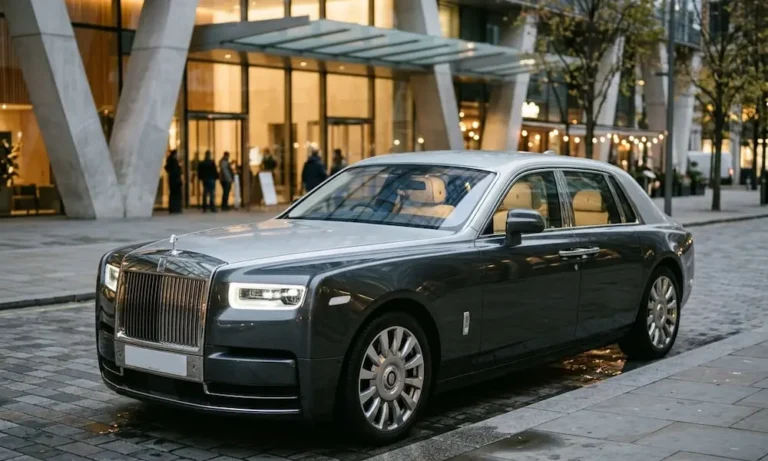
Rolls-Royce uses V12 engines across its entire combustion-powered lineup. For this brand, the engine’s perfect balance isn’t about performance — it’s about silence.
Every Rolls-Royce V12 is a 6.75-liter twin-turbocharged unit tuned to deliver peak torque at very low RPM, so the transmission almost never needs to downshift. The result is a car that glides rather than accelerates.
Current models include:
- Rolls-Royce Phantom — Starting around $555,350
- Rolls-Royce Ghost — Starting around $370,750
- Rolls-Royce Cullinan — The only V12-powered SUV in mainstream production
Aston Martin
Aston Martin offers V12 engines in two very different forms — a twin-turbocharged 5.2-liter for grand tourers and a screaming naturally aspirated 6.5-liter Cosworth unit for hypercars.
Current and upcoming V12 Aston Martin models:
- DBS Superleggera — 5.2-liter twin-turbo V12, 715 hp
- 2026 Vanquish — 5.2-liter twin-turbo V12, confirmed as the brand’s flagship GT
- Valkyrie — 6.5-liter naturally aspirated Cosworth V12, capable of exceeding 11,000 RPM. Base price exceeds $3 million.
- Valour and Valiant — Limited-run V12 specials for collectors
Mercedes-Benz Maybach
Mercedes-AMG’s 6.0-liter twin-turbocharged V12 now lives exclusively in one vehicle: the Mercedes-Maybach S-Class. This engine once powered the S65 AMG, SL65 AMG, and G65 AMG with a staggering 738 lb-ft of torque — so much torque that older five-speed transmissions were the only gearboxes strong enough to handle it.
Today, the Maybach S-Class is the last Mercedes with a V12, priced from around $211,550.
Pagani
Pagani doesn’t build its own engines. Instead, the Italian boutique hypercar maker sources heavily customized V12 units from Mercedes-AMG.
The current Pagani Utopia uses a 6.0-liter twin-turbocharged AMG V12 producing 864 hp, with a starting price of $2.5 million. Each car is hand-assembled, and production numbers stay in the dozens per year.
Table: Modern V12 Cars You Can Buy Right Now
| Manufacturer | Model | Engine | Power | Approx. Price (USD) |
|---|---|---|---|---|
| Ferrari | 12Cilindri | 6.5L NA V12 | 819 hp | $465,994+ |
| Ferrari | Purosangue | 6.5L NA V12 | 715 hp | $432,986+ |
| Ferrari | Daytona SP3 | 6.5L NA V12 | 840 hp | $2,223,935+ |
| Lamborghini | Revuelto | 6.5L NA V12 + PHEV | 1,001 hp | $608,358+ |
| Rolls-Royce | Phantom | 6.75L TT V12 | 563 hp | $555,350+ |
| Rolls-Royce | Ghost | 6.75L TT V12 | 563 hp | $370,750+ |
| Rolls-Royce | Cullinan | 6.75L TT V12 | 563 hp | $348,500+ |
| Aston Martin | DBS Superleggera | 5.2L TT V12 | 715 hp | $316,300+ |
| Aston Martin | Valkyrie | 6.5L NA V12 | 1,000+ hp | $3,000,000+ |
| Mercedes-Maybach | S-Class | 6.0L TT V12 | 621 hp | $211,550+ |
| Pagani | Utopia | 6.0L TT V12 | 864 hp | $2,500,000+ |
V12 vs. W12: What’s the Difference?
You’ll notice Bentley isn’t on that list. That’s because Bentley uses a W12 engine — and it’s not quite the same thing.
A true V12 has two banks of six cylinders. The Volkswagen Group’s W12 takes a different approach: it combines two narrow-angle VR6 engines on a single crankshaft, creating four rows of three cylinders. The result is an engine significantly shorter than a traditional V12 — roughly the same length as a V8 — which made it possible to package a twelve-cylinder engine into vehicles like the Bentley Continental GT alongside a full all-wheel-drive system.
The trade-off? The W12 doesn’t share the V12’s perfect natural balance. It’s still smooth, but it needs heavier counterweights and more complex engine mounts to hit the same refinement levels a traditional V12 achieves through geometry alone.
Bentley’s W12 currently powers the Continental GT, Flying Spur, and Bentayga. Volkswagen also used it in the Audi A8 W12.
The History of V12 Cars: A Quick Timeline
Understanding what cars have V12 engines today makes more sense with some context.
1904 — The first V12 engine appeared in a racing boat, not a car. The smoothness prevented the wooden hull from shaking apart.
1916–1948 — American luxury brands dominated V12 production during the “cylinder wars.” Packard’s Twin Six, Lincoln’s K-Series, and Cadillac’s V-12 all competed for ultra-wealthy buyers before the cheap, powerful V8 made twelve cylinders redundant in the US market.
1930s Europe — Rolls-Royce introduced the Phantom III, Hispano-Suiza built the J12, and Maybach offered the Zeppelin. The V12 became the European standard of royalty.
World War II — V12 engines powered the most famous aircraft of the war. The Rolls-Royce Merlin drove the Spitfire and Hurricane. The Packard-licensed Merlin powered the P-51 Mustang. After the war, jet turbines made piston V12s obsolete in aviation.
1947 — Enzo Ferrari founded his company and insisted his first car, the 125 S, use a 1.5-liter V12. That decision shaped the brand’s identity for the next eight decades.
1966 — Lamborghini introduced the Miura with a transverse mid-mounted V12. It became the world’s fastest production car and defined the modern supercar layout.
1987 — BMW introduced the M70 V12 in the E32 7 Series, bringing twelve-cylinder power back to the executive sedan market.
1990s–2000s — The V12 golden age for European luxury brands. Ferrari, Lamborghini, Jaguar, Aston Martin, BMW, and Mercedes all ran V12 programs simultaneously.
2025 onward — The field thins dramatically. Most manufacturers have phased out V12 engines. The remaining holdouts treat them as defining features, not just powerplants.
Why V12 Luxury Sedans Depreciate So Heavily
Here’s something counterintuitive: V12 engines make some used cars incredibly cheap to buy and terrifyingly expensive to own.
A BMW 750i from the early 2000s — once a $150,000 flagship — now sells for around $16,000 to $20,000. A used Jaguar XJ-12 sometimes drops below $10,000. Early Bentley Continental GTs have fallen under $40,000.
Why? Because maintenance costs are brutal. V12 engines have two of almost every major component: two throttle bodies, two sets of exhaust manifolds, twelve spark plugs, and extremely tight engine bay packaging. Replacing a starter motor can require pulling the entire engine. Few mechanics work on them, and shop time adds up fast.
Exotic V12 hypercars work in the exact opposite direction. Because naturally aspirated V12s are increasingly rare, limited-production models like the Ferrari Daytona SP3 and Pagani Utopia appreciate immediately after delivery. Star athletes like Patrick Mahomes have specifically cited V12 Ferraris and Rolls-Royces as investments they “truly believe in.”
The same engine architecture creates the worst depreciation in the industry and some of the strongest appreciation in the collector market — depending entirely on which car it lives in.
How Manufacturers Are Keeping the V12 Alive
The V12’s biggest enemy is regulation. Modern V12 engines often return 12 to 14 MPG combined, and twelve combustion chambers burning fuel constantly don’t pair well with carbon dioxide targets.
Manufacturers are fighting back with two main strategies:
Cylinder deactivation shuts off fuel delivery and valve operation on an entire bank of six cylinders during light highway cruising. The engine effectively becomes an inline-six when you’re not pushing hard, slashing fuel consumption and emissions on paper.
Hybrid electrification takes it further. The Lamborghini Revuelto uses three electric motors alongside its V12. In urban environments, the V12 can shut off entirely while the electric motors handle low-speed driving. This satisfies regulators while preserving the V12 experience when the driver actually demands it.
Ferrari’s approach is different — the 12Cilindri skips electrification entirely. Ferrari benefits from low-volume manufacturer exemptions that give smaller automakers more flexibility with emissions compliance, at least for now.
Frequently Asked Questions
Why do V12 engines sound so different from V8 engines?
It comes down to crankshaft geometry. A typical American V8 uses a crossplane crankshaft where crank pins sit 90 degrees apart. This forces two cylinders on the same bank to fire in rapid succession, creating the uneven, burbling rumble V8s are famous for. A V12 fires perfectly evenly every 60 degrees of rotation, alternating symmetrically between banks. Those evenly spaced pulses create overlapping sound waves that produce a smooth, high-pitched harmonic wail instead of a rumble.
Why did automakers stop at twelve cylinders instead of building sixteen-cylinder engines?
Sixteen-cylinder engines exist — Bugatti’s W16 is the most famous — but they face severe diminishing returns. A V12 already achieves perfect primary and secondary mechanical balance, so adding four more cylinders doesn’t make the engine smoother. Instead, you get a longer, heavier, and more complex engine with higher internal friction and worse packaging. The V12 represents the optimal ceiling for balancing power, smoothness, and physical size.
How do engineers handle the extreme heat in a mid-engine V12 supercar?
Packaging a large V12 directly behind the driver creates serious thermal challenges. Engineers use massive side air intakes to feed dense ambient air to the engine, multiple oversized radiators, and complex liquid cooling circuits routed through the block. High-performance V12s also use oil squirters — small nozzles positioned under each piston that spray synthetic oil directly onto the piston crown to pull heat away from the combustion chamber during hard use.
Are V12 engines still used in aircraft?
No. After World War II, jet turbines replaced piston V12s in military and commercial aviation almost entirely. Small private aircraft typically use flat four or six-cylinder engines. Jet turbines offer a far better thrust-to-weight ratio, have fewer moving parts, and perform more efficiently at altitude than heavy, liquid-cooled piston engines ever could.
How does a front-mounted V12 affect a car’s handling?
A V12 is essentially the length of two inline-six engines end to end. Place one too far forward in the engine bay and the car becomes nose-heavy, causing understeer — the front pushes wide in corners instead of turning sharply. To counter this, Ferrari and Aston Martin use a front-mid-engine layout, pushing the V12 as far back against the firewall as possible. This centralizes the mass between both axles and keeps handling balanced.