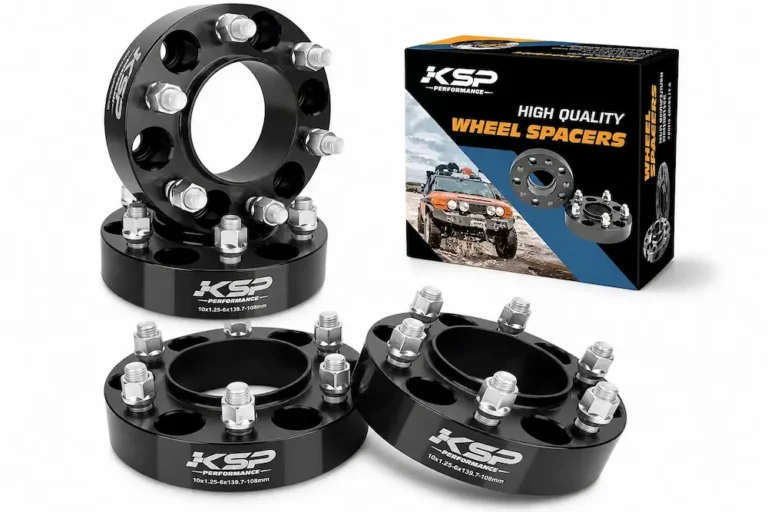
Thinking about widening your stance or clearing that tire rub? KSP Performance wheel spacers are all over Amazon and truck forums—but are they actually safe, well-built, and worth your money? This review breaks down everything: materials, handling effects, installation, and even the legal stuff. Stick around, because the details here could save you a serious headache.
What Makes KSP Wheel Spacers Different?
KSP Performance sits in an interesting market spot. They’re not cheap, unbranded junk, but they’re also not racing-exclusive hardware. They’re built for real-world truck owners, overlanders, and daily drivers who want quality without paying premium-brand prices.
Their spacers show up regularly on platforms like the Toyota Tacoma, Ford F-150, Jeep Wrangler, and BMW 3-Series—and for good reason.
Material Quality: Forged vs. Cast Aluminum
Here’s where KSP earns real credibility. Their spacers use forged 6061-T6 aerospace-grade aluminum—not cast aluminum.
Why does that matter? Cast aluminum is poured into molds. As it cools, tiny air pockets and voids form in the metal. Those weak spots can crack under hard cornering or heavy off-road stress. Catastrophic failure means your wheel comes off while driving—not a risk worth taking.
Forged aluminum starts as a solid billet. It gets compressed under extreme heat and pressure, which aligns the internal grain structure. The result is a much denser, stronger component. Then it goes through T6 heat treatment for peak hardness.
What you get with forged 6061-T6:
- Higher tensile and yield strength than cast alternatives
- Lower weight than steel spacers, keeping unsprung mass in check
- Consistent density throughout the component—no hidden weak points
Studs and Surface Coatings
KSP presses in hardened steel studs rated at 10.9 to 12.9 grade—far stronger than standard mild steel hardware. These studs handle the clamping load between your wheel and hub without stretching or shearing.
To fight corrosion, the studs get a Dacromet finish. This proprietary zinc-and-aluminum flake coating resists rust far better than standard electroplated zinc. That matters if you live near the coast or drive on salted winter roads.
The spacer body itself gets an anodized black finish—hard, abrasion-resistant, and clean-looking.
Hub-Centric Design: Why It’s Non-Negotiable
KSP builds their vehicle-specific spacers with a hub-centric design. This is the single most important engineering feature to understand before buying any spacer.
How Hub-Centric Works
The spacer’s center bore matches your vehicle’s hub pilot exactly. The spacer’s outer face also has a machined lip matching your wheel’s center bore. Everything locks together concentrically—the wheel spins in a perfect circle because the hub is physically carrying the vehicle’s weight.
The lug nuts just clamp everything flat. They’re not doing structural work.
Why Lug-Centric Spacers Are Risky
Lug-centric spacers use an oversized universal center bore. Nothing centers the spacer on the hub except the taper of the lug nuts pulling things inward. That creates problems:
- Even tiny misalignment causes severe vibration at highway speeds
- The wheel studs bear vertical shear loads they’re not designed for
- Over time, cyclical stress cracks studs—and wheels can separate from the vehicle
| Design | Weight Bearer | Vibration Risk | Best Use |
|---|---|---|---|
| Hub-Centric | Central Hub Lip | Extremely Low | Daily driving, off-road, high-speed |
| Lug-Centric | Threaded Studs | Extremely High | Temporary, low-speed, universal fits |
How Spacers Change Your Suspension Geometry
This part surprises most people. Wheel spacers don’t just change looks—they shift real suspension geometry, and you need to understand what moves.
Scrub Radius: The Big One
Scrub radius is the horizontal distance between your steering axis and the center of your tire’s contact patch. Moving the wheel outward increases positive scrub radius.
Here’s what that means in practice:
- Heavier steering feel — more leverage fighting the steering rack
- More kickback over bumps — road forces amplify through a longer lever arm
- Twitchy braking — especially noticeable on performance cars like BMW M3 and M4 platforms
If your vehicle has a negative scrub radius from the factory—common on FWD and AWD vehicles—thick spacers can push geometry toward zero scrub. That causes unpredictable handling and a lack of self-centering steering feel.
Wheel Bearing Wear
Pushing your wheel further outboard increases the lever arm acting on your wheel bearing. More leverage means more stress on the bearing with every mile you drive. Early bearing failure shows up as a humming or grinding noise that grows with speed.
Conservative spacer thickness (10–15mm) has minimal impact. But 1.5–2-inch spacers noticeably shorten the service life of hub assemblies, ball joints, and tie rods.
Do Spacers Mess Up Your Alignment?
Short answer: not directly. Wheel spacers don’t change static camber, caster, or toe settings. A spacer is a flat, parallel block—the angle of your wheel relative to suspension arms stays the same.
But here’s the catch: widening your track magnifies any existing alignment issues. A slight toe misalignment that was harmless before becomes aggressive tire scrubbing when the wheel moves two inches outboard. That feathered edge wear you see? It’s not the spacer’s fault—it’s the pre-existing alignment flaw amplified.
Bottom line: Get a laser alignment check immediately after installing KSP wheel spacers. Every time.
Real-World Applications: Where KSP Spacers Make Sense
Fixing Tire Rub
This is the most common reason truck owners install spacers. When you upgrade to larger all-terrain or mud-terrain tires, the inner sidewall often rubs against the upper control arm or strut body. Pushing the wheel out 1.0–1.5 inches creates the clearance you need.
Fair warning: fixing inner rub sometimes creates outer fender rub as the wider tire sweep hits bumper plastics or fender liners at full steering lock. On Tacoma and 4Runner platforms, this often means owners need a Body Mount Chop—cutting and re-welding the rear cab mount for clearance. That’s permanent chassis work.
Off-Road Stability
A wider track lowers your vehicle’s roll center, reducing weight transfer during aggressive cornering or steep side-hill angles. Drivers running KSP spacers report tens of thousands of miles of heavy off-road use without spacer failure. The forged aluminum holds up.
Stance Without New Wheels
New wheels with aggressive negative offset cost thousands. A set of KSP spacers achieves the same flush fitment look for a fraction of that cost.
Installation: Don’t Cut Corners Here
Most spacer failures trace back to bad installation—not bad parts. Follow these steps precisely.
Surface Prep
Wire-brush every trace of rust and debris off the hub face before mounting the spacer. Trapped rust pulverizes under load, creating gaps that let lug nuts loosen on their own. That’s how wheels come off.
Chemical Applications
- Blue or Red threadlocker on the factory studs securing the spacer to the hub. This prevents vibration from backing the nuts out. Use blue for occasional removal, red for permanent heavy-duty installs.
- Anti-seize compound on the hub face—not the threads. It prevents galvanic corrosion welding your aluminum spacer to the steel hub. Skip this step and you’ll need a torch and chisel to remove them later.
Never put anti-seize on the studs themselves. The lubrication fools your torque wrench, causing over-torquing that snaps studs under load.
Torque Specs
Forget impact wrenches. Use a calibrated torque wrench and tighten in a star pattern. Reference torque values from KSP’s own specs:
| Thread Size | Torque Range | Common Application |
|---|---|---|
| M12 x 1.25 | ~80–85 ft-lbs | Subaru WRX, Nissan Frontier |
| M12 x 1.50 | ~85–95 ft-lbs | Toyota Tacoma, Ford Escape |
| M14 x 1.50 | ~95–105 ft-lbs | Chevy Silverado, BMW M3 |
| 9/16″ | ~110–130+ ft-lbs | Ram 2500, Ford F-250 |
Re-Torque: Non-Negotiable
Drive 25–50 miles, then remove the outer wheel and re-torque every inner lug nut. Aluminum expands and contracts differently than steel, so hardware settles during the first heat cycle. Re-check again at 1,000–2,000 miles. Skipping this step is the leading cause of spacer detachment.
Are KSP Wheel Spacers Legal in Your State?
There’s no federal ban on wheel spacers in the US. But state laws vary wildly, and some will fail your inspection on the spot.
| State | Legal Status | Key Restriction |
|---|---|---|
| California | Legal | Tires must stay within body width |
| Texas | Legal | No excessive protrusion |
| Virginia | Legal | No body/tire contact; bumper height limits |
| Pennsylvania | Restricted | Spacers over 1/4 inch are banned |
| Massachusetts | Illegal | Spacers explicitly prohibited by 540 CMR 6.04 |
Massachusetts law is blunt: any spacer fails inspection, period. Pennsylvania’s 1/4-inch limit makes virtually every KSP product illegal for road use there. In both states, your only legal route to a wider track is buying wheels with a lower offset from the factory.
If your tires stick out past the fender line in any state, you’re adding another violation on top of the spacer question.
Warranty, Returns, and Customer Support
KSP sells primarily through their website, Amazon, and eBay. Returns are accepted within 30 days for unused items in original packaging. If they ship the wrong part or a defective unit, they cover return shipping. For buyer’s remorse or wrong orders, shipping costs come out of your refund—and solid aluminum blocks aren’t cheap to ship back.
Before you order, verify three things: your hub bore diameter in millimeters, your exact bolt pattern, and your stud thread pitch. Getting these wrong is an expensive mistake.
FAQs About KSP Wheel Spacers
Do wheel spacers affect my insurance coverage?
They can. If an adjuster determines a spacer contributed to an accident—especially one installed illegally or improperly—your claim could be denied. Check with your specific insurer before installing.
Can I use KSP spacers with factory steel wheels?
Yes, but with caution. Stamped steel wheels have thinner mounting pads than alloy wheels and may not provide even clamping force. More frequent torque checks are essential.
Do freezing temperatures affect forged aluminum spacers?
Forged 6061-T6 handles cold well without becoming brittle. But extreme temperature swings accelerate the thermal expansion cycle between aluminum and steel. Re-torque checks matter even more in winter climates.
Are KSP spacers compatible with manual locking hubs on older 4WD trucks?
It depends on how far the locking hub protrudes. If it extends beyond the spacer’s center bore depth, the spacer’s internal lip will interfere. KSP notes specific incompatibilities for some older platforms.
Do spacers hurt fuel economy?
Slightly. The weight addition is minimal, but pushing tires past the body breaks up the factory aerodynamic profile. At highway speeds, increased drag can reduce fuel efficiency by a small but measurable amount.
Do spacers affect ADAS features like lane-keeping assist?
They don’t disable these systems, but widening the track changes steering feedback. Lane-keeping assist may apply slightly different correction forces since the system was calibrated to factory geometry.