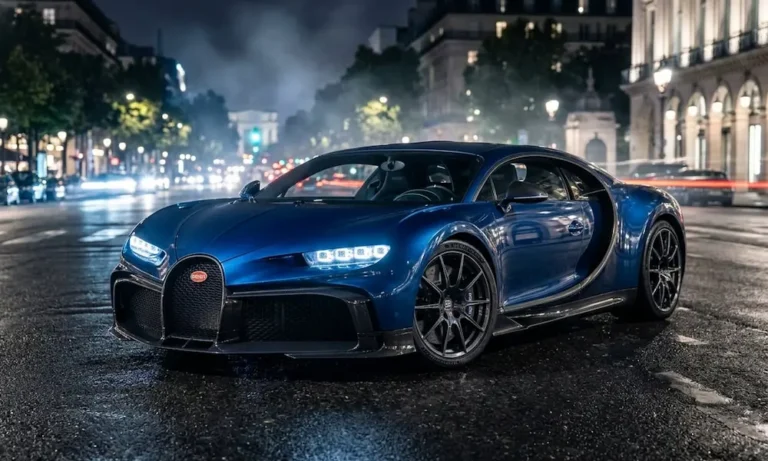
Ever wondered what sits under the hood of the world’s most extreme cars? V16 engines are rare, wild, and frankly a little insane. This guide covers every notable car that has ever used one — from 1930s American luxury giants to modern hypercars — and explains why so few manufacturers dare to build them. Stick around, because this rabbit hole goes deep.
What Exactly Is a V16 Engine?
A V16 engine is a sixteen-cylinder powerplant with two banks of eight cylinders arranged in a V-shape on a single crankshaft. Think of it as two straight-eight engines bolted together.
Here’s why that matters:
- A power stroke fires every 45 degrees of crankshaft rotation
- That rapid-fire combustion creates buttery-smooth, turbine-like torque delivery
- The result? Almost zero perceptible vibration at any speed
The downside? The engine block is enormous, extraordinarily heavy, and horrendously expensive to build. Those trade-offs explain why V16 cars are unicorns, not workhorses.
The 1930s American Cylinder Wars: Where V16 Engines Were Born
The late 1920s and early 1930s triggered an automotive arms race among American luxury brands. Manufacturers competed to build the most powerful, most refined engine imaginable. This era — called the cylinder wars by automotive historians — gave birth to the V16 as a passenger car engine.
Cadillac Series 452 (1930)
In January 1930, General Motors stunned everyone with the Cadillac Series 452. Engineer Owen Nacker led the development, and the result was genuinely revolutionary.
Key specs:
- Displacement: 452 cubic inches (7.4 liters)
- V-angle: 45 degrees
- Output: 165 hp at 3,400 rpm / 320 lb-ft at 1,400 rpm
- Top speed: 100+ mph in lighter body configurations
The Series 452 introduced hydraulic valve lash adjusters — a world first for production cars. Oil pressure automatically eliminated valve clearance, making the engine run in near-total silence. Harley Earl even styled the engine bay itself, hiding wires under polished aluminum covers. It was mechanical theater at its finest.
By 1938, Cadillac replaced it with the Series 90, which used a radical 135-degree V-angle flathead design. It kept the same 165 hp but was simpler, cheaper to build, and featured an external oil filter — unusual for the era. Production ended in 1940 when advancing V8 technology made the V16’s complexity hard to justify.
Marmon Sixteen (1931)
Howard Marmon started developing a sixteen-cylinder engine back in 1927. His car arrived in 1931 — after Cadillac had already grabbed the headlines. Despite that, the Marmon Sixteen was arguably the superior machine from a pure engineering standpoint.
- Displacement: ~500 cubic inches (8.2 liters)
- Output: 200 hp — significantly more than the Cadillac
- Construction: Aluminum block with pressed steel cylinder liners
That aluminum construction was genuinely ahead of its time. It reduced weight while improving heat dissipation. Unfortunately, the Great Depression killed Marmon before the car could gain traction.
Peerless V-16 Prototype (1932)
The Peerless Motor Company represents the most poignant story of the cylinder wars era. Peerless was a genuine luxury icon — one of the “Three Ps” alongside Packard and Pierce-Arrow.
Their V-16 prototype featured:
- A 464.6 cubic-inch V16 producing ~175 hp
- A 145-inch wheelbase aluminum chassis
- Coachwork designed by 22-year-old Franklin Hershey — who later styled the Ford Thunderbird
Only one complete prototype was ever built. Realizing that mass production was financial suicide in 1932, Peerless made a brilliant pivot: they stripped their factory, got a Carling Black Label beer license, and became a brewery. The lone V-16 prototype survived and still lives at the Crawford Auto-Aviation Museum today.
| Manufacturer | Model | Year | Displacement | Horsepower | Key Feature |
|---|---|---|---|---|---|
| Cadillac | Series 452 | 1930 | 452 cu in (7.4L) | 165 hp | First hydraulic valve lash adjusters |
| Marmon | Sixteen | 1931 | ~500 cu in (8.2L) | 200 hp | Aluminum block with steel liners |
| Peerless | V-16 Prototype | 1932 | 464.6 cu in (7.6L) | ~175 hp | Full aluminum chassis and body |
| Cadillac | Series 90 | 1938 | 431 cu in (7.0L) | 165 hp | 135-degree flathead, rigid crank |
V16 Engines in Racing: Pure Mechanical Madness
While American manufacturers chased silence and luxury, European engineers saw sixteen cylinders as a weapon. The goal was simple: more power than anyone else on the grid.
Maserati Tipo V4 (1929)
Alfieri Maserati built something borderline deranged in 1929. The Tipo V4 wasn’t technically a V16 — it was a U16, created by bolting two 2.0-liter straight-eight engines side-by-side in a single crankcase.
- Total displacement: 4.0 liters
- Induction: Twin Roots-type superchargers
- Output: 300–375 hp
- Record: Set a Class C world speed record at 153 mph in Cremona, Italy
Maserati later had Zagato build grand touring coachwork for the chassis, creating a terrifying road car with a three-speed manual gearbox. Because why not?
Auto Union Type C (1936–1937)
The Auto Union Type C remains the most iconic V16 racing car ever built. Ferdinand Porsche engineered it as part of Germany’s Silver Arrows program, and it completely flipped conventional racing car design upside down by placing the engine behind the driver — the blueprint for every modern racing car.
The numbers are staggering even today:
- Displacement: 6.0 liters, 45-degree V-angle
- Output: 512–520 hp at just 4,500 rpm
- Weight: Only 1,618 pounds (734 kg)
That power-to-weight ratio was unprecedented. The catch? The massive torque overwhelmed the rear tires constantly, and the primitive swing-axle suspension could snap into oversteer without warning. Only the best drivers on earth could manage it. The Type C collected multiple Grand Prix victories before regulations forced a switch to V12 engines in 1938.
BRM Type 15: Britain’s Noble Disaster
Post-war Britain desperately wanted to beat Italy at Formula One. The answer was the BRM Type 15 — a supercharged 1.5-liter V16 that was simultaneously brilliant and catastrophic.
The specs defy logic:
- Cylinder bore: Just 1.95 inches — pistons the size of an espresso cup
- Induction: Two-stage Rolls-Royce centrifugal supercharger running at 72 psi boost
- Peak power: 600 hp at 12,000 rpm
- Part count: Over 36,000 individual components
Juan Manuel Fangio called it the most formidable car he’d ever driven. But the BRM V16 was chronically unreliable. Cylinder head unions lifted under extreme pressure, causing catastrophic leaks. By the time BRM solved the worst problems, Formula One changed its regulations in 1952 and rendered the entire project obsolete.
| Manufacturer | Model | Displacement | Induction | Max Power |
|---|---|---|---|---|
| Maserati | Tipo V4 | 4.0L (U16) | Twin Roots Superchargers | 300–375 hp |
| Auto Union | Type C | 6.0L V16 | Single Roots Supercharger | 520 hp |
| BRM | Type 15 | 1.5L V16 | Two-Stage Centrifugal | 600 hp |
Modern V16 Cars: From Secret Prototypes to Hypercars
The V16 largely disappeared after the 1950s. Modern turbocharged V8s and V12s could match the power with a fraction of the complexity. Then, in the late 1980s, a handful of engineers and manufacturers decided rules were boring.
BMW Goldfisch: The Secret V16 Sedan
In 1987, BMW engineers quietly extended their M70 V12 by four cylinders, creating a 6.7-liter V16 shoe-horned into an E32 7 Series chassis — the 767iL.
The engine was so long that there was no room for a radiator in the front. BMW’s fix? Move the radiator to the trunk and cut fiberglass cooling gills into the rear quarter panels. The car produced 408 hp, came with a six-speed manual, and had absolutely no usable storage space.
BMW built a second version — Goldfisch II — in 1990 with a widened front end to fit the cooling system properly. It was detuned to 348 hp, paired with a five-speed automatic, and given a luxury interior. Management killed both projects over environmental concerns and development costs. The Goldfisch II stayed hidden in BMW’s vaults for 34 years before surprising everyone at the 2024 Techno Classica show.
Cizeta V16T (1991)
The Cizeta V16T took a different approach. Rather than a longitudinal layout, it used a transverse V16 — effectively two V8s joined face-to-face across the width of the car. The result was a supercar three inches wider than a Ferrari Testarossa. It looked outrageous, it sounded outrageous, and it was genuinely fast. Low-volume production ran into the early 2000s.
Jimenez Novia W16 (1995)
French motorcycle racer Ramon Jimenez spent a decade hand-building a machine he called the Jimenez Novia. He merged four Yamaha FZR1000 motorcycle engines onto a single crankcase, creating a 4.1-liter W16 (four cylinder rows, two crankshafts — technically not a true V16).
- Output: 560 hp at 10,000 rpm
- Weight: 1,962 pounds
- Verified top speed: 236 mph on the French A7 highway
- Development cost: ~$855,000
Jimenez wanted to race at Le Mans and sell limited production versions. French regulations required a second chassis for crash testing. He couldn’t afford to destroy his only car. The project died, and the Novia became one of automotive history’s greatest what-ifs.
Cadillac Sixteen Concept (2003)
General Motors returned to its roots with the Cadillac Sixteen concept at the 2003 Detroit Auto Show. Designer Wayne Cherry created a massive 5.5-meter luxury flagship powered by a 13.6-liter naturally aspirated V16 built by Katech Inc. from two LS V8 architectures.
- Output: Exactly 1,000 hp and 1,000 lb-ft of torque
- Cylinder deactivation: Could shut down 8 or even 12 cylinders for highway cruising
- Chassis: Welded aluminum at 2,270 kg
It never progressed beyond the concept stage, but the “Displacement on Demand” technology previewed what would become standard across GM’s lineup.
Bugatti Tourbillon: The Real Deal (2024)
Bugatti’s Veyron and Chiron used a W16 — four banks of four cylinders kept compact by a narrow angle between them. For the Bugatti Tourbillon, Bugatti went back to a true longitudinal V16, partnering with Cosworth to build a 8.3-liter naturally aspirated masterpiece.
The engineering is extraordinary:
- Rev limit: 9,000 rpm — naturally aspirated
- Output (combustion alone): 986 hp
- Engine weight: Just 556 pounds (252 kg) — lighter than Aston Martin’s V12
- Materials: Titanium connecting rods, carbon fiber intake plenum
- Combined hybrid output: ~1,800 hp with three electric motors
This is the current pinnacle of what a V16 passenger car engine can be.
V16 Engines in Heavy Industry: Where They Actually Dominate
Here’s the thing — V16 engines aren’t rare at all in the industrial world. They’re everywhere. The smooth, continuous torque delivery that makes them awkward in passenger cars makes them perfect for applications that run non-stop under heavy loads.
- GE GEVO-16: Powers diesel-electric locomotives, producing over 6,000 hp
- Caterpillar CAT3616: 95-liter displacement, 7,200 hp for marine and drilling applications
- Wartsila 46F V16: Produces a mind-bending 25,700 hp at 600 rpm for commercial ships
- Detroit Diesel 149 V16: A legendary two-stroke workhorse for heavy trucks and marine vessels
During World War II, Chrysler even developed the IV-2220 inverted V16 for aircraft, producing 2,500 hp. A prototype P-47 Thunderbolt fitted with this engine exceeded 500 mph.
| Manufacturer | Engine | Application | Displacement | Output |
|---|---|---|---|---|
| Chrysler | IV-2220 (Inverted V16) | Aircraft prototype | N/A | 2,500 hp |
| GE | GEVO-16 | Locomotive | Four-stroke diesel | >6,000 hp |
| Caterpillar | CAT3616 | Marine / Drilling | 95.0 liters | 7,200 hp |
| Wartsila | 46F | Commercial Marine | Medium-speed diesel | >25,700 hp |
Why V16 Engines Are So Hard to Engineer
The scarcity of V16 road cars isn’t just about cost. It’s about physics — specifically, what happens when you put sixteen cylinders on one crankshaft.
The Torsional Vibration Problem
Every cylinder that fires twists the crankshaft slightly. In a V16, those pulses come every 45 degrees of rotation — extremely rapidly. At certain engine speeds, those pulses synchronize with the crankshaft’s natural harmonic frequency, creating destructive resonance. Without intervention, the result is rapid bearing wear or a snapped crankshaft.
How Engineers Solve It
Modern V16 builders use several overlapping strategies:
- Harmonic balancers: A viscous silicone-filled damper at the crank’s nose absorbs resonant frequencies before they become destructive
- Split-pin crankshafts: Slightly offset crank pins distribute firing forces evenly across the rotation cycle
- Strategic counterweights: Precisely sized and positioned along the crank to balance reciprocating and rotating mass
- Balance shafts: Counter-rotating shafts cancel any residual secondary forces
The crankshaft design process for modern V16 engines like the Bugatti Tourbillon uses finite element analysis and computational fluid dynamics to place every counterweight with surgical precision. Getting it wrong doesn’t just cost performance — it destroys the engine.
Frequently Asked Questions About V16 Cars
Will any mass-market automaker ever build a V16 again?
Almost certainly not. Global regulations push manufacturers toward electrification, and the development costs for an emissions-compliant V16 would be astronomical. Modern turbocharged inline-six and V8 hybrid systems produce comparable power with a fraction of the emissions. The V16 is strictly a boutique hypercar proposition from here on.
How does a V16’s thermal efficiency compare to a modern V8?
A V16 loses efficiency in two key ways. First, twice as many pistons, rings, and bearings create far more internal friction. Second, the massive surface area of the block and heads bleeds combustion heat into the cooling system rather than converting it to mechanical energy. A modern V8 almost always extracts more power from the same volume of fuel.
Why is the V12 so much more common than the V16 in luxury cars?
The V12 offers most of the V16’s refinement in a package that actually fits in a car. A V12 achieves perfect primary and secondary balance naturally, without balance shafts. The shorter crankshaft suffers far less torsional stress. Ferrari, Aston Martin, and Rolls-Royce chose the V12 because it delivers 99% of the V16 experience without the packaging nightmare.
What determines the firing order in a V16?
Engineers design the camshaft lobes and crankshaft journals to alternate combustion events between left and right banks and between front, middle, and rear cylinder positions. This distributes stress evenly along the crankshaft, prevents localized vibration buildup, and creates the signature smooth power delivery that makes V16s special.
Why did aviation abandon V16 engines?
The jet engine made piston power obsolete almost overnight. V16 aircraft engines were heavy, maintenance-intensive, and struggled with cooling at high altitude. Jet turbines produce vastly more thrust, contain fewer moving parts, and operate efficiently at extreme altitudes. The transition after World War II was swift and permanent.