You’re sitting at a red light, and suddenly your car feels like it’s trying to shake itself apart. Then the light turns green, you hit the gas, and everything smooths out like nothing happened. Weird, right?
If you’re asking “why does my car shake at idle,” you’re dealing with one of the trickiest car problems to diagnose. That’s because dozens of different issues can cause the exact same shaky feeling. This guide breaks down the real causes, how to spot which one you’ve got, and what happens if you just ignore it (spoiler: it gets expensive).
Why Idle Makes Vibration So Obvious
Your engine runs its worst at idle, and there’s a simple reason for that. At idle, your engine spins slow — usually between 500 and 1,000 RPM — to save gas and cut emissions. That low speed means there’s barely any momentum in the crankshaft to smooth things out.
On the highway, a weak cylinder barely matters. The heavy, spinning flywheel just powers through it. But at idle, every single spark and fuel squirt has to be almost perfect. If one cylinder slacks off, the engine actually slows down for a split second, then jerks forward when the next cylinder fires. That jerky push-pull is the shake you feel.
Idle also creates way more vacuum inside the engine than driving does. The throttle’s nearly shut, so a tiny air leak that means nothing at 60 mph can throw off the fuel mixture big time at idle. A 1% airflow problem at highway speed can turn into a 20% problem at idle. That’s why plenty of cars run fine on the road but shake like crazy at a stoplight.
Quick Ways to Narrow Down the Cause
Before you throw money at random parts, pay attention to when the shaking happens. It tells you a lot.
Does It Shake More When Cold?
If your car shakes badly on a cold start but calms down after a few minutes, look at your throttle body or idle air control valve. Cold engines need more air, and carbon buildup chokes that supply until things warm up.
If it’s the opposite — smooth when cold, rough once warmed up — suspect your ignition coils or spark plug wires. Heat makes tiny cracks in the coil windings open up, killing the spark to one cylinder.
Does It Shake Only in Drive or Reverse?
Smooth in Park, shaky in Drive or Reverse? That’s a classic sign of worn engine mounts. When you shift into gear, the engine twists against its mounts. Healthy rubber absorbs that twist. Torn or collapsed mounts let the engine bang against its metal brackets, and you feel every bit of it.
Does It Get Worse With the AC On?
Flip on the AC or your headlights and the idle drops or shudders? Your engine computer isn’t compensating for the extra load. That often points to a dirty mass airflow sensor, a sluggish throttle body, or a weak alternator.
Here’s a quick cheat sheet to match your symptoms to likely causes:
| What You Notice | Most Likely Cause | Also Check |
|---|---|---|
| Shakes in Drive, smooth in Park | Engine or transmission mounts | Exhaust hitting the frame |
| Shakes cold, smooths out warm | Throttle body, idle air control valve | Intake manifold gaskets |
| Shakes randomly, any temp | Spark plugs, coils, vacuum leak | Mass airflow sensor, fuel pressure |
| Shakes + steady check engine light | Misfire (ignition or fuel) | Lean fuel condition codes |
| Shakes + flashing check engine light | Active misfire damaging the catalytic converter | Low compression |
Check Engine Light Codes That Point to Rough Idle
If your check engine light is on, your car’s computer already has clues for you. Two codes show up constantly with rough idle complaints: P0171 and P0174. These mean your engine is running “lean” — too much air, not enough fuel — on one side of the engine or the other.
Since your oxygen sensors are the ones catching this problem, they’re usually doing their job just fine. The real issue is unmetered air sneaking in somewhere, or your fuel system not keeping up.
If things get bad enough, you might also see P0300, which just means “random misfire detected.” Combine that with lean codes and you’re likely looking at a vacuum leak or failing fuel delivery, not a sensor problem.
Dirty Throttle Body and Carbon Buildup
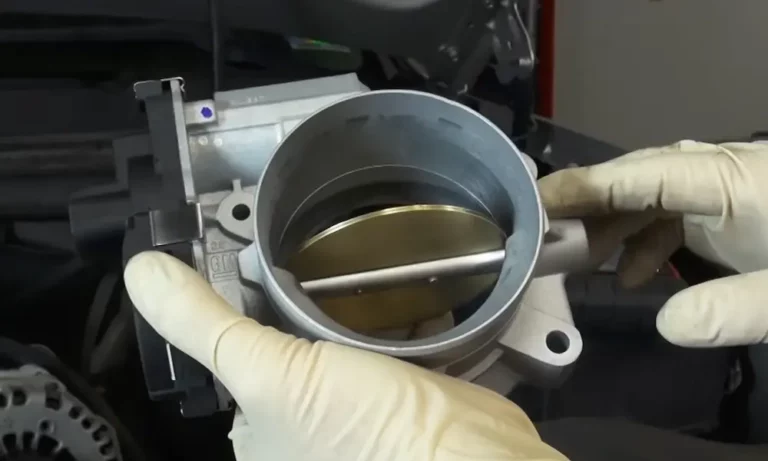
Your throttle body controls how much air gets into your engine. At idle, it’s barely cracked open — your engine is breathing through a gap not much wider than a business card’s edge.
Over time, oily vapor from your crankcase mixes with road dust and forms a hard, sticky ring of carbon right where that gap is. This slowly chokes off your idle air supply, causing the RPMs to bounce around and the car to shiver at stoplights. Cleaning the throttle body is one of the cheapest fixes here, usually running $80 to $150 at a shop.
Direct Injection Engines Have It Worse
If your car has gasoline direct injection (most new cars do), carbon buildup hits way harder. Older engines sprayed fuel behind the intake valves, and gasoline’s detergents kept things clean automatically. Direct injection sprays fuel straight into the cylinder, so nothing washes the intake valves anymore.
That lets oily crankcase vapor bake onto scorching-hot valves and form thick carbon deposits. This messes up airflow into the cylinders unevenly, causing rough idle and power loss. The fix is usually a professional intake cleaning service where technicians mist a cleaning solvent directly into the intake while the engine runs.
Vacuum Leaks: The Sneaky Idle Killer
A vacuum leak means air is sneaking into your engine without passing through the sensor that measures it. Your computer doesn’t know that extra air showed up, so it doesn’t add extra fuel to match it. Result: a lean mixture and a rough idle.
Here’s the tricky part: a small leak can double the total air entering your engine at idle (since idle needs so little air anyway), but that same leak barely matters once you’re cruising at 60 mph and gulping huge amounts of air. That’s exactly why so many cars “run fine on the highway but shake at idle.”
Mechanics usually find vacuum leaks with a smoke machine — pumping harmless smoke into the intake system and watching where it escapes.
PCV and EGR Valve Problems
Two small emissions parts cause a shocking amount of idle trouble.
The PCV valve routes oil vapor from your crankcase back into the intake to be burned off. If its internal spring breaks and it sticks open, it acts like a giant vacuum leak, flooding your intake with unmetered air.
The EGR valve feeds a little exhaust gas back into your engine to cool combustion and cut emissions — but only at cruising speed. If carbon gunk keeps it stuck open at idle, exhaust gas (which has no oxygen) chokes your cylinders and causes a sputtering, dying-sounding idle.
Ignition Problems: Spark Plugs and Coils
Spark plugs wear out from thousands of tiny electrical sparks jumping across their electrodes. Over time, that gap widens until the spark just can’t jump it anymore — especially at idle, where conditions for sparking are already tougher.
Ignition coils fail differently. Heat and vibration crack the epoxy resin inside them over the years. That lets high-voltage spark leak out and arc into the engine block instead of firing the spark plug properly. This causes a dead cylinder and a rough idle.
The good news: when a coil dies, your computer usually pinpoints exactly which cylinder is misfiring with a code like P0304 (that’s cylinder 4). No guessing required.
Diesel Owners: Check Your Glow Plugs
Diesel engines don’t use spark plugs — they rely on compression heat to ignite fuel. But on cold mornings, glow plugs preheat each cylinder so ignition actually happens. If a glow plug fails, that cylinder stays cold, misfires, and causes a rattly idle along with white or gray smoke, based on glow plug failure symptoms from FridayParts. Once the engine warms up from running, the dead cylinder often starts firing again and the idle smooths out.
Fuel Delivery Issues
Fuel injectors are precision parts with tiny nozzles. Debris, rust, or gunk can clog them partially, causing a weak dribble of fuel instead of a fine mist. Liquid fuel doesn’t burn well, so that cylinder underperforms.
On the flip side, a broken injector spring can let fuel leak continuously, flooding a cylinder so badly it won’t fire on startup — you’ll smell raw gas and notice long crank times. Fixing injectors typically costs $100 to $700 depending on how hard they are to reach.
A weak fuel pump or clogged fuel filter can also drop your fuel pressure below spec, starving all cylinders evenly and causing a lopey, stumbling idle.
Worn Engine Mounts
Your engine mounts absorb the constant vibration from thousands of tiny explosions happening every minute. Rubber mounts dry out and crack after years of heat exposure. Oil or power steering leaks dripping onto them speeds up the damage, since petroleum eats rubber alive.
Once a mount fails, the engine’s metal bracket grinds against the frame’s metal bracket with nothing to cushion it. You’ll feel a deep thrum through the pedals, wheel, and floor — especially when you’re stopped with the engine in gear.
Here’s what mount repairs typically run in the US:
| Vehicle Type | Cost Per Mount | Notes |
|---|---|---|
| Older domestic sedans | $100 – $250 | Basic solid rubber mounts |
| Modern imports | $250 – $400 | Hydraulic fluid-filled mounts |
| Luxury/European models | $400 – $600+ | Active electronic mounts |
One important tip: replace all your mounts at once, not just the broken one. A single new mount left alone will take on the full twisting load of the engine and burn out fast.
What Happens If You Ignore It
Here’s where things get costly. If your rough idle is actually a misfire, raw unburned fuel gets pumped straight into your exhaust system every time that cylinder fails to fire. That fuel ignites inside your catalytic converter, and the resulting heat can literally melt the ceramic honeycomb inside it into a solid clump.
A melted converter blocks exhaust flow completely. Your engine chokes, loses power, and can’t go above 20-30 mph. Replacing a catalytic converter isn’t cheap either:
| Replacement Type | Cost Range | Lifespan |
|---|---|---|
| Universal weld-in | $300 – $700 | 1-2 years |
| Direct-fit aftermarket | $600 – $1,400 | 2-5 years |
| OEM dealership part | $1,500 – $3,300+ | 8 years/80k miles |
If your check engine light starts flashing instead of staying steady, pull over and shut the car off. A flashing light means an active misfire is actively cooking your converter right now.
Sometimes It’s a Software Glitch, Not a Part
Not every rough idle comes from a broken part. Sometimes your car’s computer just needs to relearn its baseline settings. This usually happens after a battery replacement or a throttle body cleaning.
Here’s why: your computer slowly adjusts the throttle’s idle position over years to compensate for carbon buildup. If you clean that carbon out but don’t reset the computer, it still thinks the throttle needs to be wide open — causing a dangerously high idle. If your battery dies and wipes the memory instead, the computer reverts to factory defaults that assume a clean throttle body that isn’t actually clean, causing stalling and rough idle.
Different brands need different relearn steps:
- Toyota/Honda: Disconnect the battery, turn the key to ON (don’t start) for 10-15 seconds, then idle for 10-20 minutes with accessories off.
- Ford/GM/Hyundai: Needs a scan tool to trigger a manual “idle relearn” command.
- Nissan/Infiniti: A specific pedal-pumping sequence within strict time windows.
- Subaru: Drive normally with moderate acceleration to let the computer relearn fuel trims over time.
Sometimes manufacturers even release official fixes for known idle problems through Technical Service Bulletins — internal notices sent to dealerships describing quirks and their exact software or hardware fixes. These bulletins stop mechanics from randomly swapping parts that were never broken in the first place.
Final Thoughts
A shaky idle is your car’s way of raising a hand and saying something’s off. It could be something cheap and easy, like a dirty throttle body, or something that needs immediate attention, like a melting catalytic converter.
The trick is paying attention to the pattern. Does it happen cold or hot? In gear or in Park? With accessories on? Those clues point you toward the real fix instead of guessing and throwing parts at the problem.
Catch it early, and you’re probably looking at a $100 fix. Ignore it, and you might be looking at a $2,000 repair bill down the road. Your car’s already telling you what’s wrong — you just have to listen.