
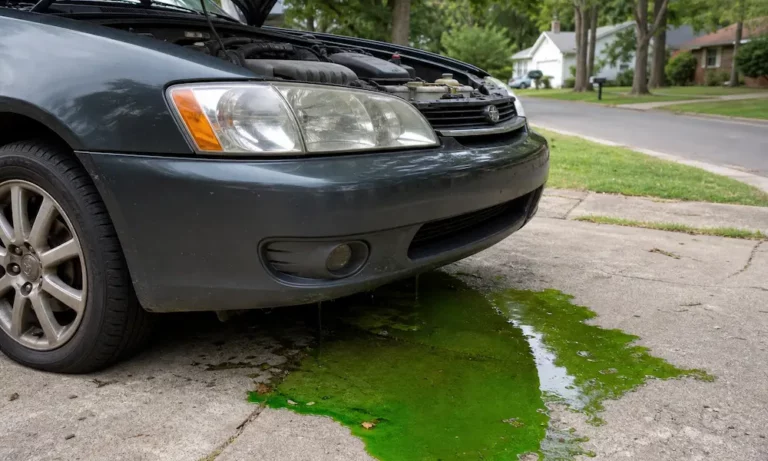
That puddle under your car isn’t going to fix itself. If you’ve spotted a bright, sweet-smelling drip near the front of your vehicle, you’re likely dealing with coolant leaking from the bottom of your car. Ignore it, and you’re looking at a seized engine and a repair bill that’ll ruin your week. Read this guide to figure out what’s leaking, why, and exactly what it’ll cost to fix it.
What Does Coolant Look Like Under Your Car?
Before you panic, confirm it’s actually coolant. Place a sheet of cardboard under the engine overnight. In the morning, check what dripped.
Engine coolant is easy to spot:
- Color: Bright lime-green, orange, pink, yellow, or blue-green
- Texture: Slightly slimy, watery, and sticky
- Smell: Sweet, almost candy-like
- Location: Usually near the front of the car, under the radiator or engine block
Clear water under your car? Don’t stress. During hot weather, your air conditioning system produces condensation that drains safely underneath the passenger side. That’s completely normal.
Here’s a quick fluid identification guide to help you sort out what’s actually on your driveway:
| Fluid Type | Color | Smell | Leak Location | Risk Level |
|---|---|---|---|---|
| Engine Coolant | Green, orange, pink, yellow | Sweet, candy-like | Front, under radiator or engine block | High |
| Engine Oil | Amber to dark brown | Faintly burnt | Under engine block or oil pan | High |
| Transmission Fluid | Bright red to dark brown | Burnt, petroleum | Center of vehicle, near transmission | High |
| Brake Fluid | Clear yellow to dark brown | Sharp, chemical | Near wheels or firewall | Critical |
| Power Steering Fluid | Clear, red, or light brown | Sweet or burnt | Front-left engine compartment | Moderate |
| AC Condensation | Clear | Odorless | Under passenger side | None |
If the fluid matches coolant’s description, keep reading.
Why Is Coolant Leaking From the Bottom of Your Car?
Your car’s cooling system is a pressurized, closed loop. When something breaks that seal, coolant escapes and your engine overheats fast. Here are the most common culprits.
Cracked or Worn Coolant Hoses
Rubber coolant hoses carry hot fluid between the engine, radiator, and heater core. Over four to ten years, the rubber hardens, cracks, and develops soft spots. Metal clamps holding those hoses in place also loosen or corrode over time.
When the engine runs hot and the system pressurizes, a weakened hose connection sprays or drips coolant straight onto the ground beneath your car.
Check for: Bulging hoses, visible cracks, wet residue near clamps.
Leaking Radiator
Modern radiators use an aluminum core bonded to plastic side tanks. Those two materials expand and contract at different rates when temperatures swing. Eventually, the seam separates and coolant drips out.
Old, neglected coolant also causes internal corrosion. When the anti-corrosive additives deplete, rust eats through the thin metal walls of the radiator’s cooling tubes, creating pinhole leaks.
Check for: Rust stains, visible cracks along the radiator seams, greenish crust near the bottom of the radiator.
Failed Water Pump
The water pump keeps coolant moving through the system. It’s designed to last 60,000 to 100,000 miles. When the internal shaft seal wears out, coolant seeps into the bearing housing and drips out through a small weep hole located just below the pulley.
If you also hear a grinding noise from the front of the engine, the bearings are failing. That’s a tow-truck situation, not a “drive it home” one.
Check for: Dripping near the front-center of the engine, grinding or whining noise from the engine bay.
Stuck Thermostat
The thermostat controls when coolant flows to the radiator. If it sticks shut, coolant can’t escape the engine to cool down. Pressure builds fast, and the weakest link snaps — usually the thermostat housing gasket or the plastic housing itself.
A failed thermostat causes rapid pressure spikes that blast coolant out through cracked housings or blown gaskets.
Check for: Engine overheating quickly, coolant dripping near the thermostat housing on the side of the engine.
Blown Head Gasket or Cracked Engine Block
This is the worst-case scenario. The head gasket seals combustion chambers away from coolant passages. When it fails, coolant leaks internally into the cylinders or mixes with engine oil.
Signs it’s a head gasket:
- White smoke from the exhaust
- Milky, coffee-colored oil on the dipstick
- Coolant disappearing with no visible external drip
- Engine overheating repeatedly
A cracked engine block causes similar symptoms but even faster fluid loss. Both repairs are expensive. Both are caused by ignoring overheating.
How to Diagnose Coolant Leaking From the Bottom of Your Car
Finding the exact leak source takes a systematic approach. Don’t guess. Here’s how pros do it.
Step 1: Visual Inspection — Cold Engine Only
Always start with a cold engine. Use a bright flashlight and check:
- Radiator seams and bottom tank
- All rubber hoses and their clamp connections
- Water pump housing and the area below its pulley
- Thermostat housing
Squeeze accessible hoses. If they feel spongy, hard, or show visible bulges, they need replacing immediately.
Step 2: Cooling System Pressure Test
A pressure test simulates a hot, running engine without the burn risk of scalding coolant. Here’s the process:
- Let the engine cool completely — at least 2 to 3 hours after driving
- Squeeze the upper radiator hose to confirm zero pressure remains
- Slowly turn the radiator cap counterclockwise to release any trapped pressure
- Attach a pressure test adapter to the filler neck
- Pump the system to the pressure rating printed on your radiator cap — typically 13 to 16 PSI
- Never exceed the rated pressure — you’ll rupture fragile components
- Watch the gauge for 10 to 20 minutes
A steady gauge means your system holds. A dropping needle confirms a leak. A fast drop means a major breach. A slow drop points to a micro-split or pinhole leak.
While the system is pressurized, wipe suspected areas with a clean cloth and watch for fresh fluid seeping out at hose connections, radiator seams, or the water pump weep hole.
Step 3: Advanced Internal Leak Tests
No visible drip but the pressure gauge still drops? Advanced testing can find internal failures:
- UV dye test: Add dye to the coolant, run the car, then scan with a UV light to spot invisible micro-cracks
- Combustion leak test: A chemical tester draws air from the reservoir — color change means exhaust gases are entering the cooling system, confirming a head gasket failure
- Borescope inspection: Remove spark plugs and look inside the cylinders for coolant pooled on top of the pistons
What Happens If You Keep Driving With a Coolant Leak?
Short answer: you destroy your engine. Here’s exactly how that happens.
A pressurized cooling system raises the boiling point of coolant, keeping it liquid. When a leak drops the pressure, the boiling point drops with it. Steam pockets form inside the engine block. Steam can’t transfer heat like liquid, so localized hot spots develop across the cylinder heads.
Those hot spots cause:
- Warped or cracked cylinder heads — aluminum and iron expand at different rates under intense heat
- Blown head gasket — extreme pressure breaches the seal between combustion chambers and coolant passages
- Seized pistons — pistons expand beyond their clearances, score the cylinder walls, and friction-weld to the block
A seized engine is not repairable. You replace the entire engine. A $150 hose repair becomes a $6,000 engine replacement. The math isn’t complicated.
What to Do If Your Car Overheats Right Now
If your temperature gauge spikes or you see steam while driving, act immediately:
- Turn off the AC — this removes load from the engine immediately
- Turn the heater to max heat and max fan — it sounds miserable, but the heater core acts as a second radiator, pulling heat away from the engine
- Pull over safely, park, and shut off the engine
- Don’t open the hood immediately — superheated coolant can exceed 230°F. Wait 15 to 30 minutes
- Never pour cold water on a hot engine or radiator — the thermal shock can crack the engine block instantly
Once the engine cools completely, slowly turn the radiator cap a quarter-turn counterclockwise to vent pressure before removing it fully. Add a 50/50 mix of antifreeze and distilled water to the radiator and reservoir. If the temperature spikes again after restarting, call for a tow. Don’t risk it.
How Much Does It Cost to Fix Coolant Leaking From the Bottom of Your Car?
Repair costs depend entirely on which component failed. Professional diagnostic fees typically run $60 to $88. That covers pressure testing, radiator cap inspection, and UV dye diagnostics.
Diagnostic Cost by Vehicle
| Vehicle | Estimated Diagnostic Cost (USD) |
|---|---|
| Chevrolet Silverado 1500 | $50 – $73 |
| Honda CR-V | $55 – $80 |
| Toyota Corolla | $56 – $82 |
| Ford F-150 | $61 – $90 |
| Toyota Camry | $61 – $90 |
| Honda Accord | $61 – $90 |
| Honda Civic | $61 – $90 |
| Nissan Altima | $61 – $90 |
Repair Cost Breakdown
| Repair Type | Estimated Total Cost (USD) | Notes |
|---|---|---|
| Stop-leak additive (DIY) | $10 – $50 | Temporary fix only — can clog heater core |
| Coolant hose replacement | $50 – $200 | Simple, low-labor repair |
| Thermostat replacement | $100 – $300 | Low to moderate labor |
| Radiator replacement | $150 – $1,000 | Varies by vehicle size and type |
| Water pump replacement | $300 – $750 | High labor if timing belt-driven |
| Head gasket replacement | $1,500 – $2,500+ | Major teardown, machine shop work required |
| Preventative coolant flush | $100 – $200 | Best value for long-term protection |
One word on stop-leak additives: mechanics don’t recommend them. These compounds harden at the leak point, but they just as easily clog the narrow passages inside your heater core or radiator. You’ll trade a $50 temporary fix for a $600 heater core replacement.
On timing belt-driven water pumps, labor costs climb sharply. Accessing the pump means removing timing covers, engine mounts, and precision gears. Misaligning the timing even slightly damages the engine. This isn’t a DIY job.
Pay the diagnostic fee. Fix the actual problem. A $70 diagnosis that catches a leaking hose is far better than a $2,000 head gasket job you could’ve avoided.


