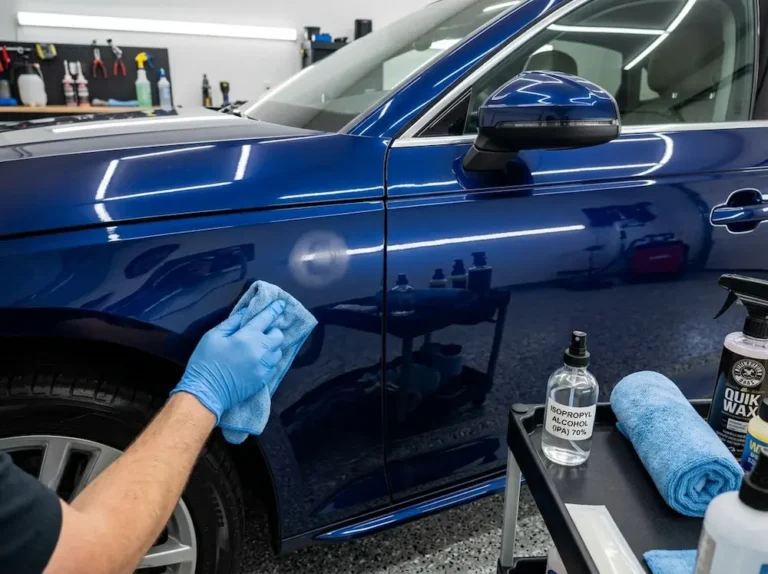
You’ve got a sticky patch of tree sap, a bottle of 91% isopropyl from the pharmacy, and a clean microfiber towel. Then the doubt creeps in: will rubbing alcohol damage auto paint? Sometimes yes. Sometimes no. The difference comes down to strength, dwell time, panel temperature, and how hard you scrub. This guide covers the chemistry, the safe dilution ratios, the parts of your car alcohol destroys on contact, and how to fix a dull spot if you’ve already made one.
The Short Answer Depends on Four Things
Straight alcohol left on a hot hood can soften a clear coat. Diluted alcohol sprayed on a cool panel and wiped off fast won’t. That gap is real, and it’s wider than most people think.
The outcome hinges on four variables:
- Concentration. Full-strength 70% or 91% products from the store hit paint far harder than a 15% mix.
- Contact time. Alcohol that flashes off in seconds barely touches the surface. Alcohol that pools and sits has time to work its way in.
- Surface temperature. Heat opens the paint’s microscopic pores and speeds up penetration.
- Friction. Wet, softened paint plus a hard scrub equals scratches.
Get all four right and you have a genuinely useful detailing tool. Get them wrong and you’re looking at a cloudy panel or a cracked headlight. There’s no middle ground here — the details do the deciding.
Your Paint Has Layers, and That Changes Everything
Almost every car built for the US market in the last few decades wears a multi-layer finish. Knowing what’s in that stack tells you what alcohol can and can’t reach.
Clear Coat Is a Shield, Not Armor
The foundation is bare steel, aluminum, or composite plastic. Factories dip that substrate in an anti-corrosion primer, then spray a primer surfacer to smooth out tiny manufacturing flaws. Next comes the base coat — the pigment, metallic flake, or pearl that gives your car its color. Many modern base coats are waterborne to meet volatile organic compound rules.
Everything gets sealed under the clear coat, a transparent layer of catalyzed polyurethane or acrylic resin. It soaks up UV radiation, repels water, and takes minor abrasion hits so the color below stays intact.
Here’s the catch. Clear coat feels like glass under your fingertip. At a microscopic level, it’s a semi-permeable membrane with a crosslinked polymer network full of tiny pores. Small liquid molecules — especially organic solvents like rubbing alcohol — can slip inside.
Single-Stage Paint Is Far More Fragile
Older cars and some restorations skip the clear coat entirely. Single-stage paint blends pigment and resin into one layer, and those finishes are softer and more porous than modern catalyzed urethane.
Wipe strong alcohol across a single-stage finish and you’ll often see color lift onto your cloth. That’s not dirt. That’s your paint dissolving. As covered in this breakdown of rubbing alcohol on car paint, the transfer shows the pigmented resin itself is coming off the panel.
What Alcohol Actually Does to a Clear Coat
Rubbing alcohol is a polar solvent with a non-polar hydrocarbon chain. That dual nature makes it great at dissolving organic oils — polishing compound residue, skin oils, certain road grime.
Polymer Swelling Is the Real Threat
Spray alcohol on a clear coat and the molecules head straight for those micropores. If the concentration is high or the liquid sits too long, solvent forces its way between the crosslinked polymer chains. The free volume between chains grows, and the film physically expands. The coatings industry calls this polymer swelling.
Swollen paint is soft paint. Wipe it with a towel and you can carve micro-scratches or leave a permanent haze. Prolonged contact with undiluted solvent can go further — wrinkling, delamination from the base coat, or lasting structural breakdown.
The degree of swelling tracks the paint’s crosslink density, which is the number of linked subunits inside the polymer. Higher density, more resistance. Lower density, more trouble.
Hot Panels Turn a Small Risk Into a Big One
Metal panels and their paint layers expand in heat. Park outside on a July afternoon and the clear coat’s pores dilate.
Apply alcohol to a hot panel and it sinks in faster and deeper than it ever would in a shaded garage. Worse, extreme heat makes the alcohol flash off almost instantly. That fast evaporation can trap vapor inside the lower paint layers, where it expands and pushes out, leaving tiny craters. Paint pros call it solvent popping, and it’s a defect you can’t polish away.
Work on cool panels in the shade. Always.
Fresh Paint and Alcohol Don’t Mix
Factory paint gets baked in high-temperature ovens, so it’s chemically tough. Refinish paint from a body shop doesn’t get that treatment. It needs weeks — sometimes up to 90 days depending on climate — to fully crosslink and off-gas its carrier solvents.
During that window, new paint stays soft and its chemical resistance is low. Alcohol on uncured paint can dissolve resins, fade color, and kill the fresh clear coat outright. No exceptions here: keep strong solvents away from new paint.
Automakers Already Test for This
Solvent resistance isn’t a forum argument. It’s a measured spec in every major manufacturing plant.
The American Society for Testing and Materials publishes repeatable protocols for chemical resistance and cure level. The best-known is the solvent rub test, where a cloth soaked in an aggressive solvent — usually methyl ethyl ketone — gets rubbed back and forth over a paint sample under a fixed weight. The number of double rubs before the coating breaks through tells engineers how well the film cured.
US automakers lean on variations of these standards. GM uses rubbing methods to determine cure on painted metal and plastic. Chrysler requires factory coatings to resist softening, swelling, and wiping when exposed to automotive fluids, including alcohol-heavy wiper solvents. Ford runs its own lab test methods on paint film solvent resistance.
Two lessons fall out of that testing. First, a fully cured factory clear coat is built to shrug off brief, light chemical contact. Second, repeated solvent exposure combined with heavy friction will eventually chew through even the toughest finish. That’s why the mildest effective concentration wins.
The Dilution Ratios That Keep Paint Safe
Concentration decides whether alcohol cleans or ruins. Store shelves sell 70% and 91%, and both are too strong straight from the bottle.
Full-strength alcohol strips wax instantly, but it also leaches plasticizers and oils out of the clear coat itself. Pull those out and the paint turns brittle, dry, and prone to micro-cracking and oxidation.
The fix is water. Cutting alcohol with water slows evaporation, softens the chemical bite, and buffers the clear coat against fast swelling. Industry consensus puts the safe working range at 10% to 20% final alcohol concentration.
Use distilled water, not tap. Minerals, calcium, and heavy metals in tap water stay behind when the mix evaporates, leaving hard water spots that can etch your clear coat. Here’s how to blend it, based on a standard 32-ounce spray bottle:
| Starting Alcohol Strength | Blending Ratio | Safety Profile |
|---|---|---|
| 91% | 1 part alcohol to 5 parts distilled water | Very safe for general degreasing. Low swelling risk, slow flash, minimal streaking. |
| 70% | 1 part alcohol to 3–4 parts distilled water | Strong balance of cleaning power and safety. Good for lifting polishing oils before coating. |
| 50% | 1 part alcohol to 2 parts distilled water | Very mild. Tends to streak on dark paint because of the high water content. |
| Undiluted | Don’t | High risk of fast swelling, plasticizer loss, marring, and permanent dulling. |
Want a sanity check before you mix? This IPA spray mixing guide walks through the same math.
What Diluted Alcohol Is Actually Good For
Diluted alcohol isn’t a replacement for pH-neutral car soap. It’s a targeted chemical tool, and it does a few jobs better than anything else.
Stripping Old Wax and Sealants
Before serious paint correction, every layer of dead carnauba wax or polymer sealant has to go. Otherwise your polishing pads ride on top of old protection instead of cutting into the clear coat. A spray-and-wipe with diluted alcohol dissolves those non-polar layers and resets the paint to bare.
Tree Sap, Bug Splatter, and Sticky Residue
Pine sap, bird droppings, and baked-on insect remains bond hard to clear coat. Alcohol breaks down the organic molecules in all three. Let it dwell a few seconds on hardened sap, then lift gently with a clean cloth. Same trick works on adhesive left behind by old emblems and vinyl decals — no scraping tools needed.
Prepping Paint for Ceramic and Graphene Coatings
This is where diluted alcohol earns its keep. Modern protective layers need a surgically clean surface to bond. Silicon dioxide ceramic coatings need it. So do polysilazane glass-resin coatings, which cure through a moisture reaction into silicon dioxide and silicon nitride, and graphene-infused coatings that anchor a carbon honeycomb network to the substrate.
Polishing liquids use lubricating oils and silicone fillers. Coat a panel without stripping those oils and your coating bonds to the oil instead of the paint. That’s premature failure, peeling, and a shortened lifespan. The alcohol wipe is what prevents it. Some detailers argue the opposite — here’s why that wipe-down advice gets challenged — but on soft paint, the technique matters more than the debate.
The Towel Matters as Much as the Liquid
Diluted alcohol provides zero lubrication. None. It leaves the surface grabby and high in friction, unlike soapy wash water or quick detailer spray. Wipe bare, unlubricated clear coat with a rough or dirty cloth and you’ll install thousands of micro-scratches — the marring and swirl marks that show up under garage lighting.
Soft paint systems, common on many Japanese cars, scratch at the slightest dry friction. Towel density is your only cushion. That’s measured in grams per square meter, or GSM.
| Towel Density (GSM) | Safe for Solvent Wipes? | Why |
|---|---|---|
| 200–300 | No | Too thin to cushion your hand. High marring risk on dry paint. |
| 350–400 | With caution | Fine on harder clear coats, but demands a very light touch. |
| 500–600 | Yes | Deep pile absorbs dissolved oils and spreads hand pressure evenly. |
| 800–1200 | No | Built for drying. Too bulky, soaks up solvent, hard to level. |
Technique matters too. Mist the diluted mix into the towel, never onto the panel — spraying the car risks uneven coverage, pooling, and overspray onto plastics you don’t want touched. Then wipe in straight lines with light pressure. Skip the aggressive circles. Flip to a dry side and level the panel before the solvent flashes.
Where Alcohol Causes Real, Permanent Damage
Your paint can survive a careful wipe. Plenty of other exterior materials can’t.
Polycarbonate Headlights and Crazing
Modern headlights are injection-molded polycarbonate, not glass. It’s impact-resistant and optically clear, but the molding process locks internal stress into the plastic.
Touch bare polycarbonate with a polar solvent and the alcohol acts as a stress-cracking agent. It lowers the energy needed for that trapped stress to release. The lens splits into a spiderweb of fine cracks in seconds. This is headlight crazing, and the cracking runs through the core of the plastic, not just the surface. You can’t sand it out or polish it away.
Replacing a modern headlight assembly, especially one with sensors and adaptive modules, can run into the thousands. Keep alcohol off your lenses entirely.
Rubber Seals and Weatherstripping
Window moldings and weatherstripping use ethylene propylene diene monomer rubber, which holds natural oils and plasticizers to stay flexible through seasonal temperature swings.
Alcohol dries these elastomers out. Wipe it across a rubber seal and it starts pulling oils from inside the material. The rubber fades from deep black to chalky gray, loses elasticity, then shrinks and cracks. Cracked seals mean water leaks in your cabin. Mask off rubber and textured plastic trim with low-tack tape before any wipe-down.
Matte Paint, Frozen Finishes, and Vinyl Wraps
Specialty finishes have their own rules.
BMW’s “Frozen” matte paints and other factory matte finishes use a clear coat with deliberate microscopic peaks and valleys. That rough surface scatters light instead of reflecting it. Matte paint can never be polished, because polishing flattens the peaks.
Press a solvent-soaked towel onto matte paint and scrub, and you’ll shear those peaks down. That spot turns glossy permanently. No polish fixes it. The panel has to be repainted at a specialty shop. As this guide to BMW Frozen paint care explains, the only safe use of diluted alcohol on matte is misting a fresh bird dropping and dabbing it off without lateral force. Full instructions live in these matte finish care notes.
Vinyl wraps work differently. Installers use diluted alcohol in the bay to clean panel edges so the adhesive bites properly. After installation, though, go easy. Repeated solvent exposure dries out polyvinyl chloride, which causes UV fading, brittleness, and lifted edges — a known issue in fleet maintenance, per these vinyl wrap care tips.
Already Left a Dull Spot? Here’s the Fix
Most alcohol damage is a cloudy, dull patch that shows up under direct light. It happens when alcohol strips surface oils unevenly, causes local micro-swelling, or lets you scratch softened resin.
Good news: unless pure alcohol pooled for hours and ate through the clear coat, this is superficial. Factory clear coat is roughly as thick as a sheet of paper, and the damaged top layer can be leveled.
Run two quick checks first. Press a fingernail across the spot — if it catches hard, the clear coat may be breached. Mist the area with water — if gloss and color return while wet, the damage sits on the surface and is fixable.
The repair is a light machine polish. Wash the car, clay the panel to remove grit, then run a dual-action polisher with a soft foam pad and a finishing polish. The microscopic diminishing abrasives shave off the compromised layer and bring back the gloss. Then seal the bare paint with wax, sealant, or a coating. Steps for reviving tired paint live here: how to restore faded car paint.
If the clear coat is peeling, flaking, or milky white all the way through, polishing won’t help. That panel needs sanding, primer, and a repaint.
Panel Wipes vs. DIY Alcohol Mixes
Given how tight the margin for error is, many shops have stopped mixing their own. They use commercial prep sprays instead — products like CarPro Eraser, Stoner Tarminator, Meguiar’s Surface Prep, and Eastwood PRE.
These formulas usually contain a calibrated dose of high-purity alcohol, plus fast-flashing solvents, degreasers, and lubricating surfactants. Those surfactants drop surface tension, so your towel glides instead of grabbing. That alone kills most marring risk — check the Eraser vs. IPA comparison for how the two behave side by side.
Prep sprays also handle contaminants plain alcohol struggles with. Silicone oils from modern compounds need specific solvents to break their molecular bonds and lift them cleanly. Some blends, like tar and sap removers, tackle baked-on asphalt and adhesive far better than diluted IPA. And they flash off without leaving residue, so you can skip a second wash before coating.
A careful DIY mix of alcohol and distilled water still works great for an educated enthusiast. But commercial prep sprays give you a wider safety margin on delicate, freshly corrected, or expensive finishes.
Final Thoughts
Will rubbing alcohol damage auto paint? It can — and quickly — but only when you give it the chance. Keep the concentration near 15%, work on cool panels in the shade, use a 500+ GSM towel, and never spray near headlights, rubber, or matte finishes. Do that and alcohol stays what it should be: a cheap, effective prep tool that helps your coating bond and your wax come off. Skip the rules and you’re buying a polisher, or worse, a new headlight. The margin is small, but it’s entirely in your hands.