Your AC is humming away outside, but inside feels like a sauna. Something’s clearly wrong — but what? This guide breaks down every real reason your AC compressor working but not cooling, from the stupidly simple to the seriously broken. Stick around, because the fix might be easier than you think.
Start Here: The Simple Stuff First
Before you panic about a dead compressor, check these basics. A surprising number of “broken AC” calls come down to one of these three things.
Your Thermostat Might Be the Culprit
Check your fan setting right now. If it’s switched to “ON” instead of “AUTO,” your indoor fan runs 24/7 — even when the compressor’s off.
Here’s what happens: the fan blows air over warm, wet coils between cooling cycles. The air coming out feels humid and stale. You assume the AC is broken. It’s not.
Also check:
- Dead thermostat batteries — weak voltage makes relays flicker and fail
- Direct sunlight on the thermostat — it reads hotter than your actual room and runs the compressor nonstop
- Thermostat set to “heat” mode — yes, it happens
Your AC Might Just Be Undersized
If your system runs all day and never cools the house during a heatwave, it might not be broken — it might just be overwhelmed. An undersized unit simply can’t remove heat fast enough on a 100°F day.
On the flip side, An oversized system short-cycles — it cools the air temperature fast but never removes humidity. The result? A cold, clammy house that feels uncomfortable either way.
Airflow Problems: The Hidden Compressor Killer
Poor airflow doesn’t just reduce cooling — it causes compressor failure.
A Dirty Filter Freezes Your Coil
A clogged air filter blocks warm air from reaching the indoor evaporator coil. Without enough heat to absorb, the refrigerant gets too cold. Condensation freezes on the coil. Ice builds up. Eventually, you’ve got a solid block of ice acting as insulation — and warm air blowing through your vents.
A frozen coil is one of the top reasons an AC compressor working but not cooling scenario develops. The fix? Turn off the system and let it thaw completely before restarting.
Other airflow blockers that cause the same problem:
- Furniture or curtains covering return air vents
- Collapsed ductwork in attics or crawlspaces
- A burned-out indoor blower motor
- Duct leaks pulling in hot attic air
A Dirty Outdoor Condenser Coil
Your outdoor unit needs to push heat outside. If grass clippings, dirt, and pollen coat the condenser fins, that heat has nowhere to go.
Coolray’s AC troubleshooting guide warns that blocked condenser coils force the compressor to work against dangerously high pressure. It draws more electricity, delivers less cooling, and eventually trips its internal thermal overload to prevent meltdown.
Check these outdoor unit issues too:
- Landscaping or fencing too close to the unit (hot air recirculates)
- A failed condenser fan motor (the compressor overheats within minutes)
- Debris packed into the fins from recent storms
Refrigerant Leaks: The Sneaky Cause Everyone Suspects
Here’s the truth about refrigerant: your AC doesn’t consume it. It circulates through a sealed loop. If it’s low, something is leaking — full stop. Cal-Bay Service explains this clearly and notes that refrigerant doesn’t “run out” naturally.
How Refrigerant Leaks Develop
Two main culprits cause most leaks:
- Formicary corrosion — household chemicals, bacteria, and moisture react with copper coils to form formic acid, which eats microscopic holes through the metal
- Vibration stress — years of compressor vibration crack brazed joints and fittings
Morris-Jenkins lists the signs of a refrigerant leak as warm air from vents, ice on the coils, a hissing or bubbling sound near the indoor unit, and oily residue around fittings. In severe cases, you might even see tiny bubbles along the evaporator coil where gas is actively escaping.
What Low Refrigerant Actually Does to Your System
Low refrigerant causes:
- Warm air at the vents — not enough fluid mass to carry the heat load
- Frozen evaporator coil — reduced refrigerant lowers system pressure, dropping the temperature below freezing
- Compressor burnout — the compressor relies on cool return gas to cool its motor. No refrigerant = no cooling = dead motor windings
Arista Air Conditioning also points out health risks: leaking refrigerant can cause headaches, dizziness, and respiratory irritation for people inside the home.
Important: Simply topping off refrigerant without fixing the leak is expensive, harmful to the environment, and only delays a bigger repair.
The Expansion Valve: When the Flow Goes Wrong
The thermostatic expansion valve (TXV) controls exactly how much refrigerant enters your indoor coil. It’s a mechanical self-regulating device — no electricity required — that constantly adjusts refrigerant flow based on your system’s heat load.
When it fails, the compressor keeps running. But cooling stops.
| TXV Failure Type | Root Cause | What You’ll Notice | What It Destroys |
|---|---|---|---|
| Stuck Closed (Starving) | Moisture freeze, debris, cracked capillary tube | Frozen coil, low suction pressure, high superheat, warm air | Compressor overheats from lack of cool return gas |
| Stuck Open (Flooding) | Loose sensing bulb, debris in valve seat | Frosted suction line, low subcooling, near-zero superheat | Liquid refrigerant enters compressor — catastrophic mechanical failure |
| Hunting (Erratic) | Oversized valve, sensing bulb on bottom of pipe | Wildly swinging pressures, inconsistent temperatures | Valve diaphragm and pin wear out prematurely |
A skilled tech can tell a restricted TXV apart from a refrigerant leak by comparing subcooling on the high side — a leak shows low subcooling, while a stuck-closed TXV shows normal to high subcooling because refrigerant backs up in the condenser.
Heat Pumps: The Reversing Valve Problem
If you have a heat pump and it’s blowing hot air in cooling mode — or barely cooling at all — the reversing valve is a prime suspect.
This brass valve switches refrigerant direction between heating and cooling modes. It works through a pilot valve that uses refrigerant pressure to shift a heavy internal slide.
What Goes Wrong With Reversing Valves
Fieldpiece Instruments identifies three main failure modes:
- Stuck slide — internal contamination prevents the valve from switching modes
- Internal bypass — worn Teflon seals let hot discharge gas bleed directly into the suction line, killing the pressure differential and leaving you with lukewarm air
- Failed solenoid coil — no electrical signal reaches the pilot valve
Here’s something most homeowners don’t know: Most brands (Carrier, Lennox, Trane) energize the valve to cool, using the “O” terminal. But Rheem, Ruud, and Bosch default to cooling and energize to heat on the “B” terminal. If the solenoid fails on an “O” terminal system in summer, the system actively pumps heat into your house.
Internal Compressor Failures: The Worst Case
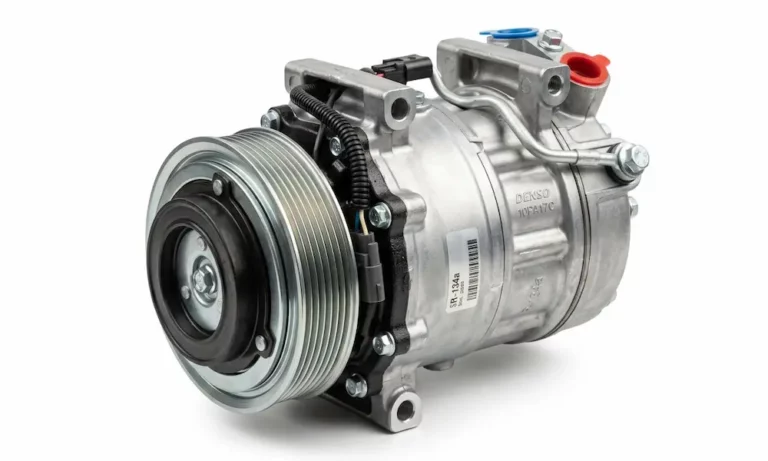
If everything else checks out — airflow is clear, refrigerant is correct, the TXV and reversing valve are fine — the problem may live inside the compressor itself.
Failed Valves and Worn Rings
Older reciprocating compressors use thin metal reed valves to push gas in one direction. When these break — from liquid slugging, overheating, or simple age — the compressor stops pumping and just churns the same gas in circles.
You’ll recognize this by:
- High-side and low-side pressures equalizing (high side drops, low side rises)
- Electrical amperage drops 20%+ below rated load
- Compressor shell gets extremely hot
- Faint whooshing sound after shutdown as pressures equalize through broken valves
Scroll Compressor Safety Shutdowns
Most modern residential units use scroll compressors. These have built-in protection: if discharge temperatures get critically high, a bimetallic thermodisc physically separates the scrolls. The motor keeps spinning, drawing minimal amperage — but it stops pumping gas entirely.
To a homeowner, it looks like the compressor is running while the AC does nothing. The fix is simple: shut everything down and let it cool for several hours before testing again.
Electrical Components That Cause Running-But-Not-Cooling
| Component | What It Does | How It Fails | What You’ll See |
|---|---|---|---|
| Run/Start Capacitor | Gives motors rotational torque to start and run | Heat, age, power surges cause dielectric breakdown | Loud humming, compressor or fan won’t start, bulging casing |
| Contactor Relay | High-voltage switch triggered by thermostat signal | Arcing pits and welds contact surfaces | Outdoor unit won’t activate, or won’t shut off |
| Compressor Motor Windings | Internal electromagnets driving the pump | Overheating or acid burns through wire insulation | Instant breaker trip, infinite resistance on multimeter |
Capacitors are the most commonly replaced HVAC component — and a failed capacitor on the condenser fan is a leading cause of compressor overheating in summer. AC Service Tech walks through exactly how to test motor windings across the Common, Start, and Run terminals — if the resistance values don’t add up, the compressor is done.
Warning: Capacitors store lethal voltage even after the breaker is off.
Your Diagnostic Checklist at a Glance
Work through this in order before assuming the worst:
- ✅ Check thermostat mode (AUTO fan, correct temperature, working batteries)
- ✅ Replace the air filter if it’s been more than 60–90 days
- ✅ Clear debris off the outdoor condenser fins
- ✅ Confirm the outdoor condenser fan is actually spinning
- ✅ Look for ice on the indoor coil or suction lines
- ✅ Listen for hissing near the indoor unit (possible refrigerant leak)
- ✅ Check for oily residue around fittings outdoors
- ✅ Visually inspect the capacitor for bulging or leaking oil
- ✅ Call a certified HVAC technician for refrigerant, TXV, reversing valve, or compressor diagnosis
The good news: most AC compressor working but not cooling situations start with something simple — a dirty filter, a thermostat setting, or a failed capacitor. Start cheap and easy. Work your way up from there.